Can you briefly tell the story of a man who fit everything into 112 small pages? Messages that have stirred children and adults for 70 years now, and that lose none of their power no matter how the years pass, how technology advances, how the world changes. Messages written in wartime that are worth rereading right now, when war is once again frightening and crushing us…
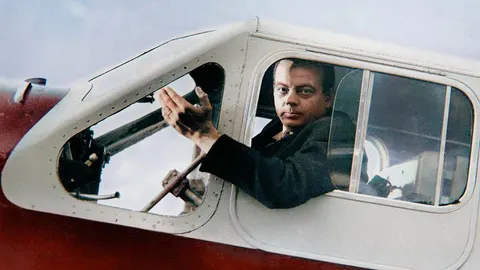
Let me try to tell this story. If you ever come across a stray pilot with an antediluvian propeller plane in the Libyan Desert, be kind, draw him a sheep, tell him about your fox. Sometimes one fleeting encounter is enough.
If you love a flower that exists only once among millions and millions of stars, that is enough to make you happy when you look at the stars. You tell yourself: “My flower is out there somewhere.”
Antoine de Saint-Exupéry is the aviator with the longest flight of all. His flight will go on for as long as there is someone to imagine what really happens when the little prince sets off back to his planet, bitten by the treacherous snake.
He was born at the very start of the new century—on June 29, 1900. “One day I saw the sun set forty-four times,” the little prince recalls in the book. His author left us for good at exactly 44 summers old, and his life is a beautiful metaphor for flight. The flight of the soul, and the most literal, physical kind, the one that lifts you above the earth.
Where are the people?… People? I saw them years ago. But one never knows where to find them. The wind blows them away. They have no roots, and that bothers them a great deal.
Did Antoine really meet the little prince from the stars? Certainly.
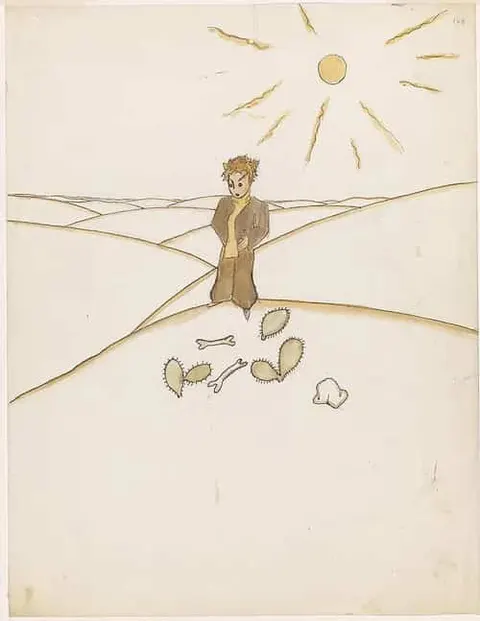
Brushing against his style in that famous little book, you would never guess what an adventurer its author was. On December 30, 1935, he set off from Paris for Saigon with his navigator André Prévot, trying to break an aviation record. The prize was 150,000 francs. But what he broke was not the record but the plane, caught in a storm. It wasn't the first time this had happened to him, and once again he survived, but the two aviators found themselves all alone in the middle of the Libyan Desert.
The situation looked hopeless, and their supplies were better suited to a ball: a few strawberries, a dozen oranges, a thermos of juice, chocolate, biscuits and wine. A menu for a party, not for survival in the desert.
By the very next day the supplies were gone, and Antoine felt the first signs of dehydration. Nearby the two men spotted a desert fox—a fennec… you can probably guess what it would become. The hallucinations began, the end seemed near… when, by an enormous stroke of luck, they were rescued by Bedouins who happened upon them.
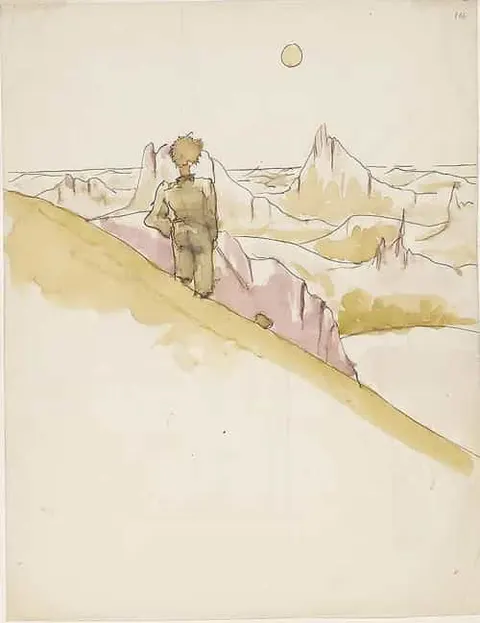
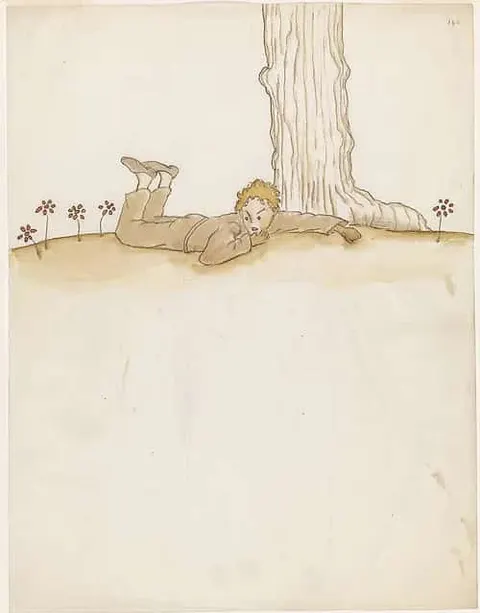
What moves me most about this sleeping little prince is his loyalty to a flower, the image of a rose that shines within him like the flame of a lamp, even while he sleeps…
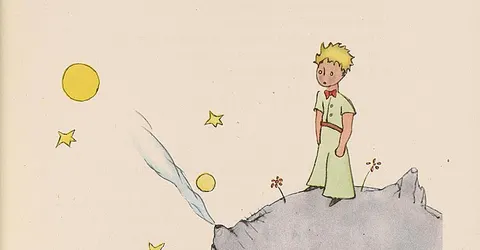
It was that moment the pilot would recall seven years later, and it would lead his imagination. By then the writer was living in the United States and had been commissioned to write a children's book that would be more exciting than Mary Poppins. And so was born the image of the little boy with sunny hair and sunny thoughts who comes from the stars.
Airplanes were the writer's great meaning and his great curse. As his name gives away, he was the heir of an aristocratic family whose roots can be traced back to the 13th century. By his time, however, the family had lost almost everything. (His full name is even more imposing: Antoine Jean-Baptiste Marie Roger de Saint-Exupéry.)
Antoine was only 4 when his father died. Many see the little prince in young Tonio, whom the family called “the Sun King” because of his golden hair. At school, meanwhile, they called him “the moonstruck one,” because every evening he would stand for a long time gazing at the stars.
He and his brother François attended a Jesuit school and were very close. François is probably part of the character too—he died at just 15.
Here is my secret. It is very simple: one sees truly only with the heart. What is essential is invisible to the eye.
Antoine was 12 when he first got into an airplane. He rode his bicycle to the nearby airfield and asked one of the aviators, Gabriel Wroblewski-Salvez, to take him up for a spin. He decided once and for all what he would do from then on. The writer flew for 22 of his 44 years on Earth.
First, though, he studied architecture. He learned to fly as a military officer. His first crash came back then, in the early 1920s; he barely survived, with serious skull injuries. He was fated never to steer clear of accidents his whole life—his worst crash came during a test flight from New York to Tierra del Fuego, and he spent three months in the hospital hovering between life and death.
He also worked in civil aviation. He was one of the first pilots on international airmail flights along the Toulouse–Dakar route.
Then he became head of an air base in Western Sahara. He managed to save the lives of his men amid the tension between warring Moorish tribes and the Spanish authorities, which earned him the title of Chevalier of the Legion of Honor.
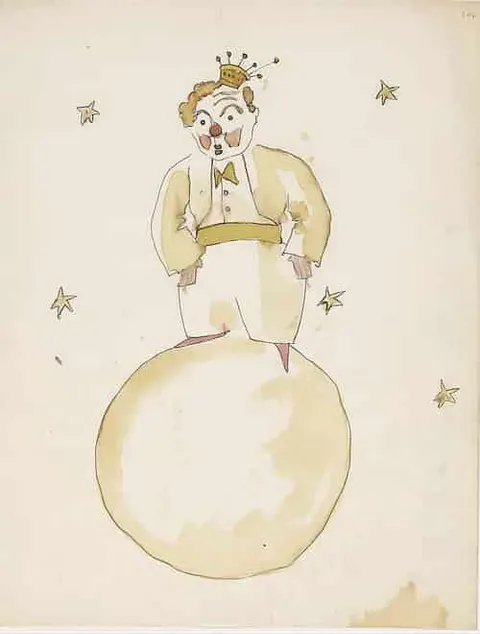
I know a planet where there is a red-faced gentleman. He has never smelled a flower. He has never looked at a star. He has never loved anyone. He has never done anything but add up figures. All day long he says over and over, just like you: “I am a serious man! I am a serious man!” and he puffs up with pride. But that isn't a man—it's a mushroom!
Then came his literary success, first with the memoir-cum-philosophical Southern Mail. When the Second World War broke out, Saint-Exupéry was already past the age at which mobilization was compulsory. He insisted on joining in, however, and took part in a series of missions.
The fall of France drove him to leave for the United States, where he sank into depression, mainly at the thought that he would never fly again. One of the ways his friends tried to pull him out of it was precisely by landing him the commission for a children's book. The Little Prince was written in 1942. Saint-Exupéry left his manuscript with the publisher and, a few days later… he was happy again. With great effort, he had managed to arrange to rejoin the war.
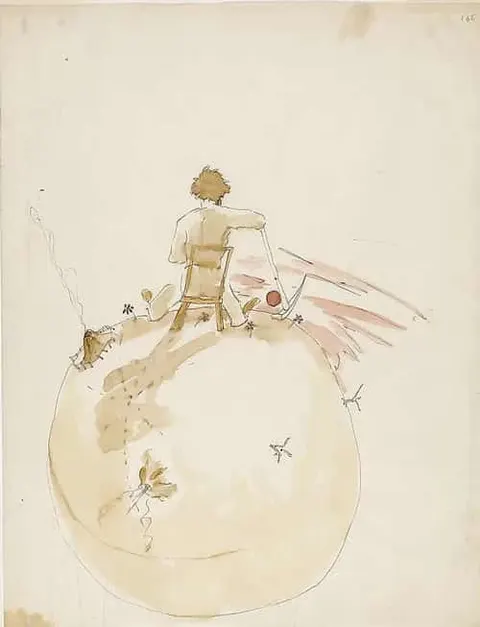
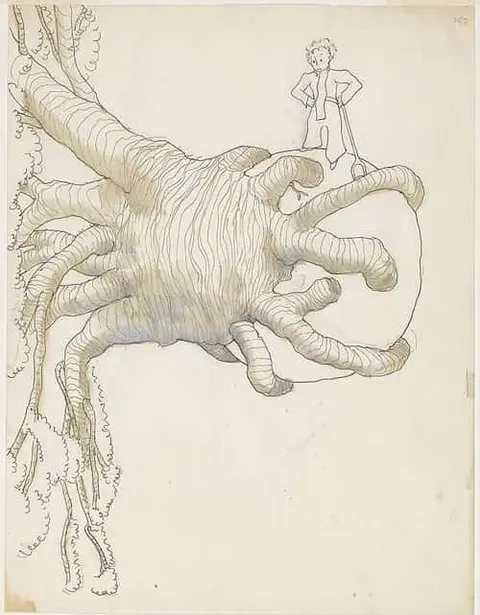
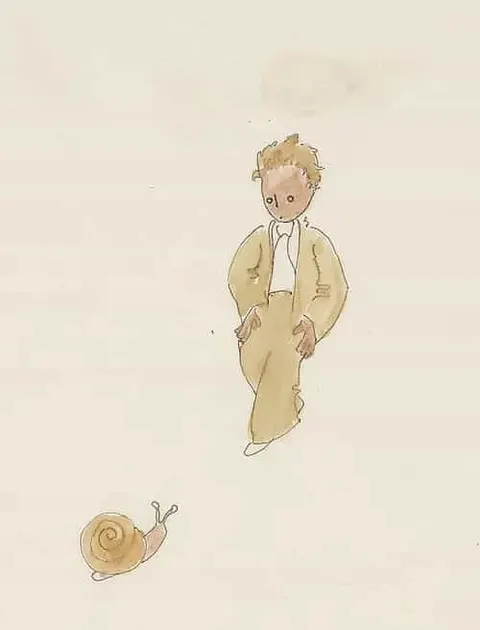
He never saw the book published. The draft is written in a tiny, hard-to-read hand, full of corrections. Coffee stains and cigarette burns are plainly visible. And there, too, are the 20 unforgettable drawings made by its author.
His unit was stationed in North Africa, from where he flew reconnaissance missions over Europe. On July 31, 1944, Saint-Exupéry's plane took off toward southeastern France… to continue its flight forever. A strangely beautiful death for a man who loved the skies so much.
“You are beautiful, but you are empty,” the little prince went on. “No one could die for you.”
And if we can look for the prototype of the little prince in those extreme days in the Libyan Desert, the model for the Rose, the prince's lovely but vain companion, is perfectly clear. Consuelo de Saint-Exupéry, the writer's great love and his wife, titled her memoir The Tale of the Rose. In it she tells of their passionate relationship, but also of the great hardships. Of the strong emotions and the infidelities.
When he wakes up on his planet, the first thing the little prince sees is three volcanoes—two active and one extinct. That is exactly the view from Consuelo's childhood home in the small Central American country of El Salvador.
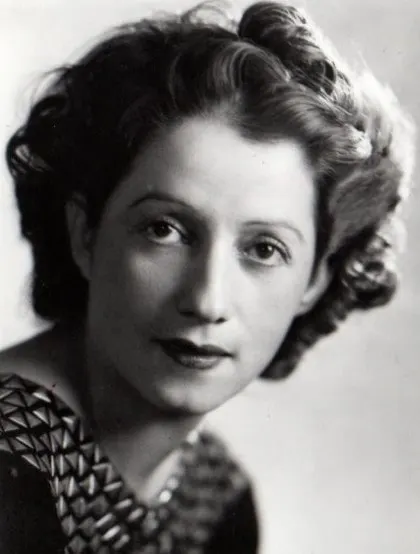
The two met in 1929, when Saint-Exupéry was director of the airmail service in Argentina. He met the beautiful Consuelo at a cocktail party and managed to talk her into going up in his plane for a ride. Up there he threatened that if she didn't kiss him, he would crash the plane, and before they had even landed, he had proposed. He was a giant of six and a half feet, and she was a petite thing “with a poisonous tongue,” as Antoine put it. Afterward they came together and split up, made sense of each other and hurt each other, just like the little prince, who in the end realizes he cannot live without his rose.
“People,” said the little prince, “rush into express trains, but they no longer know what they are looking for. So they start rushing about, and they go around in circles…”
When Saint-Exupéry met Consuelo, she had been divorced twice (though she told everyone she had been widowed). And so the day came when she had to say goodbye to her third husband too, even if officially he was listed as missing.
The bracelet bearing the names of Saint-Exupéry and Consuelo, which he wore everywhere, was found by a fisherman in 1998. In April 2004, divers discovered the wreckage of his plane off Marseille. It remains unclear whether he really was shot down in the sky, as a German officer claimed much later to have done. Whether he made a mistake, or made the decision himself.
A tender soul and a brute, a skilled pilot who nevertheless made many mistakes and often fell from the skies. A pacifist who did everything he could to take part in a war. A stubborn pessimist who in fact gave people the most humane of books. Saint-Exupéry was a collision of contradictions.
“It's a question of discipline,” the little prince told me later. “When you've finished getting ready in the morning, you must take care of your planet.”
So, I promised to be brief in telling this story from times of war. But before we part… perhaps you're wondering what's digital about it? Absolutely nothing; it is as analog as every one of the illustrations Saint-Exupéry drew for the book with his own hand. It moved me deeply when I recalled it, shortly after rereading the great little book yet again, this time as a parent.
Then it occurred to me that on every one of its pages I find at least one thought that is even more relevant today than it was when it was written. Sometimes, “when one is very sad, one loves sunsets…” And sometimes, when the hate, the sad news and the petty squabbles of the day become too much, it's worth rereading The Little Prince.
And if then a child comes to you, if he laughs, if he has golden hair, if he doesn't answer when questioned, you will guess who he is. Then be kind! Don't leave me so sad: write to me at once and tell me he has come back…