“I am trying to wrench this story out of myself, but which country will take it in?”
Do stories have a home? Does this one begin in Brooklyn, where its hero was born in 1944? Or does it begin in 1947, in the events whose telling opens with the sentence above? And what makes those distant times so different from, and so similar to, a 21st century that has already passed its first quarter?
Thomas McGonigle and I talk about Borisova Gradina, Sofia's oldest park, and then he tells me about that day in the 1960s when he found himself, quite unexpectedly, at Sofia's Central Railway Station. His map, with street names clumsily carried over into English, turned out to be useless, so he went looking for someone to give him directions. He walked into the first little shop that caught his eye. The girl behind the counter would one day become his wife. And Bulgaria would become the subject of both his first and his latest novel.
Why is it so easy for love to be born, and even easier for it to leave? Can a person fall in love with a country? Thomas McGonigle certainly loves Bulgaria. But… why?
Around the World in 80 Days
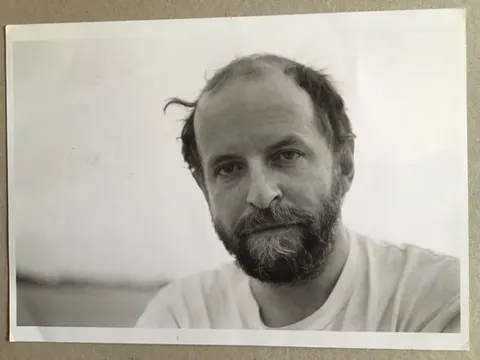
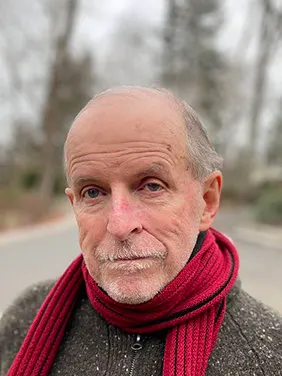
Thomas was born in Brooklyn to a family of Irish immigrants in 1944—a symbolic year for us too, the year Bulgaria fell under communist rule. Today, after eight whole decades of traveling back and forth across the world, I meet him again in his native New York. We talk online; three thousand miles stopped being a problem for technology long ago. He struggles to settle the phone—he isn't used to things happening on the internet—and while he hunts for the best spot to prop up the mobile, I catch glimpses, from various angles, of the enormous stacks of books in his home.
It isn't only the distance between us that vanishes without trouble; we fly back in time as well. Why would an American writer become so attached to our country that he devotes a large part of his work to it? What is it about the story of the agrarian leader Nikola Petkov, executed by the communist regime in 1947, that drew him to make it the subject of his first novel?
We begin in 1966, the year England became world football champion for the last (and only) time. Back then the American had decided he wanted to get to know the world and started training with the Peace Corps—a government initiative that sends people abroad to work on public health projects and to teach English. Many young men chose this path because it let you not only travel but also, if you had a university degree, skip the army.
Tsarigradsko Shose: The Road to Istanbul
In Los Angeles he trained to teach English to people whose mother tongue was Turkish. They had just three months to become fluent in the language of the place they were headed, so that they could teach in secondary schools. Part of the training was… football. “We Americans had no idea about the game, and it was thought we should learn it so we could bond more easily with the students we would be teaching,” the writer recalls.
But, caught up in his dribbling, he got a serious injury, and it became clear he would not be able to go to Turkey and start work.
He was granted compensation for a work injury and went to live in Ireland, the land of his ancestors. Because it was the cheapest place, and from there he could afford to travel around Europe. And so, in the summer of 1967, Thomas wandered through Venice, Trieste, Zagreb. There he met another American who had decided to go on to Lebanon to see the cedars. Thomas, in turn, decided to seize the chance to travel with him and go to Turkey to see how his recent classmates were coping with their teaching jobs.
The train pulls out, Belgrade, then Sofia… Do you still think only today's young people never stop traveling?
Trains Leave in All Directions
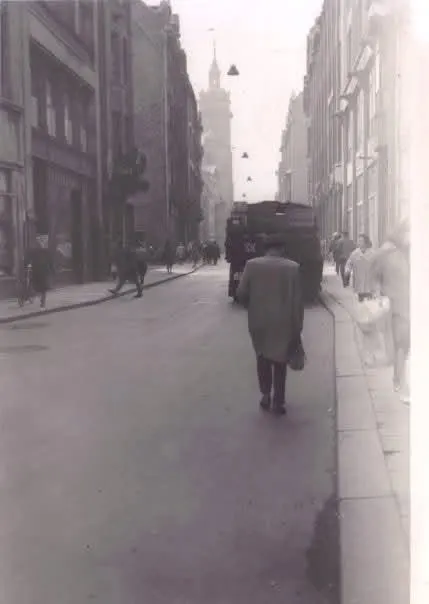
“I got off the train at Central Station. I was there again a few years ago—absolutely nothing has changed in that part of Sofia!” the writer recalls. “It was late afternoon, and I had a map that had been carefully transliterated. The Cyrillic had been meticulously rendered into the Latin alphabet, which made it completely useless. I set off down Hristo Botev Boulevard. You know, that hasn't changed much either. I went into the first little shop I saw and simply asked, ‘Do you happen to know where there's a tourist information office?’ And the girl answered, ‘I speak a little English, maybe I can direct you?’”
They get acquainted; her name is Lilia. Normally her mother worked in the shop, but she had stepped out for a short rest and Lilia was standing in for her. “That's how my Bulgarian adventure began,” Thomas recalls.
The two of them head for what was then Lenin Square, where the tourist office was, but it has already closed. The American has nowhere to go, stranded in an unfamiliar country, so the student invites him to spend the night at her family's place in Nadezhda, a neighborhood of Sofia.
The conversation carries them away, and a few days later they are off on a hike on Vitosha, the mountain above Sofia, but the mountain hut refuses to put Thomas up, because “Americans carry syphilis.”
All You Need Is Love
A few evenings later they are at a bar, enjoying songs by the Beatles and Frank Sinatra; the young man relaxes and basks in love. Well, on the way out two men come up and ask to see their passports, but nothing much comes of it, and Thomas and Lilia calmly go home to Nadezhda.
But the next morning two men in plastic raincoats knock on the door and snap, “You have to come with us.” “We got in the car, and one of them—he introduced himself as Ivan—spoke perfect English. We ended up at Lavov Most, the Lions' Bridge, where the passport office was. We went in and climbed upstairs, and on every floor there was a young man with a submachine gun on his knees.”
The same Ivan makes them write statements about who they are and what they did the previous evening, and then lets them go safe and sound.
The following morning it's time for Thomas to board the train for Istanbul, and soon he is with his Peace Corps friends… but something is missing. “I realized I had to go back to Bulgaria, because I was in love. I bought an engagement ring, and the only thing echoing in my head was ‘All You Need Is Love.’ I got straight back on the train, ended up in Nadezhda, and as soon as Lilia opened the door, I showed her the ring and asked, ‘Will you be my wife?’”
Wedlocked
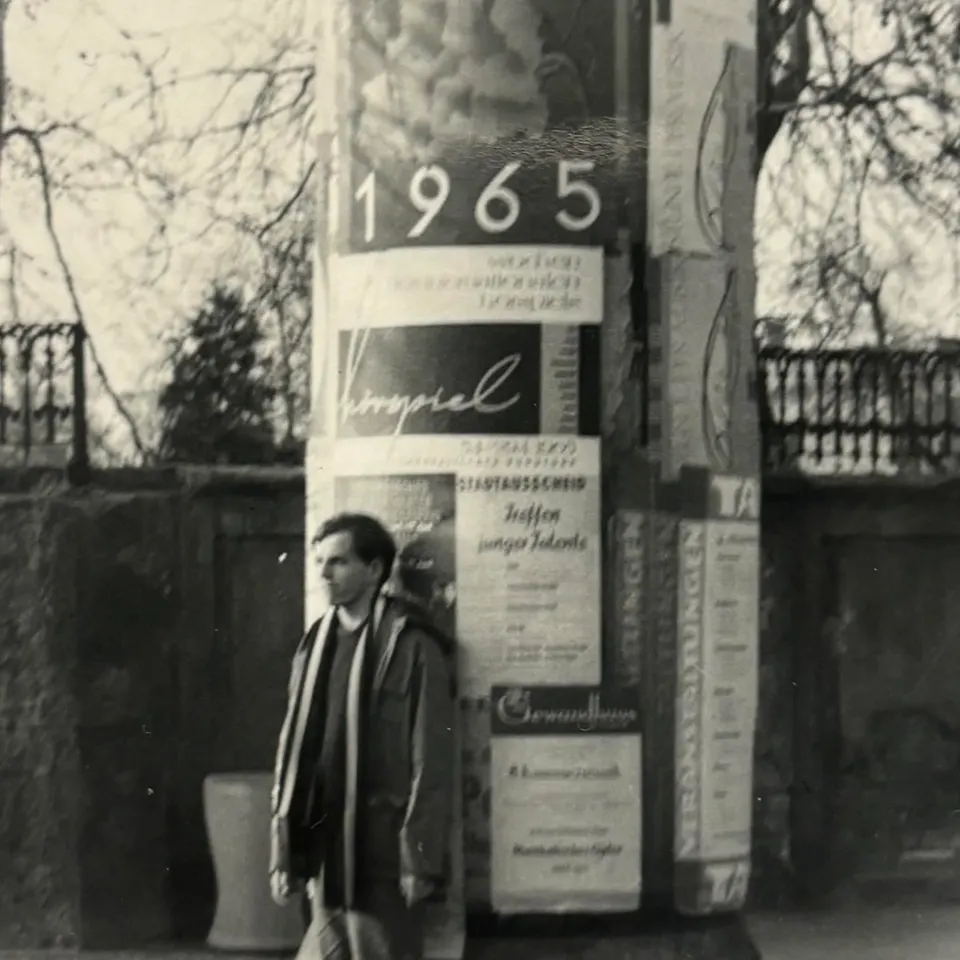
Some American stereotypes never change, wouldn't you say? Thomas gets the answer he dreamed of, but a serious administrative battle follows. “I had to have thorough medical examinations at three different hospitals and write out my family history. In the end the same English-speaking Ivan declared, ‘Your documents are ready. Now you have to fill in the forms, submit them to the marriage office, and in three months we will let you know whether your application has been granted.’”
“I said to myself, ‘Oh God, what am I going to do for three months?’ I went back to Dublin, but I didn't last long. I quickly got bored, I was in love, and I got back on the train to Sofia. I used to pick up my mail at the American embassy, near the park by the National Theater. There was a bar there, the Bambuka, I went in and… who should turn up by chance? Ivan, of course. Then for several months we went out to dinner all the time; we made the rounds of every restaurant in Sofia. They were wonderful! On top of everything, he paid—Bulgaria's taxpayers were keeping us. Finally he asked us, ‘When are you getting married? Go to the marriage office, the permission is waiting for you there.’”
And sure enough, it turns out to be the plain truth. Thomas gets a Bulgarian passport, and after that “we had to wait for the God-anointed English to give Lilia a transit visa so we could go to Ireland,” he smiles. By now the notorious year of 1968 has arrived, when so many remarkable things were happening around the world—from the Prague Spring to the assassination of Martin Luther King. “And we missed all the revolts, all the riots, because we were in Dublin,” the American says, showing his sense of humor once again.
The Way Back
It may sound strange, but to this day Lilia has never gone back to Bulgaria. Unlike Thomas, who tied his story to our country once and for all. Bulgaria becomes the stage of his first novel. “In some strange way I inherited Bulgaria as my second homeland.”
After a few years in Ireland the young family decides to return to the United States, where both of them find work. Drawn to literature since childhood, Thomas felt it was time to write something on a larger scale, and that is how the story of Nikola Petkov found him.
Arriving from across the ocean, the writer and his wife quickly connect with the local Bulgarian community. History, however, had already caught up with him back in Dublin, and in a most curious way. By chance they met Michael O'Riordan, who besides being a bus driver was also chairman of the Communist Party of Ireland. He got in touch with the young couple to pass on a gift from Sofia. His son had attended a youth conference in Bulgaria, and Lilia's mother had asked him to take an important parcel to her daughter. Yes, you know what we miss most when we are abroad—however prosaic it may be, we're talking about a little cardboard box whose main contents were lukanka, the flat cured sausage every Bulgarian abroad pines for.
Alas, somewhere along the way the precious parcel disappeared, which left the father feeling embarrassed. By way of compensation he decided to give them a book—a biography of Georgi Dimitrov, Bulgaria's first communist leader, and the only volume about Bulgaria in his library. Or so he thought; perhaps he had never opened it. The book turned out to be something else entirely—Dimitrov Wastes No Bullets by Michael Padev, an account of the tragic fate of Nikola Petkov.
Many years had to pass before Thomas discovered, by chance, that Petkov's nephew was living in the United States—by then quite elderly, in a nursing home, living out his final moments. He told the story of his relative in careful, precise detail. Then it turned out that an English translation of the transcript of the politician's trial could be found in the college library…
Visions
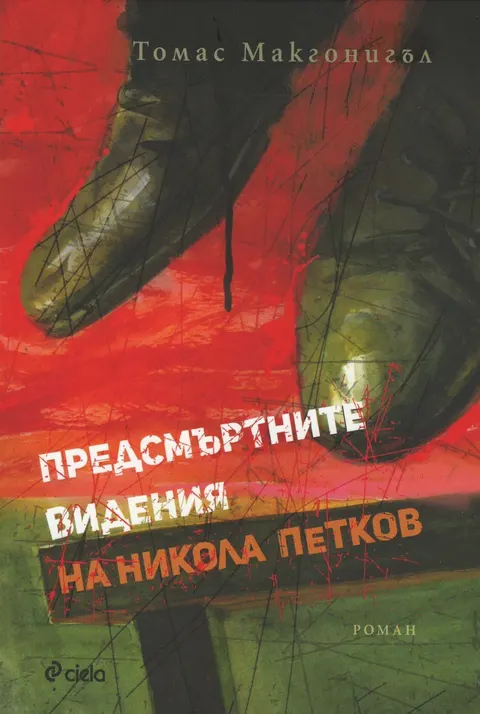
…and soon the biographical novel The Corpse Dream of N. Petkov was born, described on its cover as “a stream of consciousness in which the experiences of the agrarian leader himself, quotations from documents of the era, historical facts, the writer's reflections and the words of historical figures who knew Petkov all merge; McGonigle creates a brutal picture of the moment in which Petkov loses his life.”
The book drew interest across the ocean; it was translated into Bulgarian shortly after the fall of communism and published in Savremennik, a literary journal. A few years ago it also came out as a standalone edition.
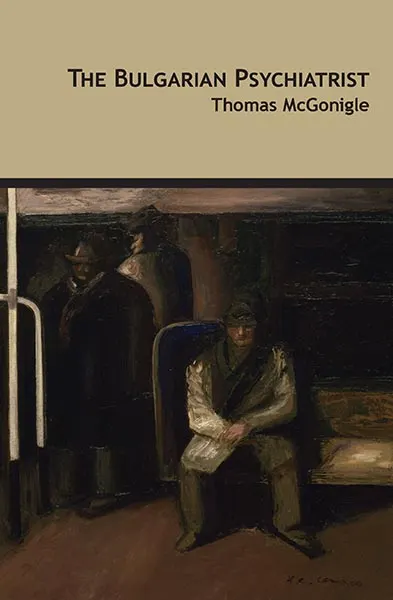
The Corpse Dream… came out in the United States in 1987 and remains the author's most successful book to this day. He returned to the Bulgarian theme in 2022 with his latest novel, The Bulgarian Psychiatrist, which has still not been published in Bulgaria.
Gradually the paths of Thomas and Lilia parted; she found happiness with her new husband from Tanzania, he with his next love, who in turn was from Estonia. Meanwhile, what remained with him as an inheritance was, as already mentioned, his “second homeland.”
“You know, Bulgaria is still unknown here; Americans don't know where it is if you ask them. But it's a country I stumbled into by chance, and it has turned out to be very good to me,” the writer smiles broadly against the backdrop of countless volumes.
He finds it interesting to follow how our country has changed over these more than 50 years. “The Bulgarian community around the world today is very scattered; during the Cold War Bulgarians seemed to be more socially connected. Now they're simply in another country, they become Americans and that's it. I've met quite a few children born in Bulgaria who consider themselves Americans and rarely visit their grandparents. I don't like that.”
I Wandered Far Across the World
Nor does he like that the world is becoming ever more uniform. “Before, under communism, everything in Bulgaria was so different from anywhere else; it was so interesting to travel. Now it's just another place. I understand the pleasure of being able to travel anywhere, to come and go, but it makes the world a little boring. People used to be curious; everything seemed new to them.”
“In America we're used to it; it's an immigrant society, and the only natives are the Indians. Everyone here is an immigrant or the descendant of one. I teach at the City College of New York, and when I look at my class, I feel as if I'm in the middle of the UN General Assembly hall. The same thing is happening, or will happen, everywhere, but it has its good and its bad sides.”
The writer says he has always felt incredibly comfortable in Bulgaria. “For me it's a dream place. A place where everything seems a little different, but everything is very pleasant. Only in Bulgaria can I talk freely about everything. In the U.S. so many subjects are taboo… And let me not even start on the isolation of the individual in the U.S., where having an original thought is at once appropriation through ignorance and oblivion.”
And now it's time to part; we wave to each other—me from Sofia, him from New Jersey. “I look at this little mobile phone and think how far it all is from getting off the train and strolling down Hristo Botev Boulevard,” Thomas says.
“The last time, I stayed in a magical house near Orlov Most, the Eagles' Bridge. A two-room apartment in a beautiful building that looked like something from the 1930s, with wide staircases… I loved walking the streets full of delicious things behind the university, just enjoying myself. I often went to Nikola Petkov's grave to pay my respects, and to talk to him a little. Sofia is the perfect place for walking. There is something, something simply physically attractive about Bulgaria.”
And I wonder. Are the things that bring us together from the far corners of the world more numerous than those that divide us?
Where are strong stories born?
How long will it still make sense to tell them to each other…?