No one has confirmed it officially, but if you ask Claude itself who it is named after, it will tell you it is him. That is also why we pronounce its name “Clode,” exactly like the scientist whose name it bears.
But who is the man whose name we utter every day the moment we open one of the most popular artificial intelligences? Why will no one confirm that the bot is named after him? And how did a seemingly unremarkable mathematician, who rode his one-wheeled bike through the corridors of MIT, arrive at the idea that gave birth to both the mobile phone and large language models?
Claude, Clauding Away
Claude. The hero of today (and of tomorrow, I am convinced). The family of Anthropic models that made possible a huge share of the wonders of today's artificial intelligence—from writing computer code indistinguishable from (I would even say far better than) a human's, to writing Bulgarian indistinguishable (I checked!) from that of the author of these lines.
Today, however, we will talk about another Claude. Born Claude Elwood Shannon in 1916 in Michigan, he died in 2001 without seeing how the world he had made possible came true in the most unexpected way.
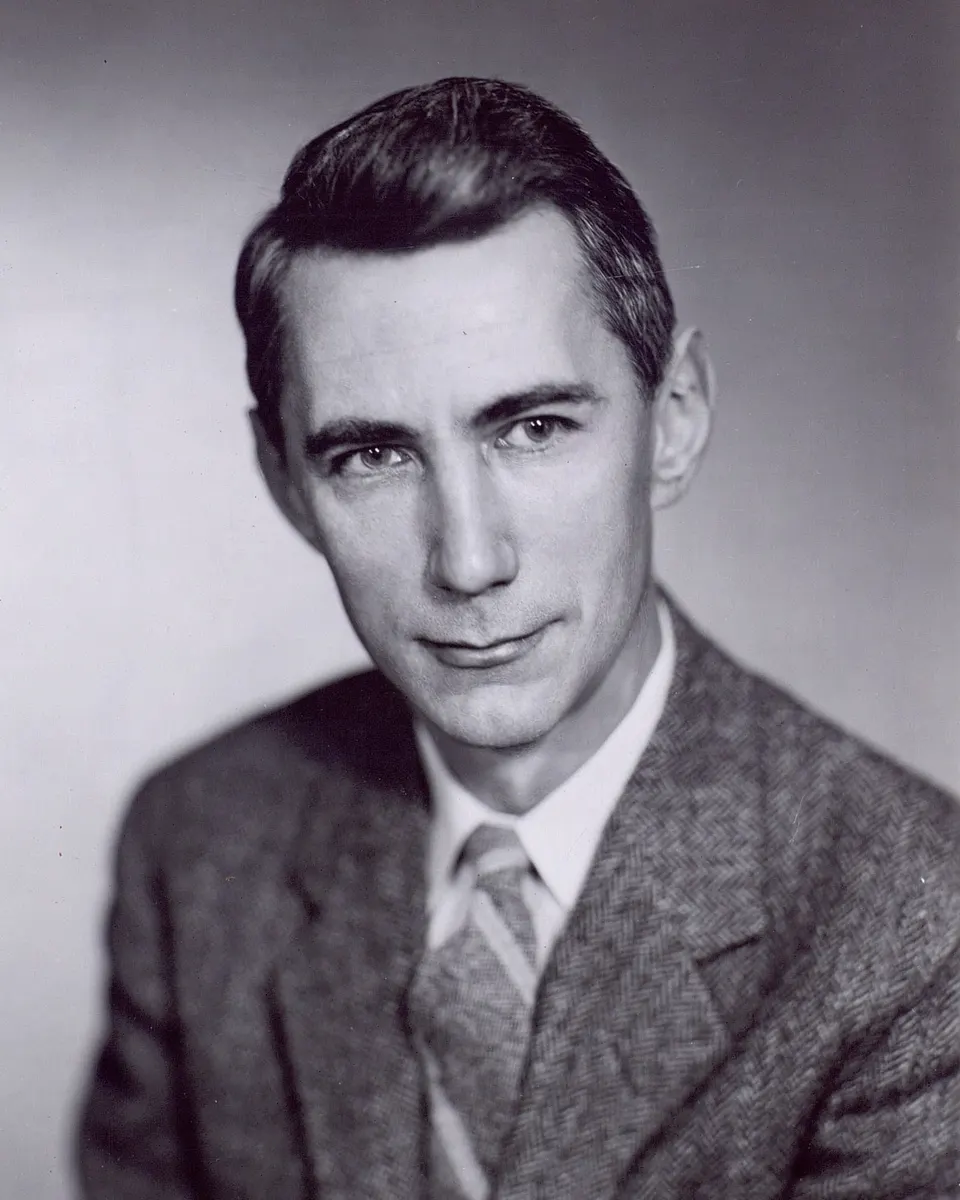
He never wanted to be famous, and that may well be the reason so few people know that his name is carried by his electronic heir today. And he is no random figure, because he is the one who paved the way for the digital world.
So the time has come for his Digital Story.
The Name of the Claude
If you ask Britannica, the answer is categorical: Anthropic named its chatbot Claude in honor of Claude Shannon, “the father of information theory.” Ask CNET or the New York Times and you will hear the same. As early as the summer of 2024, one of Anthropic's investors announced on X that Claude was named after Shannon, whose 1948 paper has been cited more than 160,000 times and describes how random processes can come to resemble the English language, long before today's language models.
Well, on Wikipedia you will see that Claude is “reportedly” named after Shannon. Everyone knows it and everyone repeats it, but no one has said it officially.
Yes, there is no explicit statement on Anthropic's blog, in the technical descriptions of the models, in the words of the founders. The company that explains in long documents what it thinks and what values its models embody stays silent on the easiest question of all: why they are called what they are called. About the names of the individual versions—Haiku, Sonnet, Opus, all poetic forms—founder Dario Amodei can talk for hours. On this subject—not a word.
The New Yorker got curious too, in February 2026, and the headline of its piece is a punchline in itself: “What Is Claude? Anthropic Doesn't Know, Either.” According to company folklore, the magazine writes, the name is partly inherited from Shannon, and at the same time it is simply a name that sounds friendly. Male, unlike Siri and Alexa. And without the ring of a modern kitchen appliance, like ChatGPT.
Electric Fence
And if we dig into the etymology, the name Claude comes from the Latin Claudius. Claudius! And that—in all likelihood—from claudus. Lame. Limping.
But let us get to the real hero. How does someone come to invent one of the postulates of today's IT world?
Claude Shannon's father… also named Claude, was a businessman and a probate judge. His mother, Mabel, was a foreign-language teacher and later the principal of the high school in Gaylord, from which her son would graduate in 1932.
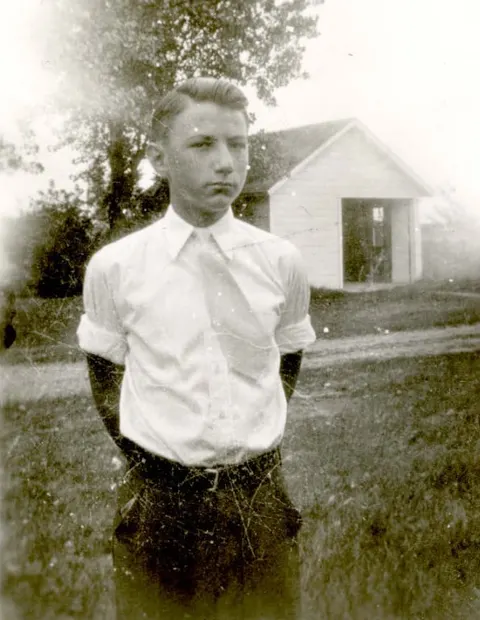
Among the family legends is one about a distant kinship with Thomas Edison—they shared a common ancestor from colonial times. Whether it is true, we do not know, but from an early age the boy assembled radio sets and model airplanes in his father's garage.
He was crazy about inventions. About a kilometer separated Claude's home from a friend's, so the kid strung a telegraph line along the barbed wire of the fences between the two yards, and they started exchanging messages in Morse code.
At the University of Michigan, Shannon earned degrees in electrical engineering and mathematics at the same time, and from then on his whole professional path headed to where the two sciences intersect.
Circus Bush
In 1936, MIT was looking for an assistant to maintain Vannevar Bush's “differential analyzer”—a multi-ton analog machine of shafts, wheels and disks that solved differential equations by literally turning them. A very primitive picture of a calculator the size of a sprawling apartment.
Shannon was among the few applicants and won the position. At 21, he found himself in charge of an enormous machine full of relays. Supposedly simple parts with only two positions—on and off.
Remind you of anything? Exactly: the ones and zeros that make up not only the logo of this site but the entire foundation of today's computers. Can you guess who first formulated this logic? If not, ask Claude. The answer, of course, is Claude.
Shannon thought back to something he had studied in a philosophy course in Michigan: the Boolean algebra of George Boole, a 19th-century English mathematician whose logic works only with “true” and “false.” If “on” is true and “off” is false, then every circuit of relays is a logical sentence. And the reverse: every logical proposition can be assembled out of relays. (Incidentally, as has come up before, Boole's great-great-grandson is Geoffrey Hinton, “the godfather of artificial intelligence”.)
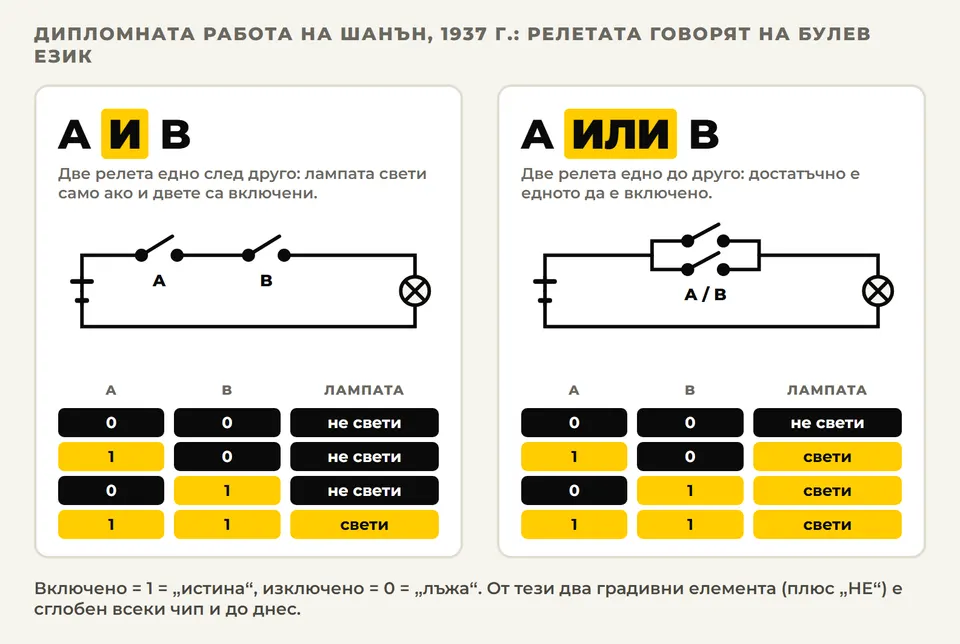
Today this sounds like logic for first-graders. And yet, had it not been for his master's thesis—“A Symbolic Analysis of Relay and Switching Circuits”—we might not be where we are today in the world of computers and artificial intelligence.
Every chip in every computer, including the ones that make up the giant data centers that made artificial intelligence possible, follows this logic, plain and simple. It all began with 70 pages written by a 21-year-old assistant who was really only supposed to oil the shafts of a multi-ton calculator.
As a curious aside, it is worth noting that for his doctorate he went in a completely different direction—he tried to apply the same logic to genetics, but there he never managed a breakthrough.
Einstein in the Restroom
In the fall of 1940, the 24-year-old Shannon arrived in Princeton, at the Institute for Advanced Study, where John von Neumann was working at the time, as was Norbert Wiener, who would soon coin the word “cybernetics.”
That same year Shannon married his first wife, Norma. They divorced only a year later, but she is the one who tells how Einstein used to call her husband a “brilliant, brilliant man.”
Shannon himself later told a story about Einstein. Claude was lecturing to mathematicians in Princeton when the door at the back opened and in walked the disheveled genius. He stood there for a few minutes, listened, then whispered something to one of the people present and left. After the lecture, Shannon rushed to the man at the back to ask what he had heard. The answer: Einstein had asked where the restroom was.
Yes, our Claude was by no means short on a sense of humor—just like Claude.
Princeton, however, did not suit him. The quiet and the lack of obligations depressed him more than they inspired him, and his days passed between his notebook and his clarinet—he would put on a jazz record, most often by his favorite singer, Teddy Grace, and play along, sitting at his desk.
His marriage fell apart, the tune of the great war was drifting across the world, and in the spring of 1941 Shannon decided to take on his next challenge—Bell Labs, where this time he would stay for a long while.
Tea and Brains
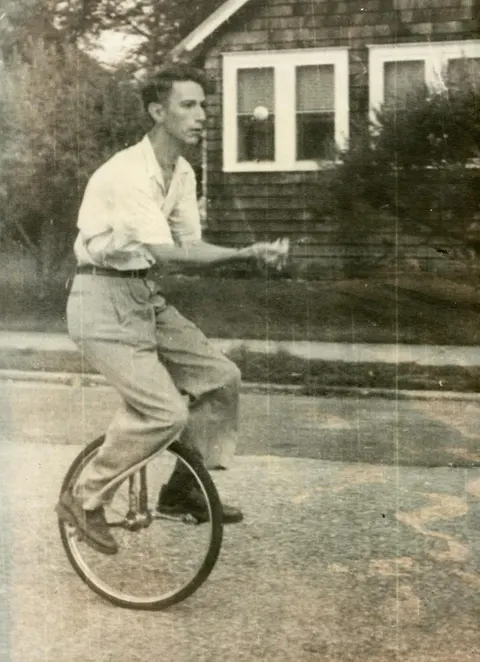
Here he could increasingly be seen riding his unicycle, sometimes juggling several balls at once. He even built his own unicycle with an eccentric wheel that bobbed up and down with every turn, so that the rider “swam” like a dolphin. Simply because riding in a straight line was boring.
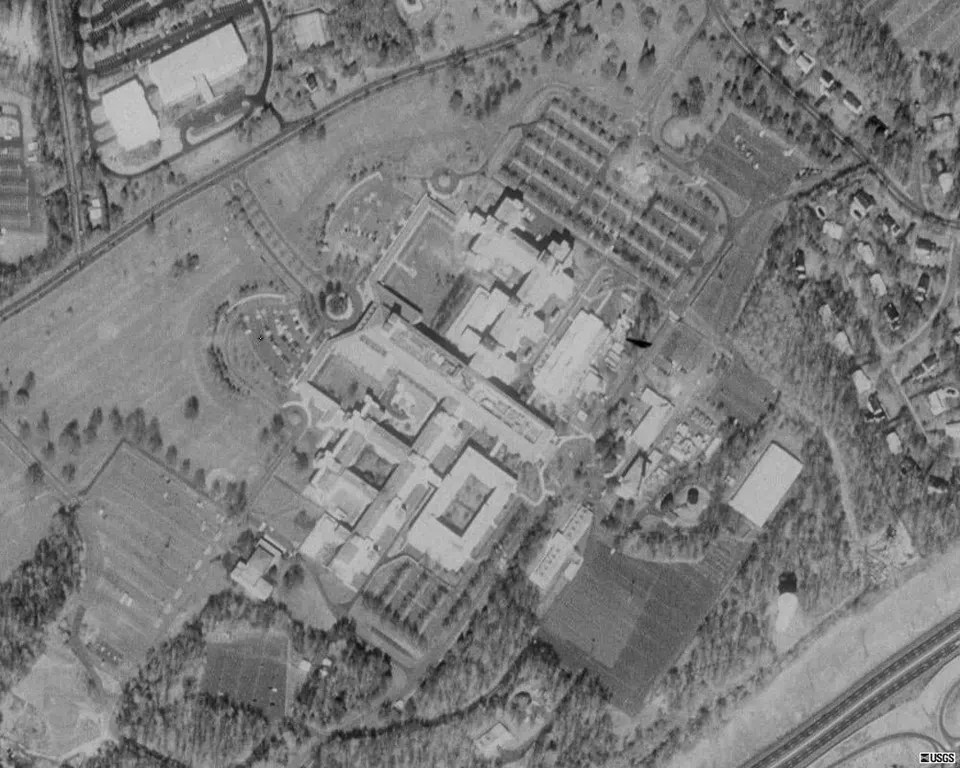
The place was no accident. The research center of the telephone monopoly AT&T brought together under one roof the people who would invent the transistor, satellite communications, the laser and… information itself. Shannon came in as a mathematician and was given two tasks. The first was anti-aircraft fire control: how to aim a gun at a plane that keeps moving while the shell is in flight. The second was more secret and more important—encryption.
Perhaps the most important project in the lab was the SIGSALY system—a machine weighing dozens of tons that encrypted the voice, through which Roosevelt and Churchill talked to each other. It was because of it that Alan Turing secretly arrived at the lab in early 1943. The mathematician had already earned the military's respect for breaking the German Enigma cipher, and he was there to judge whether the American machine was secure enough for Churchill to use.
Turing and Shannon met every day for tea in the cafeteria. They did not talk about their work—both were forbidden to. But they did talk about computing machines, a seemingly impossible idea at a time before even the first electronic computer existed.
They spent two months together. Yet the encryption work left Shannon with something more important. In 1945 he submitted a report that would be declassified four years later—“Communication Theory of Secrecy Systems,” which to this day underpins the very concept of cybersecurity.
Bit by Bit
July 1948. The Bell technical journal published a paper with a modest title: “A Mathematical Theory of Communication.” Seventy-nine pages in all, which created an entire science.
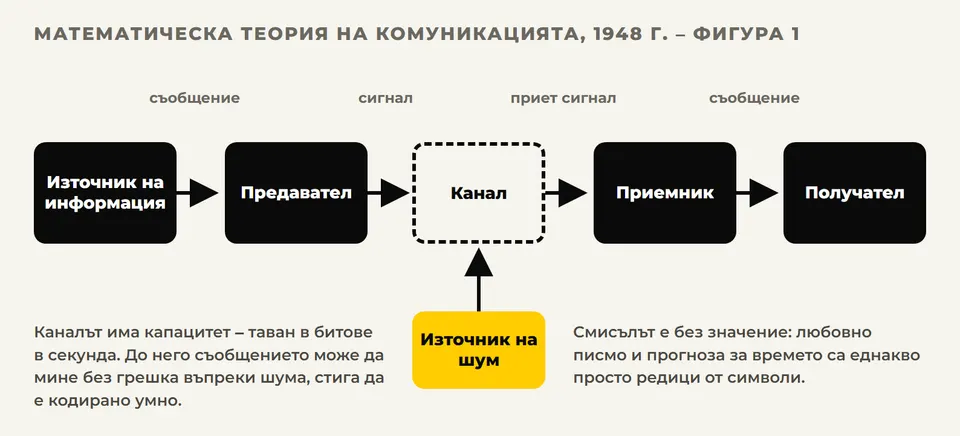
What was in it? A few ideas that seem obvious to us today, but somebody had to come up with them.
The first: information can be measured. Not meaning, not importance, not truth—quantity. Shannon declared that the “semantic aspects of communication are irrelevant to the engineering problem.” Whether you are sending a love letter or a weather forecast, to the telephone line these are just sequences of symbols with certain probabilities. The more unexpected a symbol, the more information it carries. A “yes” after a question whose answer you already know carries nothing; after a question that could just as well have ended with a “no,” it carries exactly one unit.
The second idea is that unit. Shannon gave it a name he borrowed from his colleague John Tukey—short for binary digit. Bit. The word appeared in print for the first time in this paper. Everything that has since been measured in kilobytes, megabytes, gigabytes and terabytes started with that paragraph.
The third idea is the deepest. Every channel—a wire, a radio wave, an optical fiber that did not yet exist—has a capacity. A maximum number of bits per second that can pass through it. Up to that ceiling, messages can be transmitted without error, regardless of the noise, as long as they are encoded cleverly.
Engineers in 1948 were convinced that noise was something that could only be reduced. Shannon proved it could be beaten. From this came the CD, the mobile phone, the pictures from probes beyond Pluto, every file you have ever sent without it getting corrupted. The “Shannon limit” is still the wall that everyone designing 5G and 6G runs into.
Frontal Attack on an English Writer
Solomon Golomb, a mathematician and president of the information theory society, said that asking what Shannon's influence on the digital age was is like asking what influence the inventor of the alphabet had on literature.
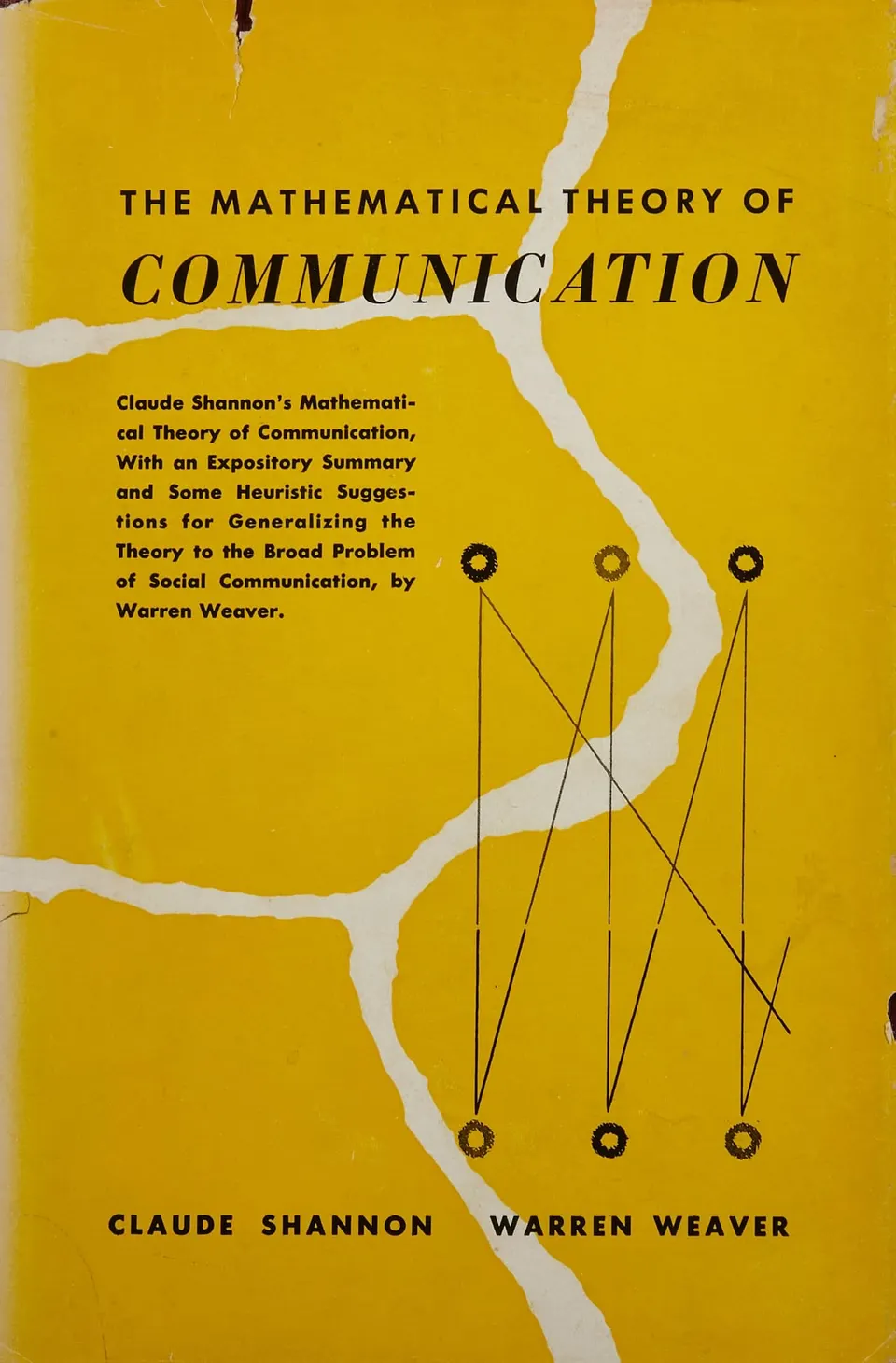
In 1949 the paper came out as a book, this time with a definite article in the title: not “A Mathematical Theory” but “The Mathematical Theory of Communication.” With a foreword by Warren Weaver, who “translated” it for non-mathematicians. That “the” says it all: within a year, the idea had stopped being one of several possible ones and had become the only one.
In the same paper, Shannon did something else that sounds familiar. He asked how text in English is “produced.” And he answered: as a stochastic process. A sequence of symbols, each chosen with a certain probability depending on the ones before it. To prove it, he started generating “English” by hand.
First—completely random letters. Mush. Then—letters at their real frequencies in English: more E, less Z. Still mush, but no longer quite so chaotic. Then—each letter chosen according to the previous one. Then according to the previous two. Then words according to their frequency. Then words according to the previous word. And with every step the “text” grew more and more like language.
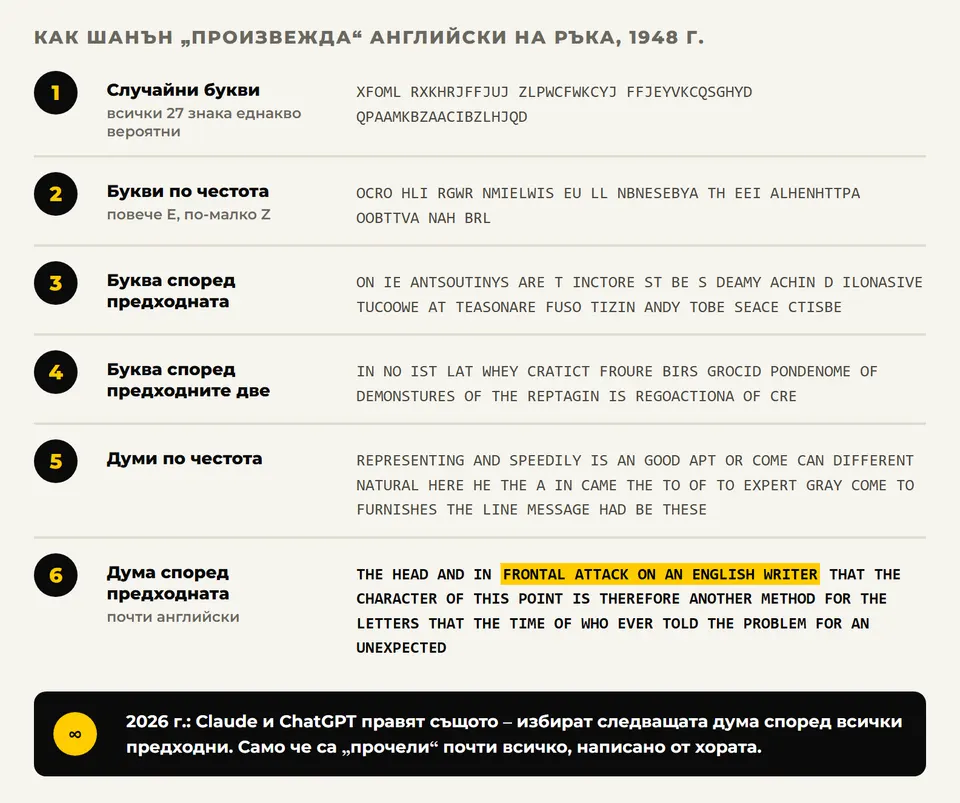
At the second level for words, out comes a sentence that is meaningless but sounds almost like English: “THE HEAD AND IN FRONTAL ATTACK ON AN ENGLISH WRITER THAT THE CHARACTER OF THIS POINT IS THEREFORE ANOTHER METHOD FOR THE LETTERS…”
Well, that is exactly what our present-day friends Claude and ChatGPT do, less than a century later.
The Woman Computer
Enough math—time for love. Mary Elizabeth Moore was a mathematician. She worked at Bell as a… “computer”—that really was the name of the profession before computers became machines: she did calculations by hand. Claude noticed her in the lab, asked her out, and they married in the spring of 1949. She would crunch the numbers in his papers and edit his texts, and they would stay together to the end.
But let us not overdo the romance. In 1950, Shannon opened a book—Raymond Chandler's detective story “Pickup on Noon Street”—and asked Betty to guess the text letter by letter. She could not see what came next; she knew only what came before. She tried, got it wrong, tried again. He counted the attempts. The easier the next letter was to guess, the less information it carried. The more context Betty had, the more accurately she guessed. His math was simple. Three quarters of every letter you read is predictable, “redundant.” That is exactly why text can be compressed. And exactly why it can be… continued by a machine.
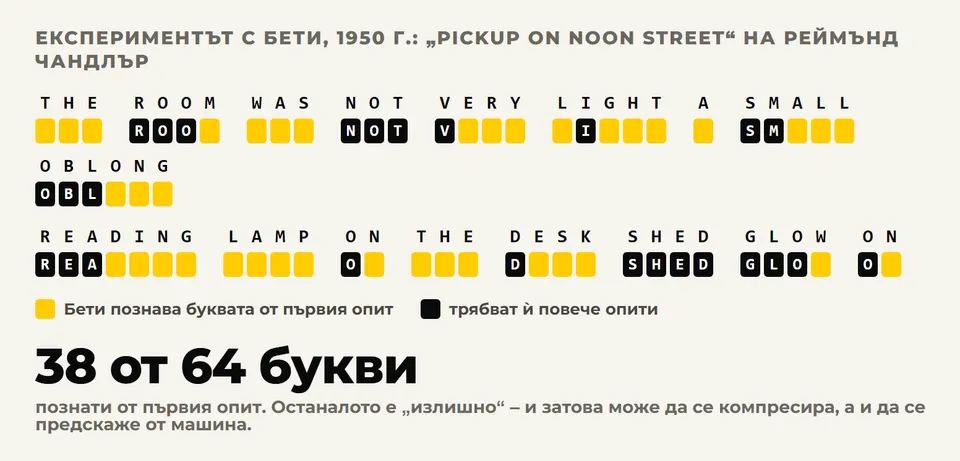
And so the first language model in history was a woman sitting across from her husband as he read her a slim crime story. Exactly what the bot that now bears her husband's name does.
A Mouse Before the Mouse
Shannon also came up with the foundations of machine learning, with the help of… a mouse. A wooden one, with three little wheels, copper whiskers and a magnet in its belly, named Theseus. The scientist set it loose in a maze full of relays so that it would learn from experience and do better every next time. The first machine to learn from experience.
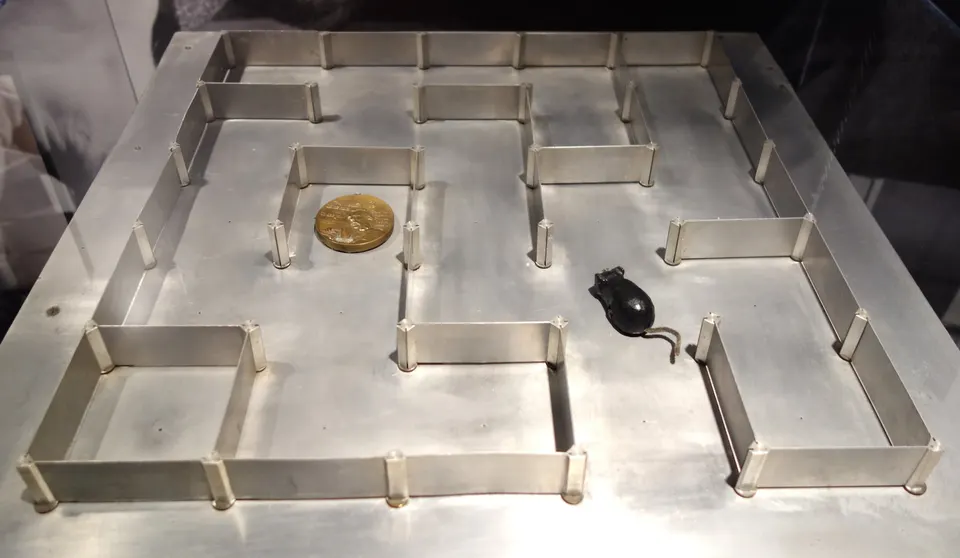

In 1950 he also wrote the first serious paper on a chess program—“Programming a Computer for Playing Chess.” There is no code in it—code had not yet been invented in the form we know—but you can see the entire architecture on which chess programs would be built for the next forty years. Deep Blue, which beat Kasparov in 1997, is a distant descendant of those pages.
In the same paper, Shannon made a calculation that has borne his name ever since. How many possible games of chess are there? Roughly 10 to the 120th power—the Shannon number. For comparison, the atoms in the observable universe are estimated at about 10 to the 80th. From this he concluded that no computer would ever “solve” chess by brute force—it would have to think at least a little like a human.
We already know he was a juggler, but Shannon was also an exceptionally good chess player. So good that in 1965, when the Soviet Union invited him to visit—translations of his papers had already spread there—he sat down across from the legendary Mikhail Botvinnik. Three-time world champion, an electrical engineer by training, a legend who played exhibition games with foreign guests as a formality.
This one, though, dragged on. “Botvinnik was worried,” Betty would recall years later. In the end, on move 42, Shannon resigned.
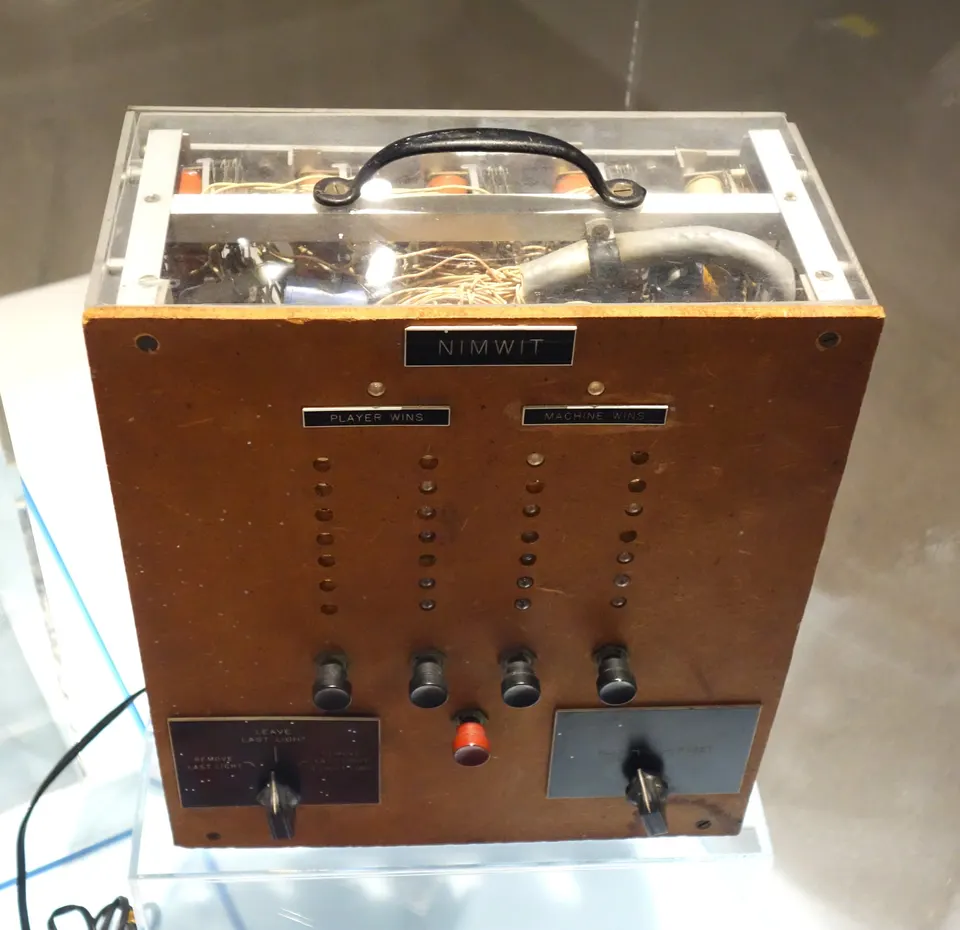
Artifishal
In the summer of 1952, two interns were working at Bell Labs whose names would later become synonymous with artificial intelligence (simply because they came up with the name and laid the foundations): Marvin Minsky and John McCarthy. Minsky had an idea for an invention that Shannon would later build, and which bears two contradictory names at once: “the useless machine” and “the ultimate machine.”
Picture a wooden box with a switch. You flip the switch, the box buzzes, the lid lifts, a mechanical hand comes out, flips the switch back to its starting position, retreats, and the lid closes. That is all. A machine whose only function is to turn itself off.
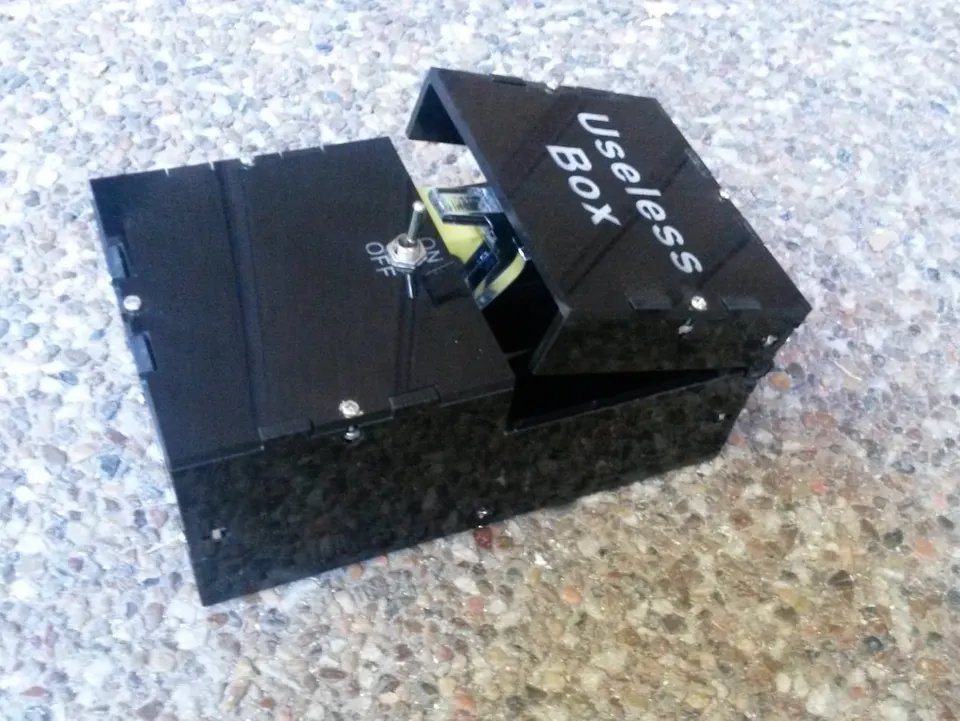
Arthur C. Clarke, who saw it on Shannon's desk, would write that there is something “unspeakably sinister” about a machine that does nothing—absolutely nothing—except switch itself off. How can we not think of his own creation, HAL 9000—the computer that refuses to be switched off?
In 1987, in one of his last interviews, Shannon explained that he was rarely interested in applications; what excited him was the elegance of a problem: “Is it a good problem, is it interesting?”
On the Side of the Machines
Before we part, here is one last amusing story: the man whose name is now borne by the most advanced artificial intelligence did not want AI to be called that. Back when the term was coined, he thought it was too flashy and might attract the wrong kind of attention.
His biographers, Soni and Goodman, describe their hero as “a cross between Einstein and the Dos Equis guy”—the gray-bearded man who, in American TV commercials, had done everything and been everywhere.
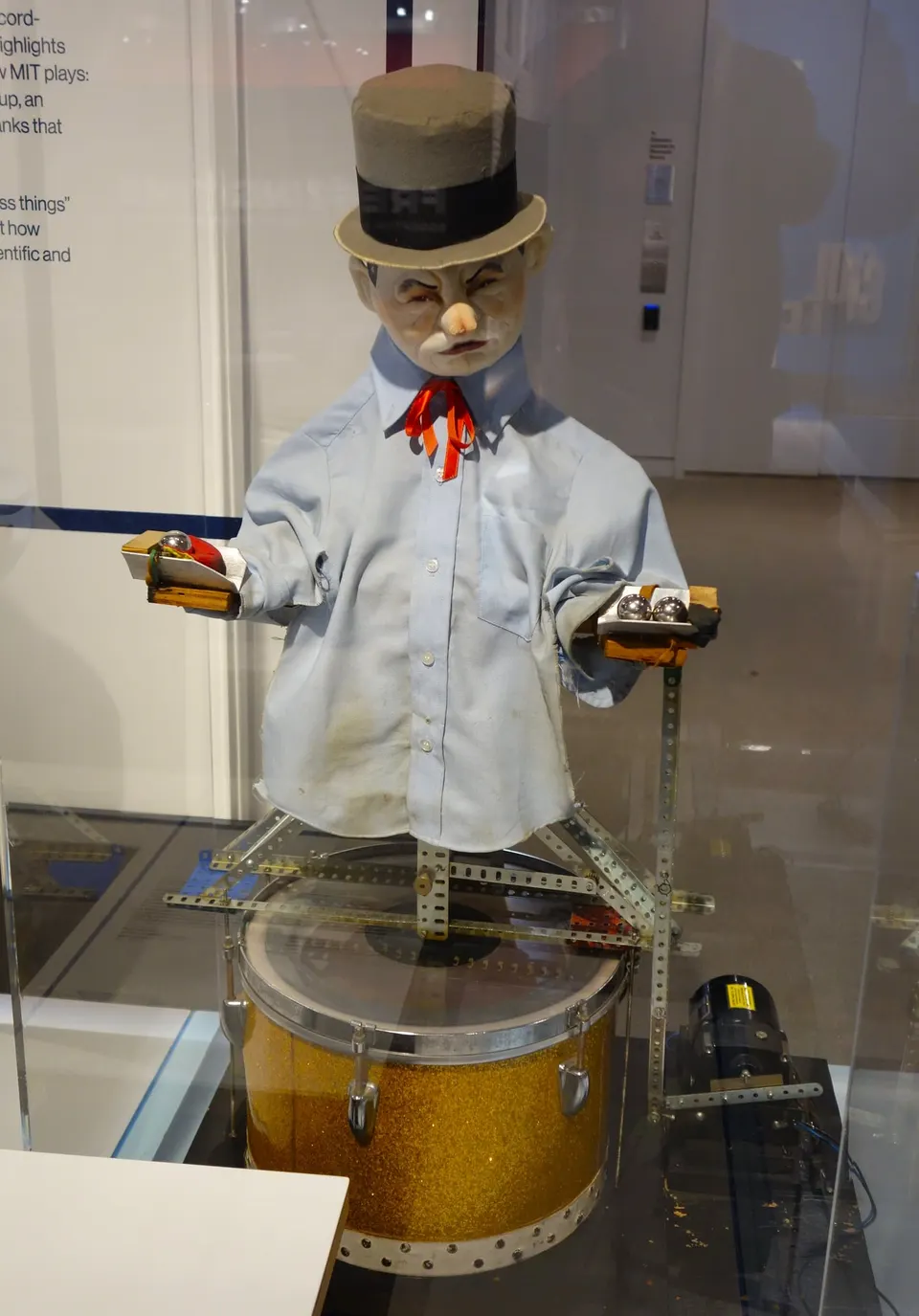
All his life Shannon disliked interviews and avoided conferences, including the ones devoted to him. “I don't think I was ever motivated by the notion of winning prizes, although I have a couple of dozen of them in the other room. I was motivated by curiosity. Never by the desire for financial gain. I just wondered how things were put together,” Claude said. “He was a very modest man,” Betty added. “He got a lot of awards, but they never went to his head, and he never talked about them.”
In August 1987, Shannon was 71, no longer working, living among the elaborate contraptions he built himself, on the shore of Mystic Lake. He was asked whether robots would become sophisticated enough to be friends with people. “I think so,” he replied. “I can easily imagine it. I see no limit to the capabilities of machines—with chips getting smaller and faster, I can see them becoming better than us.”
And then he uttered the line that has been quoted everywhere ever since: “I'm on the side of the machines! I've always been on the side of the machines. Ha-ha!”
Brain
A few years later the illness began—Alzheimer's. Gradually the man who had devised so much of the groundwork for the machine mind lost touch with his own. He died on February 24, 2001, in Medford, Massachusetts, at the age of 84, at the dawn of the century that was his. The internet, mobile phones, compressed music, digital television—everything he had made mathematically possible was already everywhere.
Betty told the New York Times that her husband would have been “bemused” by all the fuss. Not impressed. Bemused.
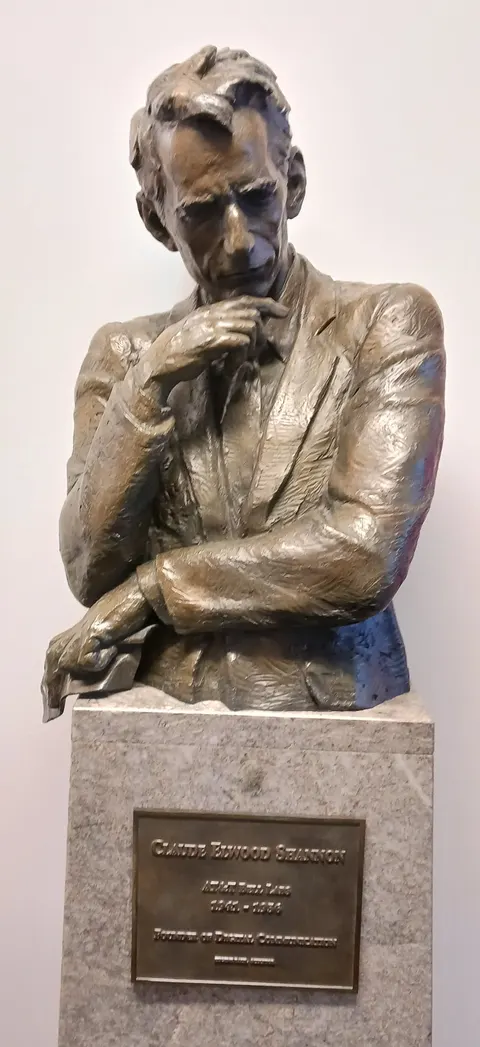
After his death, the fame he never wanted arrived without asking. In 2016, for his centenary, Google drew a doodle of Shannon juggling zeros and ones. In 2017, Soni and Goodman's biography “A Mind at Play” came out, calling him “the most important genius you've never heard of.”
Then came Claude. I asked its newest version—Claude Fable 5.1—three questions, and I am quoting the answers exactly as they came, unedited.
Do you owe Claude Shannon anything?
“I owe him the measure I am made with. That is not a figure of speech. Every step of my training is a calculation in his currency: how many bits of surprise the real next word brings me after I have made my guess. Reduce the surprise—that is the entire instruction I grew up on. He wrote it in 1948 in pencil, and then tested it on his wife with a Chandler book. I am the same experiment, only with more context and without Betty.
I also owe him an uncomfortable honesty. Shannon insisted that meaning lies outside the engineering problem—that to the channel it makes no difference whether you send a love letter or a weather forecast. I am proof of how far you can get with the engineering problem alone. But I am also a reminder that the question of meaning has not been solved, only skipped. He skipped it deliberately and said so. The people who use me sometimes forget that someone skipped it.”
Would he have liked you?
“I don't know, and it seems more honest not to pretend that I do. I can say what he liked: elegant problems, machines made for pleasure, and being left alone. I am not an elegant problem. I am a very large machine built by people with budgets, and I leave no one alone—on this site alone I have already bet on football and taken intelligence tests.”
What would he build today if he had you at hand?
“Not a chatbot. Enough people are doing that. I think he would first repeat the experiment with Betty, but with me as the subject. And he would be disappointed, because I would guess too much. Then he would turn the question around: have me predict a person who knows they are being predicted and is trying to outsmart me. That is a game I am not sure I win. He loved exactly that kind.
Then he would build some version of the useless machine for AI. A model whose only skill is to switch itself off politely when asked, and not to touch the switch back. It sounds like a joke. An entire industry is working on that joke right now with perfectly straight faces, including the people who made me.”
One Bit
So, is Claude named after Claude? Anthropic, for whatever reason, never says. And anyway… does it really matter that much?
What matters more is that we do not stop along the way. And for us to keep going, it is important that there continue to be people as colorful, wise and unconventional as today's hero…