ChatGPT was unveiled in November 2022. But when was artificial intelligence… “born”? The idea that computers can resemble humans and solve a wide range of problems. How many candles will it have to blow out on its next birthday—5, 10, 20?
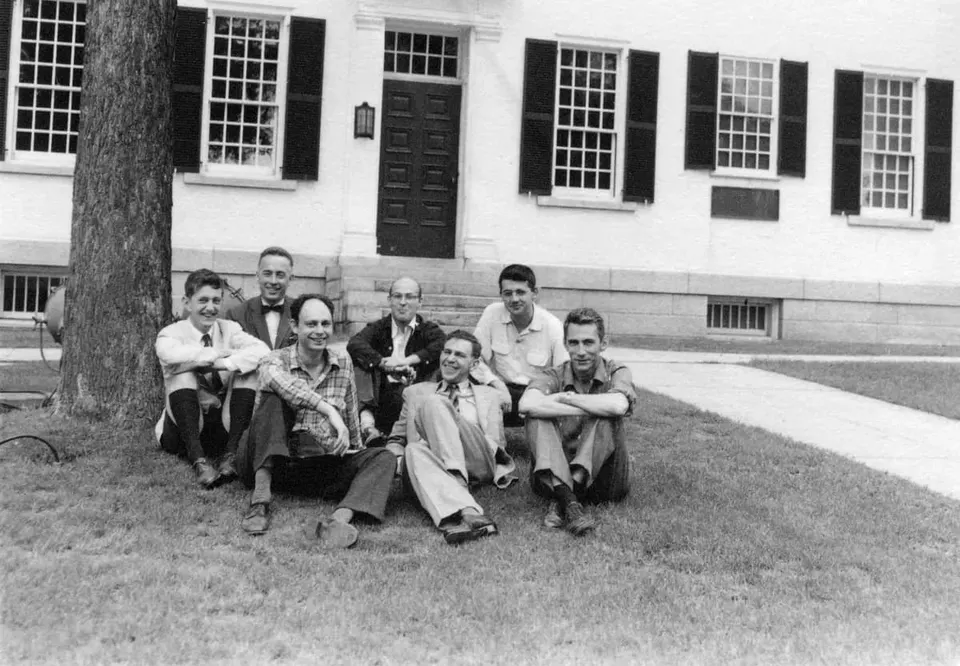
A full 68! Although by 1956 the forerunners of the field, Alan Turing and John von Neumann, had long since made their fundamental discoveries, it is ’56 that is now considered the starting year in the history of the field. For 8 weeks, the greatest scientists in this future field came and went at an American college. The people who would later lay the foundations of the field gathered to talk about the main challenges they faced…
“By 1978 at the latest, we will have a machine with general artificial intelligence comparable to average human intelligence,” Marvin Minsky, one of the main scientists who organized the Dartmouth meeting, would say a little later.

McCarthyism
We had to wait “a little” longer. The field went through waves of enthusiasm and periods of calm in which even mentioning “artificial intelligence” in scientific circles was met with outright anathema.
Is there anything we can learn from the forerunners about how hard the task really is? Their ideas still matter today and should not be forgotten. Because history more or less moves in a spiral, and every mistake we have understood may turn out to be a lifesaver in the future…
No, this McCarthy is not the famous hunter of Soviet spies during the Cold War. In the early 1950s, John McCarthy was a young scientist in mathematics and computer science who turned precisely to the fledgling field trying to answer the question: can machines think like people? At the time, the field had no name; several terms were competing for the role. Teams scattered across the United States and the world were working on these ideas, rarely exchanging views, heading in different directions, running into the very same difficulties…
That is why John came up with the idea of organizing a meeting in the summer of 1956, where scientists, freed from their teaching duties, could calmly discuss their progress, talk things over and work out how to move forward in the new, nameless field.

Unity Makes AI
At the time, McCarthy was working as an assistant professor of mathematics at Dartmouth College—the smallest of the Ivy League, an elite school located in the town of Hanover, New Hampshire. To this day it seems to remain in the ivy-covered shadow of its bigger relatives; you have hardly heard of it, except precisely because of the meeting McCarthy chose to organize here, which became the founding event in the history of artificial intelligence.
“At the time I believed that if only we could get everyone who was interested in the subject together to devote time to it and avoid distractions, we could make real progress,” McCarthy recalled.
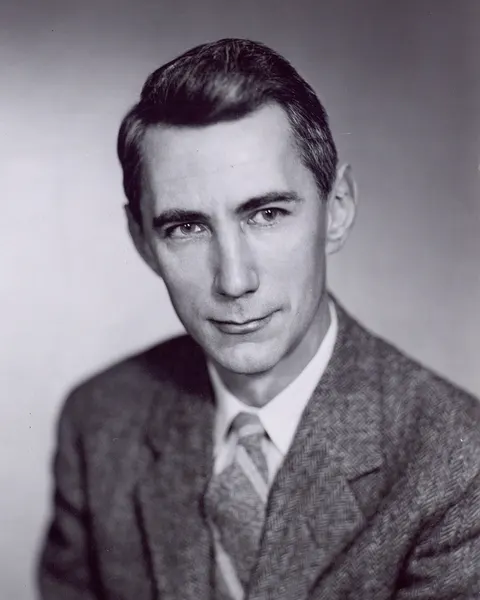
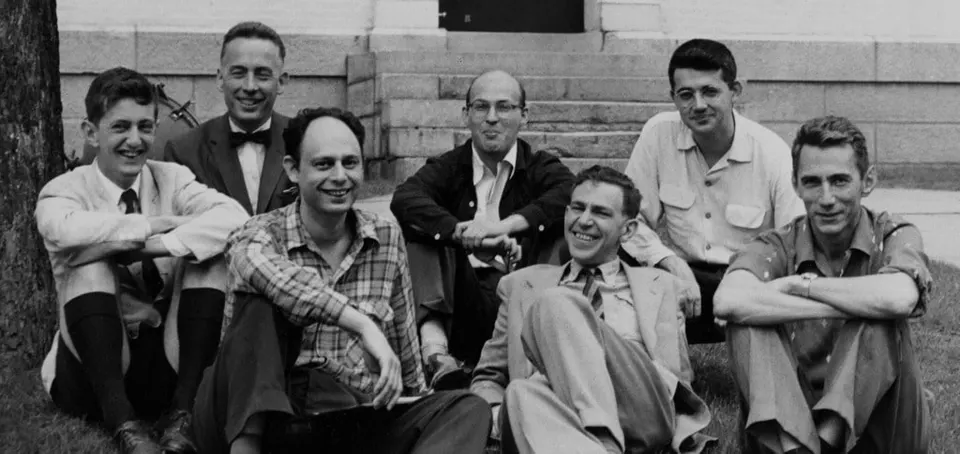
The idea came to him a year earlier, and he shared it first with his friend Marvin Minsky, also a young scientist in neurology and computer science, but at Bell Labs. The two won the support of their scientific mentors—Claude Shannon and Nathaniel Rochester.
But… who would invest in bringing together scientists to chat about a field that, at the time, sounded like a childish fantasy?
Who Will Give Us Money?
Still, they decided to try. McCarthy and Minsky wrote to the Rockefeller Foundation, which at the time set aside funds for scientific events it considered to be of public importance.
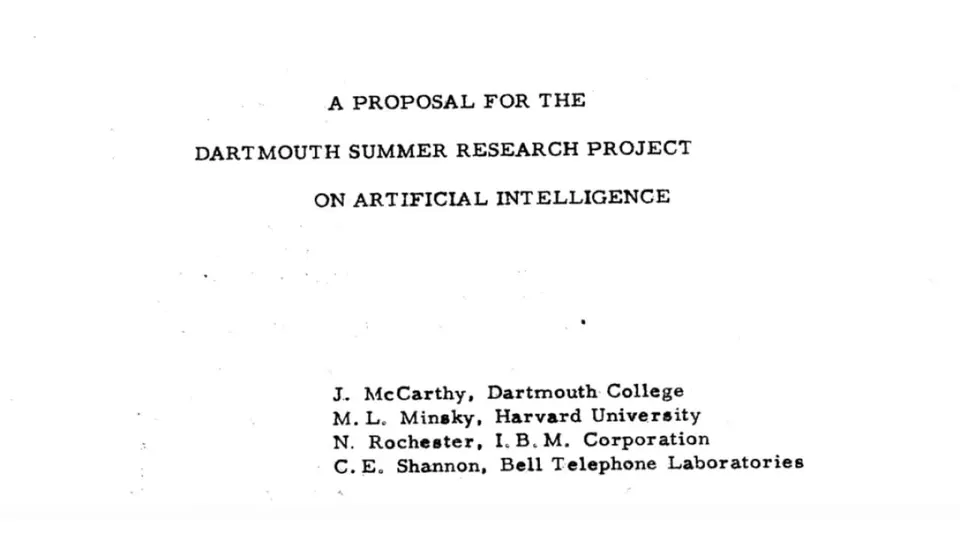
“We propose that a 2-month, 10-man study of artificial intelligence be carried out during the summer of 1956 at Dartmouth College. The study is to proceed on the basis of the conjecture that every aspect of learning or any other feature of intelligence can in principle be so precisely described that a machine can be made to simulate it,” McCarthy and Minsky wrote in their proposal. And further:
“An attempt will be made to find how to make machines use language, form abstractions and concepts, solve kinds of problems now reserved for humans, and improve themselves. We think that a significant advance can be made in one or more of these problems if a carefully selected group of scientists work on it together for a summer.”
Brains Like the Sea, Heads Like Buoys
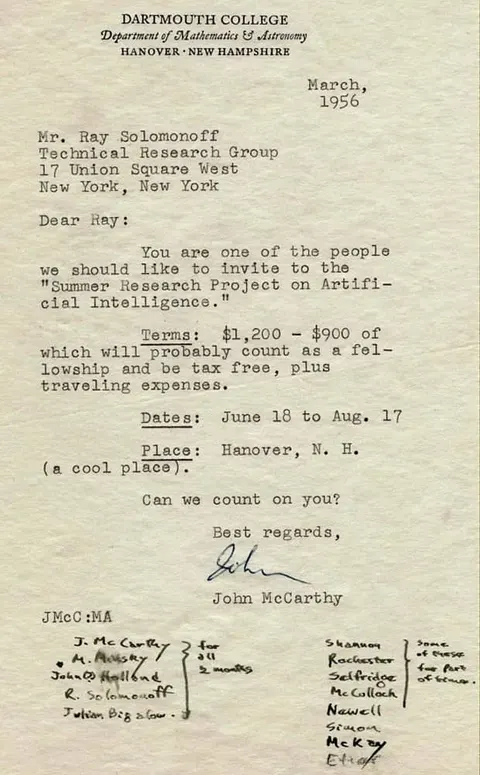
The budget included fees totaling $1,200 for the scientists who took part and $700 for the students. Another $800 was for the guests’ lodging. Even though money had a very different value in those days, it sounds rather tempting: for a total budget of $13,500, the foundation would cover an event promising to turn the primitive grandfathers of computers that existed at the time into machines that think like people.
The two enthusiasts did not cherish any great hopes of being approved, and it did not seem likely even to them that anyone would believe in their ambitious idea… and yet they got the green light. Yes, they received only half of the funds they had asked for. Then it turned out that almost none of the participants had the two months planned for joint work, but… in the end the goal would be achieved in the best possible way.
At the time there was no generally accepted term for “thinking machines”—people used terms such as “cybernetics,” “automata theory” and “complex information processing.” Each of these definitions, however, pointed to a more specific line of inquiry. That is why, in the proposal to the foundation, McCarthy decided to use the new term “artificial intelligence,” abstract enough to include everything the organizers of the Dartmouth workshop wanted to achieve.
Who’s Talking?
Nothing went as expected. Even if we compare the participants’ notes, it is not certain exactly when the meeting began and ended. Somewhere between June 18 and August 17, some scientists came for a few days, others for weeks, but no one stayed for the full 8 weeks planned.
McCarthy was deeply disappointed. He would later describe this period as an era of learning in the spirit of the child’s “Look, Ma, no hands!” He remembered that “it seemed as though there was no way we could organize ourselves and meet regularly. That was very disappointing to me. There was no real exchange of ideas.”
What’s more, no concrete discoveries came out of it, nor any document other than the one with which the organizers initiated the event itself. And yet… in the years that followed, the people who showed up at Dartmouth on one day or another would take fundamental steps in the field and would note again and again that it had all started right there.
Time to Break Up the Party
It was at this time that the two main directions in the development of artificial intelligence took shape—“strong” and “weak.” Beautifully explained by Prof. Preslav Nakov here, according to the first, the goal is to create systems capable of solving tasks that require human intelligence, while for the second the idea is to solve the task exactly the way a human would solve it.
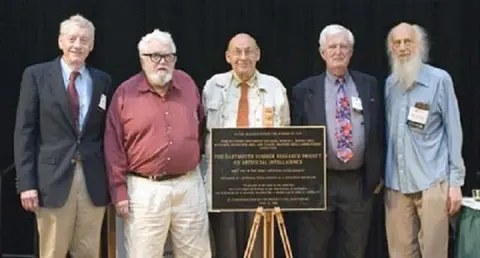
Besides the organizers and their mentors, (perhaps) 47 people took part in the event. Among them are the names of future Nobel laureates Herbert Simon and John Nash, whose story is familiar from the film A Beautiful Mind.
Apparently, sometimes it is enough simply to bring the right people together in the right place and leave them in peace. Because in the exchange of ideas, in conversation, real breakthroughs are sometimes born. And one more thing: sometimes more time has to pass before it becomes clear what actually happened.
Think about what times we are talking about. Even a decade ago, talking about “artificial intelligence” was a distant utopia—let alone the late 1950s, when personal computers were still an imaginary idea and Bill Gates could barely walk upright under the table…
The New Oppenheimer
Optimism and faith in the future are often what lead us forward. But they are also what lead us astray. Because, caught up in the enthusiasm of the meeting and the spirit of the times, the Dartmouth scientists would begin to herald unrealistic expectations that, one way or another, would bring about the end of this first wave of interest in the idea of a computer resembling the brain.
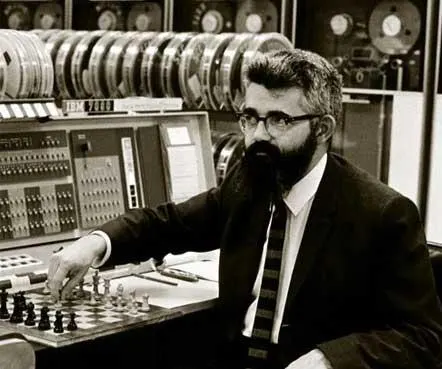
Take, for example, Minsky’s words we began with, promising an algorithm with human intelligence before the end of the 1970s. And he was by no means a random scientist—he would later receive the Turing Award, the mathematical equivalent of the Nobel.
“When intelligent machines are constructed, we should not be surprised to find them as confused and as stubborn as men in their convictions about mind-matter, consciousness, free will, and the like,” Minsky would later write. He was also a scientific consultant on the famous film 2001: A Space Odyssey.
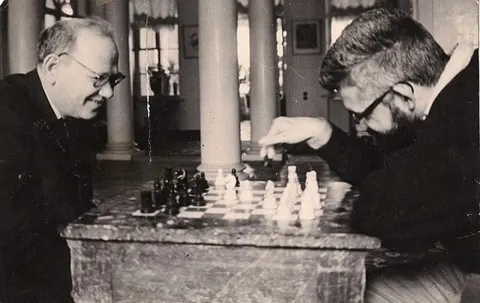
Another interesting parallel. Minsky graduated a little later from the same school as Oppenheimer, the creator of the atomic bomb. And from the very beginning his teachers kept saying: “Oh, we have a new Oppenheimer here,” although at the time the name meant nothing to him. A chance occasion for yet another link between nuclear technology and artificial intelligence…
Marvin the Robot
Scientists from various fields took part in the workshop—mathematicians, electrical engineers, physicists. Even back then the conversation turned to getting to know better how the brain works before trying, one way or another, to imitate it. Marvin’s wife, Gloria Minsky, a neurologist, also took an active part in the meetings. Decades would pass before the idea of deep neural networks was developed further by Geoffrey Hinton and his colleagues, bringing us to today’s renaissance.
Months after Dartmouth, once again as a result of those conversations, another term would appear that long drove the field forward. Arthur Samuel would propose the idea of “machine learning”—the search for algorithms through which computers teach themselves on given data.
A year after the workshop, laboratories for artificial intelligence research were founded at a number of universities, such as Carnegie, Stanford and MIT.
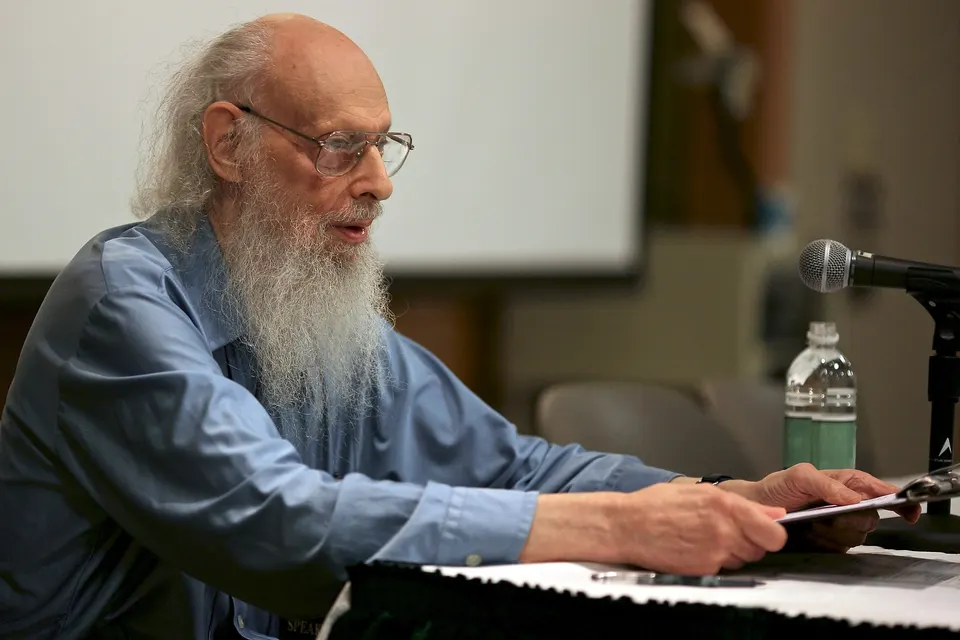
The careers of the other initiators also took off dizzyingly. Shannon went down in history as the father of information theory. Rochester was one of the creators of the IBM 701—the first mass-produced computer ready for scientific applications. John McCarthy made his name as the creator of the programming language LISP—created precisely for the needs of Rochester’s machine, only the second higher-level language, considerably more understandable and convenient for the people who would later become known as programmers.
Through Hardships to the AI
After Dartmouth, “artificial intelligence” appeared on the map as a separate field of science and gradually took hold in society too. People began dreaming of thinking machines and how they would make their lives easier… But, alas, technology was still far from such capabilities, and so, naturally, the first “winter” arrived—a moment of sharp decline in interest in a given field.
In the 1980s came expert systems, which many consider the second peak of artificial intelligence, but it did not last long, once again limited by the capabilities of the technology of the moment.
Until we reach the present day, when artificial intelligence is the hit of the day and, perhaps, of the era.
Could we once again overestimate it, carried away by some impressive successes that successfully hide its limitations? Hardly. It has long since stopped being true that “everything new is something old, well forgotten,” at least in the world of technology, where the news is big and daily. And yet it is always worth drawing on the experience so far, especially in such a dynamic field. And it is always worth keeping something in the back of our minds…
The Seven Problems
Minsky and McCarthy formulated seven problems to be solved at the Dartmouth meeting. Some of them, however, remain open to this day…
1. Automatic Computers
If a machine can do a job, then an automatic calculator can be programmed to simulate the machine. The speeds and memory capacities of present computers may be insufficient to simulate many of the higher functions of the human brain, but the major obstacle is not lack of machine capacity, but our inability to write programs taking full advantage of what we have.
2. How Can a Computer Be Programmed to Use a Language?
It may be speculated that a large part of human thought consists of manipulating words according to rules of reasoning and rules of conjecture. From this point of view, forming a generalization consists of admitting a new word and some rules whereby sentences containing it imply and are implied by others. This idea has never been very precisely formulated, nor have examples been worked out.
3. Neural Networks
How can a set of (hypothetical) neurons be arranged so as to form concepts? Considerable theoretical and experimental work has been done on this problem by Uttley, Rashevsky and his group, Farley and Clark, Pitts and McCulloch, Minsky, Rochester and Holland, and others. Partial results have been obtained, but the problem needs more theoretical work.
4. Theory of the Size of a Calculation
If we are given a well-defined problem (one for which it is possible to test mechanically whether or not a proposed answer is valid), one way of solving it is to try all possible answers in order. This method is inefficient, and to exclude it we must have some criterion for the efficiency of calculation. Objections will be raised that in order to obtain a measure of the efficiency of a calculation, one needs a method of measuring the complexity of calculating devices, which in turn can be done if we have a theory of the complexity of functions. Some partial results on this problem have been obtained by Shannon, and also by McCarthy.
5. Self-Improvement
Probably a truly intelligent machine will carry out activities that may best be described as self-improvement. Some schemes for doing this have been proposed and are worth further study. It seems likely that this question can be studied abstractly as well.
6. Abstractions
A number of types of abstraction can be clearly defined, and others less clearly. It seems worthwhile to make a direct attempt to classify them and to describe machine methods of forming abstractions from sensory and other data.
7. Randomness and Creativity
A fairly attractive and yet clearly incomplete hypothesis is that the difference between creative thinking and unimaginative thinking lies in the injection of some randomness. To be efficient, the randomness must be guided by intuition. In other words, the educated guess or the hunch includes controlled randomness in otherwise orderly thinking.