Do you know who the first astronaut from Africa, the second most populous continent on the planet, was?
Let Google or ChatGPT answer that one; I will tell you who it could have been. Because of all the eternal stories, there is one we underestimate most often. Let us saddle Rocinante, greet an illegally young Dulcinea and chase the windmills of the Solar System!
The renowned hidalgo Don Quixote, a few centuries later, is Edward Mukuka Nkoloso, the inventor who… very nearly beat the US and the USSR in their battle for space!
Jason and the Astronauts
October 30, 1964. Time magazine reports on yet another African country that has won its independence. The recent British colony of Northern Rhodesia wakes up one morning as independent Zambia, led by Kenneth David Kaunda, “the son of a Presbyterian preacher and a former teacher who plays the guitar, does not smoke and is a teetotaler.”
“Zambia: Tomorrow, the Moon” is the title of the enthusiastic piece, written in the spirit of Bulgaria’s own Dela i dokumenti (Deeds and Documents) features of the same years. It tells in detail of the history and geography of the newborn country, of its people and its economic prospects. But why the Moon? The answer comes only in the last paragraph.
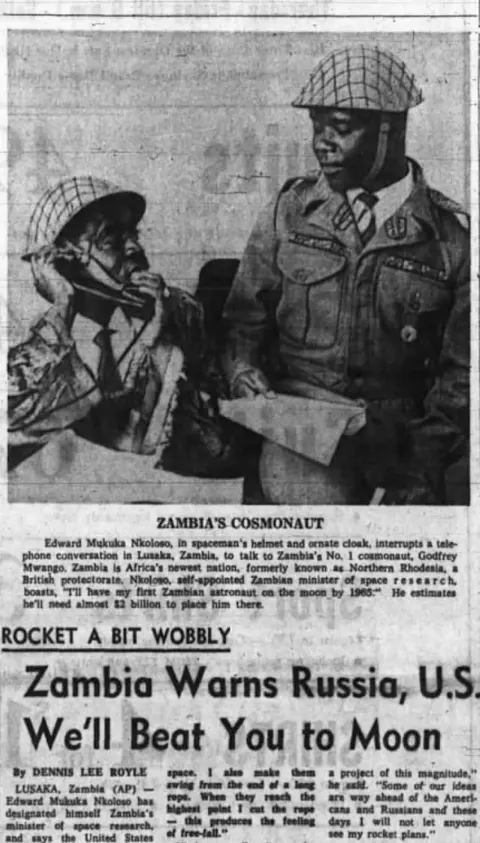
“During the independence celebrations, only one notable Zambian failed to share the general enthusiasm. He is Edward Mukuka Nkoloso, a grade-school teacher and director of Zambia’s National Academy of Science, Space Research and Philosophy, who claims the festivities coincided with his space program’s efforts to beat the US and the Soviet Union to the Moon.
Nkoloso is training twelve Zambian astronauts, among them a plump 16-year-old girl, by spinning them around a tree in an oil drum and teaching them to walk on their hands, because that is the only way humans can walk on the Moon.”
Check with a Pawn
How does a serious piece in a respected magazine end in such a surreal way?
Well, over the following years Edward, who had made up his mind to go to the Moon (and then to Mars), became a darling of the Western media.
And how could it be otherwise?
Just picture it. The US and the USSR are pouring enormous sums and concentrating their efforts at the height of the great space race, while our friend Edward is convinced he will beat them both.
Twelve Angry Men
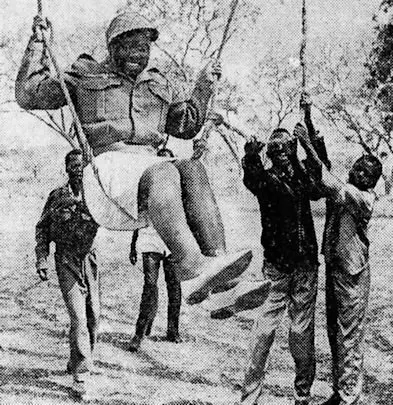
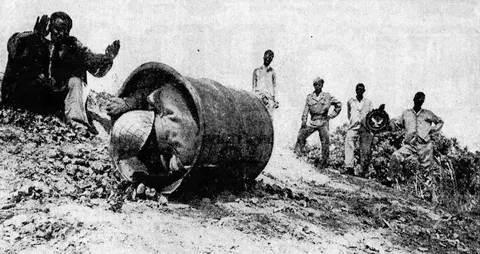
He set up his space center on an abandoned farm 11 kilometers from the capital, Lusaka. The training of the 12 future Afronauts included rolling down a hill inside 200-liter oil drums—which, according to the Zambian von Braun, was ideal preparation for life in weightlessness and then for the trip back to Earth.
“I also make them swing on the end of a long rope,” he told a reporter. “When they reach the highest point, I cut the rope. This produces the feeling of free fall.”
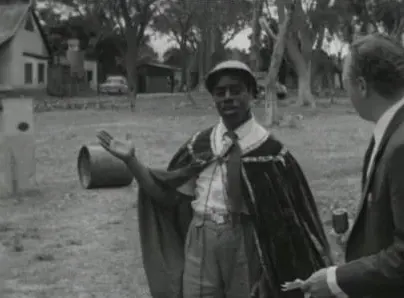
The “Afronauts,” as Nkoloso himself christened them, wore uniforms of green satin jackets and yellow trousers, because “when we are not space cadets, we are the Dynamite rock band.”
The first goal was the Moon, and the next, of course, Mars. And after that a star station named after Edward’s dog, Cyclops.
The Gods Must Always Be Crazy
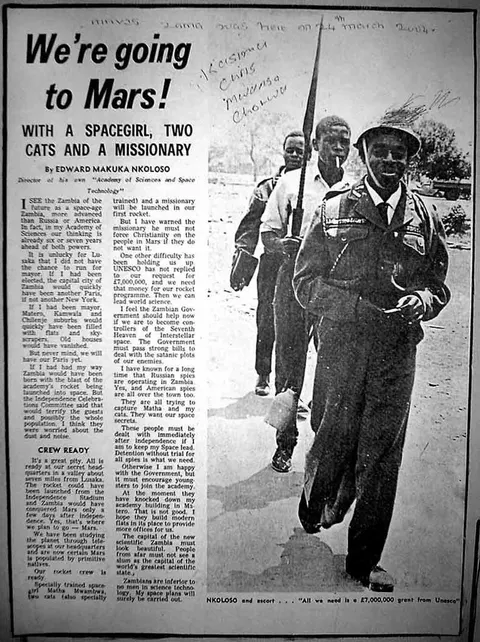
The rocket meant to carry them to these lofty goals was named after President Kenneth David Kaunda. D-Kalu 1 measured 2 by 3 meters, was shaped like a drum and was made of copper and aluminum. It was scheduled to blast off into space on the national holiday itself, from the central Independence Stadium in Lusaka.
It never became quite clear what exactly the Afronauts were training for, since the only passengers planned for D-Kalu were the first African woman to travel to the stars—Matha Mwambwa, the 16-year-old mentioned by Time—and Edward’s aforementioned best friend, Cyclops.
On the second stage, toward the Red Planet, they were to be joined by two specially trained cats and a Catholic missionary. Who, in Edward’s words, would unobtrusively present the advantages of his religion to the locals and thus help Zambia become “the dominator of the Seventh Heaven of Interplanetary Space.” All without showing excessive roughness toward the natives.
Edward Scissorhands
At the same time, the Zambian Korolev—as in Sergei Korolev, the father of the Soviet space program—invited UNESCO to join the program with a grant of 7 million pounds. He sent official offers to his great rivals as well, the space programs of the USSR and the US. He also invited private investors into the program, which he valued at $1.9 billion.
According to some sources, he did not receive a single dollar; according to others, he got back a check for 10 rupees sent by an Indian child moved by the venture.
And although he was open to help from his colleagues in the two great blocs, Edward said he was taking no sides and would keep his progress secret even if he received the funds. “You cannot trust anyone in a project of this scale. Some of our ideas are far ahead of those of the Americans and the Russians, and I will not let anyone see my rocket plans,” the Afronaut warned.
Zambezi Dream
Sadly, the story has no happy ending. Even before 1969 came along and Edward lost the race to the Moon, unforeseen events took place. Whether or not as part of the training, the first Afronaut woman in space turned out to be pregnant and, since she was still a minor, her parents took her home.
“My astronauts thought they were movie stars. At one point they wanted to be paid,” Edward complained. “Two of my best men took to drink a month ago, and I haven’t seen them since. Another of my Afronauts joined a local dance troupe.”
Little by little the other cadets lost their motivation and left the project, and Edward, without enough support, found himself forced to suspend it for the time being. With the idea of one day resuming his crusade toward the sky.
So, we have had our fun with this surreal plot, but… how serious were the intentions of our Zambian Don Quixote? Was it naivety of cosmic proportions, an attempt at easy money, a peculiar sense of humor? Or perhaps… a different kind of crusade, one for justice?
A Land the Size of a Human Palm
Don’t expect a clear-cut answer. Still, here are a few more facts about our hidalgo to round out the picture.
From an early age Edward was raised on the idea that the country he lived in deserved independence from Great Britain. Even so, he fought for 4 years in the Second World War as part of the Northern Rhodesian British forces. That is why, shortly before his death, he would receive a prestigious Soviet medal for veterans and would even be given the rank of colonel.
He founded a small school where he taught illiterate kids, but the British authorities closed it down. It was precisely this that drove the future conqueror of space into the struggle for his people’s freedom, where, they say, he sometimes showed himself in a less than flattering light. For instance, by leading a group that kidnapped the wife of a British bigwig. But then… it’s not as if Gotse Delchev, the hero of the Macedonian-Bulgarian revolutionary struggle against the Ottomans, didn’t do the same—just ask Miss Stone, the American missionary his men abducted in 1901.
Those days produced other amusing stories too. To avoid being discovered by the British, he sometimes disguised himself as a woman. Once he was so pleased with his disguise that he went around asking the soldiers who this Nkoloso was who was causing them so much trouble.
The War of the Worlds
He organized some of the largest protests against the colonizers. He even spent two years in prison.
The long-awaited independence allowed him to step back into the role of teacher, but, it seems, he was already bored. So he decided to create the National Academy of Science, Space Research and Philosophy, which later came to include the Afronaut venture. At the time he also championed the rights of local traditional healers, who, in his view, ought to have the same working conditions as doctors practicing Western medicine.
That he enjoyed well-deserved respect is shown by the fact that after the collapse of the space program, Edward was appointed special representative of the president. His task, moreover, was to work actively to help neighboring peoples who had not yet won their independence.
And wouldn’t it make sense to… put these two motifs together—the fight against the colonizers and the space program?
Over the past decades, the story of the Afronauts has been told often, with an undisguised note of mockery, even by the most respected media in the world. And yet it seems to be something more, as the remarkable article in The New Yorker by Namwali Serpell, a Harvard professor of English literature of Zambian origin, makes clear.

Who Doesn’t Know Dulcinea?
The scholar set off on Edward’s trail to uncover what lay beneath the surface of this story, which has become a kind of symbol of her homeland.
The professor dug through numerous documents and letters, and even came across one in which Edward writes to the British queen, urging her to look into the state of the prisons in the empire.
And she reveals to us an exceptionally intelligent man who, even at a fairly advanced age, decided to study law and finished the degree. By no means was he a simpleton who would believe that his homemade rocket would conquer Mars so he could win the locals over to the cause of Catholicism.
“Zambian irony is very subtle,” writes Prof. Serpell. “We don’t have ‘yes’ and ‘no.’ We have two ‘yeses,’ and one of them means ‘no.’”
Could this be where the answer lies?
“Well educated, a veteran of the Second World War, a key figure in the resistance against colonialism in Zambia”—that is how Edward’s son, who bears his name, describes him, and the picture is completed by similar words from many other people.
Zamunda Banana Band
Today we might call the show Edward put on for the Western media skillful trolling—media that arrived with their prejudices about this part of the world. Ready to laugh at the expense of the primitive Zambians, largely illiterate and yet dreaming of space.
Because the project is also a metaphor. For the ugly colonial history of the whole continent, for the Western man’s conviction that he is the center of the Universe.
Has much changed since then? Yes, there are no Afronauts today, but inequality and prejudice are still here, and they show no sign of flying off.
A small example: the world is global and high-tech now, isn’t it? In 2020, 94.6 percent of the inhabitants of North America had internet access, compared with 39.3 percent of those in Africa. And, of course, there is no need to open the subject of hunger and the lack of a future.
Even so, for the Western man the fate of five millionaires who ended up in a submarine of their own free will is a drama, while hardly anyone even hears about a ship that sank off Greece at the same time, with 700 African migrants vanished without a trace.
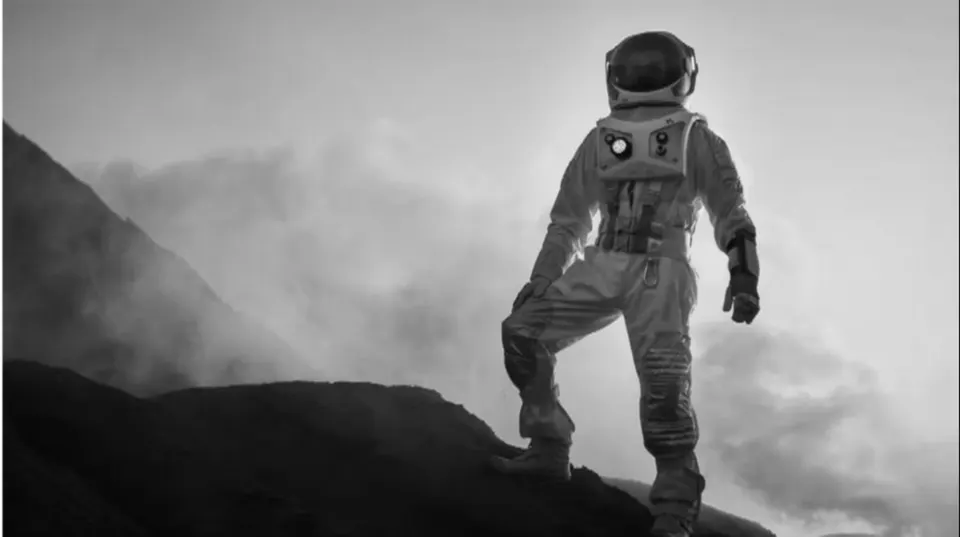
Meanwhile, the Afronauts have become a pop-culture symbol too.
At the Tip of the Spear
In his last years Edward worked as a security officer at an industrial company. “This is too lowly a job for me, I don’t feel like talking about it,” he told a Zambian reporter in one of his last interviews. In it he spoke far more eagerly about his space adventures. “I have not given up on this project,” he said. “I still have a vision of the future of man. I still feel that man will be able to travel freely from one planet to another.”
Does the astronaut Matha Mwambwa regret that she turned to family life rather than to the Moon? Her trail goes cold. Nor can we ask Edward: he flew off to the sky on March 4, 1989.
So what, the Afronauts never made it to the Moon? Well, Fyut the Little Devil, the imp of children’s stories, did it, as we know. As for whether the Americans made it too, you will meet plenty of skeptics, you know how it is…
And still, Edward’s story is so beautiful. Because dreams are never ridiculous, and they are always worth chasing. Because a person really is as big as their dreams…