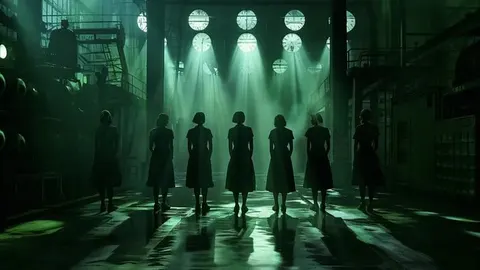
An incredibly powerful phenomenon has been discovered, one that creates a new substance! Not only does it cure even incurable cases of cancer, it will open the eyes of science in so many directions. For instance… lighting up the dark night!
Marie Curie discovers radioactivity, wins not one but two Nobel Prizes and paves the way to the future.
She opens the doors to a new technology that turns out to be unexpectedly successful… Until it becomes clear that we have badly underestimated its dangers. It will cost the lives of thousands of people who were simply trying to earn a living.
Do we know the technologies we trust well enough? Could the much-hyped artificial intelligence, or some other fashionable field of today, prove more dangerous than it looks at first glance?
The most important thing is to stop and think, to reflect, to discuss. To tell each other stories.
Stories like that of the radium girls are worth reading more often. That is what stories are for—to make us question things, to keep us on our guard. Alas, not all that glitters is gold…
Burn to Shine
“My beautiful radium,” Marie Curie called it, and to this day she remains one of the most revered and celebrated scientists to have carried progress on her shoulders. A long time would pass before humanity grasped the full horror her discovery was capable of—that would only hit with full force after the atomic bombs dropped on Hiroshima and Nagasaki.
But much earlier, at the beginning of the last century, her invention was everywhere. The Curies did their first experiments with polonium—it starts a nuclear reaction that, however, stops after about a day. Then came uranium… until the ideal new substance was found. Radium, and specifically its isotope 226, has a half-life of 1,600 years! Imagine how many applications that could have!
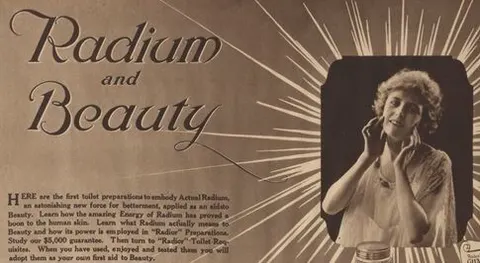
Within just two years, the power of its radiation to treat cancer was discovered. Compared with what had been known before, the results were sometimes miraculous, and radium became a superstar. Bottles of radium water appeared, radium candy, rejuvenating face creams…
Very quickly another, if more everyday, application came into fashion—watches that glowed in the dark became the favorite accessory! Had there been Instagram back then, you can be sure they would have been a staple of every feed. At the time it sounded like magic… and it was magic, because the dials were coated with an innovative paint based on the Curies’ discovery.
The mixture glows thanks to a cascade of chemical interactions: radium salts are mixed with a zinc compound, and as a result the particles emitted by the radium make the zinc atoms vibrate, which produces sparks of flickering light, almost invisible by day but clearly visible at night.
The glowing “Undark” (“not dark”) watches became especially popular after the outbreak of the First World War. In the trenches, soldiers needed a reliable way to tell the time without a flashlight, which would have drawn the sights of the snipers on the other side. The production of luminous watches became a hugely profitable industry.

Enlightenment
This progress had a very specific face—the U.S. Radium Corporation, which owned mines in Colorado and Utah and was the first to sense the enormous possibilities of this technology. It was the company that created the Undark paint and built several specialized factories where the new watches were made. The largest, in Orange, New Jersey, quickly became the engine of the local economy.
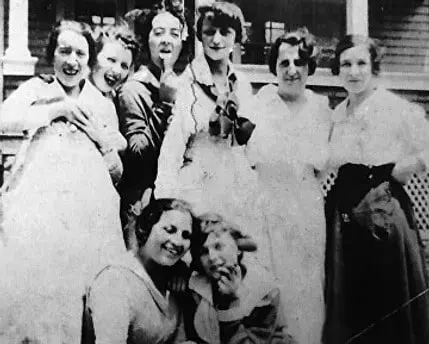
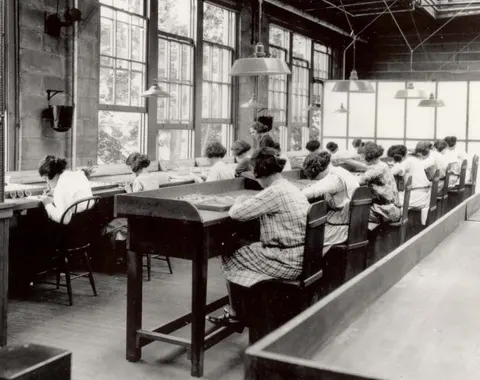
This is how the story of the “radium girls” begins. Hundreds of young women were hired to paint the dials. The work was easy for its time, pleasant, and it quickly turned into an adventure. What’s more, the girls from poor local families not only earned good money, they were lucky enough to work with the most talked-about and healthiest technology of all.
To apply the paint quickly and efficiently, they developed a special technique—after every stroke they licked their brushes to give them a sharp point, so they could precisely paint the tiny numerals and lines on the dial.
Each worker was expected to paint 250 dials a day, working five and a half days a week. They were paid a cent and a half per watch, which came to a weekly wage of 20 dollars—excellent pay for a job that required no particular education. The workers earned three times as much as their relatives toiling in neighboring factories.
Along the way, they noticed one more wonderful side effect—they themselves… began to glow. They smeared the paint on their faces (after all, it was the healthiest cream there was!), until soon several hundred girls could be spotted even on the darkest night thanks to their luminescent bodies…
People began calling them the “ghost girls,” which in turn brought them a rather romantic fame and made them sought-after, delightful company for dancing on Saturday nights…

Paradise Around the Next Corner
Not only did they work with the healthiest substance, but also with the most expensive one of its time—a single gram cost $2.2 million in today’s money.
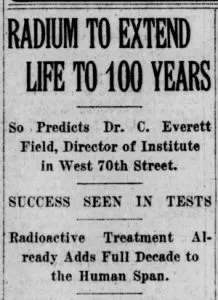
“Radium will extend human life to 100 years,” read a headline in The New York Herald in 1921.
In one of the sequels to The Wonderful Wizard of Oz, Lyman Frank Baum included the Horners, who mine radium so that people can line the walls of their homes with it, giving them a beautiful, soft light. “It is also medicine; no one can ever get sick who lives near radium,” one of the Horners explains.
How could the girls have suspected that anything was wrong? At the time, not a word was said about any possible danger. In 1921, at the height of her fame, Marie Curie toured the United States to raise money for further research. Huge crowds greeted her, and she spoke to them about the benefits of radioactivity. The climax came one evening when she pulled a vial of radioactive isotope from the pocket of her skirt and began sprinkling it into the air to show off its soft, ethereal, blue-green glow…
Today, of course, it is easy to marvel at the radium girls’ trustfulness. Alas, dangers are not always spotted in time. Even Oppenheimer, working on the nuclear bomb project, did not know exactly what he would end up with. Not to mention the cautionary tale of Thomas Midgley, who spread across the world not one but two mass-killing inventions—leaded gasoline and Freon—decades before it became clear how dangerous they really were.
The radium girls’ paradise quickly turned into hell. After just two years, they began falling seriously ill in large numbers, and deaths grew steadily more frequent. “Nothing of the sort!” their employers at the Radium Corporation assured everyone—these were coincidences, the deceased had had syphilis…
At the End of the Tunnel
The factory kept running, the brushes kept dipping into Undark and laying their progressive film on the watches. All while the hands ticked away the days of life most of the girls had left. Nearly all of them were between 18 and 22.
By 1924, nine of the girls were dead, and the rest felt an ever more stubborn weakness caused by advancing anemia; their teeth began to fall out.
The corporation’s managers decided it was time to act and hired a team of scientists from Harvard to investigate the problem. In their findings, the scientists described the entire factory as covered in radium dust and the girls as literally glowing in the dark. But also that some unknown, mysterious illness had appeared, bringing a whole series of complications in its wake. The scientists did not note that the two phenomena might be connected—radioactive technologies still had a spotless reputation.
Even so, the corporation did not like the report and forced the authors to remove all information related to radium from the final version.
That same year a second team of scientists got involved, carrying out far more detailed and thorough research and raising a serious stir around the new disease. This caught the attention of the local medical examiner, Harrison Martland, and it was his investigation that led to the inescapable truth—the technology in use was deadly, and all the radium girls were doomed.
So Simple and Logical
Radiation. That is what made the numbers on the dials glow, and it is also what made the clocks tick away relentlessly at the remaining days of hundreds of trusting girls. They turned out to be far more affected than anyone else in the factories precisely because of their habit of licking the brushes. That is how the radium compound got into their bodies, gradually building up in their bones and in all their internal organs, and beginning its destructive work.
Not, of course, according to the Radium Corporation, which accused the medical examiner of biased data, fabricated to damage its reputation.
And although everything was obvious, years would pass before the truth came out. It would take the courage of five “radium girls” who decided to sue the corporation over their deadly injuries. For two years no lawyer could be found to defend their rights—that is how strong the Radium Corporation’s position was. Then another two years went by before the first hearing was scheduled. In that time, thirteen more girls died.
In the courtroom, the plaintiffs did not even have the strength to raise a hand to take the oath. Meanwhile, the corporation kept postponing the trial again and again on every pretext imaginable, apparently expecting the problem to resolve itself naturally…
The 16th documented victim was Dr. Sabin von Sochocky, the inventor who had developed the “not dark” paint.
Eyes Wide Shut
Martland’s investigation carried weight with its irrefutable conclusions, which he published in 1925 in a prestigious scientific journal. The case ended in 1928, after an autopsy was performed on one of the girls—Amelia Maggia, who died at just 25 after four years of work at the factory.
Shortly before her death she began losing weight rapidly, her joints ached terribly, and she complained to her doctor that she could barely move and felt like an old woman. Then, while pulling one of her teeth, her dentist saw with horror that a huge piece of her jaw had come away in his forceps. Severe anemia followed, along with constant hemorrhaging. Her suffering did not last long, and her death certificate stated that she had died of an aggravated stomach ulcer.
Her exhumed bones, however, literally… glowed. Within seconds they left white spots on photographic film, and with a little more testing Martland proved that this was radioactivity.
Martland himself was shocked by the results; he could never have imagined how deadly a technology so popular in its day could be. It emerged that the plants had employed around 4,000 workers; it is not known how many of them worked with the brushes, but 112 early deaths are officially documented as a result of the radiation.
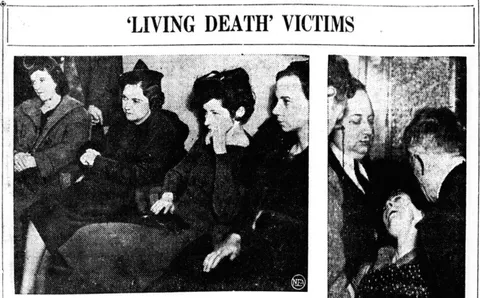
The trial ended with a ruling that the Radium Corporation pay $10,000 to each of the five girls, a substantial sum for the time, and cover their medical expenses. Sadly, they could not enjoy the compensation—worn out by the drawn-out trial, they were at the very end of their strength and died one after another within three years.
Food for Thought
Radioactivity would also take the life of Marie Curie herself, in 1934.
There is no happy ending—sometimes that is how it goes. And yet Martland’s research and the noise around the trial helped put an end to the horrifying Undark and to the other hasty attempts to attribute supernatural qualities to the newly discovered phenomenon. Their data were used in the following decades to establish safety practices in the Manhattan Project, and in all later developments involving nuclear technology. Books and films have been dedicated to the “radium girls.”
“I am not thinking of myself,” said Grace Fryer after the trial, one of the women who refused to give up. “I’m thinking of the hundreds of girls for whom this may serve as an example.”
According to experts, almost everything we know about radiation in the human body we owe to the studies carried out on the suffering women in the years that followed.

After the trial, the American government came under pressure to create a special agency responsible for ensuring acceptable working conditions.
Why is it worth not forgetting such horrifying stories? We humans are the only species that can get burned twice by the same fire.
In the rush of the tech boom, amplified by the speed of everyday life, we often underestimate the risks of every innovation. Whether it is radium, social media or artificial intelligence. And all of this is magnified by a brutal economic logic in which the online giants are stronger than states, and their leaders have to make decisions on which the future of all of us depends.
Shouldn’t we be talking about this more?