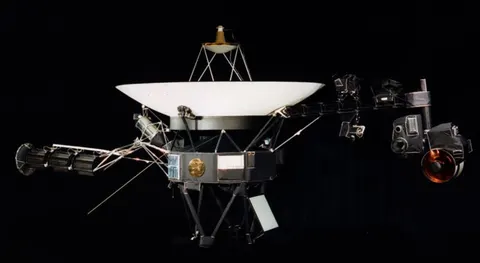
If, thanks to its “wisdom,” our civilization disappears… these two car-sized objects may be the last ones carrying fragments of human culture. Apart from Musk's Tesla, of course, which is also drifting far away but would hardly tell distant civilizations much.
If you met an alien, how would you introduce today's humanity?
The story of the Voyager project is incredible. It is the first, and so far the last, attempt by our civilization to introduce itself. To gather everything most important, everything that defines it, and present it in a form that other species could decipher. And to do it with technology that today, almost half a century later, seems primitive to us.
Mostly Harmless
Yes, aliens and outer space are out of fashion these days; we are far too busy saving the world individually while scrolling our feeds and taking sharp stances.
How the talk of aliens has dwindled since the earthly slaps of our times swallowed us… but this story comes from another era, in the hope of reminding us, at least a little, to think about people. About us as a species, as a civilization that will not destroy itself, will not sink into its inner-earthly torments, and will not allow itself to be enslaved by its own technology.
We all know about the space song of Valya Balkanska, the great Bulgarian folk singer from the Rhodope Mountains, but… what else have you heard about the story of Voyager, the space traveler drifting among the stars that may be the last witness to humanity's existence? And how exactly are aliens supposed to understand what we have to tell them? Liftoff!
So Long, and Thanks for All the Fish
Technology today advances astonishingly and changes everything… but if we look to space, that is not quite true. On December 19, 1972, the last human foot so far stepped on the Moon. Soon it will be half a century in which the big news from space has had nothing to do with people.
In the 1970s, however, there was another big event that thrilled the planet. The Voyager mission is special for countless reasons. Suffice it to say that humanity has managed to send only five objects beyond the borders of the Solar System. In the unbelievable dimensions of space this is a truly microscopic distance… or perhaps it is only the beginning of their journey?
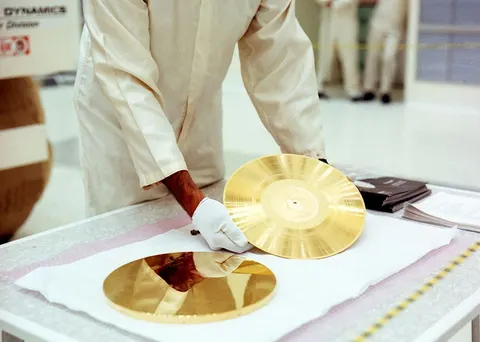
And yet what makes Voyager 1 and 2 truly unique is the golden disc each probe carries, in the hope that one day it will introduce us to a distant species. And in the best possible light.
Life, the Universe and Everything
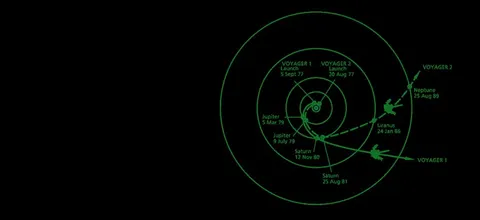
Voyager 2 lifted off from Cape Canaveral exactly 45 years ago, on August 20, 1977. Its “twin brother,” number 1, headed for space 16 days later, on September 5. The numbering may seem illogical to you; it has to do with the different trajectories they follow and the fact that number one had already overtaken its colleague on the way to the outer planets.
The idea for the expedition came in the 1960s. American astronomers seized an incredible opportunity: a planetary alignment that repeats once every 176 years, in which the gravity of Jupiter and Saturn could be “harnessed” to speed up the probes, flinging them away from us at tremendous speed.
Although the goal was to study the outer planets, the idea that the probes would continue onward as a kind of letter from humanity came later and became quite popular.
Both messengers coped brilliantly with their task, sending back astonishing images and scientific data. Then, with a clear conscience, they headed out into the unknown, leaving the depths of our Solar System. From here on, their role is rather to carry on as bearers of the time capsule each of them holds.

Pan Galactic Gargle Blaster
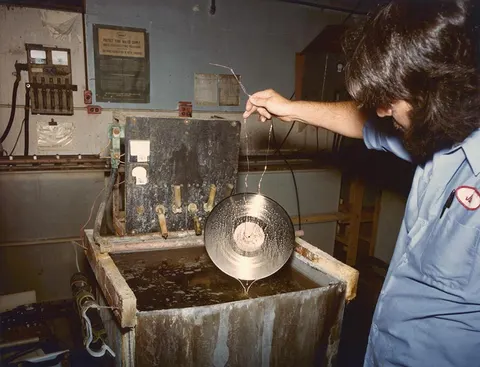
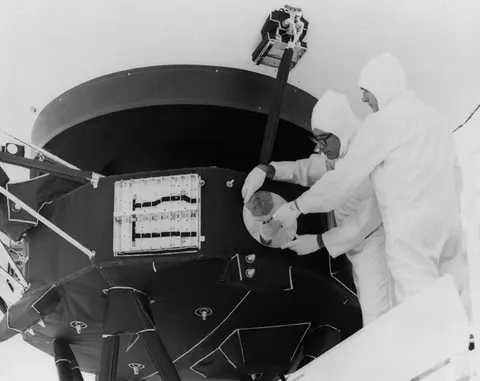
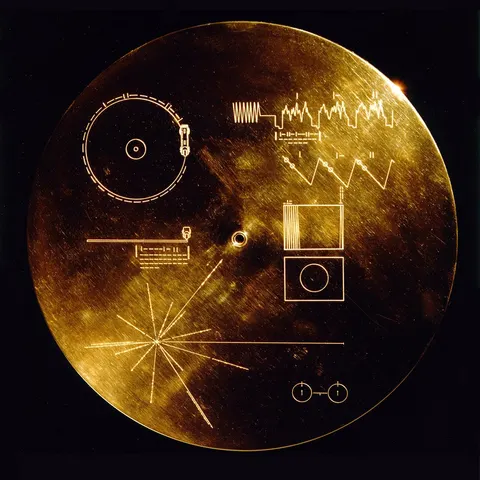
The two probes are identical, and so are the discs attached to them. The records, 12 inches or 30 centimeters in diameter, made of copper and gold-plated, are mounted on the outside of each Voyager. They are packed together with a phonograph needle in an aluminum case. Engraved on the case are symbols explaining how the records should be decoded.
There were two main tasks in creating them: to choose content that would represent us, and a technology that would make it as easy as possible to play back for someone who has no idea about earthly technology.
The answers were to be found by a committee headed by the world-famous astronomer and popularizer of science Carl Sagan. Astonishingly, the team had only six weeks for the job—from the idea to the final result, a disc ready for launch.
Engraved on the “packaging” are universal symbols that another advanced civilization should be able to understand easily. Of course… if you look at the cover, it will hardly occur to you right away what it is “saying.”
42
The largest symbol is a kind of star map describing where the Earth is located. The starting point is the position of our Solar System relative to neutron stars (pulsars).
All the other symbols on the “cover” are there to give decoding instructions. As you might guess, the disc came long before we moved information onto digital technology, and it essentially embodies the technology of the vinyl record. The images, too, are encoded as sound waves. They take up one side of the record, while the other side holds the audio.
The code itself relies on knowledge of chemistry, which was considered the most universal. It depicts a hydrogen atom changing state, which provides a reference to the binary code used in the following steps. Other instructions follow, meant to hint that the record should be played at a speed of 21 seconds per revolution. The last image is simply a circle. It serves as a kind of calibration—the idea is that if the decoding succeeds, the first picture to appear will be exactly that same circle.
Life Is Wasted on the Living
There is one more “wild card” on the cover. Welded onto it is a small plate of ultrapure uranium-238 with very low radioactivity. It will decay over 4.5 billion years, and from its composition the recipients are expected to work out how long the space traveler has been on its way to them.
It turns out that today the disc is quite easy to decode with our modern technology. With the caveat, of course, that we know enough about how it was encoded… and that we are humans, not ALF. Here, for example, you can see the content deciphered in a matter of minutes with a few simple lines of computer code.
In fact, when the mission was being organized, there was far more debate about what the content of our peculiar message in a bottle should be. That is why the task was entrusted to Sagan, who at the time was an undisputed and popular authority.

Vogon Poetry
The “visual side” of the disc holds 116 images (you can see them here), the first of them being the calibration circle. Sagan and his colleagues decided not to include images connected in any way with war, poverty, ideology, crime or religion. The pictures cover human anatomy, scientific knowledge, beautiful scenes of nature. Even simply happy families. To save space, only 20 of them are in color.
The “sound collection” includes greetings in 55 languages, beginning with Akkadian, spoken in Sumer six millennia ago, and ending with the Wu dialect of Chinese. There are also sounds of nature and… the famous musical selection, which includes “Delyo Haydutin” (Delyo the Outlaw), a Bulgarian folk song. In fact, the choice of songs turned out to be the most subjective part. It may well surprise you: it contains plenty of pieces you have never heard, at the expense of others we consider musical classics. The 90 minutes of music have no Beatles. Supposedly they were meant to be there with “Here Comes the Sun,” but their record label refused permission. Duke Ellington and Chuck Berry are there, but Elvis is not.
Altogether there are 27 pieces, about a third of them by Western composers, three by Bach and two by Beethoven. Azerbaijani bagpipes play, along with songs from initiation rites in Zaire. Some musicologists say this was the first compilation of world music.
How did “Izlel e Delyo Haydutin” (Delyo the Outlaw Has Come Out) end up there? Let Carl Sagan himself tell it. “When Lomax first played us the recording of Valya Balkanska and that astonishing aria began to pour through the air, my wife Ann jumped up and started dancing. Just like that, spontaneously! She ran over to me and said: ‘Do you hear it, darling? This is Europe. These are the first people who had enough food to start making art.’”

Don't Panic!
From today's perspective it is downright astonishing how something like this was achieved with the technology of the time. Voyager's entire computer system had a memory that was colossal for its day… 69 kilobytes.
Communication with the probes is almost primitive: just 16 bits per second from Earth and 160 in the other direction. Even so, for the $865 million invested in the mission, humanity received 5 trillion bits of information about our distant planets.
Voyager weighs about 860 kilograms, less even than most modern cars. With its antennas it is 13 meters long, but without them it is also about the size of a car. Each probe is built from around 65,000 parts. And the hardware keeps amazing us with the way it works.
Better Happy Than Right
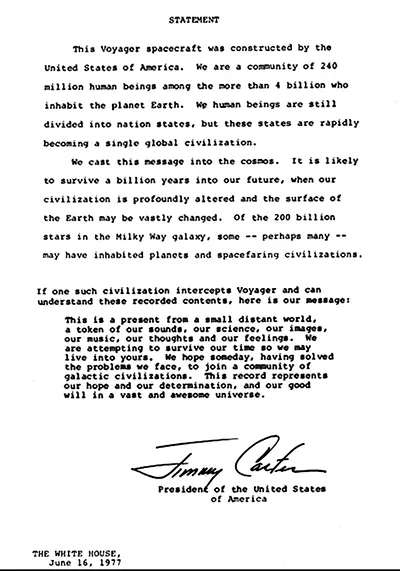
- That was supposedly when the world was going to end, and instead… humankind reached the edge of the Solar System. Voyager 1 became the first probe to leave it. This became clear once the samples it analyzed showed dense plasma beyond the heliosphere—the region the solar wind reaches.
April 25, 2012, was the day Neil Armstrong departed this world. And the day the “traveler,” as we might translate the probe's name, left home forever. In 2018 the second twin did the same, and “Delyo” found himself quite a long way from the Rhodopes.
It is estimated that in about 40,000 years both objects will come into the orbit of another star.
It is worth mentioning that NASA has also published the curious sounds drifting through interstellar space, captured by our heroes. Many people think they sound like a melody:

And Don't Forget Your Towel…
Earlier in the 1970s NASA also launched the Pioneer 10 and 11 probes, with which it lost contact long ago. They move more slowly than their successors, but they are believed to have left the Solar System too, or to be about to. They also carry plaques, encoded in a similar way, but their content is far less interesting.
The fifth on the list is the New Horizons probe, which launched in 2006 and will probably also make it “outside,” but in about 30 years. By the time it was sent, however, the world was a different place and nobody could be bothered making records. There is still a chance something similar will happen, since it is, after all, a far more computerized system. Jon Lomberg, a member of Sagan's committee, is among the initiators of the idea of preparing a similar message to be uploaded into New Horizons' memory.
In 1974 another such message was sent into space, this time with the help of the extremely powerful telescope at Arecibo. It was encoded as a radio signal meant to travel an astonishing 25,000 light-years to tell anyone out there about our civilization. Once again universal messages were encoded, but of course there was no way to include music.
Toward the Galactic Hitchhiker
The 50th anniversary of the Arecibo message is approaching, and there is talk of a new message to be sent with modern technology, and in serious scientific circles at that… Though today we hardly have much more to be proud of as a species, apart from technology, of course.
As of December 2022, Voyager 1 is about 23.3 billion kilometers from Earth, roughly 156 times the distance between our planet and the Sun. Right here you can follow how far it has gone. Its next big step is to enter the Oort Cloud, which is expected to happen in about 300 years. I wish for us to discuss that piece of news together, too.
The travelers are expected to stop transmitting to us soon, but… they have exceeded even the boldest expectations. Now all that remains is for them to do their last important job and tell others about humankind. About its good side. And our job is to try to do what it takes so that, by then, there are still humans around…