Today’s geniuses aren’t what they used to be. Not to mention they’re in short supply. Most of them seem tiresomely half-mad only because of social media. And there are plenty of reasons to argue over whether the people who look like geniuses to modern society really are geniuses.
You know how to tell whether you’re a misunderstood genius? First: you’re a genius. Second: nobody understands you.
We’re starting this digital story a little madly, entirely in the spirit of the mad geniuses we truly miss. At least the ones who fully live up to the second word of the phrase. And, without a drop of exaggeration, today’s hero is the only person we can call a genius with any certainty in the 21st century, which has by now racked up a fair number of years.
These Millennia
Those of us who are a bit more… experienced, let’s say, will remember how fashionable it was around the year 2000 to talk about millennia. We humans really love playing with round numbers, as if it were some great achievement to have had the luck to be alive at the moment the counter resets.
Simple math… And yet the moment was so exciting that even mathematicians got excited.
The Clay Institute in Cambridge bears the name of the billionaire who founded it. And right at the much-hyped start of the millennium, this mathematical center compiled the seven greatest challenges that specialists in the field have been unable to solve despite their enormous efforts. What’s more, the Clay Institute announced it would award a prize of one million dollars for every puzzle on the list that got solved.
And these are not just brainteasers for armchair scholars. According to the Clay scientists, the seven problems matter far beyond the development of mathematics. Thanks to them, “humanity will take a step forward in mastering airspace and outer space, and in cryptography.”
Poincaré and the Seven Dwarfs
The initiative quickly became famous, known popularly as the “seven Millennium Problems.”
In today’s world, math may not be as popular as your middle-school teacher would like. But all modern technology rests on it, which is why this challenge was, and still is, important for us, no exaggeration, even as a species.
Then one mathematician solved precisely the first problem on the list. And he told them to mind their own business with their million dollars; he never asked for it. He came from the same country that also leads the world in turned-down Nobel Prizes. “Russia cannot be grasped with the mind,” as Tyutchev’s classic line goes.
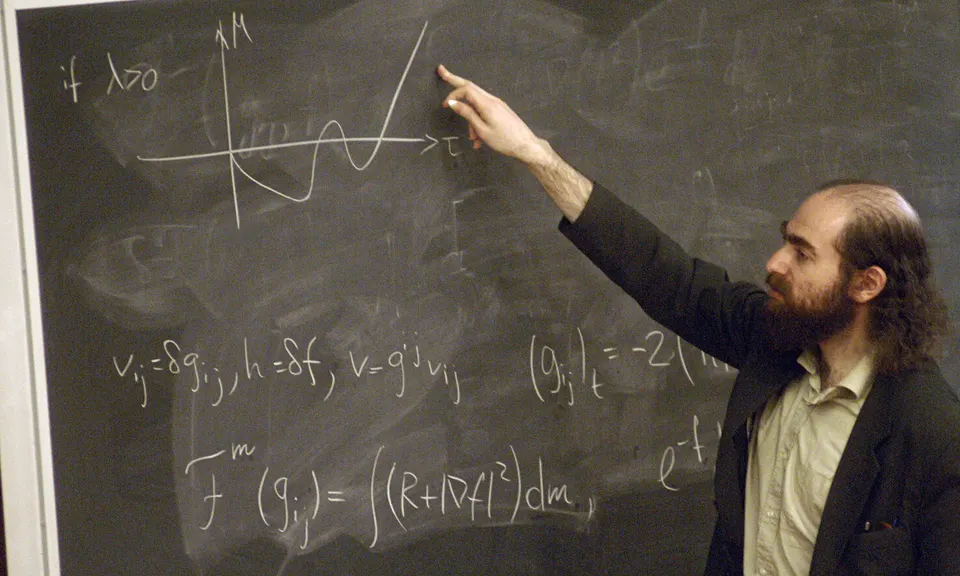
You’ve already seen the photos: he’s exactly the one you’d picture as a mad scientist. Or as your strange neighbor. Grigori Perelman managed to find the proof of the famous Poincaré conjecture before turning 40. Then he turned down a measly million dollars and shut himself away in his own world, letting in neither the media nor fame.
And he would have made a wonderful influencer, wouldn’t he? Picture him in photos with popular rappers, with Billie Eilish, with some rising hope of the Kardashian clan. Damn, what a waste of resources…
Long Live the Madmen
I don’t know if it’s just me, but this Grigori physically resembles another famous Grigori in Russian history, one credited with an important role in the years at the start of the 20th century that proved crucial for that country and the world.
What’s interesting, though, is that he is who he is precisely now, in defiance of everything else.
Even in the Russian media you won’t find much detailed gossip about him. Here is what we do know.
Grigori Perelman was born on June 13, 1966; just over a month ago he turned 55. I couldn’t track down what Veselin Marinov, a Bulgarian pop star, and Philipp Kirkorov, the Bulgarian-born king of Russian pop, were doing on that date, but I suspect the mathematician neglected to mark the memorable occasion with a suitable banquet featuring them.
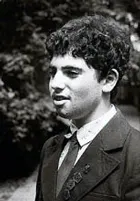
Here the Clever Are Taken for Mad
To this day he lives in a small apartment in a prefab concrete block in Kupchino, a southern suburb of St. Petersburg. With his mother. They are believed to rely mainly on her pension of about 200 leva (about $120) and on the math lessons Grigori is said to give the neighborhood kids.
According to others, for several years now he has often traveled to visit his sister in Sweden, who is also a mathematician. But only for a few days at a time, before returning again to take care of his mother.
Reliable information about him is scarce. For better and worse, paparazzi and the unhealthy obsession with celebrities’ lives aren’t so popular in his country. The militia still beats people up, never mind that for some years now it has officially been the police.
As the West tries to figure him out, its journalists are impressed by his ascetic daily life—he supposedly eats nothing but bread and cheese. His only passion outside mathematics is playing the violin, at which, they say, he shows real talent. He very nearly chose the conservatory, having the chance to enter any university in the USSR without an entrance exam.
As is customary for geniuses, from a young age Grigori won every math competition he entered, then studied at Leningrad State University. He took up research, and his country’s opening to the world after its capitulation in the Cold War became an unexpected opportunity for him. He set off on a long-awaited journey through the Western world…
Numbers with a Soul
The first mathematical breakthrough he made, in 1994, was a short proof of… the Soul conjecture. Yes, it sounds very poetic, but it has nothing to do with lyric verse. It’s a homonym, a purely mathematical term related to spatial representation in mathematics. With it, our hero’s international star began to rise.
That same year he was invited to lecture at the International Congress of Mathematicians in Zurich. Immediately afterward, leading universities, including Princeton and Tel Aviv, offered him permanent teaching positions.
He, however, decided to go back to his Moscow institute and his concrete block.
In 1996, the European Mathematical Society awarded Perelman an international prize for his serious research, and the young mathematician turned it down with a laconic explanation: “I’m not interested in money or fame. I don’t want to be on display like an animal in a zoo. I’m not a hero of mathematics, I’m not even that successful, and that’s why I don’t want people looking at me.”
Having nothing to do with politics, he just as unceremoniously declined to become a member of the Russian Academy of Sciences.
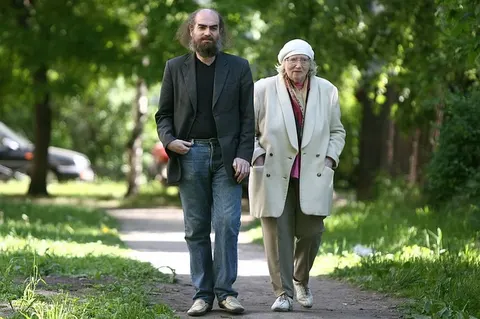
Anathema, Mathematics
Then, in 2003, Perelman published short solutions to the problems Poincaré had created with his theory a century earlier. His solutions, experts say, contain no superfluous explanations. They are elegant, concise and unambiguous. They did not, however, appear in prestigious scientific journals. Our mad genius dislikes the bureaucracy and endless chatter of academic circles as much as he dislikes publicity.
He went on another tour of the United States to present his work but, by all appearances, met with incomprehension and was disappointed.
In 2005, he left the institute where he worked and cut off contact with his colleagues too. Presumably to look after his mother, who had fallen ill.
A year later he was awarded the Fields Medal, a sort of Nobel Prize in mathematics for young scientists. Naturally, he refused to accept it.
Do the Math!
Between 2004 and 2006, three independent teams—from the University of Michigan, Lehigh University in China, and MIT—analyzed Perelman’s work before it was acknowledged that it met every requirement for proving the Poincaré conjecture.
Of course, as is only proper whenever prizes and scientists are involved, a few years later a group of Chinese mathematicians accused our hero of plagiarism, but on the whole they received little attention from the scientific community.
In 2007, the Clay Institute’s team of experts also confirmed that Perelman had solved one of the Millennium Problems and deserved the promised million dollars.
He refused to accept it.
He said he disagreed with the fact that nobody recognized the contribution to the solution of the American mathematician Hamilton, who had done at least as much as Grigori himself.
“I turned down the prize. You know, I had many reasons to decide either way,” goes one of the rare pieces of direct speech to come from Perelman. “That’s why I deliberated for so long. The main reason is my disagreement with the way mathematical societies are organized. I don’t like their decisions; I consider them unfair. I think Hamilton’s contribution to solving this problem is no smaller than mine.”
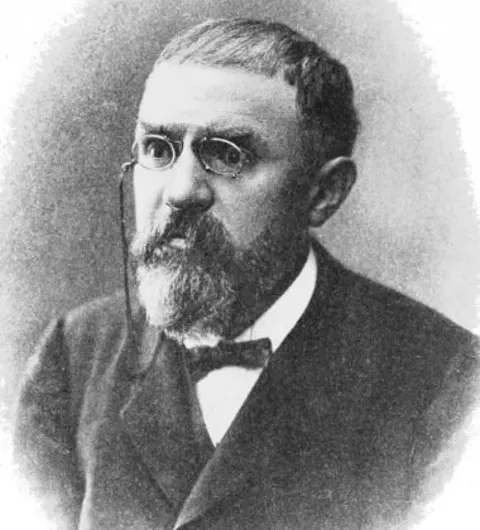
A Hand of Belote with Poincaré
So who is this Poincaré, and why does his conjecture matter? Jules Henri Poincaré was a French mathematician, physicist and philosopher, one of the most significant scientific figures of the second half of the 19th century. Thanks to his discoveries, we have many of the technologies that have changed our lives today. And our worldview too—his work contributed decisively to the birth of the Theory of Relativity.
In 1904, Poincaré formulated his conjecture, linking mathematics and topology. Broadly speaking, it explains how multidimensional topological data can be “translated” and explained in the language of algebra. The subject is genuinely complex; you can find a fairly detailed yet accessible explanation in Bulgarian here.
Concentrated
Perelman’s high-school math teacher, Sergei Rukshin, says that what set Perelman apart as a kid was his ability to keep his attention focused on a problem for a long time, even when he made no progress at all toward solving it.
We note this as a tip for coaches and professional motivational speakers.
“Also,” the teacher adds, “this applies to the Poincaré conjecture. He worked on it for nine years without knowing whether he would solve the problem. It was astonishing! After all, a person needs psychological support, someone to pat him on the shoulder and say he’s on the right track. You think for nine years. Then you publish a 20-page paper and wonder—have you really proved what you set out to prove? Many people before him had achieved partial proofs, and it was quite likely his work would end up in the wastebasket. But it worked out for him. That endless concentration on something without any hope of succeeding—that is Perelman’s remarkable quality!”
Sergei Krasnov, a neighbor who lives two floors below Perelman, adds with authority: “When we found out that Grisha had proved the Poincaré conjecture, which not a single person on Earth had managed to do, we weren’t surprised. Of course we were happy for him; we said to ourselves: Hey, Grigori’s finally going to make it, he’ll have a dizzying career! Molodets, good lad! Well, he’s earned it! But he chose a different path.”
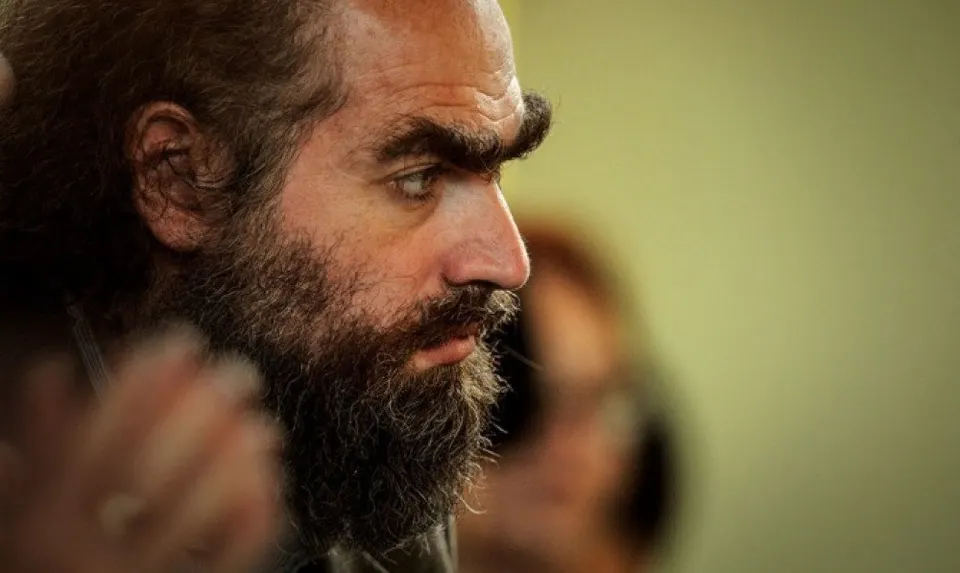
Grigenius
If you were invited to give an interview, would you refuse? Wouldn’t you want to reach more people, share what excites you, where you think the truth lies?
Grigori Perelman has given just three interviews whose authenticity is beyond doubt. To put it mildly about doubts: all the rest are outright proven fakes. Even though he isn’t the kind of man who will log on to Twitter and confess how things really stand, the way today’s politicians do. Oh, I’ve blown it—now it’ll be hard to convince you that Perelman said he’d learned Bulgarian and reads nothing but Digital Stories.
In some ways his story recalls Salinger’s, who cut himself off from the world after doing what he had to do.
The ultra-respectable British Daily Mail quotes the vigilant neighbor Vera Petrovna, who recalls: “I visited him once and was stunned! A table, a chair and a bed with filthy mattresses left by the previous tenants—alcoholics he had bought the apartment from. And there were cockroaches crawling around, while we’re racking our brains how to get rid of them at home.” Ah, Vera Petrovna, I hope you’ve managed to deal with the cockroaches.
He has also been spotted with a classic string shopping bag from the socialist era, choosing from the rich selection of sausages in a St. Petersburg hypermarket.
He has no car; a friend of his says he walks 15 to 20 kilometers a day, and used to cover 40 to 45.

Pluses and Minuses
So, Grigori Perelman is a genius; there’s nothing to argue about there. But who is mad—him or us?
The measures of success can be quite different, can’t they? If you’ve got nothing to amuse yourself with, there are still six unsolved Millennium Problems. Ever since they took away the National Lottery, the long-running Bulgarian TV lottery show, there’s hardly an easier way to win a million dollars.
Of course, the other option is to set up an Instagram profile. Or a Tinder one. If you “match” with Grigori Perelman, we’d love to hear about it afterward.
This Digital Story isn’t very long, but it’s about a man of whom even his neighbors in the concrete block know almost nothing. Genius or not, his attitude toward the information world may well be quite wise. Whether he finds a wife is none of our business. The man found the solution to a puzzle that had preoccupied experts for more than a century. One day his work may help us advance in space exploration too. What’s more, some mathematicians believe that the space described by Poincaré and proven by Perelman may be the most accurate mathematical model of the shape of the Universe.
Still, it’s a pity—he really could have become a killer Instagram influencer…