A glittering Hollywood star with six marriages and three children, one of them supposedly adopted. She mingles at lavish parties with some of the leaders of Nazi Germany, even though she is Jewish. Then she conquers Hollywood. Along the way she comes up with an invention that could have ended the war sooner, but no one trusts her with it. Later, though, her idea will be recognized as the thing that made technologies like GPS, Wi-Fi and Bluetooth possible… Was her contribution really that big?
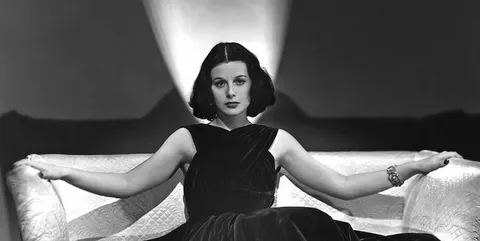
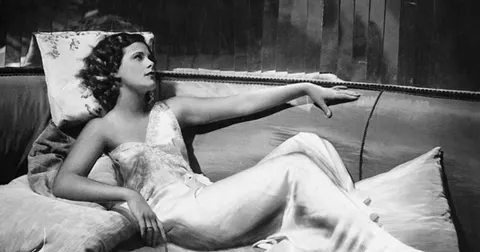
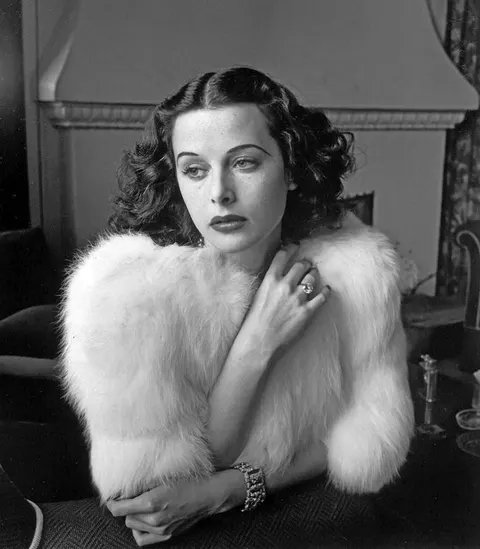
They called Hedy Lamarr “the most beautiful woman ever to appear on film.” As you can see from the photo, not without reason. She was also the inventor behind the technology on which today’s wireless networks rest. This digital story from the analog age is as beautiful as its heroine. So unusual, smashing stereotypes to pieces. And at the same time: entirely true.
Cat on a Hot Tin Roof
“Beauty will save the world,” goes Dostoevsky’s famous line, but he never says exactly how. He must have had Hedy Lamarr in mind. If you’re over 30, you probably remember how we connected to the world at the end of the last century. The phone line, if it wasn’t taken by the granny next door who shared it with you on a duplex line, the modem and that familiar “hsssh…” sound. Then wireless connections came into our homes. The LAN cable fell in love with the modem, and thanks to Wi-Fi every electronic gadget in the house could suddenly talk to every other gadget in the world at speeds unthinkable until then.
“Any girl can be glamorous. All you have to do is stand still and look stupid.” Those are the words of Hedy Lamarr, one of Hollywood’s most dazzling stars in the middle of the last century. And at the same time: the inventor who made the wireless revolution possible. That same Hollywood has yet to honor her with a worthy film about her incredible story.
Gone with the Wind
Hedwig Eva Maria Kiesler was born on November 9, 1914, in Vienna, into a Jewish family. Her father, born in Lemberg (today’s Lviv), was a high-ranking bank official; her mother was a pianist from Budapest.
At 12 she won her first beauty contest. She didn’t even have time to finish high school; she dropped out early, having decided she would become an actress.
Her family was conservative and not at all happy with the idea. But she was as strong and independent as she would remain for the rest of her life, and she devoted herself to the dream. And her lack of education wouldn’t stop her name from appearing today on the honor rolls of inventors both in Austria and in her second homeland, the United States.
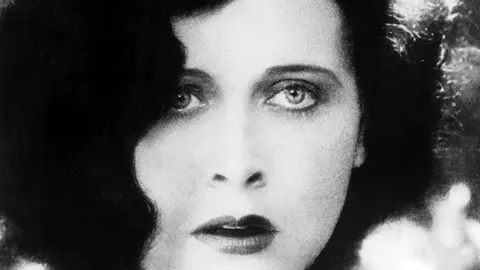
A lightning-fast stage career followed. Hedwig also burst loudly and dramatically onto the screen. Her first major film, Ecstasy, was shot in 1933 in Czechoslovakia. It caused a sensation and a huge scandal. And at the same time, the first revolution that, in its own way, created the future inventor. The film was banned in both Germany and the United States. The latter would turn out to be a bonus for Hedwig, but that would only become clear much later.
She played a beautiful young wife neglected by her older husband. She appeared in rather explicit erotic scenes, unusual for the time. Critics still argue over what was most scandalous: that she was the first naked woman in a mainstream film, or that it was the first time a scene showed a woman having an orgasm. In close-up, no less. (As Hedy later recalled, the director stuck pins into her heels during the scene to make it more convincing.)
Dangerous Charm
The story goes that Hedwig attended the premiere with her parents, who suspected nothing and… were not pleasantly surprised. Her father decided the only sensible solution was to marry her off quickly, and supposedly arranged a meeting with the arms dealer Fritz Mandl the very next day. Oddly enough, Hedwig was at first infatuated with her husband, even though the groom was 15 years her senior.
When it comes to stars, the truth can sometimes be hard to pin down. According to another version (from her autobiography), she herself was seduced by Friedrich Mandl, the third-richest man in Austria, who stubbornly sent her flowers, showered her with attention and made her feel special. Either way, the two married, she at 18, he at 33.
His business flourished, helped no doubt by the presence of his ravishing wife at every evening function. She found them rather dull; among the few topics that interested her were conversations about… military technology. The generals and engineers her husband traded with were impressed by how much the girl knew about the subject, a girl famous for a scandalous film who hadn’t even finished high school. They treated her condescendingly and shared quite a few technological secrets they would otherwise have guarded. Hedwig’s husband was on very good terms with the Nazi bigwigs, and his business thrived.
But Hedy quickly grew bored and decided this life was not for her. She told her husband she had put on her finest jewels to show them to a friend. In fact she went to Paris, leaving behind a letter saying she wouldn’t be coming back.
Fritz agreed to a quick divorce, because being married to a Jewish woman had gradually become inconvenient for him too. She made the most of her freedom and set off across Europe. Her career took off after a meeting in London. Louis B. Mayer, the founder of Metro-Goldwyn-Mayer, was extremely impressed by the young Austrian. He offered her a long-term contract in Hollywood. She turned down his first offer of $125 a week and managed to bargain him up to four times as much.

Some Like It Hot
From then on, things unfolded exactly like a Hollywood movie. A real star was born, and with a new name. The name “Hedy Lamarr” was dreamed up by Mayer’s wife, an admirer of the silent-era star Barbara La Marr.
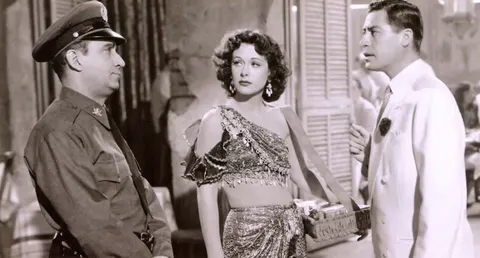
In 1938 began the career that would make her known as the most beautiful woman in Hollywood. Until the end of the 1950s Hedy starred in a huge number of box-office hits. Among her most successful titles are Samson and Delilah, in which she played the lead, Tortilla Flat, based on Steinbeck, and many more. She starred opposite Spencer Tracy and Clark Gable.
Meanwhile, she wasted no time on the personal front. She married six times in all. During her third marriage, she and her husband adopted a boy. When she divorced and remarried, her next husband adopted him too. Only many decades later did the boy discover his mother’s notes, from which he learned that he was her own son from one of her many affairs. Hedy had two more children with her third husband and divorced soon afterward. Husbands number 4 and 5 followed, before her final attempt.
“I have never had good taste in scripts or in husbands. That’s why both my marriages and my films failed,” she said.

City Lights
“The happiest moments in life are the ones between marriages.”
Her sixth wedding was to the lawyer who had handled her last four divorces. Well, that didn’t work out either, and at some point Hedy seemed to give up trying.
At roughly the same time she abandoned her Hollywood career. The scandalous Ecstasy had never made it to America, but Hedy loved to provoke, and once she found herself out of the spotlight, she used it to draw attention. Her autobiography, Ecstasy and Me, published in the 1960s, set off yet another big scandal on Hedy’s list.
“Any girl can be glamorous… If you use your imagination, you can look at any actress and see her nude. I hope to make you use your imagination.”
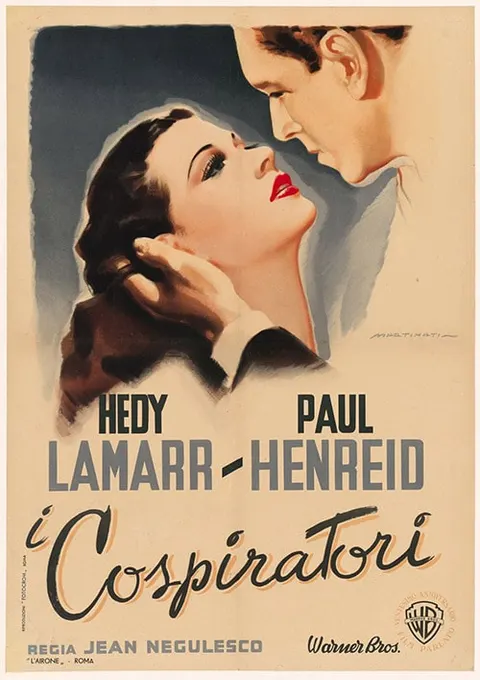
In the 1970s she was offered parts in quite a few series, films and commercials, but none caught her interest. She had clearly had enough of Hollywood. In 1974 she sued Warner Bros. for $10 million because she felt insulted by Mel Brooks’s comedy Blazing Saddles, which featured a character with a name similar to hers.
She spent the last 20 years of her life alone on her estate in Miami Beach, constantly quarreling with all three of her children.
One more curious detail: in 2011 Anne Hathaway revealed that the character of Catwoman was actually based on Hedy Lamarr’s personality. The modern actress had dug into the story of her predecessor.
Singin’ in the Rain
Behind the luxurious gloss, they say, she was a rather lonely person who disliked fame. She liked to fill her free time thinking up unconventional inventions. Besides torpedoes, she loved toying with other ideas: how to improve traffic lights, for instance. Or how to create a tablet that would dissolve in water and turn it into a fizzy drink. The latter didn’t pan out; Hedy herself admitted the result tasted more like Alka-Seltzer.
In 1966 Hedy was arrested in Los Angeles for shoplifting cosmetics. It happened again in 1991 in Florida, when she took $21 worth of eye drops and laxatives.
“I advise all my friends not to save. Spend your money. Most people hoard it all their lives and leave it to someone else. Money is for having fun!” Hedy said.
With personalities like hers, it’s very hard to separate fiction from the real person. They say she was the first to be offered the lead in Casablanca. That she mostly preferred women. That she had an affair with Charlie Chaplin. And who knows what else.
Doomed Souls
We mentioned that this same woman invented a technology. Have we got something wrong? How did she find the time for something like that, between the films and the marriages? With no special training, not even a high school diploma, and apparently devoted to hedonism?
This is the most instructive part of the story. You never know when the person in front of you will surprise you, and who knows whether we’ll ever manage to teach even artificial intelligence that.
Hedy Lamarr and the composer George Antheil received a patent for their invention, and the first thing they did was offer the idea to the military. There’s no need to dwell on what chance a Hollywood star and a composer had of selling their invention to the Pentagon at the height of the war.
Their invention was a device that generated radio signals with hopping frequencies. The main goal: to guide torpedoes in the water far more accurately while reducing the risk of the enemy intercepting them.
A Beautiful Mind
“We got to talking about the war in the late summer of 1940, when things looked very bad. Hedy said she didn’t feel at all comfortable sitting in Hollywood piling up money while things were going so badly in the world. She said she knew a good deal about weapons and secret developments in that field, and that she was seriously thinking of quitting acting for a while to go to Washington and tell the National Inventors Council everything,” Antheil recalled.
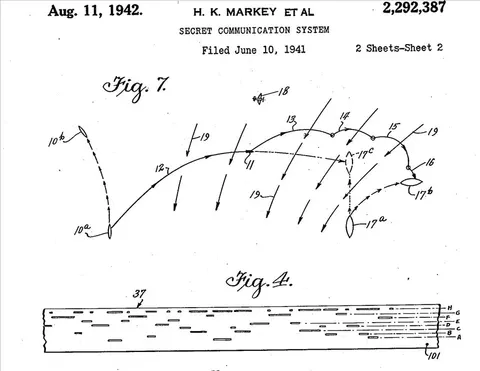
The two managed to synchronize a miniature mechanism resembling a piano roll with the radio signals. The invention was protected in the United States by patent 2,292,387 on August 11, 1942, under the actress’s real name, Hedy Kiesler Markey.
But how important was their discovery for today’s wireless technologies?
As the name “frequency hopping” suggests, the idea is that messages don’t travel over a single communication channel but hop between several, which makes them harder to intercept. Their patent used 88 channels, the same as the number of keys on a piano. If both sender and receiver know in advance the sequence of frequencies to be used, the message can be easily encoded and decoded. And at the same time: it is almost impossible for the enemy to intercept.
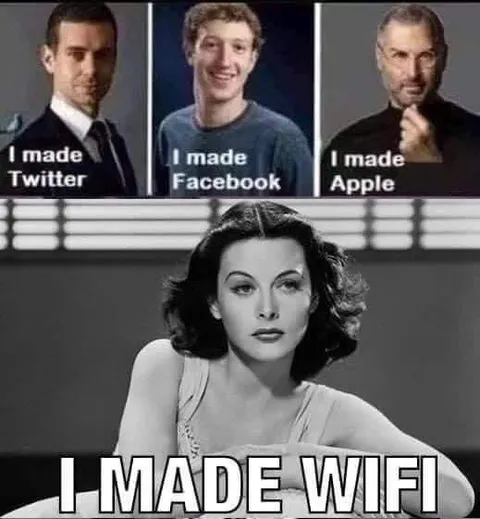
It may sound logical and simple, but Hedy’s invention turned out to be a brilliant idea, and it’s no accident that it later ended up at the foundation of technologies like GPS, Bluetooth and Wi-Fi. Such a signal is not only hard to intercept but also unaffected by surrounding noise. The system was eventually put into practice in the 1960s, though not with the mechanical solutions proposed in the patent but with electronic signals.
It’s a Wonderful Life
Antheil died in 1959, the year their patent expired.
Today you’ll often come across the explanation that the military rejected her idea because she was a woman. In 2019 the novel The Only Woman in the Room came out, drawing plenty of attention and reviving the story, albeit in a sugary modern style. In that version, the invention by Hedy and her friend could have ended the war much sooner. But no one took it seriously.
The fact is that the invention was seen as hard to put into practice. It was first actually used, again by the military, in 1962, aboard the warships prepared to head for Cuba at the height of the Cuban Missile Crisis. Much later it made its way into civilian technology.
The Queen’s Gambit
The fact is that Hedy is a modern heroine with no shortage of glamour, which makes it convenient to emphasize her discovery. Whether scientists would have managed to create these technologies without it, and whether they actually drew on her work specifically, we have no way of knowing.
But that doesn’t make her contribution any less significant. Hedy and George’s patent really did formulate principles that proved especially important in the next stages of technological development. Whether it was precisely this patent that inspired the creators of later technologies to settle on frequency hopping is very hard to say. Online you can find quite a few arguments (for example here) that her contribution to technology was not especially large.
Science, knowledge and invention often move far more unpredictably, zigzagging, complementing and building on ideas, than we tend to think. The fact is that later generations of scientists acknowledge Hedy’s contribution. She was inducted into the US National Inventors Hall of Fame posthumously, in 2014. More than half a century after she earned a star on the Hollywood Walk of Fame.
Her birthday, November 9, has been declared Inventors’ Day in Austria, Germany and Switzerland. That says more than enough about how scientists regard her work.
Breakfast at Tiffany’s
The recognition came posthumously. Hedy had already passed away on January 19, 2000, and, as she wished, her ashes were scattered in her beloved Vienna Woods.
And perhaps she has already become a convenient star to be promoted in a new way. But she deserves the attention; her story is powerful and dramatic. Objectivity in it is hard to achieve.
“Hope and curiosity about the future seemed better than guarantees. That’s the way I was. The unknown was always so attractive to me,” she said. Maybe it really is worth not giving up. Changing the frequency every now and then. And who knows…