Have you ever stopped to think… technology has exploded, we have access to an unthinkable ocean of information, and yet what makes us laugh most often these days is… the same dozen pictures.
Is there any logic to this phenomenon at all… or is it the art of our time? What is a meme? A descendant of the joke, anonymous online folklore? Or… a phenomenon that marks a new stage in the evolution of humankind?
We'll look into the philosophy behind it and try to explain how it came about. And to have some fun along the way, we'll also tell the stories of some of the most recognizable meme heroes.
Seize the Meme-ent!
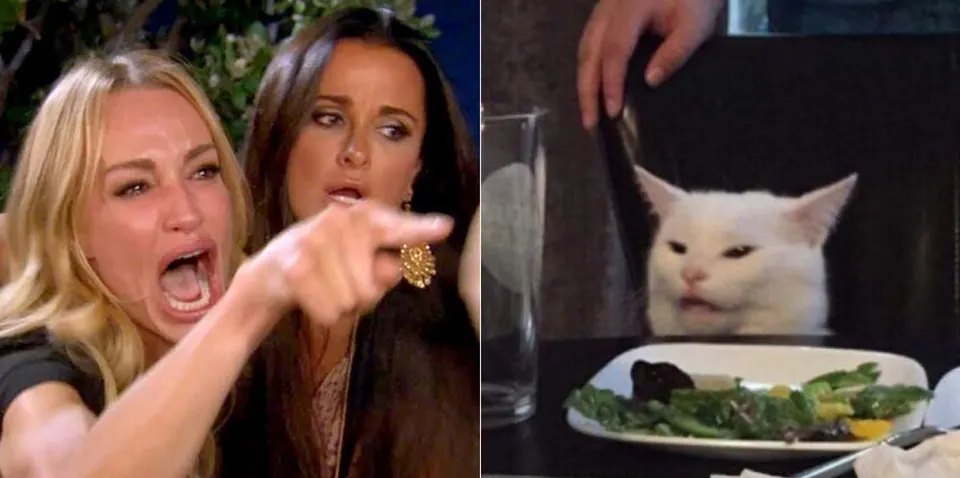
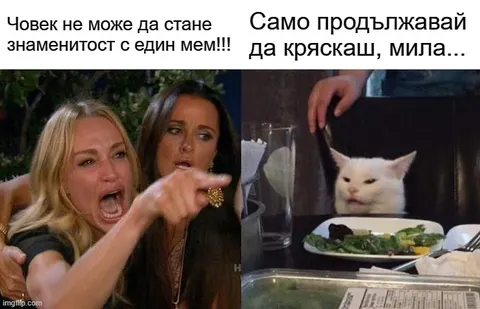
A blonde woman is screaming in the picture on the left, while on the right a cat, cozily settled behind a dinner table, watches her with perfect composure.
You don't know what I'm talking about? I don't believe you, but if that's really the case, it's time to go back to Facebook for a three-hour remedial class.
Of course, I mean one of the most widespread meme templates, which appeared in 2019. And if you scroll long enough, you're bound to see it in your feed even today, with yet another witty caption.
This is quite an amusing side of this strange… hm… genre? We look at the same pictures, some of them a decade old, and we don't get tired of them, even though the joke stays the same and the kind of surprise that makes us laugh never changes. We know the screaming woman will say something she firmly believes in, and that she'll be met with a cold and rather convincing denial. So we keep looking at one and the same picture, which our brain otherwise won't let us do online—because it's always looking for something new, and so we scroll and scroll.
Memento mori
In real life, the two heroes of the pictures have never met. On the left is the actress Taylor Armstrong in an episode of The Real Housewives of Beverly Hills shot in 2011. I don't need to tell you what the show is about; the title is eloquent and seems to explain everything you need to know about the situation in which we see Taylor's character. For the record, before this scene her character had told her friends that her late husband had abused her. Her friend Camille then started spreading rumors about it, which got back to Taylor's character, and… it doesn't really matter.
Facing her is Smudge. The cat first appeared in this photo on Tumblr, the somewhat faded social network, with the caption “He no like vegetables.”
Taylor Armstrong made use of the fame that came not from the show but from the meme: she was a guest on Oprah, and she wouldn't have said no if Gala, the Bulgarian talk show host, had invited her too. Smudge wasn't so lucky; he just quietly gathers followers and fans. What can you do, influencers. After several joint appearances in TV studios, though, Taylor and the cat's owner became friends and started swapping the funniest memes made from this template.
Seventeen Memes of Spring
Who came up with the idea of putting the two photos together? History is silent. But whoever it was clearly struck straight to the heart of a great many online users. “Straight to the heart”—did you notice? Memes very often have magical word combinations stuck to the picture, and they, too, are always clichés.
Is this just a coincidence that produced a perfectly ordinary collage at exactly the right moment, which then became a pop-culture phenomenon? Exactly. The two photos obviously capture some quite clear moods, but… no one will ever manage to explain what exactly made them so, so successful online, no matter how many doctoral dissertations are written on the subject.
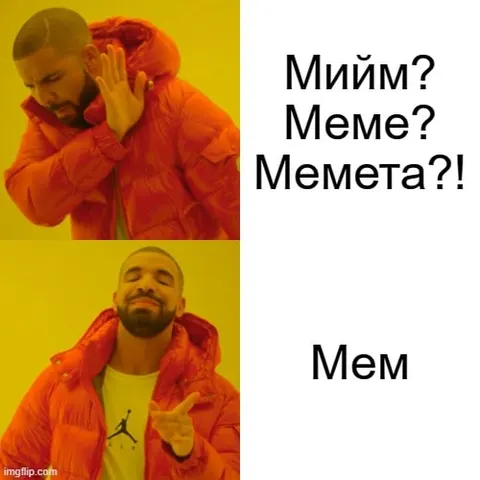
Let's move on to terminology. You may have noticed that in Bulgarian I call this phenomenon „мем“ (mem). You, however, are used to „мийм“ (miym), lifted straight from the English, or to the literal „меме“ (meme), borrowed from the vocabulary of goats as small children imagine it. The reason is quite interesting and lies far back in history.
Meme Dreams
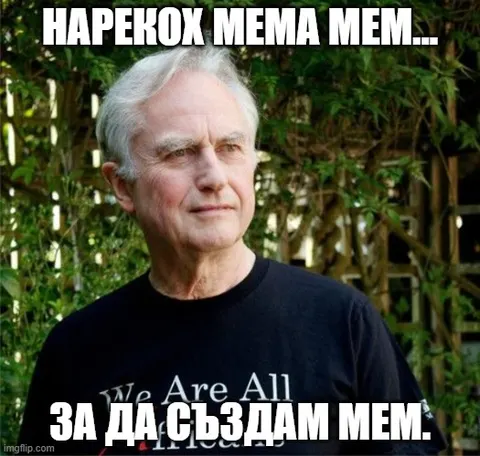
Unless you've come across this fact before, you'd hardly guess that the term was coined by the science popularizer Richard Dawkins in 1976, long, long before we all found ourselves on the internet, let alone liked our first meme.
Excuse me? How could Dawkins have guessed that a quarter of a century later we'd start stuffing our jokes into identical pictures that we look at hundreds of times a day without getting bored? Wasn't he the scientist mostly busy with the important task of explaining to us that religion is obsolete?
In fact, the phenomenon is much broader, more interesting and more revealing of our digital present than the simple use that has brought us together here. In English, “meme” has the same kind of origin as “gene.” Because it's not just about online jokes, it's about the way humankind evolves. At least if we stick to the author of the word rather than to its so widely familiar meaning today.
Man Is a Meme to Man
The term itself comes from the Greek “mimema”—“imitation,” which also gives us words like “mimicry” and “mime.”
Language is a very dynamic world. Bulgarian dictionaries still have no standard, and yet logic points to „мем“ (mem) precisely because of the similarity to „ген“ (gen, gene) that Dawkins was after. The plural is open to debate—you'll come across „меми“ (memi)—but „мемове“ (memove) is far more familiar.
The name is only a detail; what the phenomenon represents is far more important. Let's give the floor to its godfather.
“If you want to understand life,” Dawkins writes back in the good old year of 1976, “don't think about vibrant, throbbing gels and oozes, think about information technology.”
“I think that a new kind of replicator has recently emerged on this very planet,” the scientist continues. “It is staring us in the face. It is still in its infancy, still drifting clumsily about in its primeval soup, but already it is achieving evolutionary change at a rate that leaves the old gene panting far behind.”
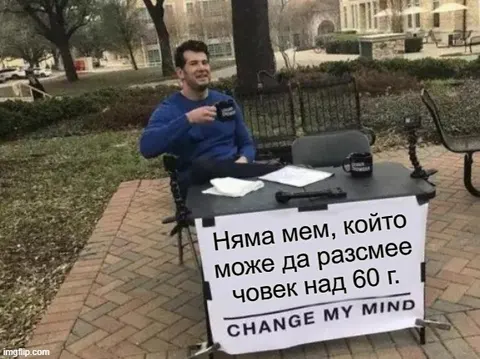
The Meme Trickster
It is this replicator that Dawkins calls a “meme.”
If we ask biology, genes are our chief defining factor and the main field of evolution—the way they combine and reproduce onward. Just like ideas. The replicator is the dividing unit, the thing that carries life forward. In one case the replicator is the gene, in the other the meme.
“Memes propagate themselves in the meme pool by leaping from brain to brain via a process which, in the broad sense, can be called imitation,” the researcher explains.
“Dawkins made his own leap from the evolution of genes to the evolution of ideas,” adds James Gleick, a writer and technology journalist. “Today memes compete for limited resources, such as our brain's capacity to take in information.”
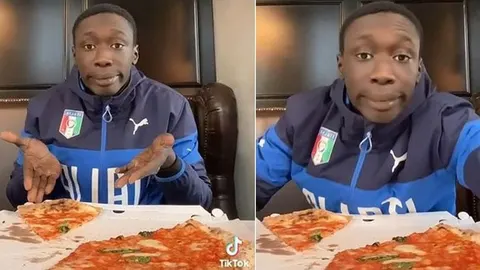
Memelets and Memelings
Of course, the memes Dawkins described have countless different applications and are far from limited to identical pictures with funny text. They can be ideas, tunes, messages or images. The Mona Lisa's smile is a meme, so is the slogan “survival of the fittest,” and so are the little songs we sing to our children. They all fight for the same thing—our attention, our interest. A resource that grows ever scarcer as the competition grows ever fiercer.
And so it is images, but in a new and rather peculiar digital way, that have become very unexpected contenders in this race. Scientists call them “internet memes” to set them apart from Dawkins's more general definition, but that definition stays in the books: for all of us, these are simply memes.
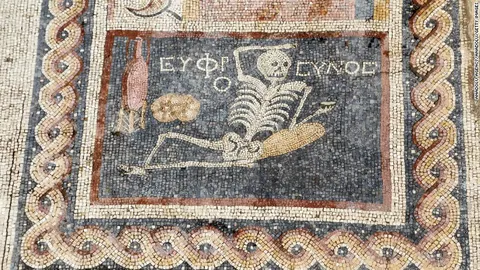
Some trace the first example resembling its internet descendants all the way back to the 3rd century BC. A mosaic found in Antioch shows three scenes. In the first, a servant prepares a bath. In the second, a young man runs from the bath, chased by an old servant trying to catch him. In the third, a visibly happy skeleton lounges casually, holding a cup of wine. In fact, you can see it as a template for today's memes too.
Slowly and Memethodically
What exactly is a meme? We can picture it as the tiny units of cultural code that make us who we are.
Today the Oxford dictionary says it is “an image, a video, a piece of text, etc. that is passed very quickly from one internet user to another, often with slight changes.”
The pioneering internet meme is probably the well-known emoticon 🙂, first used in 1982. The first successful video example came in 1999: a GIF of a dancing hamster managed to attract 18 million visitors, a huge number for the internet of the time.
Remember the “Harlem Shake”? Another fine example of a hugely popular meme that later vanished in the course of meme evolution. For a few months we watched celebrities all over the world behave absurdly to a moronic track from the '80s. Then they were pouring buckets of water over themselves. Today young people have largely carried this fashion, in different, much smaller and wackier waves, over to TikTok. Yes, it seems today's banal pictures with sometimes original captions are rather more likable.
Memeories
It's curious to note that years after he created this theory, and long before he became truly famous, mainly for his anti-religious views, Dawkins worked for several years as a programmer.
And while in his first work on the subject he wrote that “the computers in which memes live are human brains,” in 1989, in the second edition of The Selfish Gene, he added: “It was obviously predictable that manufactured electronic computers, too, would eventually play host to self-replicating patterns of information.”
Like genes, memes change the world beyond themselves too. Their chances of survival depend on how quickly they spread.
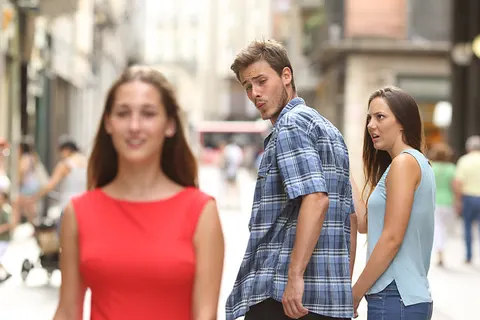

Memento Shake
From here it's only a small step to the term “viral.” The first to use it in the context of online information was the cognitive scientist Douglas Hofstadter, inspired by Dawkins's ideas.
Gradually a whole scientific school formed around Dawkins's ideas—memetics. One of the parallels memeticists draw is with those popular chain letters you had to forward to ten people… you certainly know what we're talking about if you were born before the internet went mainstream. The principle is similar; they were simply limited by the technology. Unlike the heroes of our story.
Could internet memes transform the whole Earth, the way genes have for millions of years? In a way, it's already happening, at least as far as the way we take in information is concerned.
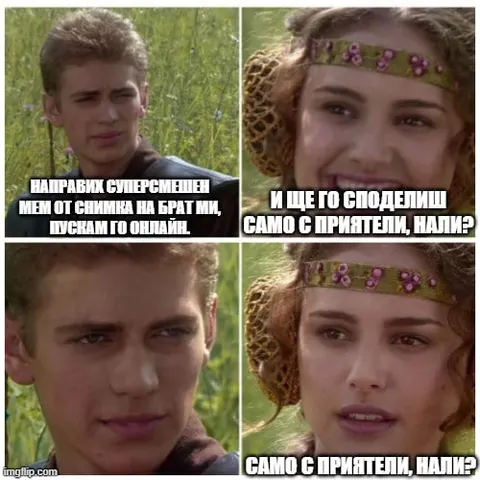
Monumemental
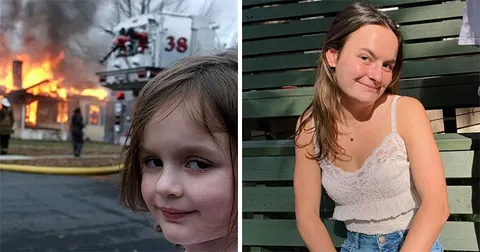
Meanwhile, as you can see from the pictures scattered around this text, memes have made quite a few people famous, and that, too, has two sides.
The story of two-year-old Mariah Pringle is telling. The little girl has a rare disease that affects her motor and cognitive abilities. Somehow a photo from her birthday escaped the family album and in no time became a popular template. The family did everything in its power to stop it, but once a picture has spread, that turns out to be almost impossible.
Other newly minted celebrities use their fame to win a little offline popularity too. Only the best get as far as properly monetizing their immortalization—for instance, by selling souvenirs bearing their face. Some become vloggers. András Arató, the old fellow we've grown used to associating with suppressed pain or discomfort, says in a TED talk that ending up in a meme was the greatest chance of his life and opened countless doors for him.
(You'll find many more interesting stories about the heroes of the templates in this wiki.)
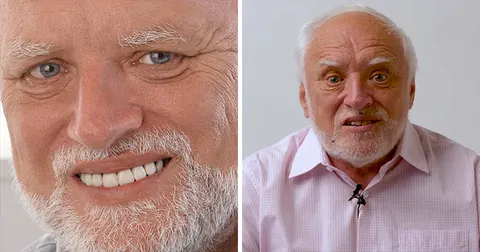
Phenomeme
Sometimes waves of memes come along, inspired by current political moments or news photos. Think of everything Bernie Sanders got up to in his famous thick knitted mittens.
The same goes for sports. It's enough to mention the way Neymar and Cristiano Ronaldo are mocked for their diving. Or Giorgio Chiellini's brutal foul in this year's European Championship final.
TV series are another traditional source of pictures. Friends, The Big Bang Theory, Game of Thrones, Chernobyl… the list is huge, and you can surely think right away of the most recognizable templates from each show.
With all these groups, though, the fashion usually explodes with the popularity of a given show or a particular sporting or political event, and then fades away. Much more interesting are the shots of ordinary people that go viral by some unknown path and don't grow stale for decades.
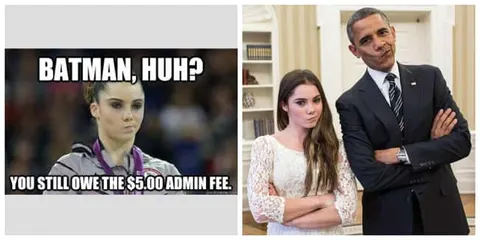
Meme Fritters
The world is big, and that's just as well, because if we peek into the Bulgarian-language corners of it… we'll find almost nothing original. Yes, now and then a photo of a politician briefly becomes a cool meme, and sometimes the jokes really are charming. But on the whole we mostly copy and reuse content that is universal and close to our perceptions anyway. The visually familiar wins; it stops our gaze in the endless flow of information.
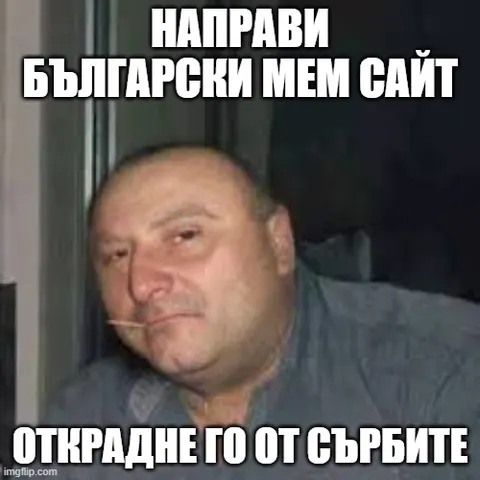
One of the funniest pages—with the stories of the classic Bulgarian (and later his relatives)—turns out to largely repeat the stories of the classic Serb, who is also in the picture, from the much older page Dnevna doza prosečnog Srbende.
Spinderman, Motikarya (the Hoe Man), the pages devoted to trending TV series… everything follows the same popular templates. And no wonder: memes are like jokes, they have no original source and you pay no copyright. And thanks to the advances of digital marketing (with all its cost to the way we take in information and look for the truth today), gathering a large following in a group can bring in real money.
Meee-meee
Making a new picture takes seconds (here's one of the countless handy generators that carry all the most popular templates). You have a neat idea and, presto, the meme is ready.
Most templates carry the bulk of the message on their own; all that's left is to add the nuances. We all know what the quarreling woman and the composed cat will tell us, or the artificially grinning Leonardo DiCaprio with a glass in his hand from Django Unchained, or the “classic Bulgarian.” All it takes is some small nuance that fits the logic and comes from the text—a modern haiku.
What could be easier than climbing onto things already invented and, with simple translations or a little sense of humor of your own, “breaking through” online on the spot? Before your meme sinks among all the others.
Nothing wrong with that, of course. I, and surely you too, often smile at pictures like these.
And what could be better than smiling, especially when it's not at someone else's expense?
Meme evolution goes on. What will its next forms be? How will it surprise us, and where will the changes in the meme pool take us? All that's left is to ask Dawkins, or to let our imagination run free…
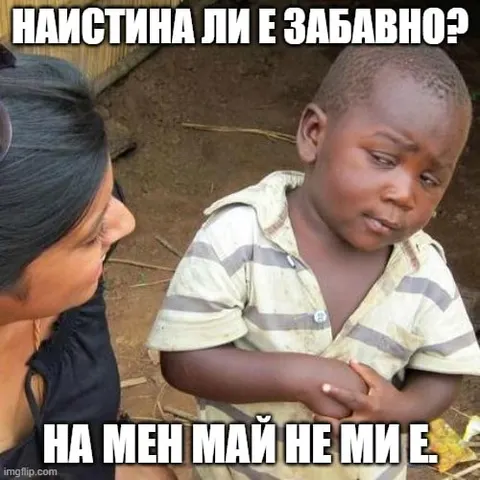
The shot was first shared on the social network Reddit. The kid in dirty clothes with the mischievous look was photographed by Heena Pranav, a doctor from Chicago, who can be seen on the left. In 2012 she was in Northern Uganda as part of a project to help women who had suffered violence. Heena and the kid couldn't talk, because he didn't speak English. She gave him some small presents and he went back to his mother at the market. We don't know whether the fame ever reached him in any way; let's hope it did, and that it was of some use to him.