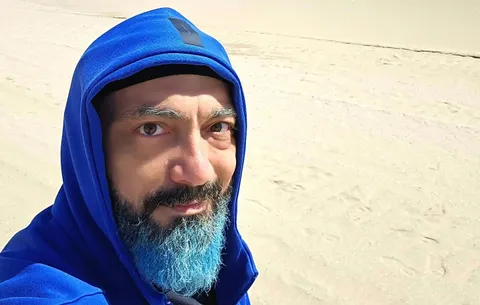
Just imagine living a whole week without money. None at all—no cards, no banknotes! Now what about a month, a year? Today's hero has been getting by this way for 15 whole summers.
He started it as an experiment—how would it go if he tried to live without money for a year? He liked it so much that he never went back.
You'll say that we here in the Balkans can manage that just fine. And yet, even in our latitudes, nobody can live entirely on sauerkraut and homemade rakia, the local fruit brandy; sooner or later you end up back in the system through benefits, electricity, water… Unlike Mark, who used to be a successful businessman.
And there's more! Seven years ago he took the next step and began living with no contact with modern technology. He says he is happier than ever before. Because he can appreciate the things we once had, unburdened by the problems of modern society.
And you—could you imagine tomorrow stripped of both money and technology? What else does Mark Boyle have to tell us?
A Guinness Without the Guinness
It's 2007, and the 28-year-old Irishman is sitting over a beer with friends when the conversation turns to what divides people. They chat about ecology, about how society is developing… and conclude that money lies at the root of every problem. So can you live happily today without money?
Up to that moment his story is a classic one. Six years studying business and economics, then a prestigious job in Bristol as a manager at a large organic food company. He is more than content with life—not only has he fulfilled every white-collar dream, he also believes he is helping to save the planet. Ecology has been close to his heart since his final year of college, when he came across the film Gandhi.
And suddenly we arrive at that quiet evening of pleasant talk, when the conversation reaches the point that, in today's world, a truly ethical business simply cannot exist. That the way our society is built sets us against one another and destroys nature. “And the main problem is money, the great divider of people,” Mark decides. It dawns on him that he isn't doing enough to make the world a better place, and that the time has come for a radical solution. “Be the change you wish to see in the world”—he recalls Gandhi's famous words.
Rich = Poor?
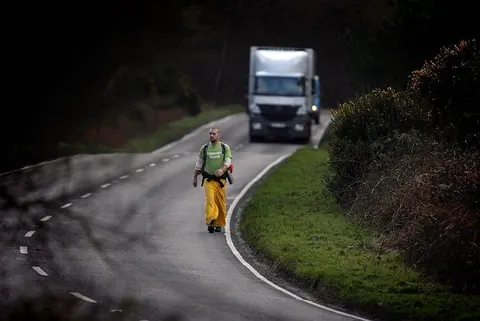
His first idea is a different one. The Irishman decides to set off on a two-and-a-half-year walk from Bristol to Gandhi's birthplace, Porbandar. With no money and very little luggage. It doesn't work out: he comes back just a month later, having realized that the language barrier won't let him go on. He makes it home with considerable difficulty, but with a clear plan in his head.
His venture begins on Buy Nothing Day, the symbolic antagonist of Black Friday. Of course, before that he has to make a few long-term investments—a solar-powered laptop, for instance. But when day one of the experiment arrives, he no longer has a single penny. He has handed back his bank cards and left himself to fate…
But how do you live without money? What do you eat, how do you dress, what do you brush your teeth with? And for that matter… where do you live, so that there's no risk of the building's cashier—the neighbor who collects the block's maintenance fees—knocking on your door? Our hero faces all these challenges with no certainty at all that he can cope.
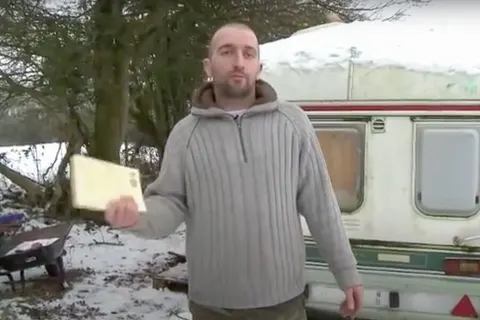
He finds his first “free” home by chance. On the very day after he makes the decision for the big change, a girl he doesn't know stops him on a bike path, tells him about the farm where she works and invites him to join as a volunteer. “And is there any chance I could park my caravan there and live in it?” he asks timidly, and the girl replies that it would be wonderful.
The Man and the Money…
“So in just one day I had a place to stay. Three days later I got a caravan from Freecycle—a worldwide organization for giving away unwanted goods. It simply showed that when you commit to something you believe in, ‘someone’ supports you, rewards those actions. I started living off the land, foraging for food, bartering, and dumpster diving when I was in town for the weekend,” Mark says, looking back on those days.
He makes friends with the neighbors; he does them small favors, and they pay him in kind. He also strikes a deal with local restaurants to give him food that's about to go off, again in exchange for a bit of work.
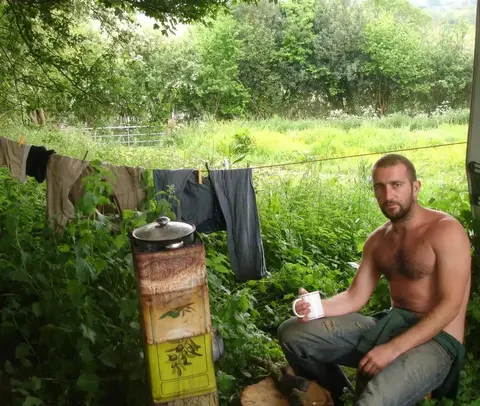
He bathes in the stream, without any cosmetics. He makes toothpaste from cuttlefish bone and fennel seeds. What he uses for toilet paper you can guess if you remember the 1980s (for everyone else—unsold newspapers from the nearby kiosk). He even recalls that, years later, he once found himself wiping with… an article about himself.
He changes his diet, too. He has been vegan his whole life, but once he gives up money he has to give up that principle as well. He fishes three times a week, and when he finds a deer hit by a car on the road, he drags it home and uses every part of it. He lights his fire by striking stones, because he has given up lighters too.
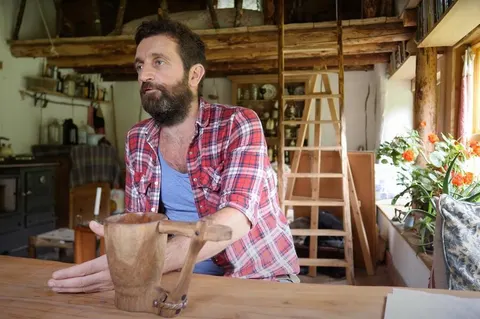
The Millionaire Pauper
Even before all this, he decided he wouldn't rely on fossil fuels for heating. He had worked as a volunteer at a refugee center in Calais and heard plenty of stories from people from Iraq and Afghanistan. “From them I understood that wars happen because of the West's desire to get hold of those countries' resources. I realized I could no longer use fossil fuels, I couldn't be part of a system that destroys families and wrecks nature. That's exactly what money does to us too—it cuts us off from such people, we don't see their faces, their suffering. We don't see how any of it happens, hidden behind the screen of consumerism.”
So what is it about those Phoenician symbols, as Bulgarians jokingly call money, that he finds so distasteful, when the rest of us knock ourselves out for them every single day? In his view, one of the main problems of today's society is that the consumer is separated from the process of making the product. He doesn't know how much human labor goes into producing the things he uses, and he has stopped valuing both the labor and the people. If we grew our own food, we wouldn't throw away a third of it. If we made our own tables and chairs, we wouldn't throw them out when they need repainting.
“When you have money, you don't need neighbors, you don't need anyone. You can buy everything, pay remotely. You shop at the supermarket from someone who doesn't know your name, who doesn't care whether you're a good person or whether you do anything for the community. When you have money, you don't need to live by any principles or respect people,” Mark explains.
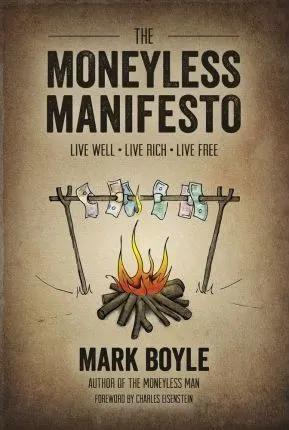
Freeconomy / Freak-onomy
No, don't picture him as a modern-day version of Saint Ivan of Rila, the tenth-century hermit who became Bulgaria's patron saint. Boyle quickly makes plenty of friends in the area. Little by little he also learns to travel without money.
It gets even easier once he becomes well known. A year goes by, the experiment ends, but… he has liked it and decides to carry on. He reflects that for a whole year he hasn't been ill, thanks to natural produce and clean air. He has felt calmer than ever before, back when he thought about work, loans and purchases. Yes, his girlfriend supported him at first and then left him, but… that was her call.
He says he surprised even himself with what he turned out to be capable of. From a man who filled his days with spreadsheets and had never touched a shovel, he quickly becomes a skilled grower, gets used to foraging, develops unexpected skills.
“At first it was terrifying and hard, but by the end of the first year I somehow found myself more fulfilled, healthier and calmer than ever.”
Dirt Cheap
“For the first time I felt how connected and interdependent I was with the people and the nature around me,” Mark writes. “Ideas like these only get into a person's arteries, tendons and bones when he physically realizes how his own health depends entirely on that of the vast web of life. I found that my security no longer lay in a bank account but in the strength of my relationships with the people, plants and animals around me. My character replaced sterling as my currency.”
He gathers his experience in the book The Moneyless Man: A Year of Freeconomic Living. The wordplay is an English one and means “free economy.” The book quickly becomes popular, he starts getting invitations to lecture all over the world, and he is given a column in The Guardian. Later he will write three more books and gather admirers in 162 countries. He will compare notes with other “moneyless” people such as Heidemarie Schwermer, whose story deserves a telling of its own.
In his third year he partly gives up his “moneylessness.” He agrees to manage the funds coming into an account from sales of the book, but only for purposes that support the venture. Otherwise, to this day, exactly 15 years later, he has no money of his own, not even a wallet.
Don't You Mock Me, Little Millionaire
Of course, there are haters too. “I understand them perfectly, because I grew up that way myself,” he says. “From the moment we're born, with the very best intentions, our parents and teachers instill in us that we must be successful. That we must earn money, because that's the only way to be successful. But it isn't so, and my experience proves it.”
The Irishman often repeats that life without money is nothing new, that money is in fact a construct that has existed for only a small part of 200,000 years of human history. Well, historians reply that some form of monetary exchange has existed for almost all of our 5,000 documented years.
Gradually Mark delves deeper into environmental issues, and in 2015 he publishes the provocative book Drinking Molotov Cocktails with Gandhi, in which he describes how the political and economic system has brought us to the point where climate change is irreversible and environmental measures merely palliative. So it's time to replace the three “R”s of today's care for nature—reduce, reuse, recycle—with the far more radical resist, revolt, rewild. We can only guess whether the book ever reached Greta Thunberg; she would certainly approve.
Millions Know No Laws
And despite his radical calls, he goes on doing only the third, but systematically. In 2014 he returns to Ireland and, with all the money he has earned from book sales, buys land and builds his new home on it with his own hands. There is also a large open space, though, where he invites anyone who shares his principles to come.
And so we reach his next big step. Back in Ireland, he finds the latest villain of modern society—technology. In his view, although it was created to bring people closer, it has long since become yet another means of dividing them.
So one morning in 2017 Mark wakes up without his beloved laptop, his last link to modernity. And here the change surprises him with how good it is for him.
Since We're No Longer Friends
Despite the abrupt transition, Mark keeps writing books—by hand. For a few years he also keeps up his column in The Guardian, sending the letters by ordinary mail, and his editor selects and prints some of the most interesting reader responses. Of course, there is plenty of irony in the fact that even this message from the anti-digital man reaches you thanks to those very same digital technologies.
Contrary to the stereotype, he says he hasn't chosen “the simpler life,” but quite the opposite. “It's quite complex and made up of thousands of simple things. Compared to it, my old life in the city was fairly simple, but it was made up of thousands of complex things, like smartphones, power sockets and plastic. I was bored doing the same thing day after day, using complex technologies that, I suspected, bored the people who made them too. Living without running water, electricity or machines, my life has certainly become more complex. I don't idealize the past, or the future. I have lived both with technology and without it, and I know which brings me the most peace and fulfillment.”
And still—what does he miss most about technology? Match of the Day and his parents' voices.
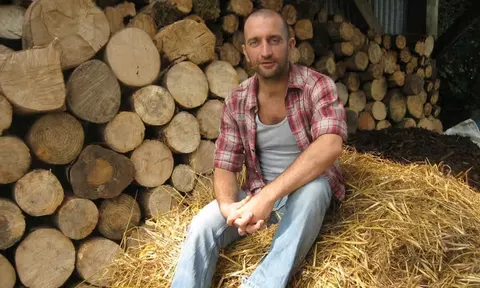
Rolling in It
And yes, in case you're wondering, he has found a new girlfriend.
Another thing he missed in the early days was the music of Joni Mitchell and David Bowie. But he says that today he has replaced it with birdsong, and that reminds him how we have turned art into passive consumption rather than an inner need. “We consume our entertainment instead of taking part in it with our whole hearts. We have become consumers of everything…”
Somewhere around here the experiment finally turns into a way of life. It continues to this day… although his last media appearance was a few months ago, so he may have given up, and the letter announcing it may still be on its way, if it was entrusted to Bulgarian Posts, the national postal service.
“People often ask me how I manage without technology. To me that question is more interesting than the answer; I do thousands of little things,” Mark says. “No two days are alike. Today, for instance, out of tree trunks blown down in the forest by the wind, I built a rack for smoking trout and venison—I have no fridge, and I store the ‘surplus’ in my neighbors' bellies. The next day I made a fence for the horses. In the morning I finished paving the path to the house, then I worked a reindeer hide that I'll one day make into clothes or something useful. The sinews will serve me as thread.”
Tyger, Tyger
“When I decided to give up technology, my biggest worry was that I would be cut off from family, friends and the rest of society,” Mark recalls. “But it turned out to be exactly the opposite. Now I keep in touch with the people I care about through letters, and writing them provokes a completely different level of thought and expression compared with email or text messages. I have never been more sociable with my neighbors and loved ones than since I gave up social media. Lots of people come and stay at the free hostel we run. I have come to value quiet time for reflection with the landscape and the wildlife as much as time with people.”
Mark found out about Brexit only several months later. When his latest novel was finished, he had to interrupt his “hermitage” for a little while to type it up on a computer. He remembers that moment as horrible.
“Poverty is a funny thing,” our moneyless hero muses. “It is always defined financially and always measured against what others earn. It's possible to be extremely happy despite having little money and being officially classed as poor. You can also be very unhappy despite earning a high salary. Those who always want something more will always live in poverty, no matter how much they earn, while others, who are content with what they have, will always feel abundance. Most of the poverty in the modern world is not material but spiritual—a state of mind in which satisfaction comes only from the pursuit of material gain.”
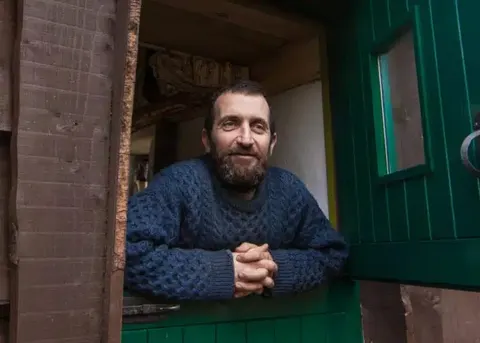
100 Million or a Single Lev
So what are the lessons? Mark is adamant—he doesn't believe that everyone could live the embodiment of what his critics call “anarcho-primitivism.” He simply lives the way he feels he should.
“My biggest lesson so far is that while I was busy with my little things, species were disappearing faster than ever, and social injustice was growing exponentially, putting more and more money into the hands of those least inclined to use it for the common good,” he says.
“We cannot stand by and watch industrial civilization push the great web of life—including us—to the edge of the abyss. Democracy is meant to hold power to account, but in a world of propaganda, nine-to-six jobs and political and economic illiteracy, democracies fail to do so. When that happens, activism has to step in.”
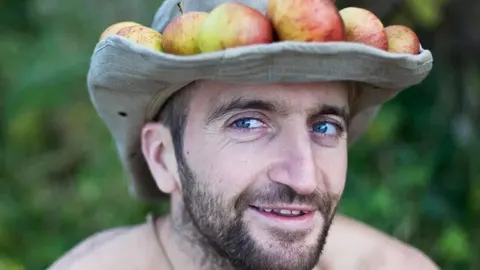
My Two Cents
“Now is the time to be brave. We must stop the machine's advance into the natural world, using every effective means. Otherwise, before we know it, we will witness the devastation and loss of all the beauty that still remains. If we allow that to happen, we will deserve our fate.”
Of course, there's no need for us to become Luddites today, and it would be hard to live a full life that way. Technology is everywhere in our daily lives, but every such perspective that makes us think about it is endlessly useful. About our digital and our real connections, about face-to-face relationships with the people we love. About the price of the conveniences we so easily surround ourselves with, letting in along with them division, social injustice and the other unpleasant sides of the digital world.
Mark's choice is certainly not for everyone… but it's worth thinking about. The next time we throw ourselves into the frenzied Christmas shopping for things we don't need. When we try to win someone over online with hate. Or simply when we sense it would do us good, even for an hour, to switch off the phone and go outside…