If someone grabs your computer, slams it into the ground with all their strength and breaks it in two… you'll probably think they're mad! In fact, you could even say they're something more: a follower of Ludd, with a capital L.
The Luddites—a name that sounds like a pun in Bulgarian, where луд (lud) means “mad”—were a British movement that rose up against the machines two centuries ago. Workers fighting for rights that had fallen victim to automation caused such chaos that Britain had to send more soldiers against them than against Napoleon's army!
Technological progress is often frightening. Today, the Western world calls people who worry about the future brought by the supposedly limitless possibilities of computers “Luddites.” In that sense, we all are, or at least it is good to be, Luddites to some degree.
“The mad ones, the mad ones—long may they live,” said Chorbadzhi Marko, the wealthy, good-hearted patriarch of Ivan Vazov's classic novel Under the Yoke.
What does the history of the skeptics' battle against technology look like, and was it always doomed?
Is Ned Mad?
The Luddites are a curious phenomenon in British history, one that is hard to match anywhere else in the world. A protest movement aimed, in principle, against… progress. Against new technologies, against science, against advancement.
In fact, there are quite a few nuances worth learning about; the story is far from as extreme or clear-cut as it seems.
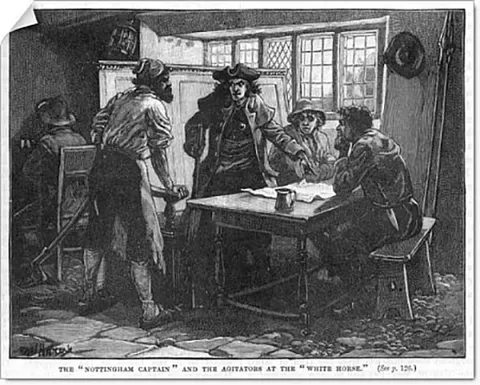
Ned Ludd (or Ned Lud, depending on which spelling you prefer) is the mythical figure whose name this revolution bears. According to legend, a man by that name, also known as General Ludd or even King Ludd, led the massive uprisings that swept England in 1812. As is typical of such stories, his headquarters were said to be in Sherwood Forest.
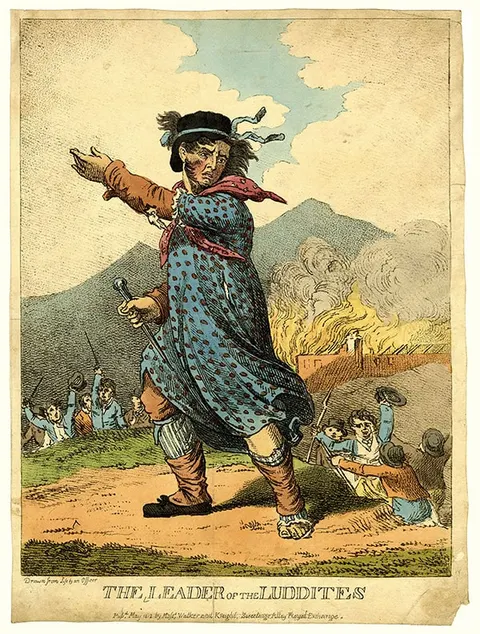
Mad Young Ned
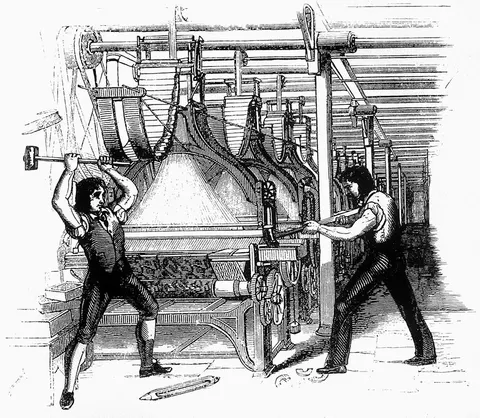
Today historians tend to dispute this part. According to them, a man by that name became known in 1779, well before the uprisings. In a village in Leicestershire, in a fit of rage, he smashed two knitting frames. Either way, his name became a byword.
The figure is often compared to Robin Hood, but Ned is not (yet) as popular in pop culture. Might that change? Come to think of it, it's strange that he has no heirs today, considering what the political climate in Albion has looked like in recent years.
Back then, the problems were mostly social, rooted in the first blasts of the Industrial Revolution. Mechanized looms weren't even a new invention; they had been in use for over a century, but their mass adoption put many people out on the street.
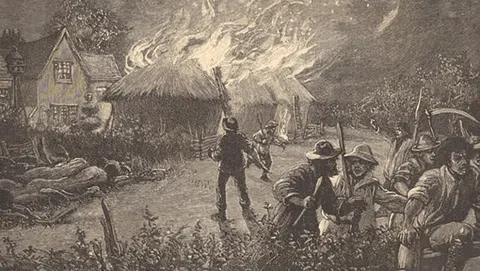
God Protects Drunks and Luddites
That is why, according to the most popular version, the Luddites aimed their hatred precisely at the symbols of the new. And also because, by wrecking the machines, they caused the most trouble for their wealthy employers.
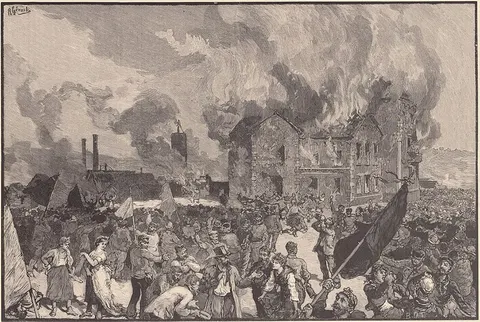
The real uprising began in Nottingham in 1811, and the following year a huge part of England was ablaze. The rebels managed to organize a force that proved remarkably well prepared to take on the might of the state. Many textile and wool factories were destroyed before the government sent an army strong enough to put down the revolt.
It all ended in York in 1812: many of the Luddite leaders were sentenced to death or to penal transportation. Seventeen people were executed.
Over the following decades, local revolts kept smoldering here and there, with workers turning their anger on the machines under the banner of King Ludd. In southern and eastern England in 1830, the uprisings were led by farm laborers who destroyed threshing machines.
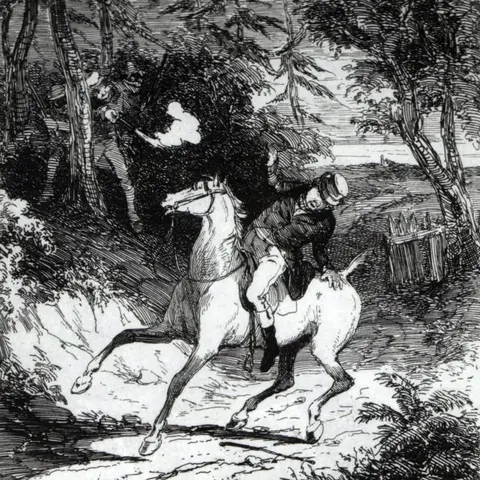
It's Not the Madman Who Eats the Pie…
But how is it that the name of good old Ned Ludd is still alive today, a symbol of resistance to industrialization, automation, computerization and new technology in general?
Today's historians say that precisely this part of the story is exaggerated—that it was actually a typical social or class problem, that the revolt was directed against the authorities and social injustice, not against technology. Yes, the Luddites had lost their jobs or feared losing them, but the truth is there would have been no problem if new ones had been found for them.
Throughout history, things usually sort themselves out naturally: technology makes some human activities redundant but creates others that also need people. All this, however, was happening in an England weakened by the Napoleonic Wars, suffering serious economic hardship and, if anything, a shortage rather than a surplus of labor.
Mad, Mad Luddites
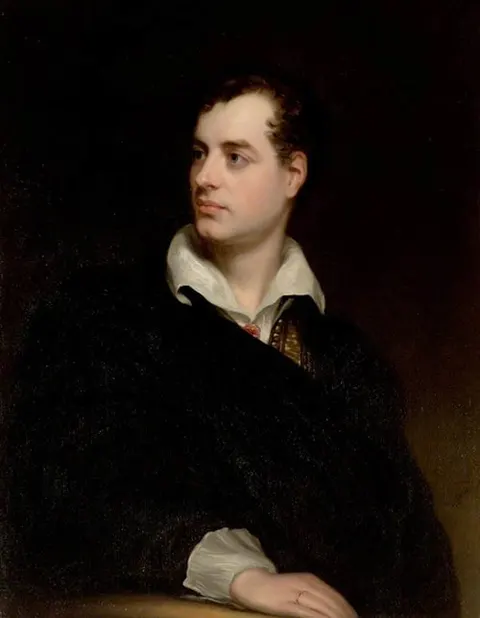
In the British government's battle with the Luddites in 1812, two special laws were passed imposing harsh penalties for destroying machines. Among the fiercest opponents of this measure, and an undisputed fan of the Luddites, was none other than Lord Byron. Outraged, he told the British Parliament: “I have been in some of the most oppressed provinces of Turkey; but never, under the most despotic of infidel governments, did I behold such squalid wretchedness as I have seen since my return, in the very heart of a Christian country.”
He wrote to Thomas Moore that if there was a fight, he would be by the Luddites' side. “How go on the weavers—the breakers of frames—the Lutherans of politics—the reformers?”
That letter dates from 1816, and the previous summer Byron had spent in Switzerland with his friend Percy Shelley. And with Shelley's wife, Mary, who at exactly that time was writing Frankenstein. What more fitting emblem of the fear of technology could there be?
To round off the British connection, it's worth mentioning that the poet's only daughter, Ada Lovelace, would become one of the pioneers of computing; she is even called “the first programmer.”
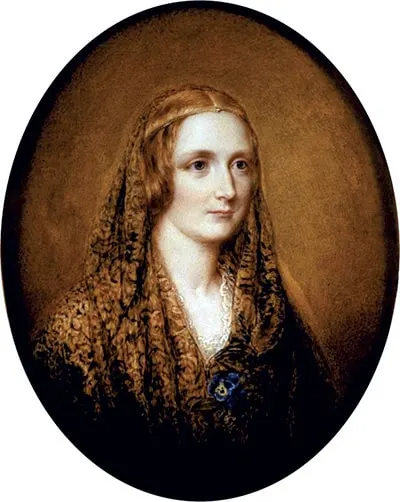
Slowly Going Mad
Still, it's strange that in the two centuries since, no other symbols of the battle against technological progress strong enough have been born. Perhaps progress really is stronger than we'd like? More irreversible?
More broadly, there has always been the “natural” outlook, the turn toward nature at the expense of progress. We find it as far back as the Huainanzi, a collection of philosophical treatises from the 2nd century BC. Here is what, according to one of its authors, the introduction of new technologies led to:
“In the mountains no tall trees were left, and the silkworms vanished from the groves. Countless forests were burned for charcoal, and many plants were turned to white ash. Jasmine and anise will never regain their former perfection. Above us, smoke clouded the sky, and below, the riches of the earth were utterly exhausted.”
Let's Go Wild
In the days of the Huainanzi, in the days of Byron and King Ludd, and today, innovations can be frightening. In the very foreseeable future, many of today's professions will disappear at a speed never seen before in history. At the same time, artificial intelligence is arriving—with the exaggeration surrounding many of its applications, with unjustified expectations, but also with its incredible, undeniable progress. And above all: with the unknown, and our inability to think by its criteria.
“Neo-Luddites” have been talked about since 2006; there is even a kind of worldwide organization that has held several congresses. They describe themselves as “a passive resistance to consumerism and the increasingly bizarre and frightening technologies of the computer age.”
Other modern Luddites, meanwhile, create technologies to destroy technology more efficiently. What can we say about computer viruses and hacking weapons?
You know, more or less, we all play the role of Luddites today—whether by underestimating the innovations on the horizon or, on the contrary, by grasping their scale. But it is by no means impossible that one day we'll reach their extremes, which somehow often creep into the more pessimistic classic science fiction.
Technologies are coming, and we can't comprehend them, partly because we don't understand them in depth. Often because they change us precisely in how we perceive the new, change itself, and what is happening in the world.
Rage Against the Machine
There's no way around it: it's time to turn to the iconic year 1984, though not in its usual, rather worn-out sense. (I declare a conflict of interest: I, too, was born in Orwell's classic year.)
Thomas Pynchon is a cult American writer of recent decades whose literary success goes hand in hand with eccentricity. No one even knows what he looks like, because the only photos are from his youth in the 1950s.
But here is what he wrote, precisely in 1984.
“If our world survives, the next great challenge to watch out for will come—you heard it here first—when the curves of research and development in artificial intelligence, molecular biology and robotics all converge. Oboy. It will be amazing and unpredictable, and even the biggest of brass, let us devoutly hope, are going to be caught flat-footed. It is certainly something for all good Luddites to look forward to if, God willing, we should live so long.”
The original publication of his brilliant essay on the Luddites, Byron and today's technologies is in The New York Times (here), and you can find a Bulgarian translation here.
Do you know who else is an open Luddite? Sir Elton John. That's what he calls himself in a well-known interview, explaining that he doesn't have and doesn't want a smartphone, a computer or a tablet.
Sir Elton and Lord Byron turn out to be kindred spirits. The times are changing—or are they, really?
Beat Up the Computer!
Not long ago, Digital Stories reported that according to Assoc. Prof. Mariana Todorova, a futurologist and philosopher with vast knowledge and a broad outlook, within five years artificial intelligence will change every area of our lives—from birth to death.
“totaly agenst ai,” reads one of the comments. “It'll turn us into a digital concentration camp!” reads another, which gathered a serious number of likes. On social media, this attitude and this spelling often dominate such topics.
So… the Luddites are out there. And the more of them, the better. The nuances are many. And if we get to topics like the uncontrolled way our data is used thanks to technology, filter bubbles, hate, or the ethical aspects of developing artificial intelligence, it's worth all of us being a bit more like followers of Ludd when it comes to thinking critically about machines. Ask Jaron Lanier.
“A computer will never replace a human.” That, by the way, was supposedly… a classic piece of cannibal wisdom.
Artificial intelligence certainly frightens many people, and with good reason. It is overturning the paradigm far too quickly, and healthy skepticism toward it may turn out to be the key on which all our futures depend. Yes, healthy—but intelligent, thoughtful, constructive skepticism.
A Mad Young Lad Dreamed a Dream
Are you a Luddite or a techno-optimist?
Come on, let's not look for yet another dividing line. Vaxxers or not, supporters of this or that party, country, worldview, flat-earthers or round-earthers. We have more important things to do. To talk about the future, about the technologies that are coming. Chorbadzhi Marko is right that what matters most is for the different view to exist… so that we don't end up in the unflattering role of his “colleague” Muncho, the village madman of the same novel.
We began with a quote from “the friend of the mad ones”; it's only fitting to end with “the friend of the Luddites,” Lord Byron.
As the Liberty lads o'er the sea
Bought their freedom, and cheaply, with blood,
So we, boys, we
Will die fighting, or live free,
And down with all kings but King Ludd!