Once upon a time there was a boy… no, nobody today has the patience for Scheherazade's leisurely clauses, nobody has time for fairy tales.
He is not Aladdin but Radostin. From Barutin. The thing in his hands that he works magic with is not a magic lamp but a neural network, artificial intelligence. And he works quite a bit of real magic, even though he lacks the fearsome look of a genie many meters tall.
Thanks to Radostin, we may soon have all the possibilities that artificial intelligence offers for language processing in our native tongue, Bulgarian. A fairy tale? No, pure reality.
Some digital stories are real fairy tales. Like this one.
The Magic Carpet
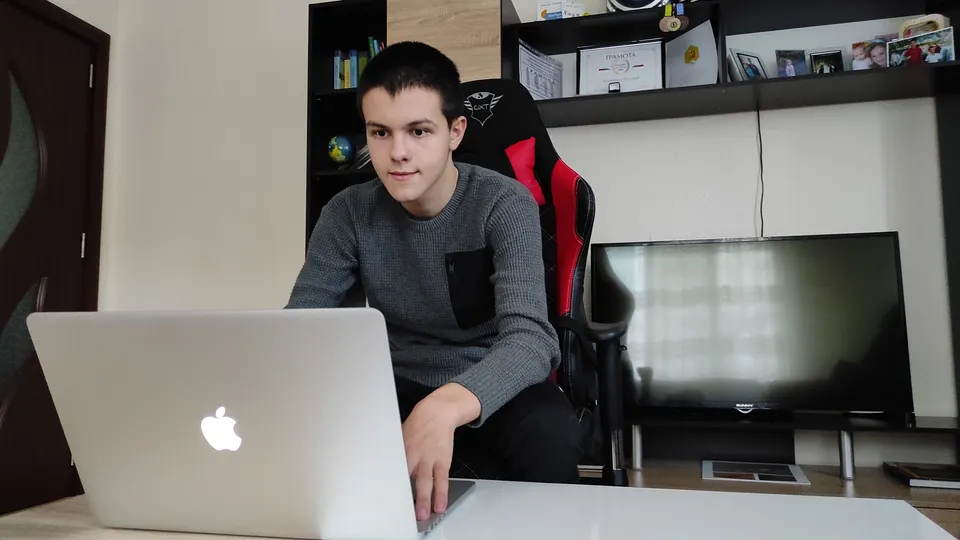
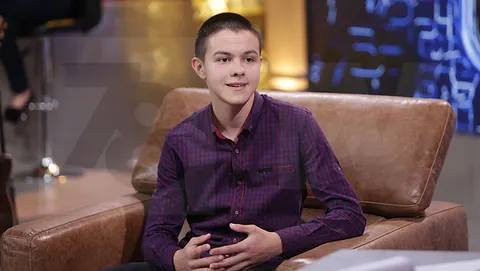
I find it downright impossible to believe that the kid on the other side of the connection knows and can do so much. But then, it only looks as if I'm talking to a kid. A few months ago, Radostin Cholakov received the most prestigious Bulgarian IT distinction—the award of BAIT (the Bulgarian Association of Information Technologies) in its youth category.
What's more, my 15-year-old interlocutor already has an impressive six years of experience as a programmer. And, as I mentioned, he is currently working on a project that, without exaggeration, could be useful to every one of us online. Radostin is developing his own neural network: software that teaches itself, or, as we prefer to call it, artificial intelligence.
He is teaching it Bulgarian—to recognize even spelling and the emotional coloring of a sentence. And so successfully that it can already write more correctly than many of the people you'll come across online.
If this isn't a meaningful digital story, I don't know what could be.
A Powder Keg from Barutin
We sit and talk through the screen, and every now and then he fiddles with a plastic set square while speaking maturely and seriously about extremely complex subjects.
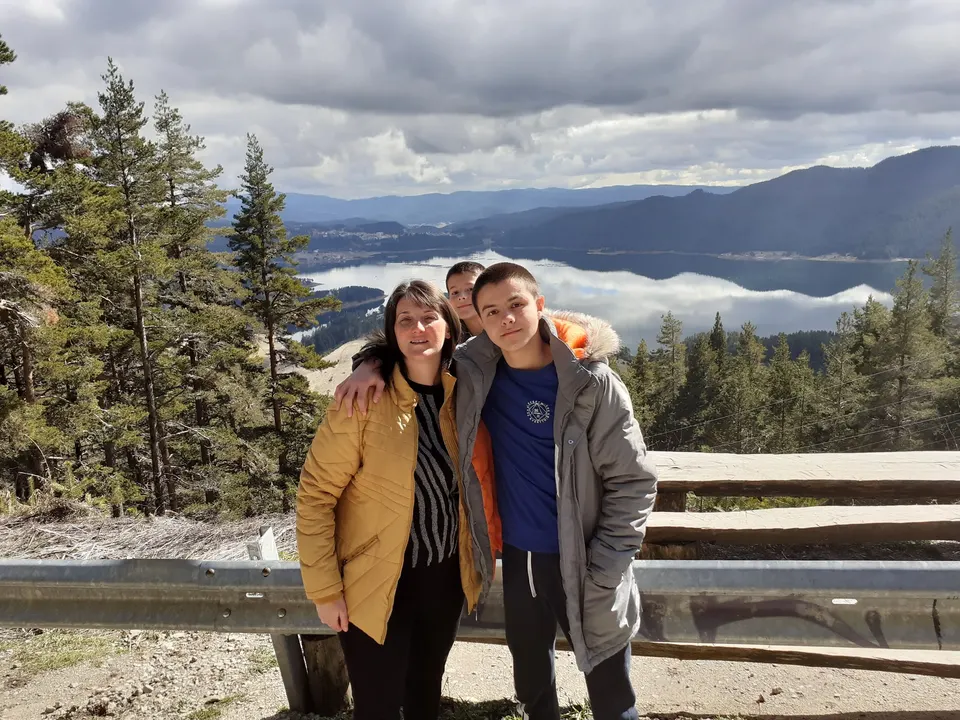
Radostin is from the village of Barutin—its name comes from barut, the Bulgarian word for gunpowder—in the Rhodopes, the mountain range in southern Bulgaria, near the shore of the Dospat reservoir. His father works in the village carpentry workshop, his mother is a seamstress. He first meets his magic lamp when he is 9. His uncle and aunt, both programmers living in Plovdiv, come to visit. They show him a simple program, and that is enough to get him hooked on computers. He rubs the magic lamp and…
He sets about learning. He doesn't know even basic English, but he becomes terribly curious about how everything happens under the hood of the clicking electronic machine. There is no genie in its magic lamp; instead, wishes are granted by logic and abstract thinking. That is exactly what programming is.
At first there isn't even internet. Then suddenly the sea of information floods over him, and he quickly learns to swim. Until he figures out how things work, he often “breaks” the settings of phones and computers.
The Goal and the Means
His first practice website is about the planets of the Solar System. Then Radostin starts helping out by building sites for friends and for projects he finds meaningful. For example, for a charity campaign raising money for schools in Africa.
While learning, he creates his own mobile app for playing chess. Then comes the time for his first larger Android application—AnyGoal. It is a kind of mini social network where you set yourself a goal and mark every step of your progress. Once you achieve it, you upload a video so you can show off to your friends.
Quite symbolic, given this young man's story.
In 2018 he wins a competition organized by Google. The contest is for creating voice applications for its assistant, the counterpart of Apple's Siri. The criterion is which app will be downloaded and used by 10,000 people, and Radostin manages to beat some pretty serious competition.
Back then, one of his pastimes is studying the various virtual assistants and the neural network technologies hidden behind them. That is how his next big idea is born.
The Cave of Wonders
While working on his various projects, Radostin often runs into one serious inconvenience—online, the Bulgarian language still gets only a tiny fraction of the capabilities it could have.
Thanks to modern technology, it is extremely easy to process text today. To find spelling mistakes, to insert commas. To quickly turn an audio file into written words and vice versa—to make written speech sound out loud. To analyze any text—by content, meaning, emotional tone—whether it is positive or negative. All of this opens up a huge palette of possibilities. Just one small example—these technologies make possible the “birth” of electronic journalists.
But all of this happens only if you use a popular language. Not just the “lingua franca” of online life—English—but quite a few others too. None of the above, however, is possible in Bulgarian. At best you'll stumble upon a few antique, primitive spell-checkers that rely solely on running words through their dictionary, underlining whatever they can't find and offering you the closest match. And that's it.
Az, Buki. I, Robot
Radostin decides to do what he can to fill the gap. That is how his current project is born—AzBuki.ML, named after az and buki, the old names of the first two letters of the Cyrillic alphabet. And what might that “ML” be? Machine learning. The cherry on the cake, the high art of programming today. The thing that comes closest to the true meaning of the label “artificial intelligence,” which gets slapped on just about anything.
A neural network is software designed to take in an enormous volume of information and process it, looking for patterns. It is no accident that it's called that, by association with the way our own brain cells work. It is a program that learns on its own and improves itself based on the data fed into it.
For Radostin, taking on a project in a field where he has little experience is nothing new. That is exactly how he is used to doing everything—dig in, learn. Try, make mistakes, and seek advice when needed. Whether from StackOverflow or from the Bulgarian Academy of Sciences.
Subject: Mathematics
That is how he manages here too, even though projects like this rest on knowledge he won't study at school for many years yet. Technologies and paradigms he had never touched before.
“Yes, I'm in ninth grade now, and the math I need for these neural networks and algorithms is at a higher level,” says Radostin. “But I'm used to it; it was the same with English at the beginning. This isn't a new problem for me, everything is simply driven by my curiosity. I get interested in making something, learning something, and I start studying it, reading.
At first I might not understand anything, but I don't give up. I search and just try to figure it out. I needed to understand something more complicated in math, so I simply opened a video lesson site for 12th grade and looked through the section I needed. Then I went back, tried ‘trial and error,’ and it worked. That is mostly my method of learning.”
Vedi, Glagoli
AzBuki.ML is taking its first steps successfully and is already being used even by linguistics students at Sofia University.
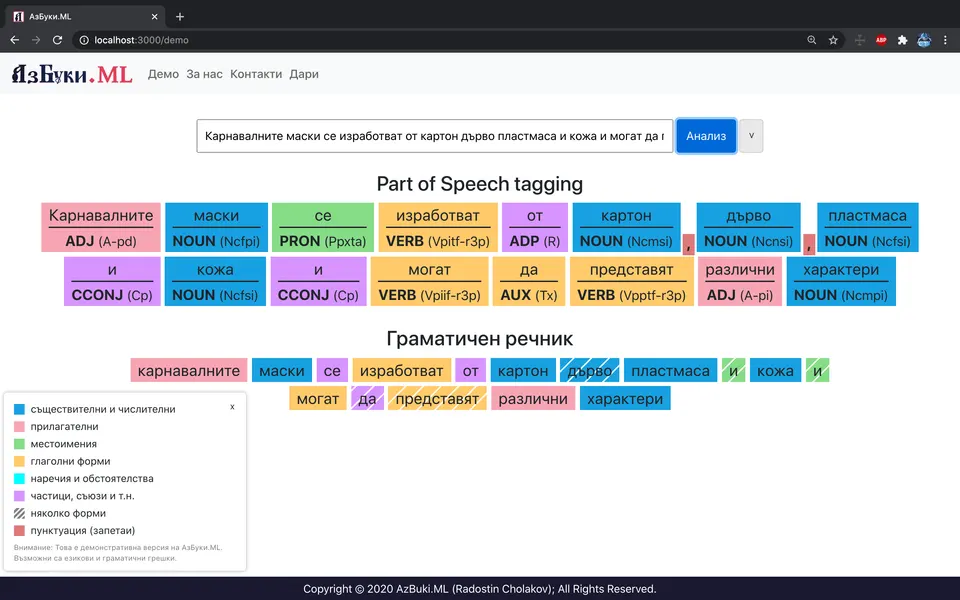
Today AzBuki—whose letters run on, in the old alphabet, to vedi and glagoli, “know” and “speak”—has several working modules and a sea of prospects for development. You can try each of the systems yourself on the site. One of the modules processes the submitted text and does so-called part-of-speech tagging—it classifies each word by as many of its characteristics as possible. Such as part of speech and emotional tone, but many other parameters too.
At the start, Radostin needs a substantial volume of text to “teach” his neural network. He decides to contact the Bulgarian Academy of Sciences and gets the help he needs—they give him a solid enough corpus that has already been part-of-speech tagged.
Another module focuses on commas. You may never have thought about how hard it is in Bulgarian to get them in exactly the right place. Of course, you don't need artificial intelligence to put the familiar squiggle before “that” and leave it out when “that” is part of a compound conjunction, but things get murkier with complex sentences.
Sacred Tongue
A third module, already working and open for you to test, focuses on the emotional coloring of a text. Long or short, Radostin's neural network analyzes it and tells you its predominant mood—whether it is positive or negative.
This is definitely only the beginning, but a very solid beginning. The neural network has yet to develop, to learn everything it needs. There is no challenge Radi has decided to take on and then abandoned.
The technology gradually grows more complex. At first, part-of-speech tagging relies on dictionary lookups, before the real analysis kicks in, based on analyzing and comparing large volumes of information. Over time, to make the comma-placement system work, an additional model is built, reminiscent of how our short-term memory works—it analyzes sentences to find where they split logically.
“The model turned out to work. In the end the result was pretty good; it started putting in commas, closing off subordinate clauses within complex sentences. Something that, honestly, I didn't expect to manage. It isn't perfect, but it's good enough to show that it works and can be built upon,” says Radostin.
The main goal of the project is for the neural network to improve and offer serious capabilities through its convenient API integration. In other words—any programmers who want to use its capabilities can connect to it and build their own applications on top. Until at some point we have in Bulgarian the full palette of services that artificial intelligence makes possible for text processing today.
“I've thought up enough applications to build myself, but from there anyone can develop them further. Add something different to their product that I haven't thought of. For example—you can send a request with the sentence ‘I love eating ice cream.’ And I'll tell you—this sentence is positive, ‘love’ is a verb, and so on and so forth. Lots of things that you can then decide how to use.”
Read, Computer, Read
An end to the agonies of spelling, to the journalist's chore of spending hours turning a recorded conversation into typed text. And if you don't have time to read… presto, you play the article you found interesting through your car speakers.
The ways AzBuki can be used are countless. Our interlocutor gives an example of how the neural network could be useful even to an online store. The integration will let it analyze the comments on the site and show which products are good, which visitors like, which they don't, and why. This will automate tasks that would take many hours of human labor.
With AzBuki's help, it will eventually be possible to summarize the news, something Google already offers in English. Instead of reading long articles on a given topic, you'll get the information summarized meaningfully and briefly, with an emphasis on which source wrote with a particular bias. What's more, it will be done by an open-source program. Something especially useful given today's dangers in the information environment, discussed in detail here.
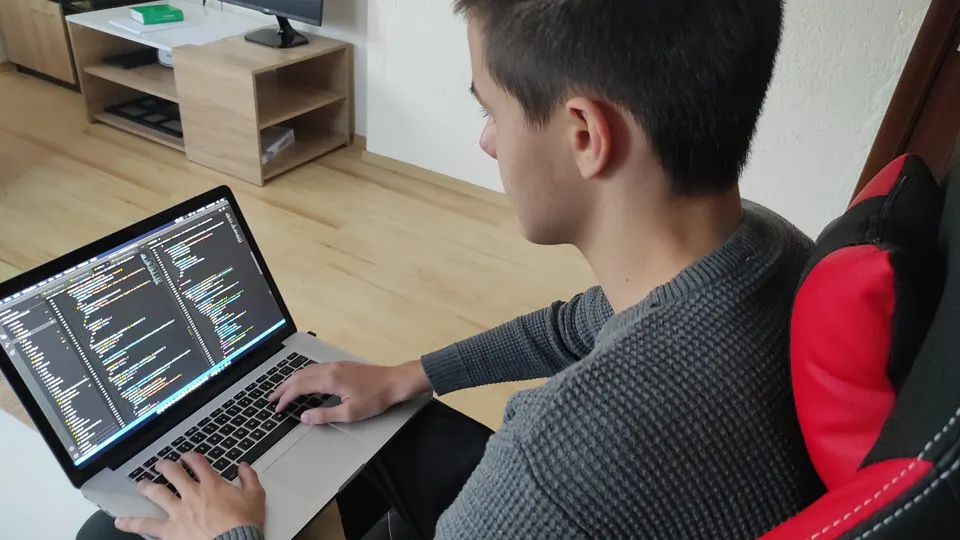
For the “software people,” it's worth mentioning that AzBuki.ML uses TensorFlow with Python, the most popular platform in the field. For his front-end work, Radostin relies on React.js. He has also worked with technologies such as Kubernetes for hosting his projects, as well as Flutter, Dart and React Native.
A Gunpowder Primer
Radostin works on his projects only when he is free from school. He is now in ninth grade at the Plovdiv High School of Mathematics. But because of the pandemic restrictions he is studying online and is back with his family in Barutin.
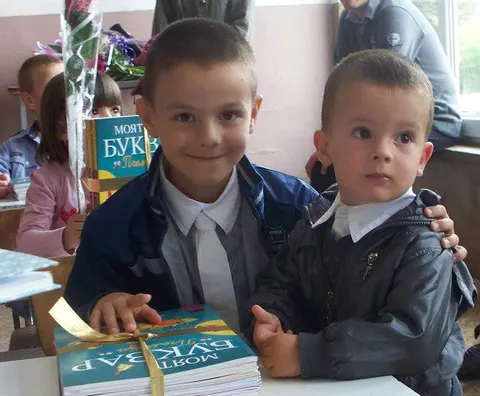
Before that, he finished primary school in his native village. Officially it has 1,700 inhabitants, but most are away on gurbet, working abroad as so many Bulgarians do. Those who have stayed rely on the carpentry workshop and the sewing factory, where the young man's parents also work.
The school has 80 pupils; there aren't enough teachers, and several grades often share lessons. Radostin was glad, back in fifth grade, that he could also listen to the sixth-grade lessons and “catch” a bit more.
After all this, you may have pictured a young nerd with no interest in anything beyond computers. You'd be wrong: he has quite a broad outlook and wide-ranging interests. And friends—his best friend from Barutin understands nothing at all about computers, but the two of them have a great time together every time.
As befits someone from the Rhodopes, he loves nature and the mountains. And his family—his younger brother is also learning programming little by little.
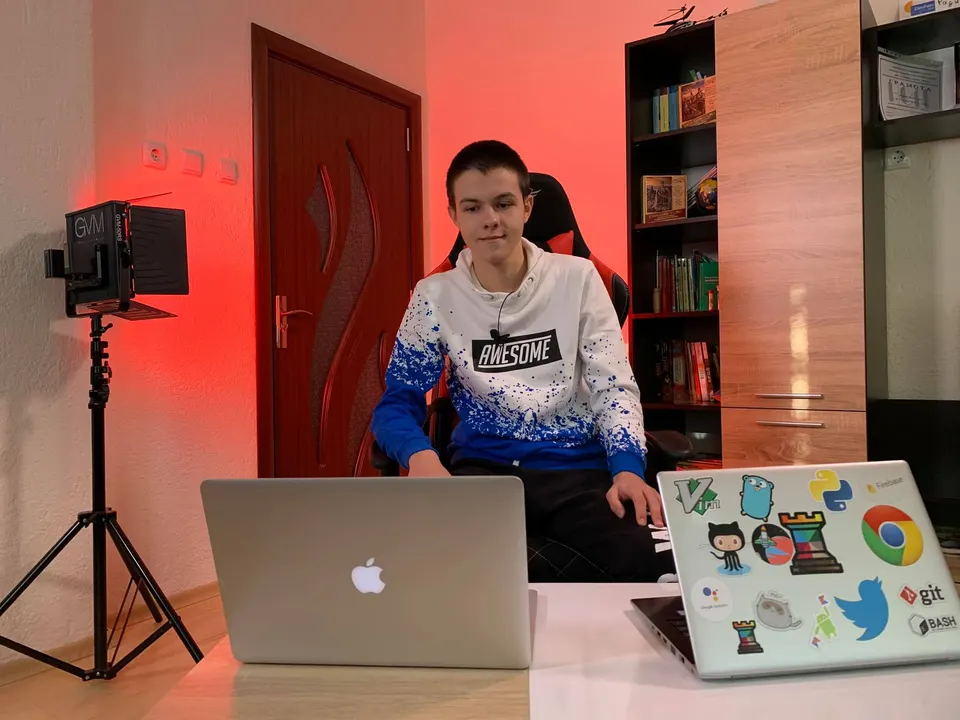
Radostin loves reading fiction, but because of all the projects he works on, he doesn't have much free time left. He has three laptops around him, each useful for part of the work. He admits he spends more time online than he should.
Bread and Robots
At the math high school, our hero has met many more people with interests similar to his own. And as an experienced programmer, he knows there's no surviving online without collaboration. For a while he kept a profile on Medium. In the beginning, when he was starting with the basics, he also had a StackOverflow profile and asked questions very often.
“I recently stumbled on the profile I used in third grade and it really made me laugh,” says Radostin. “I didn't know any English and used Google Translate. I was a super-beginner at absolutely everything and asked the dumbest questions. But when I looked now—some of them have 1.5 million views. So they've helped a lot of other people too.”
Should anything in technology scare us? “Of course,” the programmer says firmly. “First of all, we're not ready for automation. In the last century, General Motors made 15 billion in annual revenue with 1.5 million employees, while Google achieves it with 50,000. Perhaps humanity as a whole will suffer losses from automation in terms of jobs.
But it also depends on how it adapts, how it uses artificial intelligence itself. We have to manage to do it in a way that doesn't threaten us. There will be robots that are superintelligent, but let them work for us. And let us introduce some kind of universal basic income, and everything will be fine.”
The Musk of Barutin?
Which brings us to the logical question: what next?
The media were quick to write about him as “the Bill Gates of Barutin,” the new Elon Musk or Steve Jobs. That irritates him. Luckily, they came across a Rhodope lad who knows what it means to keep both feet firmly on the ground. Radostin wants to be simply “Rado from Barutin” and to advance in technology little by little, as he has done so far. To find his own path, guided by meaningful ventures.
It seems terribly far off to say what he'll be at 30—that's twice as long as he has lived so far. Either way, he is sure that at some point he will found his own company to work on the technologies that excite him most—artificial intelligence, augmented reality, virtual reality.
E-storical
In a few days, Radostin is expecting the team from Estorium. If you haven't heard of this venture, it is a particularly meaningful and interesting Digital Story that we'll tell in detail soon. In short—a digital archive that will preserve, collect and present meaningful stories of Bulgarians from different places and generations. A kind of anthropological lexicon.
They have chosen our interlocutor as one of their first heroes, and he will be given the floor in a professionally made themed video. From Barutin through the thickets of the internet to everyone who has ears to hear. (More about the venture and ways to support it—here.)
We leave Barutin and its neural network, promising to stay in touch so we can follow the possibilities AzBuki.ML will open up. And to delight in the technologies Radostin will one day create with his magic lamp.
I don't know about you, but I sincerely hope the future belongs to people like him.