This piece won the grand prize for “Technology and Innovation” at Web Report 2021, Dir.bg’s awards for good journalism. More on this here.
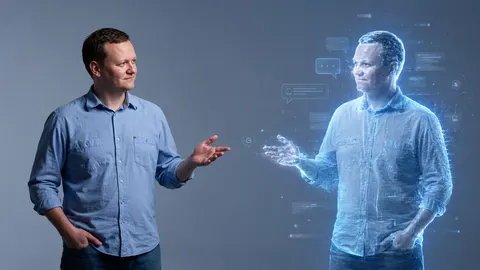
Zdravko wants to be a journalist; Zhelyazko is an artificial intelligence. Who does the future belong to?
Today the most valuable resource isn’t oil, or money. It isn’t gold, it isn’t even power. At the epicenter of the computer revolution, everything is information, and information is the digital gold whose price will climb faster than bitcoin’s during a global crisis.
Every day you read news written by a computer, and not a little of it. Surprised? Wasn’t artificial intelligence supposed to be something years away, with today’s systems still so imperfect… The Associated Press, Reuters, Forbes and Bloomberg have had working projects for years in which artificial intelligence generates texts, processes information and does the analysis instead of people. Sometimes it even publishes news entirely on its own.
Meanwhile, a few hundred people are studying journalism at universities in Bulgaria. Their future doesn’t look rosy; as a rule, they would earn more as waiters. Most of them have nowhere to start working, against a backdrop of a frankly dying press, a horrifyingly small number of quality websites and the gradual, still barely noticed but undeniable collapse of radio and television.
Why is this happening? Isn’t information supposed to be the most precious thing? Wasn’t the truth supposed to set us free?
Not a Man, but Iron
It’s time to bring two digital stories together.
Zhelyazko—his name comes from the Bulgarian word for iron—is a young journalistic hopeful. He doesn’t eat, doesn’t sleep, doesn’t get tired.
He doesn’t lose his files, doesn’t drink, doesn’t chase women or men. You don’t need to explain to him who “our people” are. He doesn’t do the most annoying thing as far as media owners are concerned—ask for a salary. He learns quickly what people like and adjusts the way he works accordingly. Well, he could be told to care about the truth, to gather different points of view, but who needs that?! The AI journalist is already here. It will only get better and will try to take the bread out of the mouth of a profession that society increasingly neglects.
And Zdravko? Well, Zdravko is just a human. He wants to report the news, to tell stories. He’s studying journalism. He has heard many times that “journalists are to blame for everything.” That “anyone can be a journalist,” that “I don’t watch TV or read the papers anymore, I’m free.” He goes to his lectures and wonders… does he stand a chance against his iron competitor?
All of us want information and yet don’t value it. We scroll and scroll. We don’t have time to read past the headline. We surround ourselves with sources that tell us only what we like to hear. Anyone can write anything themselves, like a journalist. Anyone can check whether a piece of information is true in the endless ocean of billions of libraries that is the internet. And nobody does. We’re in a hurry, we have no time.
How could our two heroes help us here?

Iron-Clad Arguments
With Zdravko, everything is clear. After several centuries of journalistic history, we know well what he can do. And still, if he lands in the newsroom of a newspaper (while they still exist), his four years earning a bachelor’s in journalism will be infinitely useful. So that he can soar in the genre of the “news brief” (which doesn’t even exist in the textbooks). And, as an experienced colleague used to say, every winter alternate news brief No. 7, “Flu With Diarrhea,” with No. 8, “Flu Without Diarrhea.”
If he goes to a website instead, even setting aside the salary he will (sometimes) receive, he enters into competition with… the entire internet. It is no accident that social networks are an enormous challenge to which journalism worldwide seems to have no answer. Because when everyone becomes a “journalist” and “understands” the profession; when everyone has the same starting point as the biggest players—their own profile wall.
Now let’s turn our gaze to Zhelyazko. Here are a few examples from the work of his colleagues.
1–0 Against Our Side
In 2013 the 140-year-old Washington Post was bought by Jeff Bezos. Three years later Heliograf joined its team. The AI’s role was mostly for show: covering the Rio Olympics, regional news and election results. In its first year it managed to produce 850 pieces that reached readers.
The Associated Press hired its first artificial intelligence to follow regional basketball games. In 2018 it published more than 5,000 game reports, cutting journalists’ workload by 20 percent. The idea is that information about sports results can be created quickly and easily by analyzing the statistics.
Clearly, sports is one of the first fields in which Zhelyazko becomes real competition for Zdravko. Working from the statistics, the AI generates summaries at lightning speed. For now it simply “covers” games the outlet would otherwise have no resources for.
Of course, it might miss some colorful incident, like a cow wandering onto the pitch in a third-division match, but everything has its risks. Do you imagine the information will be presented dryly this way? That depends on how the AI is designed. If it is “taught” a sense of humor and loaded with a very rich vocabulary, it could easily rival Petar Vasilev and Georgi Popvasilev, the famously florid Bulgarian football commentators, combined. “The leather sphere” and “linear speed” would be mere hors d’oeuvres for connoisseurs.
Zhelyazko is also good when tiny deviations need to be spotted. During the Olympics, for example, Heliograf was set up to track the statistics from every event and immediately post a message in the lead reporters’ Slack channel if any result came within 10 percent of the world record.
You’re Loaded
So Zdravko’s long-term prospects in sports journalism have dimmed a little. Let’s see how things look if he turns to economics and finance.
Here we land on another beat the machines are seriously moving into. Bertie—like Wodehouse’s beloved rascal—is the name of the AI used by Forbes. Its main use is the same as with its sports colleagues: it can analyze huge volumes of statistical data at lightning speed—stock indices, reports, charts—to summarize the data on a given company. Or look for trends, draw broader conclusions, “catch” events before they happen.
The electronic Bertie, however, at least at this stage, also needs a human Jeeves to check his information. Because in 2015 a similar algorithm trumpeted online that Netflix shares had plunged 71 percent for the quarter… when in fact they had nearly doubled in price. The reason was that it hadn’t accounted for a stock split.
In this case there are actually two Jeeveses. Because the success of Bertie and Zdravko depends as much on the people building the algorithms as on those setting their approach to the work. On the engineers as well as the journalists. And as someone who has earned his bread among both groups, I can tell you the balance is sometimes quite hard to strike, and nobody likes being lectured in a field where they consider themselves the expert.
Algorhythm
“3,232 new infections today…”—did a journalist write those lines, or an artificial intelligence? Who cares. Over the past year we’ve grown used to scanning the numbers without nitpicking about the style of such pieces. No, these particular news items were probably written by a person sitting at a text editor, mechanically changing the statistics. He isn’t a journalist but a copy-paster, an author in another popular journalistic “genre.”
They say Yordan Yovkov, the great Bulgarian short-story writer of the early 20th century, took many of the ideas for his stories from the newspapers. We would hardly have stories like the one about the Mokanin shepherd if he had had to hunt for them on Facebook. Or in the few remaining newspapers.
The rampant illiteracy, especially in online media, the lack of basic editing, the low professional quality of the work… all the ugly sides of the coin show up in a huge part of Bulgarian online journalism, and they definitely make me pin more hope on artificial intelligence.
And not because the natural kind—the journalists’—is to blame. The whole environment makes them this way, and we readers help. You spend weeks writing the most gripping story, and the clicks go to “…is getting divorced” or simply “Unbelievable! See what happened yesterday to…”
And that’s actually the better option.
Many of the online outlets that stand out for their traffic, compared with the few higher-quality ones, are a hodgepodge stew of texts that could easily be produced by a drunk robot running 1990s technology. I thought about collecting examples, but the choice was too great, and there are plenty of collections online. Besides, it stopped being funny long ago and became simply sad.
Iron Logic
So Zdravko hasn’t yet given up on a place in the media sun; he makes the rounds of the websites, looking for his niche.
Speed in journalism is sometimes vital. Here Zhelyazko will soon take a very serious lead. His colleague proved it as early as May 17, 2014, at 6:25 a.m.—the Los Angeles Times artificial intelligence, Quakebot. It “senses” that an earthquake is happening and exactly three minutes later publishes a short article with preliminary data on the tremor, the direction the waves are spreading and practical advice on how people can protect themselves.
By then Quakebot had been on the job for two years. They didn’t yet trust it much; its creator, Ken Schwencke, had to approve the piece first, but he didn’t find a single mistake. The piece was not only objective, it used the right style and the exact words. It followed the inverted pyramid precisely and punctiliously cited all its sources, as if the bot had never missed a lecture at Sofia University’s Faculty of Journalism and Mass Communication. And Schwencke decided to do something rather unusual for the time—he put Quakebot’s name on the byline.
Which brings us to another interesting question. Suppose Zhelyazko has done his homework (or rather, his creators have) and learned to produce excellent journalistic texts. How do you keep them from being stolen? Who actually wrote these texts, and who will defend the copyright? How exactly can, and would, an artificial intelligence want to be credited? And how will its creators claim authorship of the piece, when they insist that it is an algorithm capable of judging and creating on its own?
The same goes for ethical norms. If we accept that they (sometimes) exist in journalism, in Zhelyazko’s case someone has to take care of creating them for him. Whatever kind they themselves decide on. Because professional organizations, state censors or NGOs will hardly be able to give advice to… a program. Or to punish it.

I Write, Therefore I Am
A third of the content at Bloomberg News is created with the help of artificial intelligence. The company’s system is called Cyborg, and it lets journalists publish data on a huge number of companies every quarter. It does work that would put real reporters to sleep at their desks. But here too, every piece of information must be checked by a human.
The idea, seen from a distance, is to generate a larger volume of personalized content. Not overview articles aimed at every market player, but data on each company, even the smaller ones, needed by whoever is looking for information on them specifically. As with the regional games mentioned earlier. All this is an example of one of the economic phenomena of recent years, popularly known as the “long tail” theory. The idea is that in the 21st century it becomes increasingly popular to sell “less of more.” To cover smaller business niches with minimal changes to production. That is exactly how Amazon broke through, offering a huge selection of books that wiped out the small bookstores. Then the model was repeated with every other kind of goods.
He Who Writes, Drinks
All of this applies fully to journalism. Because whatever we may say, in modern society delivering information cannot be just a cause, a public service or a personal initiative. It is a business. There are always interests and money behind it. The better option is for information to have real value and for media to support themselves by selling meaningful content. But who pays for information these days, when you supposedly have everything for free online? Not long ago Facebook literally laughed in the face of the Australian government, which had dared to oblige it to pay paltry sums for the journalistic content it uses.
And then comes the second option: turning the media into conduits of influence, of interests. Into clubs. In principle it’s wonderful that giants like Facebook and Google have programs to support journalism, but… it’s always wise to beware of Greeks bearing gifts.
“Long-tail” content can also help in another battle that looks lost for today’s media—the one for the advertising market. Now that it is almost impossible for them to survive by selling content, this is the second devastating blow the internet has dealt them.

A Bit of All Bits
Can a robot have its own view, its own style? Not in the sense we would mean. But it could build them, with the perfect mirror in front of it: the readers. Any journalist can only dream of receiving and processing the impressions of millions of people (even if they often run into obscenities). And of adjusting their subjects, approach and style to what is in demand.
And in details you would hardly imagine. A reader can easily tell you whether they like a text or not. But with the help of technology you can easily see much more—which passages are interesting, which amuse, which have an effect. Soon, perhaps, which ones excite the reader so much that their breathing quickens, or absorb them so that they forget to blink… And when this is multiplied by data from millions, the result could be the perfect text. Exactly the kind that would move the most people the most.
I believe that used to be called “conformism.” Let’s not forget the balance between being liked and having a position, an attitude, a style. Or, without feedback, ending up as the only reader of your own texts…
From Each According to His Ability
We won’t invite Zdravko into political journalism at all. Yes, it still exists in places. There are even outlets you don’t necessarily know are extremely positive toward one person or party and murderously sharp toward another. Only they are melting away like the smile of a young reporter invited, under a training project, to a seminar at a spa resort. And the problem isn’t only Bulgarian—over the past four years the biggest American media have split, ugly and partisan, into two black-and-white camps.
And what about hunting down manipulation? In the coming years much of the fake news will come courtesy of so-called deep fakes, a technology that creates video from real images in which the speaker can say things they would never dream of. The persuasiveness has already reached astonishing levels; I’ll show you in detail soon in a dedicated piece. Either way, the human eye cannot tell deep fakes apart. And here artificial intelligence can play the role of Taras Bulba: I gave birth to you, I will kill you.
Television
We’ve clearly talked Zdravko out of writing, and we won’t send him to radio either. The dedication shows on Radio Veselina, a folk-pop station, sometimes contain more journalistic gems than the newspapers, but on the whole this particular medium isn’t for Zdravko—he can’t pronounce his r’s.
How about we try to make him a TV star? Anchor the news, the morning show and then, cut to camera, maybe even some reality show? That was what the dream journalistic career looked like a decade or two ago. Television certainly has its devotees and its niche, but it too has set off down the road of the relic print media, and nothing can save it from Netflix and Facebook. Zhelyazko, though, can survive in these formats, even if they move entirely online.
The Chinese have figured it out. The first such robot, Jia Jia, is a charming presenter who in 2016 appeared on television as a digital Kevork Kevorkian (or Hekimyan, depending on your generation—both famous Bulgarian TV hosts). The trouble was that her creators decided first to let her answer questions herself in an interview with Wired founder Kevin Kelly, instead of asking them (which for a journalist, robot or not, is the harder part). She gives short answers, a few words each. Sometimes she pauses for ten seconds or so. She cracks little jokes—what she looks forward to most in life is Friday, “because that’s when they transfer my salary.” But she wins no fans. Maybe her creators simply tried to give her too ordinary a look instead of making her look like a chalga pop-folk star. Still, she shows that artificial intelligence can be convincing.
It doesn’t even need to exist physically; the news can already easily be presented to you by a digital human. Yes, these are people who don’t exist physically but do exist online. They won’t have slips of the tongue, they will always keep the right intonation and convey the right emotion.
Incidentally, the future tense is superfluous here too:

In March 2019, a new newsreader, Xin Xiaomeng, debuted on China’s Xinhua. She reports on the arrival of delegates at the biggest party gathering of the year. She was created with machine learning so that she articulates as much like a human as possible, though she is purely a digital image.
Face to Interface
It’s worth mentioning that at least twice so far, Zdravko and Zhelyazko have faced each other in a fair duel on equal terms. In 2015 such a battle pitted Scott Horsley—business journalist and White House correspondent for the public broadcaster NPR—against Wordsmith, the writing algorithm of the company Automated Insights. The two were tasked with producing, as fast as possible, a news story on the finances of the Denny’s restaurant chain. The (real) journalist turned out to be a regular at the restaurants, which let him slip in a personal touch and words readers enjoy. He enriched the dry statistics with a mention of his favorite waitress, Genevieve, who knew his order by heart—a bacon omelet sandwich.
Writing it took him seven minutes. Wordsmith managed in two, but even though it has 100,000 English words in its vocabulary (twice as many as Shakespeare!), its piece came out drier. Perhaps because its creators deliberately aimed for texts that are easy to take in.
It’s not so certain, though, that the judges’ decision was objective. At least I was taught that people in finance have no time and would not appreciate a story about a bacon sandwich in a financial news brief.
If the human victory seems obvious and final to you, let me just remind you how long artificial intelligence couldn’t beat us at chess or Go, while today the prototypes convincingly put us in our place even in games whose rules they have to learn themselves. Yes, journalism isn’t a competition… but in some respects it is exactly that.
The second clash dates from 2012. Christer Clerwall, a professor of media studies at Karlstad University in Sweden, asked 46 of his students to compare two texts on various criteria: objectivity, credibility, accuracy, readability and so on. They didn’t know who the authors were. As you’ve guessed, one was a human and the other an artificial intelligence; only the headline and the first paragraph had been “touched up,” a job that, at least back in the day, editors used to do.
The result was almost a draw—each text won on several of the parameters. Even almost a decade ago, the technology proved a strong enough contender.
We Fill Niches of Every Kind
How could Zdravko not despair? At the British Guardian works Guarbot. Their Zhelyazko has been creating news templates since 2014. It has access to the paper’s entire 21st-century archive and prepares first drafts, filling them out with information from the archive. The journalists just have to check them, breathe a little… life into them, and sign them. A curious detail is that part of Guarbot’s “training” consisted of fake news and tabloids. A huge volume of such texts was fed into its database so it would learn what to avoid. Well, in our context Zhelyazko could also read old issues of Show, a Bulgarian tabloid, but Zdravko can do that too. If he wants.
Some outlets already have entire AI teams. Reuters works with numerous separate systems that use artificial intelligence to process information. News Tracer scans Twitter and raises an alert when a topic becomes surprisingly popular. Lynx Insight processes huge arrays of sports and business news to pick up trends. It even prepares short items of a few sentences, which it passes on to the journalists.
Synthesia, meanwhile, combines in real time the photos coming in from football matches with commentary on what is happening. So seconds after the final whistle, a full minute-by-minute report is ready, garnished with the right illustrations. Gradually the same will happen with video.
But no, Zdravko is stubborn. Having resigned himself to studying journalism, he doesn’t give up easily. Maybe he’ll get to know Zhelyazko, and together they’ll find the way?
We’re All Equal Before the Set Square
Weren’t we supposed to be after the truth? Yes, but the truth is what they demand in the courts. If only because that is the only place that has the ambition of believing there is just one truth. Because the higher bar of journalism is called opinion writing, and there you are not merely justified but downright obliged to have your own position.
All the noise about artificial intelligence entering many spheres of life is tied to the field of machine learning. Thanks to it, computer systems can teach themselves from vast amounts of information. The fact is, though, that today the label “artificial intelligence” is fashionable and gets slapped on everything from electric kettles to chatbots.
In reality it covers a huge number of different approaches and variants, and they determine to what extent we can really speak of intelligence rather than following a series of commands. If our Zhelyazko, for example, can only pull out the score of a football match and tell us who won, he isn’t intelligent enough for the “title.” But if he notices that the goal came from “a beautiful sideways scissor kick” and “from a clear offside position,” and turns out to be right, then things get more serious.
I don’t want to end up in the awkward position of astrologers whose prediction of the next celebrity divorce didn’t come true. In technology it is almost as hard to forecast convincingly, and enthusiasm often turns out to outrun the substance. In 2015, for example, Kristian Hammond, researcher and chief scientist at the company Narrative Science, said that by 2030 computers would write 90 percent of the news and that the first software would win a Pulitzer in 2017. Well, the truth is it hasn’t happened yet. Not so much because of the jury’s fussiness, but because there is still no indisputable contender.
Common Sense
Wouldn’t it be a breath of fresh air if one day we had a media outlet staffed only by artificial intelligences? Ones that generate topics and prepare interview questions. That produce impartial analyses of the economy, and of political decisions too? That have open source code, clear and transparent algorithms, with none of the information mastodons behind them—who can always favor one party or another as they see fit. After all, we keep talking about objective journalism. But is there even such a thing? Is it possible not to sympathize with one side, to be sure the journalist’s uncle isn’t an oligarch or a local mayor ruling his town like a petty feudal lord?
On the other hand, is it even interesting to listen to and read absolutely impartial information? Yes, probably, when it comes to your horoscope or the price of bitcoin, but can’t emotion and bias be an ornament?
Of course—both directions are right. Zdravko will always have his emotion, which is his strong suit, while Zhelyazko has other great advantages we shouldn’t deprive ourselves of. The fact that he is a machine makes him predictable. Yes, information technology today is a world of its own; big projects can’t fit even in the smartest head. But for a program, 1 + 1 will always be 2, at least unless we deliberately decide to build in the opposite. Even with self-learning systems. As long as we know how they are made.
Journalism’s Truth
Zhelyazko is here to stay. The idea, as Lisa Gibbs of the Associated Press management puts it, is that “the work of a journalist is creative. It’s about curiosity, about storytelling. It’s about digging, about holding politicians accountable for their actions. It’s about critical thinking, about judgment. And it is for all of those things that we want our journalists to save their energy.”
Sounds wonderful, doesn’t it? Only, alas, for some reason or other it doesn’t quite happen that way. You can guess that when Zdravko, full of such thoughts, lands in one of today’s media outlets… it won’t take long before he is disillusioned.
Information today really is more expensive than ever. But whereas it used to be valuable because it informed the masses about what the elite was doing, today it’s the other way around. The truly expensive information is where each of us goes, what we buy. And how we can most easily be manipulated.
Robot Garelov, Anchorman
Zdravko will never manage—especially if his outlet has more readers than a modern Bulgarian daily—to write his pieces personally for each of them. Zhelyazko could.
We’re not talking at all about receiving, say, a newsletter with news specially selected for you. That has been happening for a long time; the huge blogging platform Medium is an example. You know very well that once you go to the search engine to find out how often to water the rhododendron at home, over the following days you’ll be surrounded by information about rhododendrons and themed ads.
We’re talking about something aptly called “origami journalism.” The news itself is different for every reader.
For a neural network that is perfect enough one day, it would be no problem to generate millions of personalized newsletters about a given event. Avoiding negative news at each reader’s request, adding emotional color, or injecting emotion, say, because of the reader’s party preferences.
The Question of Questions
Is this journalism? You can easily think of plenty of arguments for both extreme answers.
I, for one, wouldn’t mind such personalization, but only if it concerns the selection of news and if… I can be sure enough how exactly it happens. Because we have something similar before our eyes every day. Clearly, the whole idea of the social network is to pick things for us that we like, that make us click and scroll. And so we easily inflate ourselves inside the social bubble, surround ourselves with the like-minded and narrow points of view. And the algorithms by which Facebook fills our wall are as opaque as the trail of a ball of yarn caught in the claws of a young tomcat.
Here is one advantage of Zhelyazko that we saved for dessert. Once his time comes, we can forget about the human touch, but also about human speling and grammer erors on evry line…
Story Hunter
You don’t like the slightly clumsy joke? Well, that’s because I’m a colleague of Zdravko’s. My associative thinking is more creative than the average Zhelyazko’s, but also… more limited. If I write a piece about the electronic journalist, I am limited to my own experience, to everything I’ve read on the subject, to my own (missing) sense of humor. A cousin of Zhelyazko’s would have access to an enormous volume of information, publications, interconnections… all that remains is to teach him to look for the metaphors in them.
But there is also the other kind of journalism. The kind that would still create stories for a Yovkov today, and would carry on even when only artificial intelligence is left. Because this profession, in my view, is by no means exhausted by the topical function we assign it today. It must also tell meaningful stories that show and tell. That can make people laugh and cry. At least for now, I simply don’t see any real competition from Zhelyazko there. All Zdravko needs is to remember that not everything important happens in parliament, and that powerful stories exist even in the age of the internet.