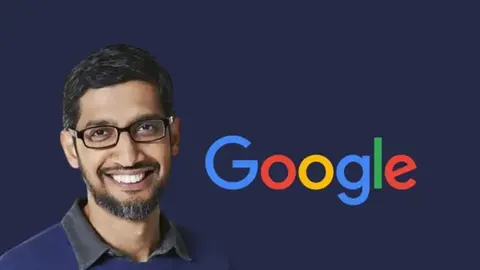
Do you know the name of Google's boss? And if you happen to have heard it, do you know his story?
Usually the biggest players in the tech world, the ones who set the dimensions of the present, have their own recognizable public faces. Sometimes they turn into thoroughly negative media figures (Bill, sorry if you're reading this), sometimes into superstars (Steve, it would be really cool if you're reading this), and sometimes they manage to be both at once (Elon, I know you're not reading, we're not on Twitter).
The one exception is Google. The platform's creators, Larry Page and Sergey Brin, were never especially inclined toward media fame either. And their current successor is practically unknown to the press. Somehow that fits perfectly with the image of a company that manages to conquer huge markets and vast fields of attention without pushing itself on us all that aggressively. All the while it never stops expanding both its influence and the data it piles up about its users. And, of course, the conveniences it creates for us thanks to that data.
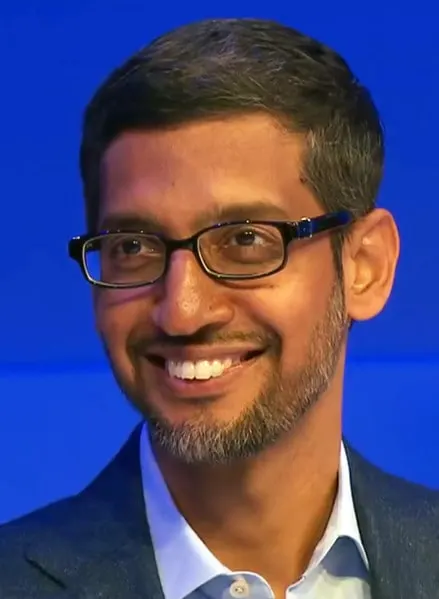
If anyone can embody Google in his own person, it is the company's current leader, Sundar Pichai.
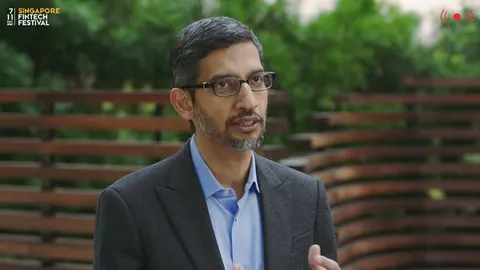
Pichai, Dude!
He grew up far from luxury. He first had regular access to a computer only after he left for a master's degree in the United States. He boldly climbed the ladder until he stood at the head of one of the biggest companies of our day. At the same time, he has managed to stay out of the spotlight and the attention his peers attract.
He rarely speaks to the media, and even more rarely in a way that sticks (only one short speech of his is often quoted online; we'll save it for dessert).
Sundararajan Pichai was born exactly 50 years ago, on June 10, 1972, in Madras, the capital of the state of Tamil Nadu, which today is called Chennai.
The family was not among the poorest, since his father was an electrical engineer at a British company and his mother worked as a stenographer. But they lived in a modest home, and he and his brother slept in the living room.
It was a big celebration when they managed to buy a refrigerator. And when they got a telephone, they were the first in the neighborhood with such a luxury, and many neighbors came over to make calls from their home. That was also the first signal the kid noticed of how important technology had already become.
Shantaram
Technology drew him in from an early age, even if computers were only a dream. What was impressive back then was his memory: he could memorize phone numbers in a flash and served as a kind of directory for his neighbors.
So he naturally followed his path in life and became an engineer… No, not a software one. Only an unexpected and fateful encounter with Google would lead him to software.
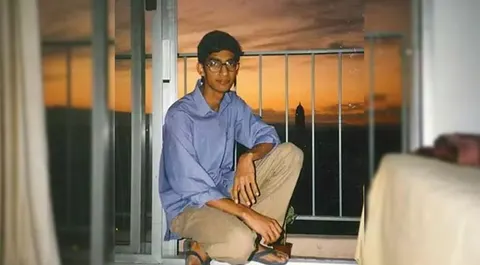
He graduated in metallurgy in 1995, stood out with his grades and left for a master's degree at Stanford. Once again his field was engineering and materials science. He liked it in the United States and decided to stay.
Interestingly, he was offered a place directly in a Stanford PhD program, but turned it down. He preferred to spend a few years working as a product manager at a semiconductor company in Silicon Valley.
Then he abruptly changed direction and completed an MBA at the University of Pennsylvania. For the next few years he worked in management at the big consulting firm McKinsey, before the time came to arrive at his current employer. By then, though, he had built up quite serious experience in management and team building, and had watched work processes up close.
Sundar, Heaven-Sent
So far nothing special: a kid walking his path through life with a moderate amount of ambition, without showing off, with nothing to suggest that he was about to become the leader of one of the world's biggest companies, and quite soon at that.
He advanced slowly and quietly, somehow typically for the culture he comes from. Just as calmly, without dramatic twists, without a dazzling personal story, inspiring quotes, incredible encounters…
And so it went until 2015. For several years he had been in Google's top management. The company announced a major reorganization ahead. A parent company called Alphabet would be created, and Google would be split off as a subsidiary. Larry Page took the helm of Alphabet, and our hero was chosen as Google's chief executive officer.
He evidently did quite well in the job, since in December 2019 he replaced Page as CEO of the parent company too. A pretty impressive career, isn't it?
How did the boy from Chennai soar so high? What lessons can we take from his path? Is he incredible as an engineer, as a manager, as a visionary, to have ended up at the head of one of the world's giants?
Intellectual Humility
His first job interview at Google fell on… April 1. One of the first topics the conversation turned to was the company's big upcoming project, Gmail, which planned to change forever the way email communication works. Pichai, however, had never heard of the project and decided it was an April Fools' joke. He replied that such a program could not exist, and asked them please not to make fun of him.
His future employers, however, knew what they were looking for, and described him as “the candidate of intellectual humility.”
His first job at Google, which he started in 2004, was heading product management and development. The company was at the dawn of its present fame; he definitely had the luck to land in the right place at the perfect time.
Which in no way diminishes the skills he demonstrated over the following years. Meanwhile Google rose headlong, largely creating today's online world and sketching tomorrow's.
My Friend, the Browser
Sundar was lucky enough to find himself at the epicenter of a quiet revolution. His first task was to manage the development of Google Toolbar, the handy add-on for the then-fashionable browsers Internet Explorer and Firefox that let you search for information on the web.
Then, quietly, an alternative to them appeared, some strange competitor. 2008 was the year Chrome arrived: Google's browser, which became the standard and still dominates a huge share of the market. It set the concepts in technological terms and established the firm as a huge factor in yet another online field. It is largely responsible for the company's monopoly position in so many directions. Thanks to it, Google is not just a search engine but an entire ecosystem that makes today's internet possible. Only with its arrival were desktop applications replaced by the web apps we now use for everything.
Pichai was directly involved in the work on the browser, which quickly became a hit. He pushed hard for the idea and fought seriously until it was realized. At the time he was also directly responsible for developing products such as Google Search, Maps, Play, Gmail and Workspace.
Be the Change You Wish to See
It is evidently no coincidence that in the same year our hero became a product development manager and now had to show his face to the media as well.
After that he climbed steadily: in 2012 he was promoted to senior manager, and two years later he took charge of the team responsible both for developing Google's technologies and for the Android operating system.
How well he handled these tasks is also easy to judge. Today Android is the undisputed standard among operating systems for mobile phones and other devices outside Apple's world, and Google dominates unchallenged in all its important areas. It moves forward quietly and slowly. The company tried to break into social networks, then sensed that this was not where its strength lay, and the Google+ project vanished into oblivion.
At the same time, it keeps expanding into new markets while holding on to its strength where that strength is unconditional. There is hardly going to be a search engine in the foreseeable future that comes anywhere near it.
Karma
Google gave birth to an entire profession: search engine optimization, which we know as SEO, could just as well be called “optimization for Google.” Its overall ecosystem is resilient, multilayered and not as intrusive in public life as those of its big competitors.
Might we find here the deep imprint of the man at the head of the company, so boring from the media's point of view? Shouldn't we also look for the typical traits of his people, of his culture, of the quiet strength with which Gandhi showed that wars are sometimes won far more convincingly when there are no weapons at all?
Forgive the lyrical digression; it's time for prose. And for a few more strokes on the difference between Sundar and the other strong figures we've mentioned.
The main one is that he is an employee, not the owner of a company. Yes, the position of chief executive officer certainly comes with the main responsibility, which is why we're usually used to seeing in that role the same people who also control a large part of the ownership. Sundar Pichai is simply a hired employee with a rather impressive income.
Nirvana
In 2020 his annual salary was $2 million, and he received about $5 million more in bonuses. Today his fortune is estimated at around $600 million (about half of it in Alphabet shares). That makes him not only one of the best-paid company bosses but also one of the richest people who do not rely on their own ownership stake.
In that sense, unlike his peers, he did not create a venture of his own. Brin, Page and Eric Schmidt, who succeeded them at the top, managed to raise a university project to the level of one of the most successful companies on the planet. But Sundar has definitely raised the bar even higher, which often turns out to be the harder part of the journey. In 2021, at the height of the pandemic, Google crossed the astonishing mark of $2 trillion in market capitalization.
It is no accident that his success at the helm has been recognized. Tellingly, he has been invited several times to take top positions at Twitter and Microsoft. And yet his current employers have managed to keep his services.

Siddhartha
Today one of the big topics for Google is artificial intelligence. Through its Google AI unit (whose creation Pichai announced in 2017) and, of course, the huge DeepMind project, the company is producing some of the most impressive (and at the same time somewhat frightening) developments in the field.
Unlike his counterpart at Facebook, Sundar is not so much excited about the future of the metaverse as about artificial intelligence. He says he sees the company's future where it is strongest even today: in searching for and spreading information of every kind. In his view, algorithms will replace us in more and more areas, and this “will have a greater contribution than all the other breakthroughs in history. AI can make people more productive than we ever imagined possible.”
Sometimes his decisions seem slightly inexplicable. This year, for example, $9.5 billion in investment is planned for new offices and data centers. Pichai is convinced that only by working together, at least part of the time, can people be truly effective.
At the same time, he promises that all the company's properties will be carbon neutral by 2030.
A Pinch of Nutmeg
“Maybe there are things about technology that frustrate you, and others that make you impatient,” he said last year in a speech to graduating students. “Don't lose that impatience. It will create the next technological revolution and allow you to build things my generation could never even dream of.”
A bit like Louis Armstrong, wouldn't you say? In the end, he is definitely not the classic dry office type either; he can't be, since he manages to inspire and lead his subordinates… who number 135,000 people scattered across the globe (you can read the fascinating account of Minko Gechev, a member of the Google team developing the Angular platform, here).
“Sundar has a tremendous knack for seeing what's ahead and mobilizing teams around the things that really matter,” says his employer, Larry Page.
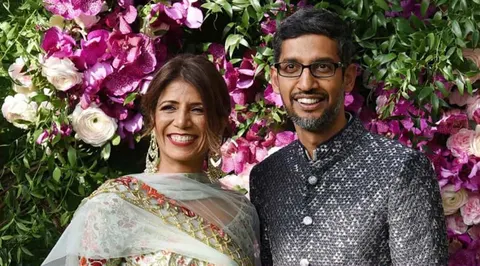
Google's boss is married to his high school sweetheart, and they have a boy and a girl. He loves reading English classics, watching Friends and… Bollywood movies. He is a soccer fan, a supporter of Messi and Barcelona. And, of course, as is typical of his country, of cricket.
Panchatantra
As promised, before we part, we give him the floor for the speech with which he drew the most attention. It's short: he delivers it within the allotted 60 seconds, and it is definitely worth remembering.
So here is what our hero says:
“Imagine life as a game of five balls that you juggle in the air, trying to keep them from falling. One of them is made of rubber, and all the others are made of glass.
The five balls are: work, family, health, friends, spirit.
Soon you will realize that work is the rubber ball. Whenever it falls, it will bounce back, while the other balls are made of glass. If one of them falls, it can never return to its former shape.
It will be damaged, bruised or cracked. It may even shatter into pieces.
You must understand this and strive to protect it.
Manage your work efficiently during working hours, be sincere, give the necessary time to your family and friends, get proper rest and take care of your health. If something happens to you, it won't be easy to go back to the way you were in the first place…”