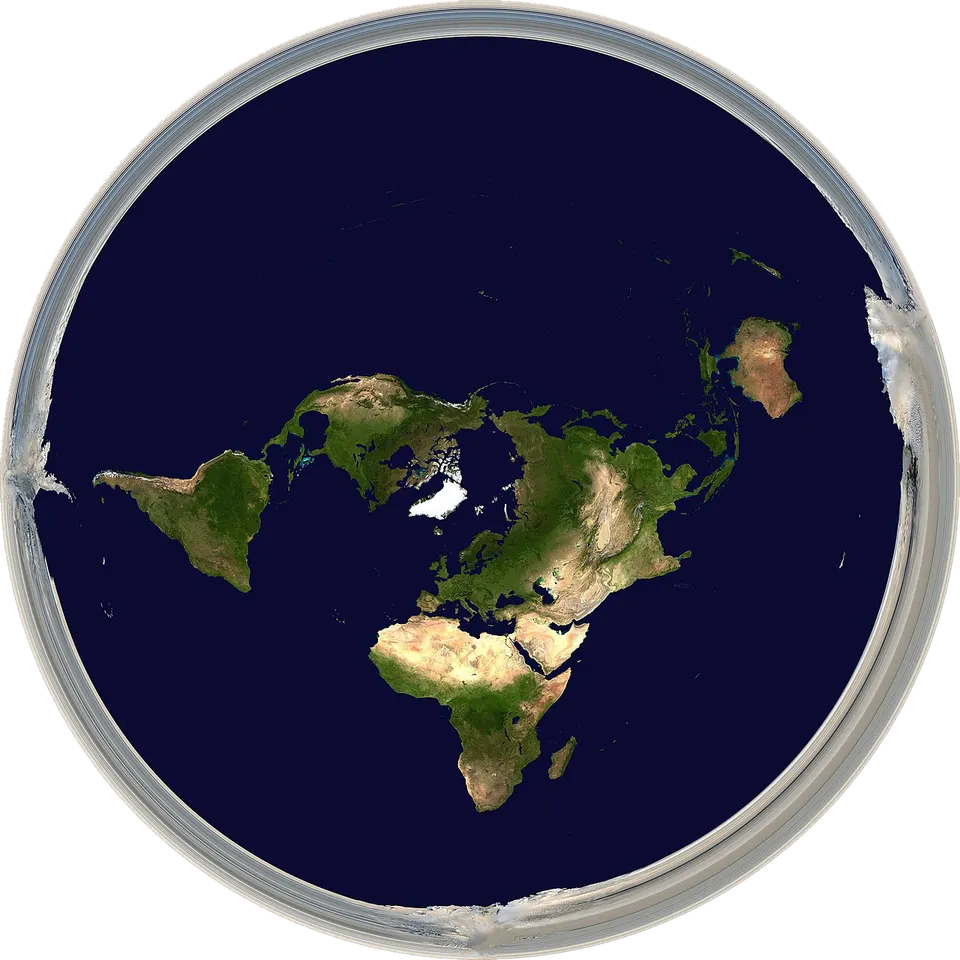
In my personal ranking of favorite conspiracy theories, somewhere just behind the reptilians and the microchips in vaccines, comes the idea of a flat Earth, which has been gathering speed lately. Today, when anyone online can say whatever they like, when access to information is unprecedented and general knowledge is shrinking in proportion, it is time to question the sixth-grade physics textbook. Today, when technology is shoving us forward at breakneck speed, why not go back for a change, and live for a little while in a more interesting world, where the Sun circles across the ceiling above our pancake planet, and Galileo and his ideas have gone from mainstream to dissident once again.
And while you read… just be careful not to fall off. I have yet to come across a sufficiently charming theory about what lies beneath and beside the flat Earth, but it is hardly an ocean of beer…
0. A Flat Joke
“Down there, spread out like a platter of gemstones, the flat Earth appeared. It looked like a plate full of continents. A coin tossed, heads or tails, by some indecisive god…”
So far you could easily assume you had stumbled upon the words of one of the growing number of flat Earth enthusiasts, one blessed with a little extra eloquence. If we go on, however, with the description of the four elephants carrying the planet on the back of the giant turtle A’Tuin, the science fiction lovers among you will immediately guess whose quote this is.
Let us loosen the reins of our imagination and try to believe, at least until the last line of this piece, that the Earth really is flat. Brace yourselves for a series of crushing arguments…
1. Shenton and the Shambolic
The topic came to the fore partly because of the QAnon community, which became famous around the storming of the Capitol at the start of 2021. Yes, those people led by the “Indian chief,” for whom the Earth really is flat.
And so we are now in a world where global society, like a drunk, has lost its sense of up and down, hiding its intoxication behind the hazy idea of a three-dimensional Universe, packed with planets and stars like a jar of cherry compote.
A little searching online is enough to find countless videos that gather the arguments for the flat thesis and enjoy impressive interest. They come in every language, even Bulgarian, and the arguments underneath them are long and heated.
“There is no single unified flat Earth theory,” says Daniel Shenton. “But there are serious enough reasons to believe that our planet is exactly that.”
The words belong to a 44-year-old Londoner who came over from America and now lives in Hong Kong, and who today heads the Flat Earth Society—the largest association of people won over to the idea. He does not dispute the theory of evolution, he accepts the evidence for global warming, and the world’s media describe him as a likable man without particularly extravagant views on the world… except for one. He does not believe that gravity is what keeps his beloved motorcycle on the road. On the contrary: we all live on a Terry Pratchett disc.
Shenton is a man who has traveled quite a bit—he has no qualms about using the GPS navigation on his phone, even though, in principle, this technology works thanks to its link to satellites scattered in orbit around the Earth. According to Shenton, the satellites really are above us—like the Moon and the Sun, they spin along their trajectories above the pancake Earth, tethered by cables, and their work has nothing whatsoever to do with the shape of what lies below.
“Does sailing around an island prove that it is a sphere? The same goes for the Earth.”
Samuel Shenton
By pure coincidence, today’s leader of the society bears the same surname as the pioneer of his field. After long years of oblivion, the truth about the flat Earth came to light in 1956, when the Englishman Samuel Shenton founded the organization fighting to restore justice. The theory was born while Shenton was still in primary school and gradually grew into a complete cosmology, which flat-earthers still more or less uphold today.
2. Galileo’s Chandelier
Until recently, a far more famous Don Quixote of the flat Earth was among us. The limousine driver Mike Hughes, also known as Mad Mike (a nickname he gave himself), had a hobby of building steam-powered rockets out of spare car parts. With them he tried to climb high enough to take photographs that would debunk the spherical lie. “I like doing amazing things that no one else can do. No one else in the history of humanity has designed, built and launched himself in his own rocket,” the American used to say.
On March 24, 2018, his rocket rose to 460 meters, reaching a speed of 500 kilometers per hour, before a hard landing followed. His ambitions, however, were far more serious—one of his next ideas was to launch it from a balloon, have it reach 800 km/h and make it to open space.
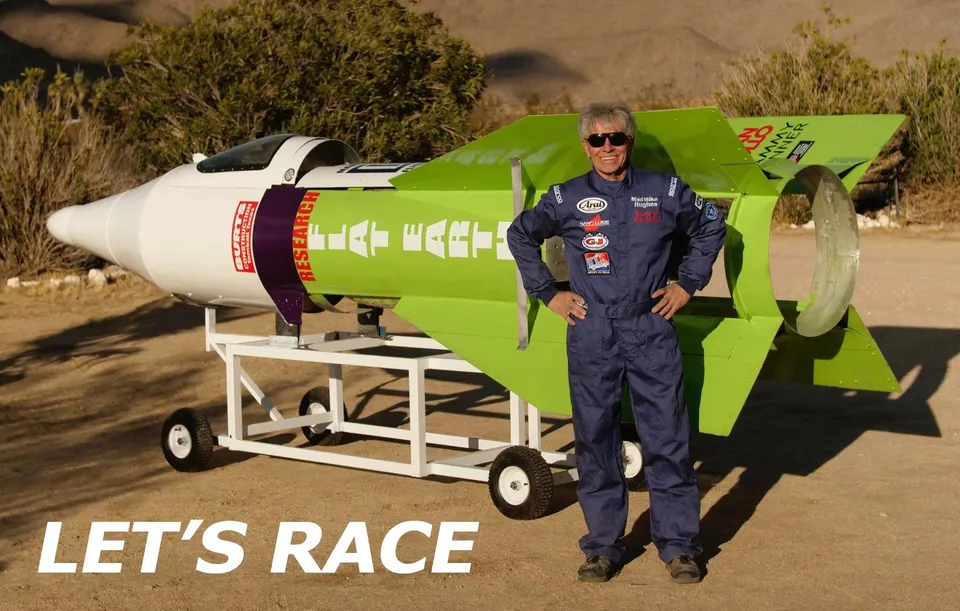
Yes, there is a reason we speak of him in the past tense. On February 22, 2020, Mad Mike’s epic came to a sad end when yet another of his homemade rockets crashed. The parachute failed, and so proving the hypothesis was left to the next daredevils.
As for us, it is time to turn to the arguments that cannot fail to convince us of the rightness of flatness.
3. Earth Under Pressure
All photographs of our planet from afar are fake, the International Space Station is a hoax, and the Moon landing was masterfully directed by Stanley Kubrick.
You will say you have seen the Earth from above in photos from space missions, and it really does look like a ball? Well, have you never used Photoshop?
Just because you have seen a photo of, say, Donald Trump, does that make you firmly believe that such a strange person could really exist, and that he very nearly became president of the most powerful country on the planet a second time?
One piece of evidence is the surprisingly small number of “portraits” of the Earth from afar, despite the countless (made-up) space missions by now. Flat-earthers count exactly eight photos, each of them a rather clumsy montage, as you can see in plenty of videos online.
The continents look completely different from one to the next, cheap Photoshop tricks are visible—the clouds repeat, patterns in the landforms are cloned… And in the pictures from the Apollo 17 mission, it is obvious a mile away that our planet was pasted in.
“I like doing amazing things that no one else can do.”
Mad Mike Hughes
Former NASA employee Matthew Boylan of the flat-earth community admits that he was forced to doctor photos so that the Earth would look round.
Do you think it could be mere chance that enlightened and wise peoples such as the ancient Greeks, the Egyptians and the indigenous civilizations of the Americas believed, just like that, that we live on a plate, that down is down and the sky is up?
Is it by chance that Homer and Hesiod tell us of a world as flat as the shield of Achilles?
Sadly, the Flat Earth Society overlooks the experience of the ancient Shopi—the people of the Sofia region, proverbial for their stubbornness—who proved empirically that “there’s nothing higher than Vitosha,” the mountain above the capital, as well as that of quite a few sergeants in the Bulgarian army who have ordered their men to run to the horizon and back.
4. Chicken Soup for the Earth
In this sense, the Iskar reservoir near Sofia will also be of use to us, never mind that it does not date back to the days of the ancient Shopi. Because one of the experiments that unambiguously shows flat-earthers are right has to do with large bodies of water.
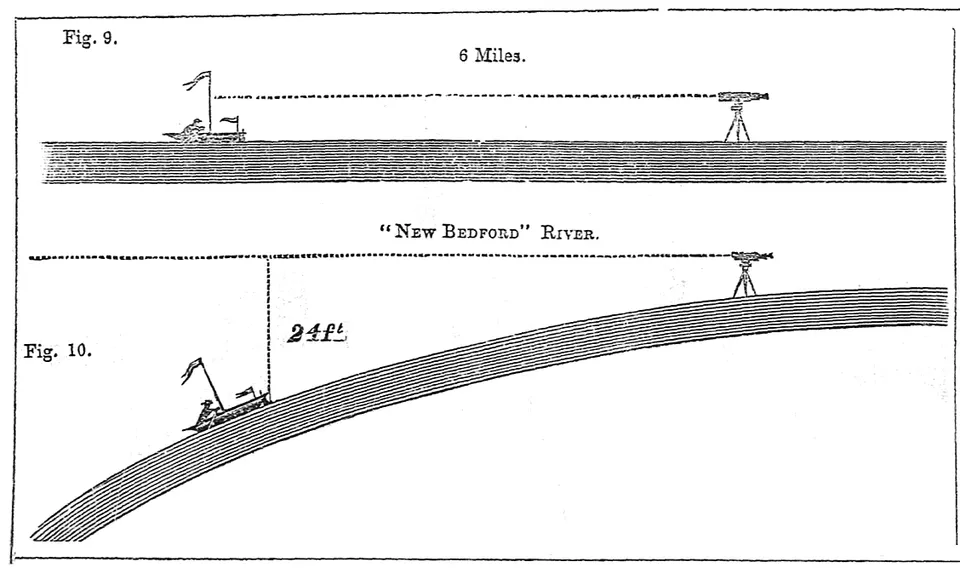
The example was set by one of the “grandfathers” of the theory, Samuel Rowbotham. In 1838 he stood on the bank of the Old Bedford River in Norfolk, England. He chose a straight stretch, six miles long, where the water flows slowly, and mounted his telescope eight inches above it. Through it he watched a receding boat with a five-meter mast and… never lost sight of it, even when, by the flat-earthers’ calculations, it should have been eleven feet below his line of sight. It took the false scientists a full 30 years to come up with an explanation—in his calculations, he had not taken into account the refraction of light over the surface of the water.
The Old Bedford observations led Rowbotham, who besides being an amateur astronomer and inventor was also a writer, to produce his pamphlet Zetetic Astronomy, to this day something of a manifesto for flat-earthers. That is why they sometimes call themselves zetetics—from the Greek “zeteo,” meaning “I seek.” What is being sought, of course, is the truth.
The Salar de Uyuni is perfectly flat, and because of the salt in its waters it turns into a huge, perfect mirror, beloved by photography fans. Here is yet more evidence: there is no way a large body of water could be flat if the Earth were spherical. And from one shore of Lake Michigan you can see the other, which should be absolutely impossible because of the Earth’s curvature.
And what about rivers? They keep flowing even when there is not enough slope, and they have the nerve to do it in every direction.
Beach season is approaching, so the next time you find yourself on the sand, watch a departing ship in search of the truth. The globe theory will tell you it should start to vanish little by little, until the last thing you lose sight of is its highest part. Nothing of the sort happens in practice—the ship disappears all at once, because it is moving away across the pancake.
While you are at the beach anyway, watch the sunset too, for science. You will see that the sun gradually shrinks. So how can we claim it is so far away, 145 million kilometers from us? It always vanishes not at the horizon itself, but a little before it.
In other words: it simply hides from us to light up the other part of the Earth’s disc. One last look at the Sun before it disappears: if it is behind a cloud, its rays do not fall vertically but fan out sideways. So there is no way that shining thing is not very close to us.
5. Flat as a Board
This brings us to the point that a round Earth (or geoid-shaped, as the boring scientists insist on calling it) would be more or less… round. That is—walking forward, we would not be moving in a straight line, and sooner or later our path would have to start heading downward. If you don’t believe it, experiment at home with an ant, an orange and a ruler.
Then why is all construction based on the Earth being flat? Surveyors and architects are obviously among the specialists who indirectly admit the theory is right, because in their measurements, even for huuuuge structures, they do not account for the arc beneath our feet.
If the Earth were a circle with a diameter of 13,000 km, then the horizon would have to curve 12 cm per kilometer, 36 cm over 2 kilometers and about a meter over 3 km! The longest bridge on the planet, in China, at 165 kilometers, would have to have at least 2 kilometers of curvature, which the civil engineers, following the traditional rules, did not account for.
What’s more, the people who most often rise above the pancake will confirm its shape for you, albeit indirectly. No pilot is taught to point the plane downward every so often to compensate for curvature.
We have all flown on a plane. Is the horizon straight and level, or do its edges drop away, as they should if we were on a ball? Let us go even further. Let us take off in search of the truth with Felix Baumgartner.
When in 2012 he drew the eyes of the world with his jump from the edge of space, two things stood out. First: how can a man rise almost 40 kilometers, jump, fall down while the Earth is spinning, and suddenly find himself back at the same starting position, in the net waiting for him where he set off? You probably didn’t notice, but the footage of him preparing to jump is especially telling, too. From the side, the camera captures a perfectly flat horizon, but when it turns toward it, the curvature becomes enormous…
6. The Horizon Program
It is time to turn to the authorities. George Orwell himself speaks of the flat Earth, if metaphorically, saying that most people are quite convinced of the truth of the fact, yet could not explain why the Earth is round. Press them for a justification, and they would get angry.
The galaxy of celebrities who attack the status quo even more directly begins with Mohammed Yusuf, the founder of Boko Haram. We are all flooded by the stream of information, so it is important to clarify that this was not a successful youth rock band, but one of the most popular terrorist organizations, thriving in Nigeria. Well, according to Yusuf, rain comes not from the clouds but directly from Allah, but let us leave theological disputes aside. The list of prominent advocates of the flat Earth thesis includes the basketball players Kyrie Irving and Shaquille O’Neal (who sometimes claims he is joking) and the rapper B.o.B., an honorary member of the society.
Despite a careful search, I failed to come across any other famous names, probably because no one has yet thought to ask the attention-loving regular guests of Bulgarian morning TV shows.
Actually, I missed the official announcement from none other than Neil deGrasse Tyson, reading: “I admit it, the Earth is flat!”
Alas, published on April 1.
While we are on the subject of authorities, real and imagined, it is actually not Galileo and Copernicus who are to blame for the lovely pancake turning into a doughnut. Their role was to strip the Earth of its role as the center of the Universe. The real damage had been done earlier by Aristotle and Ptolemy, in the 4th century BC and the 2nd century AD respectively, who imposed the idea of spherical bodies across the empty sky.
“It is time for experience and logic to get ahead of dogma.”
Daniel Shenton
It was Aristotle who first tossed out the absurd notion that if some object casts a round shadow on the Moon, it must undoubtedly be the Earth. As if he had never seen spotlights in a theater. Besides: a disc casts a round shadow too, doesn’t it?
Magellan, for his part, stubbornly boasted of having circled the planet—a good marketing move, but also a whopping lie—he simply went around the disc without ever reaching its edge.
An important point for all scientists, including the more progressive ones associated with the flat Earth, is eclipses. In a solar eclipse, for example, a disc appears over the body of the daytime luminary that is perfectly smooth—not even the 9,000-meter peaks show.
Is it really possible that in a vast, vast expanse of space the Earth, the Moon and the Sun, so different in size, could line up in such a way that during eclipses their shadows coincide so perfectly that in a solar one the Moon hides the Sun, and in a lunar one the Earth’s shadow covers its supposedly celestial satellite exactly? Coincidence?
You throw a stone hiiiigh, high up, and instead of drifting away because of the planet spinning beneath you, it smacks you mercilessly on the forehead? After a sufficiently precise experiment of this kind, there is truly no way you won’t join the ranks of the flat-earthers.
Our bowl of soup revolves around the Sun?
Well, if it did, we would surely have spilled out of it long ago.
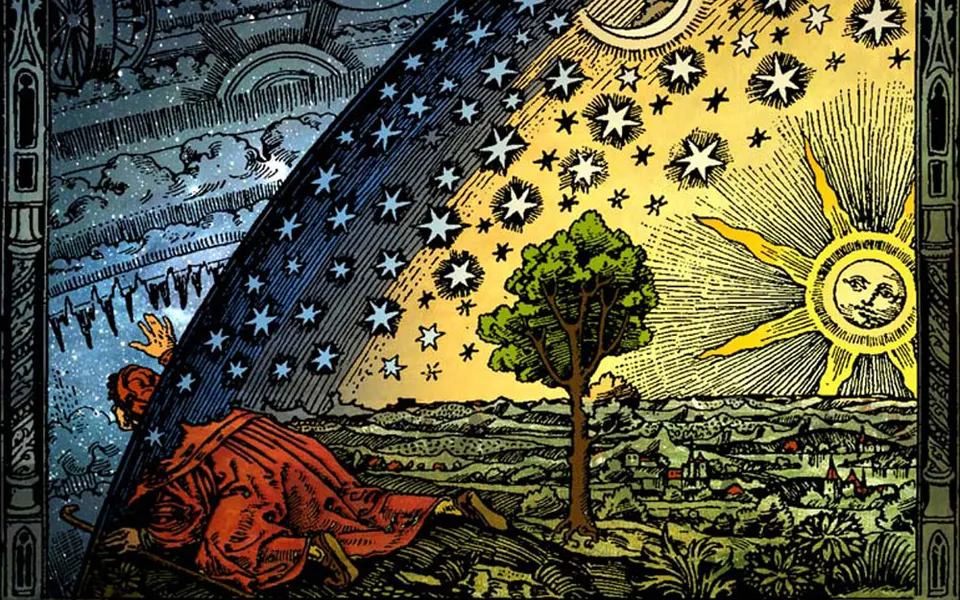
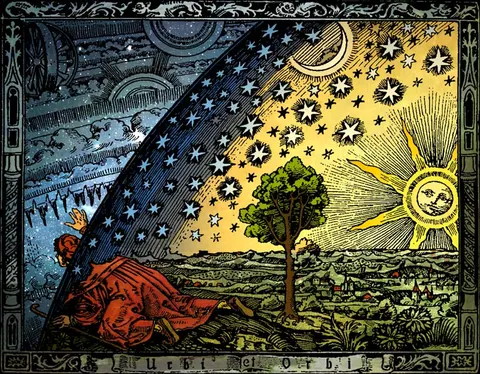
But then how do day and night alternate? In fact, the Sun stays on the ceiling above us and circles sideways around the North Pole, which is not a pole but the center of the disc. And now that we no longer doubt the flat idea, it is time to look further, to seek the reasons the oceans don’t spill out of the soup bowl, to see what lies at its rim that has kept us for so many years from being convinced of flatness.
7. Everyone into the Baking Pan
Well, we won’t tell you. Because the UN (an organization that has most demonstratively put a flat Earth in its logo!) lets no one near the so-called South Pole itself.
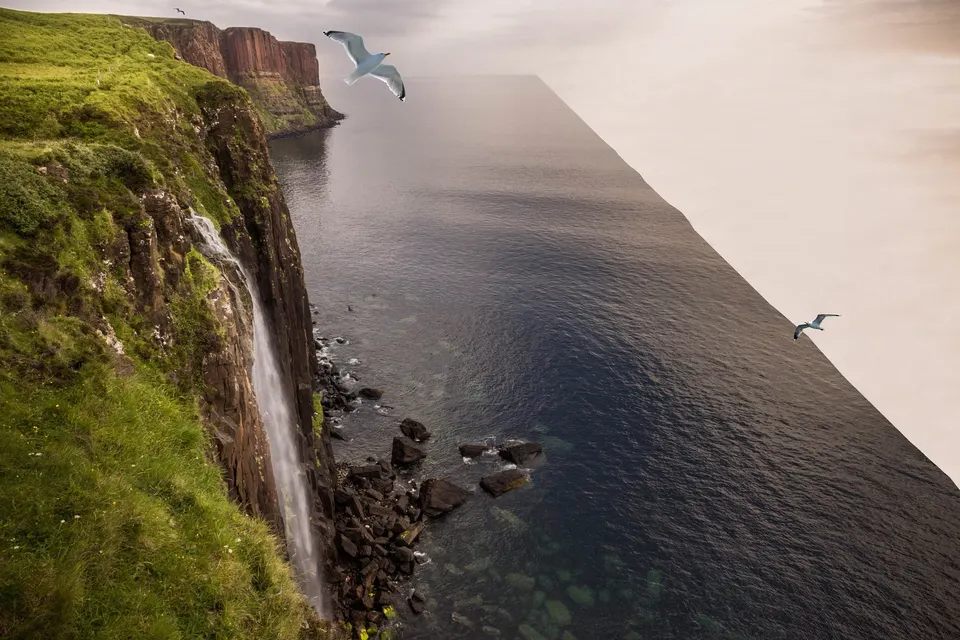
This is usually done with invented arguments about the need to protect its ecosystem, but the truth is that the edge is simply there. And as for what lies beyond it, flat Earth advocates don’t say, because they are researchers, not people of imagination.
All that is mentioned is the 45-meter ice wall that keeps us from sliding off.
Let us complete the overall theory. The Earth’s disc has a diameter of 40,000 km; the Sun and the Moon are the same size—objects 51 km in diameter, at a distance of 4,800 and 4,100 km from us respectively. Different stars are visible from different parts of the pancake, which logically counters the arguments of good old Aristotle, for whom the difference between the northern and southern hemispheres was proof of the spherical lie. But what is to stop different “little lamps” from simply shining “on the ceiling” above the two outer parts of the disc?
If there is no gravity, what holds us down? Well, not only a lack of faith in our own abilities, as with Jonathan Livingston Seagull, but also the fact that the disc is moving through space, and its acceleration pulls us toward the Earth, just as it happens to those sitting in the back seat of a souped-up BMW.
As mentioned, there is no universal flat cosmology to speak of. According to the current secretary of the Flat Earth Society, the programmer John Davis, for example, the earth stretches horizontally to infinity, and governments confine us to a narrow part of it so they can manipulate us.
In November 2017, the first world conference of flat-earthers was held in North Carolina; tickets cost $249, and around 400 people attended. Today the society has over 1,000 members (although in the days of the “old” Shenton there were up to ten times as many), and more than 9,000 people have joined the official forum. There is no need to mention the millions of views of the videos and the discussions on social media. “We now number in the thousands, and it is time for the theory to blaze new trails,” says James McIntyre, a moderator of the forum. “The moment has come to gather all the information in one place, to talk about it scientifically, and for its advocates to come together in a global community,” he adds.
“Of course, if you’ll forgive me for using the silly word ‘global’ (get the joke?).”
8. Nobody Loves the Flat Ones
One of the flat-earthers’ most charming arguments holds that the world of Copernicus was invented the way it was because it casts us in the role of specks of dust.
We think we are infinitesimally small, that we know nothing and control nothing, and this makes us a convenient, manageable mass in the hands of politicians.
Half of Americans (as of 2014) believe in at least one conspiracy theory. It is far more innocent to think that Elvis is alive (or Hitler; so far there is no such hypothesis about Lenin) than to question a fact undisputedly accepted for millennia.
“Doubting pleases me no less than knowing,” says Dante Alighieri. Confucius adds that what everyone hates needs to be examined, but the same goes for what everyone loves.
The next Flat Earth Society conference is planned for the second half of 2021, so if the arguments have won you over, it is not too late to join the ranks of this transnational anti-establishment elite.
The truth is that if no one told us otherwise, we would conclude that the Earth is flat. That is exactly how it looks at every moment of our lives. And when it comes to space, no one can check things for themselves; you always have to trust someone. That is why it is quite easy, if one is inclined to question everything, to doubt the so very doubtful fact that we live on a ball.
Flat-earthism is one of the most popular forms of denialism—the irrational rejection of generally accepted facts and scientific data.
And if you will excuse the ironic take on the topic so far, it is time to admit that people who have the courage to stand against the conventional deserve some sympathy. Sometimes their imagination even reaches impressive heights. Some of them are not afraid of society’s ridicule, while others use it quite deliberately to rack up cheap fame.
In the ocean of the internet, anyone can get any kind of information. That is a priceless treasure and a risk, because not everyone is ready for it. Still, perhaps it is going too far to challenge the very foundations of our knowledge, because from there to primitivism it is only a few steps.
And once we start taking them, it would be no wonder if, without noticing, we spilled off the flat Earth, far away, into nothingness.
Published: Spisanie 8 magazine, December 2018
Last updated: April 12, 2021