“The best way to get the right answer is not to ask a question. It is far more effective to post the wrong answer.” And everyone will rush to correct you, to jump into the argument, right?
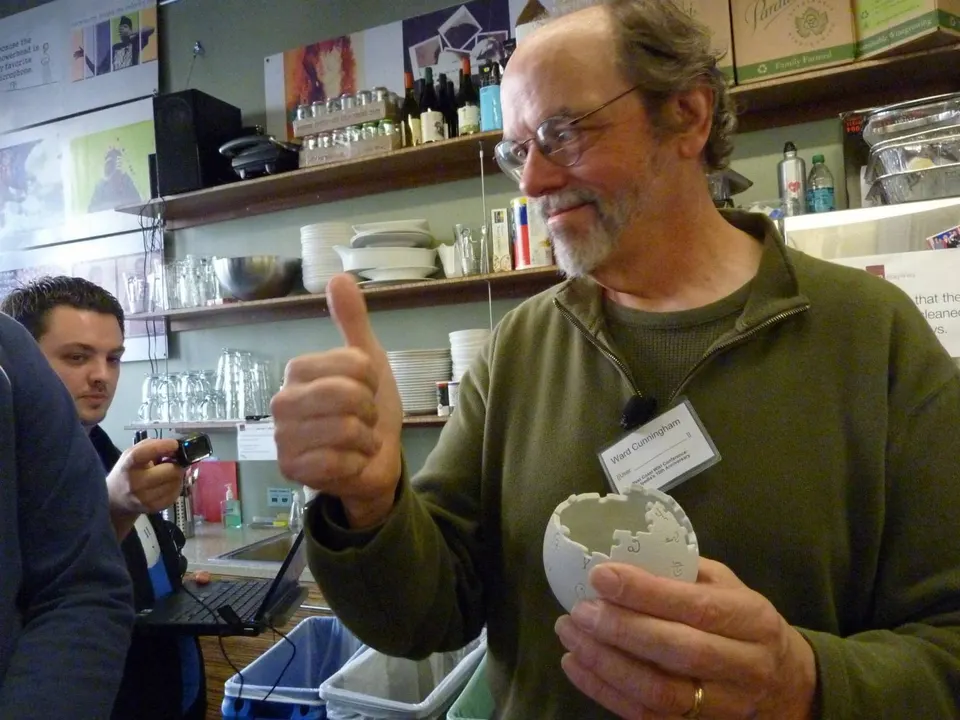
That is exactly what “Cunningham’s Law” says, a fascinating rule about how online communication has changed us. But who is this Cunningham? His story is an interesting and instructive one. One of the pioneers of the democratic internet, he paved the way for Wikipedia and for the systems we use to share opinions online. And if you have ever wondered where the free encyclopedia got its name, he is the one who came up with it, after an unexpected episode.
Our hero’s contribution to the way we develop software is enormous. Besides being one of the authors of the Agile Manifesto, which laid down the foundations of today’s IT industry, Ward Cunningham gave us concepts that are used everywhere these days, such as technical debt and extreme programming.
And yet today you will find only a handful of lines about him online, repeated over and over. So it is time to dig into the story of one of the pioneers, one of the fascinating figures who stood on the bright side of the tech world. The ones we have to thank for the internet still being a free platform. One where, despite the relentless and ever-deepening dominance of the giants, there is always room for everyone’s opinion…
Wiki, Wiki Way
The early 1990s. Howard Cunningham and his wife have set off on a long-awaited trip to Hawaii. The two are among the pioneers of computer technology; they met at university in the 1970s, at a student party after a tough exam. Back then computing was not even taught as a separate discipline, and the two studied electrical engineering combined with software. After graduating, they founded a company together, helping the pioneering firms that had decided to use the grandfathers of today’s computers in their daily work.
But work stayed at home. The couple landed at the airport in the capital, Honolulu, where an unheard-of heat was waiting for them. They hurried outside to find quick transport to the hotel, and in front of them stood two little shuttle buses. With big, proud signs… “Wiki” and “Wiki Wiki.” What on earth could that mean, Ward wondered. It turned out that in the local language the word means “quick,” and saying it twice translates as “even quicker.” It was the first Hawaiian word Ward ever heard (and probably the last one he learned), but it struck him as especially colorful.
We will leave it to the experts in Hawaiian to tell us whether more repetitions would make things faster still, but the vacation in Hawaii certainly went by quickly for the Cunninghams.
The two came home, and when Ward went back to the side project he was building in his spare time, he remembered the “wiki” buses and decided to name it after them: “WikiWikiWeb.” Just a few years later the word would become famous as part of “Wikipedia,” the universal place where we so often look for an independent view today. One of the symbols of the democratic internet, of the attempt at impartiality, of the ideal of equality online, which so often finds itself in a decisive battle with the ideas of the big players…
Hakuna Matata!
And although our hero had no direct part in creating the free encyclopedia itself, he is not only its godfather (the origin of names in the tech world can be truly curious) but also its forerunner. It was his system with the two “wikis” that laid the foundation. It let people gather and add to information at the same time, and discuss it in a way that was traceable, clear and well argued. And all of this… so that we could build better software.
That is the big dream Ward Cunningham keeps chasing even today, now past 70. As he tells it, back in the 1970s computer science was already looming as a great challenge, yet its real foundations had not been laid. Hardware development was moving ahead, engineering practices were being introduced, computers were getting faster and faster, while writing programs happened chaotically, without organization, leaving behind serious problems that were far harder to solve later on.
Ward learned about the network that would become the internet shortly after it was developed by Sir Tim Berners-Lee’s team. And he quickly began dreaming of a global platform that would let us exchange information at unprecedented speed.
He built his first website in 1993, when the internet was anything but fast. It would take another decade before speeds were good enough for us to swap files casually with the other side of the world.
Go, Wiki, Go!
Ward’s first site was exactly that platform, where he invited like-minded people to discuss the problems and big questions of software development. And when, a year later, he hit on a technical way to let any visitor add to the information, he remembered the trip and Honolulu’s quick little buses. And so WikiWikiWeb was born—a site where programmers discussed and added to each other’s ideas… quickly, at least by the speeds the network was capable of back then.
Gradually, after the first “wiki,” thousands of others would appear, tied to different communities. Ward would offer the platform to anyone who wanted to use it, because, as he says himself, it never occurred to him that this was something that could be patented. “Wiki” would become a synonym for a collection of information on a given subject, even before the next generation of computer enthusiasts took the idea further and turned it into “Wikipedia,” an “encyclopedia of everything.”
What is a wiki? “In its simplest form, it is a website that respects the intellectual creativity of the reader,” Cunningham says. “It says that this person reading the site might know something I don’t know. And when he knows it, if he’s willing to give it, we’re willing to take it. It says: ‘We are having a conversation.’ Isn’t that cool? That is what our culture is built on—trust between us.”
It was in that first wiki that Ward put forward another of the ideas that earned him a place in the history of computer science. In recent years there has been a lot of talk about “extreme programming,” an approach used to develop software above all when it has to happen fast, for example in startups.
The Extremist in Glasses
But… what could extreme programming possibly mean? Skiing down a slope while writing your code, or bench-pressing a hundred kilos? That would be interesting, but, as you might guess from Ward’s photos, that is not quite the idea.
In fact, it is a fairly broad concept in which programmers develop their product in short cycles, with higher productivity that comes neither at the expense of quality nor, as the name might mislead us into thinking, at the expense of stress.
Another idea from extreme programming is writing code in pairs (could it be a coincidence that Ward has been working alongside his wife for 50 years?). The ideals include simple code and frequent communication within the team. And if you are wondering where the extreme part comes in… the idea is that the very practices Ward and his like-minded colleagues considered most useful in building software are taken to extreme levels.
Even people from the software world may never have heard of extreme programming, but whether you know one particular little word from our hero’s experience is a sure sign of whether you have ever brushed up against the industry. In recent years, being “agile” has become a mantra repeated everywhere you turn. The concept, which we might render as “flexible” software development, came at the start of the new millennium from a short, clear yet general manifesto written by leading lights of the industry. The “Ten Commandments” for programmers are actually… twelve. Principles such as “individuals and interactions over processes and tools” and “working software over comprehensive documentation.”
These days you will hardly hear of a software team, at least in our part of the world, that does not follow the tenets formulated by 17 “wise heads” in 2001 (you can find the official Bulgarian translation here). Perhaps the best known among the signatories are Robert Martin, familiar to visitors of Digital Stories as Uncle Bob, Martin Fowler and, of course, our hero today.
Although throughout his long career he never stopped working for the family company, he joined many other ventures along the way. And while most of them were smaller projects, away from the mainstream, it is worth noting that he spent two years at Microsoft in the Patterns & Practices group. How many good practices he managed to introduce we can only guess, given that he did not manage to stay in that job for very long.
Debt Calls
Owing someone money… for many it is a nightmare, for others everyday life. And so we come to another huge and very important concept formulated and popularized by Ward—so-called technical debt.
All too often, in a hurry and driven by the need to keep adding new features to the software, its creators settle for compromises. They leave lines of code that could have been written more clearly, they make judgment calls that are far from optimal. And so, slowly but surely, this burden accumulates—a measure our hero was the first to popularize.
Today we all witness the enormous tons of technical debt piled up by the biggest software companies. Massive projects with billions of users often fail because of small bugs, do not work as expected, become vulnerable to cyberattacks. Ward predicted this phenomenon back in the days before the internet conquered the world. And he put it clearly: every software team should keep track of the technical debt it accumulates and take measures periodically. So that code already written gets improved, adapted, updated… The opposite of what the traditional programmer’s wisdom says: “if it works, don’t touch it.”
Well, with views like these we can guess why Ward never made it big among the Silicon Valley giants, who are always in a rush, rush, rush, chasing new software features… and billions.
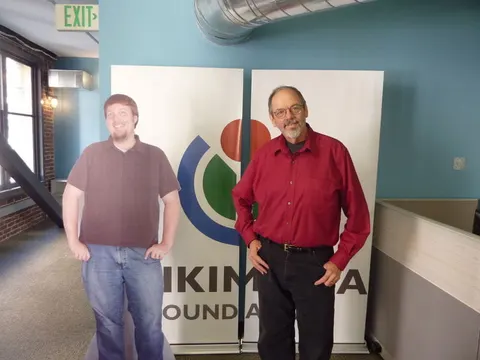
No Credit, to Anyone!
And so, despite all his remarkable achievements and his contribution to the way we build software today, you are far more likely to come across his name as part of “Cunningham’s Law,” which we started with. But how did a programmer become famous for the thought that “The best way to get the right answer is not to ask a question. It is far more effective to post the wrong answer”? It is not his fault.
Some trace the roots of the law back to antiquity. In Plato’s dialogue Meno, for example, Socrates agrees with the mistaken conclusions of his friend Meno, hoping that this will keep the conversation going. Either way, the principle still works flawlessly on Facebook, because people often love to look smarter than others. And online they get the chance to show it in full force (although sometimes the result is the opposite).
While he admits that the popularity of the “law” flatters him, the programmer believes the rule refutes itself by how often it is misquoted online. In fact, the wording was proposed by Steven McGeady, a longtime leader at the microprocessor maker Intel.

Ward’s Word
Steven recalls how in the 1980s Ward gave him this piece of advice about communicating in the ancestors of today’s forums. Our hero later said he had been misquoted, but that did not stop the law from becoming more famous than his real achievements. He himself considers the wiki platform his greatest contribution and believes that it is what will be carved on his tombstone.
Because it helps us share, work together, complement one another—something that is getting harder and harder these days, he notes. “Sometimes, when you work in a team, you have to trust people more than you have reason to,” Cunningham says. “And it works, because most people are good.”
This comes from a man driven forward by technology his whole life. Who back in the 1990s lived in a house with several internal networks, where every resident, even the cat, had a website. And computers lay scattered around the way magazines lie open in most homes, as a journalist who visited the programmer aptly put it.
“Ward has always been a social type,” says his wife, Karen. “He is especially interested in meeting people who challenge his thinking or inspire his intellectual curiosity. For quite a while now his real focus has been on communities, on ways of using technology to build them.”
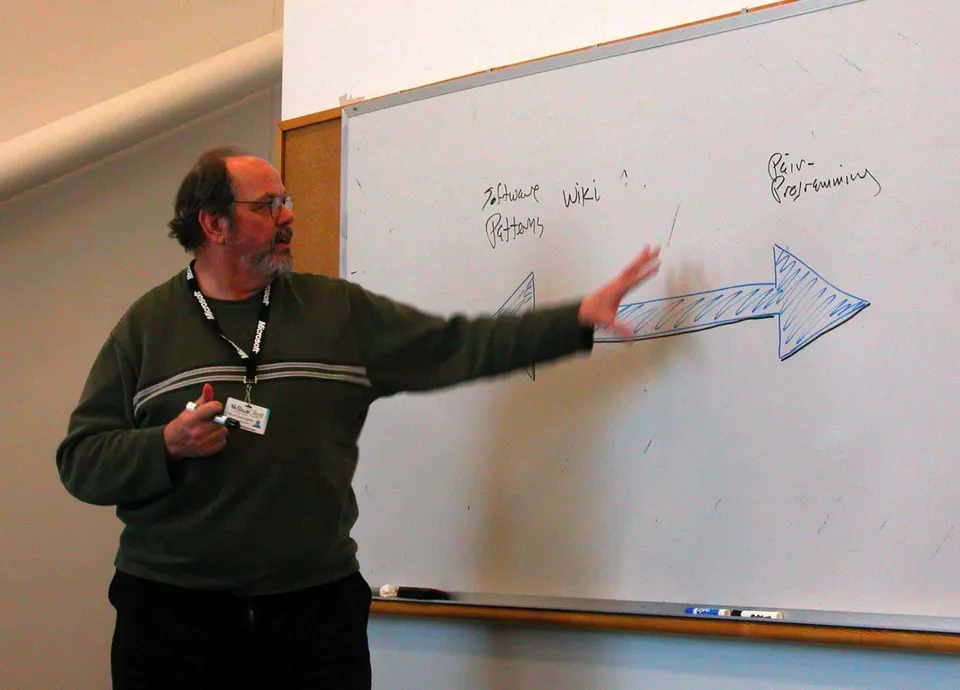
Simply Ward
“I really do think programming is an easy and fun thing to do,” Ward says.
“Those who find it hard and boring just need to get a little more experience.”
And if there is one more thing from his professional biography worth mentioning before we part, it is that Ward is among the people who spent many years championing the “little” programming language Smalltalk. (More about it here.) A language whose syntax is so concise it fits on a postcard turns out to be extremely handy in a whole range of situations.
Because, as our hero likes to repeat, simplicity should be a fundamental rule in the work of people who build software. Simple solutions are the most elegant, the most understandable, the easiest to maintain. And every complication that can be avoided is worth avoiding.
“What is simplicity? The shortest path to a solution,” he says. “Actually, I enjoy complexity that empowers me. If it challenges me, it’s very pleasant. But sometimes I have to deal with complexity that disempowers me. The complexity we despise is the kind that leads to needless difficulty.”
And come to think of it… for the software world this is beyond dispute. But might it not also be a wonderful rule for life?
This piece was prepared with the special assistance of Irina Marudina.