Would you like to hear a song with a catchy melody, performed at the same time by a symphony orchestra, a rock band, a DJ and three singers, one for each of these styles? And what if you could add or mute every performer and every group of instruments? Wouldn’t the result be remarkably interesting? A thought-provoking metaphor for how easy it is to find the shared melody and build on it, even when at first glance we seem impossibly different.
It is a fascinating digital experiment that you can try for yourself here. But before you do, there are quite a few interesting things worth reading about it and about its author—the composer Alexander Kostov.
In One Voice
These days the subject of war is everywhere. And although this project is called “War of the Instruments,” that is definitely not the message you will take away once you open the site. Experimenting with the separate groups of instruments turns out to be an instructive musical experience.
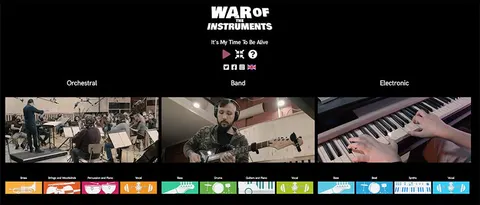
The project is as original as it is impressively precise in its execution. We watch videos laid out side by side: the symphony orchestra, the rock band and the DJ with his electronic trills. Three parallel video clips that look and sound entirely complete, while all playing one and the same piece.
We stop one of the three performances and the song takes on a new sound. Then the next one… and it seems slightly maimed, when in fact it has simply settled into one of the genres. Then we can switch individual groups of instruments on and off, discovering more and more for ourselves, along with further musical messages buried deep beneath the lyrics.
Maestro, Music!
There are two songs on the site, but you can listen to them many times over, because their meaning is rather more philosophical. At the same time, they are genuine, meaningful music, written by a composer who knows exactly what he is doing—enough to render his work in so many different styles at once. And without those styles arguing or fighting with one another.
We owe this original experiment to a composer who, tired of creating only to turn other people’s ideas into notes, decided to make something of his own, straight from the heart…
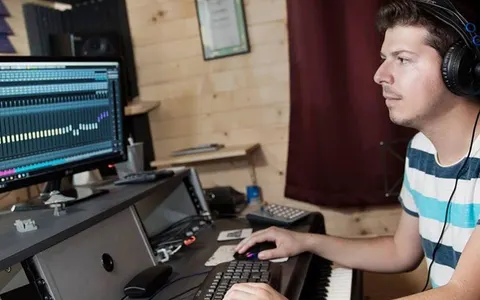
Alexander Kostov writes music for films, computer games and other projects. At just 32, he already has quite a few titles behind him.
How does a person choose to make music professionally? What kind of profession is that of a composer today?
Not in the Mood to Sing
Although his father is a composer, when he was in high school it never even crossed his mind that this might be his future calling. It happened by chance. In tenth grade his father gave him his old laptop, which—by accident or not—turned out to contain the music programs he used every day. “I was a teenager looking for a new hobby, and out of curiosity I started opening those programs,” Alexander recalls.
He had been thinking of applying for something related to information technology, but became convinced that music was an interesting vocation, and so he ended up at the Academy of Music in Plovdiv.
After that, his professional development took the best possible direction, because he got the chance to compose for films and computer games—precisely the two things that had fascinated him since childhood. “From a very young age, when I watched films, I listened more to the music than anything else. I was interested in how it was made so that it sounded good and fit the picture at the same time. So that it was in sync with it and supported the action.” His first experiments with composing were exactly like that. He would take a clip from a film or a game and create his own version. Then it all turned into a profession…
…and Let the Orchestra Play
But how did the story continue, all the way to “War of the Instruments,” which is no war at all, but quite the opposite?
This story is interesting because the idea has nothing to do with the result.
A devoted fan of well-designed computer games ever since the days of Age of Empires and StarCraft, Alexander came up with the idea for an original project to work on in his spare time.
The project was born as an idea for a cartoon-style game in which the instruments themselves are the heroes, moving across the battlefield. “Only instead of shooting at each other with bows or rifles, each one plays some melody. You hear it from both instruments that are fighting. It looks like a classic strategy game, but in terms of sound it’s interesting for people who would appreciate that,” the composer explains.
Taking Flight in Spring
He met with colleagues from the world of computer games and discussed his idea, but they all told him the undertaking was far too ambitious to build easily. The composer didn’t give up on his dream of “War of the Instruments,” but decided to bring it to life in a very different way first. And so the unconventional online platform was born, in which the instruments do, after all, go to “war.”
Alexander decided that this was a form of the idea worth working on, and he found kindred spirits. Every colleague from those circles he told about it was keen to take part. The composer judged for himself that this was the venture worth doing for his own sake, and that he would put serious effort into it. That is how “It’s my time to be alive” and “If I” came about—the two tracks you can hear today, impeccably polished, as part of the project.
The symphonic part was taken on by the Sofia Session Orchestra, and the vocals belong to Jamie Rashed, known from The Voice of Bulgaria, Eva-Maria of Deep Zone Project, and Vesela Delcheva, known for her performances for the game Baldur’s Gate 3.
A Musician’s House…
How is this astonishing synchrony achieved—not only between the people performing the music, but between the styles themselves?
Perhaps the secret lies in Alexander’s experience with film music, which brings together so many styles.
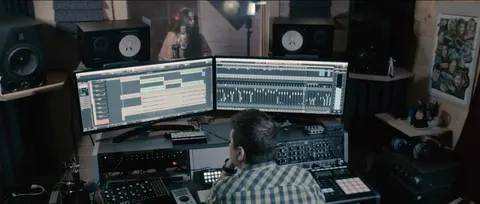
Each group of instruments was recorded separately, and so were the vocals. Joint performances were organized only to shoot the music videos, which the composer cares about a great deal, because they show his overall idea.
Is it really hard to get so many different musical strokes to arrange themselves into a picture that can be filled in further? Certainly—but not if you listen to the man who created it.
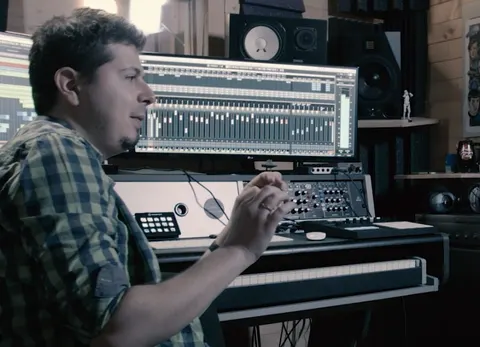
First the electronic version is made, and there things are fairly easy, because there is no human element apart from the vocals. The orchestral version is painted on top of it, and then the one for the band.
The Voice of Bulgaria
For most musicians the performance was routine work, because that is exactly how they are used to recording—hearing the other sound and following it. “The only problems were with the singers and the percussion,” the composer says. The electronic drums are computer-synthesized, so everything there happens without the slightest deviation, while with the band, however strict the drummer, corrections were needed in post-production.
The voices, however, proved the hardest. No matter how good the chosen performers are musically, they cannot escape the human tendency to slip in even an imperceptible bit of improvisation.
“My idea was to show what it would sound like to hear two different instruments playing the same melody at the same time,” he adds. Each song is now divided into 12 groups—3 for each style of instruments plus vocals—though originally the idea was to have many more. The musicians were also filmed in groups, so that only those you can hear would be shown on screen. That, however, turned out to be a technically complicated undertaking… and all the better, because in its current form the project looks finished.
Songs and Dances of the Nations
And yet, at least in my view, it flatly contradicts the idea of any kind of war. Quite the opposite.
Alexander has a very clear idea of what his game would look like. The melody would play the leading role, changing at every moment depending on which instruments are fighting. He has even drawn up a detailed plan describing how he imagines it all. First come the classical Western European instruments, cast as the typical Western empire. Next, as the rebels, come the pop-rock instruments that challenge it. From the east or the north, the electronic ones step in…
The young composer believes that one day he will have the energy and the time to develop this idea as well. For now, the site presents it in a somewhat different way. “I just want to make something interesting that I myself get a kick out of,” Alexander admits candidly.

Melody of the Year
Meanwhile, he has to get back to work. You can find the long list of films, games and other projects he has worked on on his website.
So which ones is he proudest of?
Stanislav Donchev’s film Letters to Antarctica challenged him because… it was not supposed to have a single memorable theme—a wacky decision by the standards of the film world. “That gave me the challenge of making the music interesting without it being memorable. The director had a clear vision that he didn’t want the music to pull the viewer’s attention away; it simply had to support the action. The result turned out pretty good, but if someone asked me to hum a tune from it, I’d find it extremely hard,” the composer confesses.
Among computer games, his most interesting project is Lifeslide for the small Bulgarian studio Dreamteck. “The game is a flight on a paper airplane, which is a metaphorical journey through life—starting with birth, going through all kinds of hardships and reaching the end. The music changes imperceptibly, taking on different forms and moods as the game progresses,” Alexander explains.
Mozart and Salieri
I have always wondered… how is music born? Does the composer suddenly hear some “ready-made” idea, or does he sit at his desk, thinking and trying things out?
“It has always been both. Sometimes I’m at home cooking dinner, or I’ve just gotten up and I’m making coffee, and some melody appears. I decide it sounds interesting and is worth writing down before I forget it. I grab a sheet of paper and a pencil and write it out, or I just hum it into my phone so I don’t forget it before I get to the studio,” the composer says.
That, though, is the rarer case. Usually he receives a project, a task and a deadline to work to. Very often he is also given a reference: music to follow as a guide to the style. From there on it is sitting, thinking, trial and error, until the final result is reached.
And where is the art? In everything so far. And yet, in a more unexpected way, in “War of the Instruments,” which is no war at all but complete synergy. Doesn’t this venture tell us everything about music, about synergy, about the point of playing on the same string?
Have a listen here—you’ll find some interesting answers.