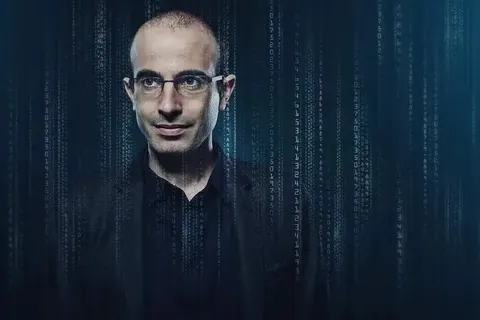
To tell the whole history of humankind in a few hundred pages… sounds like an impossible task. Then to tell the future. And finally, to draw attention to the big questions of our day in a way that wins over both readers and the people who make decisions… That becomes more than a superhero mission, wouldn't you say? I can think of only one person who has pulled it off, even though he lacks the typical outward features of Batman or Superman.
Yuval Noah Harari. You will often hear the name of the historian and futurist in conversations about the future. In recent years he has established himself as the world's thinker who not only manages to untangle, thoroughly and competently, the threads from which the history of humankind is stitched together, but also poses the big questions of tomorrow.
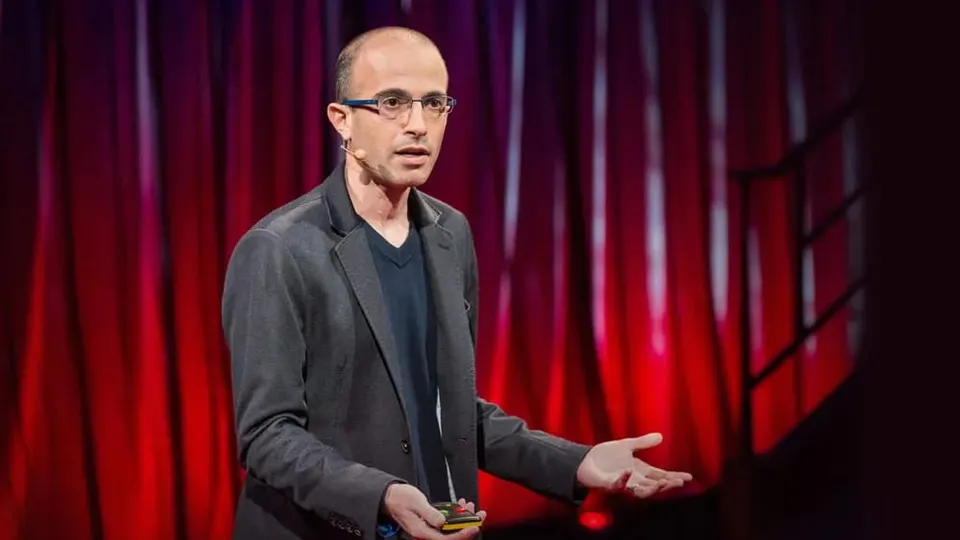
The Salt of the Earth
But how did a history professor become the favorite author of people like Bill Gates and Barack Obama, Mark Zuckerberg and Bill Clinton, while at the same time being popular, translated, read and debated? How does he manage to reach people's minds with his long texts in an age when concentration and a deep look at things have become exotic skills?
A colorful figure, beyond the stereotypes. A favorite target for anyone who wants to shine. A vegan and an animal-rights advocate, he and his husband head a foundation that aims to provoke public debate on important issues. The Israeli is at once a widely recognized scholar and an authority. Most importantly, in my view, he is a valuable and powerful voice warning us about the immediate dangers we face as a species. Here is what is worth knowing about him and his striking insights.
1. “Given the magnitude of the danger, artificial intelligence should be of interest to every human being. While not everyone can become an expert in the field, we must remember that this is the first technology in history that can make decisions and formulate new ideas on its own. All our previous inventions gave new powers to humans, because no matter how powerful a new tool was, the decision about how to use it remained in our hands. Knives and bombs do not decide by themselves whom to kill. They are mere tools, lacking the intelligence that would allow them to process information and make independent decisions. Artificial intelligence, by contrast, can process information by itself and can replace humans in decision-making. It is not a tool but an agent.”*
* The quotes are from Yuval Noah Harari's new book Nexus: A Brief History of Information Networks from the Stone Age to AI
Harari is a legend, a myth, a luxury brand. Inviting him to give a lecture can cost a six-figure sum in dollars.
Though he himself says that a brand is simply a well-told story that has turned into much more. He tells us about Stalin, who refused to let his own son use his name as proof of authority, because the story is much more.
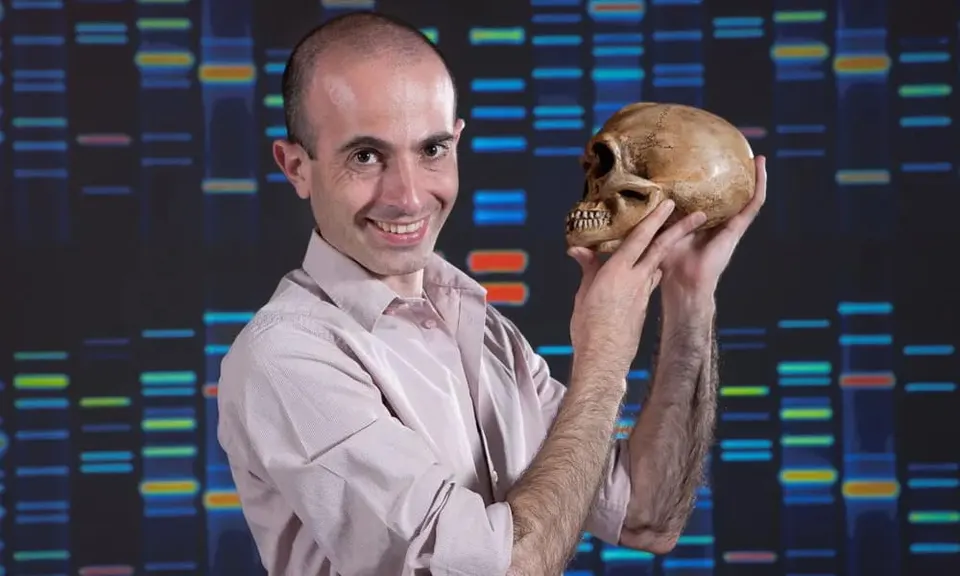
A Time to Be Born and a Time to Die
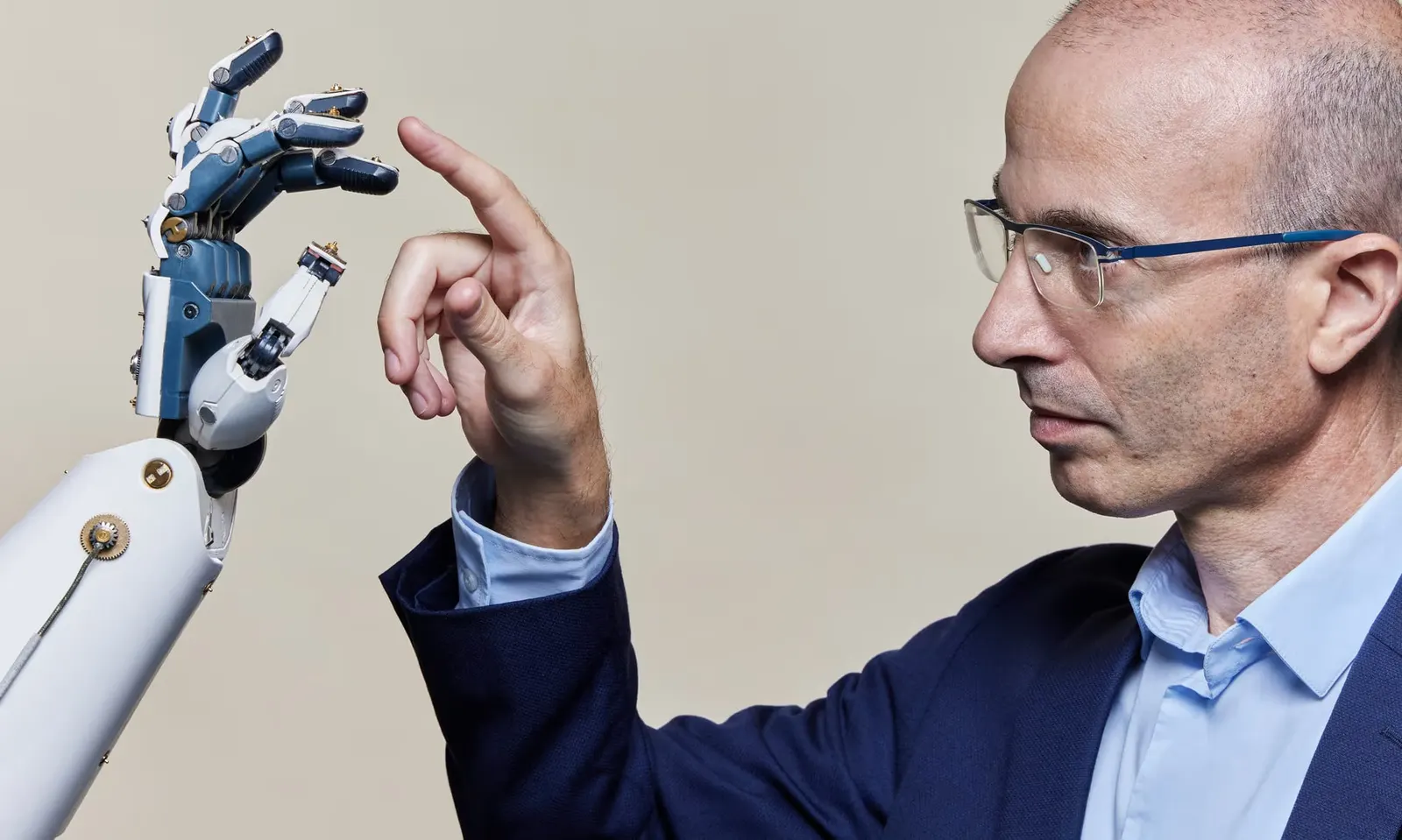
There is also a stronger story connected with that same son of Stalin, but Harari chose the other one. “Harari”—you can hear his name from so many directions. On this site, for example, I quote him often for his brilliant metaphor that the human being today is not the crown of creation but simply a creature that can easily be (and already has been!) hacked by algorithms.
How is the Harari legend born? A hard question, but Yuval himself was born in 1976 in the small Israeli town of Kiryat Ata. His father was a weapons engineer, his mother an office manager.
2. “How does information flow? As we have seen, the new information technologies of late modernity gave rise to large-scale democracy and large-scale totalitarianism. But there are key differences in the way the two systems use information technology. Democracy allows information to flow through many mutually independent channels rather than passing through the center, so that many independent centers process it and make decisions. Information circulates freely among private companies, media outlets, municipal authorities, sports associations, charities, families and individuals without passing through any government office. Totalitarianism, on the other hand, seeks to have all information pass through the center and does not want independent institutions making decisions on their own.”
By the age of 3 he could already read; at 8 his ambitious parents enrolled him in a school for gifted children. At 17 he was admitted to study history and international relations at Tel Aviv University.
His home country is famously strict about military service, yet he was spared it. First it was deferred by his university studies, then by medical reasons.
To this day Harari, perhaps the most popular thinker of our new age, lives in a typical middle-class neighborhood of Tel Aviv. All while being one of the favorite speakers at Davos and one of the best-selling writers on the planet. Even so, they say, his life is unusually modest. Far from the glitter of high society, which, of course, cannot be unconnected to his nationality.
3. “For a long time we believed that the victory of democracy over totalitarianism was final. That victory is usually explained by democracy's fundamental advantages in processing information—totalitarianism doesn't work because it tries to concentrate and process all data in one place, which is extremely inefficient. At the start of the twenty-first century, it seemed that the future belonged to distributed information networks and to democracy. That turned out to be wrong. In fact, the next information revolution, which is just gathering momentum, is preparing the ground for a new round in the contest between democracy and totalitarianism.”
He specialized in medieval warfare and went on to a doctorate at Oxford. And soon afterward, imperceptibly and unexpectedly… he became a superstar. Forgive me for repeating myself, but he definitely does not like to talk about personal matters and knows how to keep them hidden; from what we know, though, his first book came out almost by chance.
Ask, and It Shall Be Given You
After successfully completing his doctorate, Harari returned home and began teaching the fundamentals of historical science to students from a wide range of majors. The students loved the course, and so came a publisher's invitation for Harari to gather his lectures into a book. Thus in 2011 Sapiens: A Brief History of Humankind appeared, bringing together millennia of evolution in an engaging narrative, as the historian sees it. Three years later it was translated into English, and today it has been published in more than 50 languages. The book stayed in the top three of The New York Times list for 96 consecutive weeks! Not a romance, not a thriller, but a scholar's account of humanity's past…
Sapiens catapulted its author's popularity to a global level. A history textbook, only written with the page-turning pull of an adventure novel. The reader gallops from the Stone Age through the agricultural revolution all the way to the age of artificial intelligence, realizing along the way that our species' secret weapon is neither muscle nor claws but the unique ability to believe in shared “fictions”—gods, nations, money—that bind us together in groups.
Harari shows how one particular species of primate rose to become master of the planet thanks to its rich imagination and its ability to cooperate in large societies through shared myths.
4. “By skillfully using language, computers can go one step further. By conversing and interacting with us, they can form intimate relationships with people and use them to influence us. To create such fake intimacy, computers don't need feelings; they only need to learn how to make us become emotionally attached to them.”
Having reminded us where we come from, Harari turned his gaze forward. In 2016, in Homo Deus: A Brief History of Tomorrow, the historian looked at humanity's ambitions to surpass itself, to defeat aging and death, and even to “upgrade” Homo sapiens into a kind of god.

The Beam in Thine Own Eye
In this book Harari predicts both dizzying achievements and grim scenarios. He warns of the emergence, by the middle of the century, of a new kind of people—the “useless class,” unable to fit into the labor market. While some become godlike through biotechnology, others risk being left as superfluous onlookers. As the futurist Assoc. Prof. Mariana Todorova aptly put it, it is the time when we have to reinvent ourselves.
5. “We humans are still holding the reins. Nobody knows how long that will last, but we still have the power to shape these new realities. To do so wisely, we need to understand what is happening. When we write a computer program, we are not just creating a new product; we are reshaping politics, society and culture, so it is good to have a solid understanding of each of these fields. We also need to take responsibility for what we do.”
But why did a historian, and a specialist in medieval wars at that, step into the role of futurist? I don't think anyone could find a worthy answer. Naturally, the courage to venture in such a different direction has earned him criticism too, but it doesn't seem to trouble him.
Next came the essay collection 21 Lessons for the 21st Century, and then we arrive at his newest book—Nexus boldly peers into the existential questions about the future of humankind in the age of artificial intelligence. Into the next step in the seemingly eternal war between democratic regimes and autocracy.
At least in my view, in this paradigm he gets carried away by stereotypes, by black-and-white, emotional thinking. He tries to project phenomena from the past onto a future that, by every indication, is far too different for far too many reasons. But, I am sure, my opinion would not trouble an adviser to American presidents and an author with print runs in the millions. So if you ever meet him, feel free not to spare him.
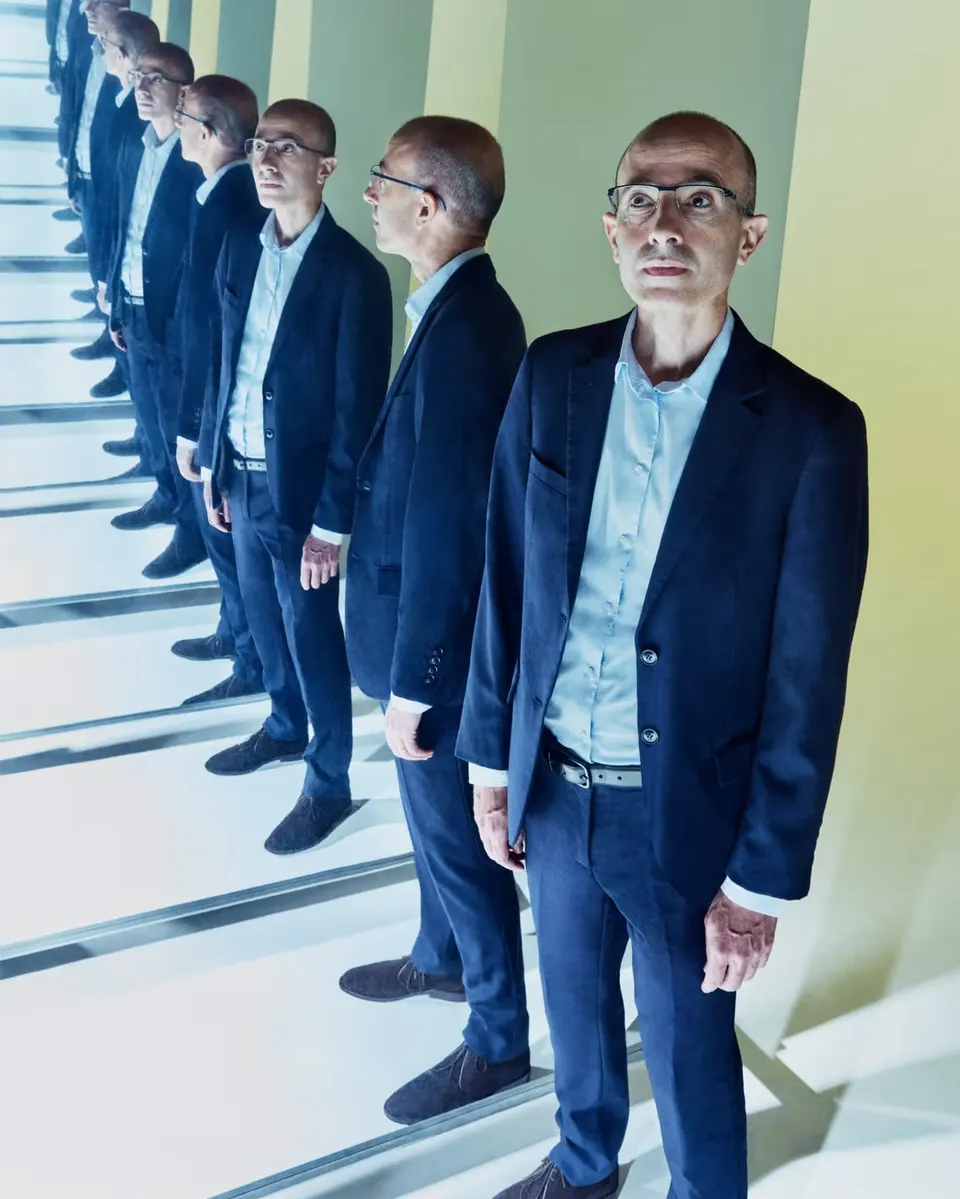
Love Suffereth Long, and Is Kind
Harari strongly (and, in my opinion, naively) advocates very strict regulation of artificial intelligence. He points out that every pharmaceutical product goes through years of evaluation before it reaches people, while new versions of artificial intelligence, on which the future of all humankind may depend, are released just like that, mostly at the discretion of tech leaders. Yes, regulation is a wonderful idea—at least until we realize that the models keep getting better and are open source. And the idea of controlling such a technology may safely be called an illusion.
6. “A dangerous asymmetry arises. The leaders of the information revolution know far more about the technology than the people who are expected to regulate it. What, then, is the point of repeating that the customer is always right and the voter knows best?
Nexus: a link. That which connects us as human beings and which is only now confronting us with the enormous challenge of technology—the very reason this site exists.
The success of his books inspired him to found Sapienship, an organization that aims to focus society's attention on the most important global challenges. It is headed by his husband, Itzik Yahav, who is also Harari's personal manager. Same-sex marriages are not permitted in Israel, but they are recognized if performed abroad, and so the two married in 2010 in Toronto, Canada. In the rare moments when he allows himself a personal emotion, Harari says Itzik is the love of his life. Although both come from the same small town, their paths crossed some 20 years ago through one of the first online dating apps.
7. “The key question is: what would it be like to live in the new computer network as an increasingly powerless minority? How will the new network change our politics, society, economy and daily lives? How would it feel to be constantly monitored, guided, nudged and sanctioned by billions of nonhuman entities? How will we have to change in order to adapt, survive and even flourish in this astonishing new world?”
Among his other favorite subjects are animal rights, especially those of farm animals. That is why he went vegan long ago; in his view, “industrial farming is one of the worst crimes in history,” and “the fate of the animals raised there is one of the most important ethical questions of our time.”
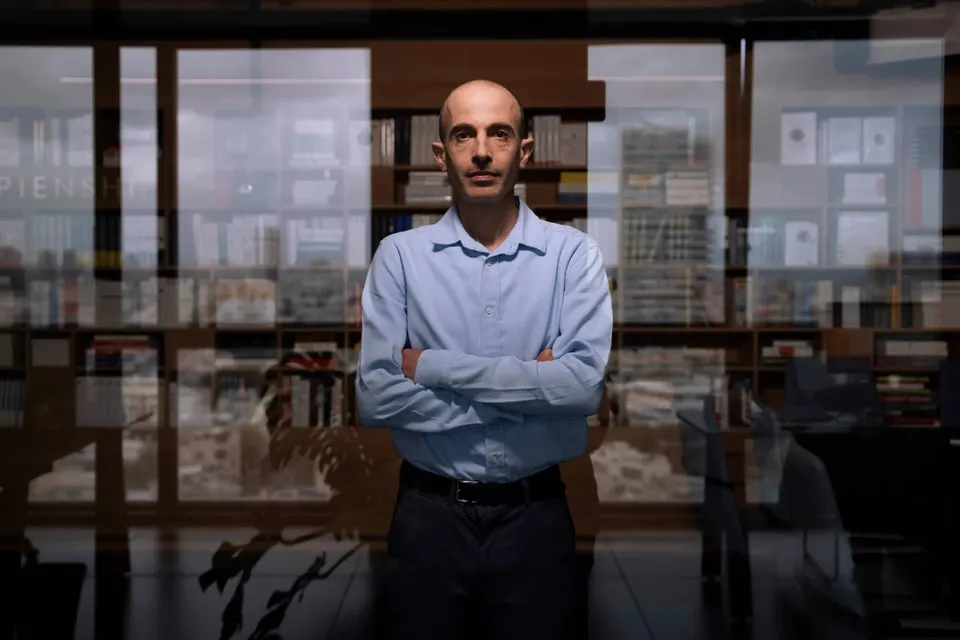
The Truth Shall Make You Free
Meanwhile, he has written many scholarly books on topics such as military operations in the age of chivalry, the concept of “decisive battles” in world history, and the birth of modern warfare.
8. “The end of privacy. In a world where humans watch humans, privacy is the default state, but in a world where computers watch humans, it may become possible for the first time in history to destroy personal space completely.”
Inevitably, he draws no small amount of criticism—both for the way he presents history and for often writing on subjects outside his expertise. According to Ian Parker, “Harari did not invent ‘big history,’ but he updated it with notes of self-help and futurology, as well as a lofty, almost nihilistic calm about human suffering.” Another review of Sapiens, by Christopher Robert Hallpike, states that the author “has read surprisingly little on some quite essential subjects. It would be fair to say that when his facts are broadly correct they are not new, and when he tries to strike out on his own he often gets things wrong, sometimes seriously.”

Love Your Enemies
One might almost be surprised that it doesn't happen only in our part of the world, but he is often called not a historian but an “infotainment” specialist. And yet, especially in times of frayed authority and a sea of information, his powerful voice is important and useful.
9. “Can we still talk to one another? Civilizations are born from the marriage of bureaucracy and mythology. Computer-based networks are a new kind of bureaucracy, far more powerful and tireless than the human bureaucracy we know from the past. This network is likely to create inter-computer technologies that will be far more complex and alien to us than the gods humans created. The potential benefits of this network are enormous. The potential harm is the destruction of human civilization.”
Harari certainly likes to provoke—he has gone down in history as the first speaker at the TED conferences to appear not in person but as a digital avatar.
Meanwhile, against that backdrop, Yuval himself… avoids technology. Until a few years ago he had no mobile phone at all; now he uses a basic model, saying he needs it only when abroad, in case of emergency.
In the Beginning Was the Word
He describes himself as an atheist but is also devoted to meditation—he practices for two hours every day. Once a year he withdraws from the world to meditate for 30 days or more. He spends them in silence, with no social media, not even books.
10. “In the German elections of May 1928, the Nazi Party won less than 3 percent of the vote, and the republic seemed in no danger. Within less than 5 years it collapsed, and Hitler became an absolute dictator. This reversal is usually explained by the financial crisis of 1929 and the global depression that followed. Whereas before the crash of the American stock markets that year unemployment in Germany was around 4.5 percent, by early 1932 it had reached almost 25 percent.
If three years of high unemployment could turn a seemingly prosperous democracy into the most brutal totalitarian regime history has known, what might happen to democracies when, in the twenty-first century, automation causes even greater upheavals in the job market?”
And though he lives modestly, at the height of the COVID pandemic, when Donald Trump cut American funding to the World Health Organization, his foundation supported it with $1 million.
His political views are clearly liberal; he is no great fan of Israeli Prime Minister Netanyahu and his policies.

Give, and It Shall Be Given unto You
What is his greatest fear? That we will destroy humankind without even understanding what we have lost. Whom does he admire? On a personal level, a friend who is a single mother of two children in difficult times. But the historical figure he bows down to is Mikhail Gorbachev, because he probably saved the world from a Third World War.
What secret would he like to share with everyone else? “The people who run the world don't understand it.”
11. “Before the advent of newspapers, radio and other modern information technologies, no large society had managed to combine free debate with institutional trust, which is why democracy was impossible on a large scale. Will the rise of the new computer network make it impossible once again? One of the difficulties is that the computer network makes it easier to join the conversation. In the past, organizations such as newspapers, radio stations and traditional political parties acted as a sieve that determined who got heard in the public sphere. Social media has undermined the role of that sieve, making public conversation more open but also more chaotic.”
People often say he is a posthumanist—an advocate of the school of thought holding that humans should continue their evolution together with technology as a new, different biological species. He denies it, because using bioengineering and artificial intelligence to change human beings is, in his words, “an extremely dangerous idea.”
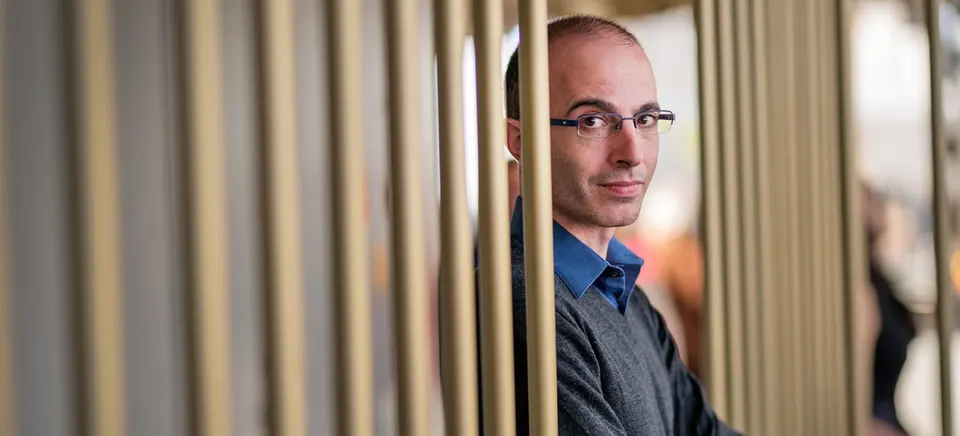
While It Is Day, the Night Cometh
“I am definitely not a prophet or a guru. I don't predict the future, and I don't think anyone can. History is not deterministic, and nobody has any idea what the world will look like in 2050. All I do is use my knowledge of history to raise questions about the future and to map out possible scenarios, highlighting the most dangerous ones in the hope that we can prevent them,” the professor explains.
12. “As far as we know today, primates, rats and the other living creatures on this planet may be the only conscious beings in the entire universe. We have created a nonconscious but extremely powerful ‘alien’ intelligence. If we do not use it properly, it could end not only human dominion over the planet but also extinguish the flame of consciousness itself, leaving the universe shrouded in impenetrable darkness. It is our responsibility not to let that happen.”
His middle name is a variant of Noah. Could knowledge itself be the Noah's Ark of the future, the one that will save us in turbulent times ahead?
“AI may enslave or destroy us,” runs another popular quote of his, one that came long before we reached advanced artificial intelligence. Harari is certainly among the authorities who were the first to draw public attention to the dangers that come with it. And even if that were his only contribution, it truly matters to every one of us.
“I am glad to see that many people are already concerned about these dangers. I am less glad that instead of uniting against common threats, we are fighting and blaming one another,” says the historian, and I don't think he could be more right.
Especially if we take the next steps too—talk more about these dangers and bring more important perspectives into the conversation. Before it's too late. What will historians write about today's technological times? And will there even be historians? It's up to us. For now.