
“You are not the customer of the internet giants, you are their product.”
“Social media is worse than cigarettes. Cigarettes don’t make you degrade. They kill you, but you still remain yourself.”
You will hardly believe that these words belong to one of the pioneers of today’s digital world. Jaron Lanier popularized the term “virtual reality” and created the concept of avatars. One of the first tech millionaires has turned into a venerable guru with loose clothes, six-foot dreadlocks and an obligatory set of exotic musical instruments. You can see him speaking out against the internet world we live in at all kinds of conferences—from the gatherings in Davos to TED.
His path crossed those of Richard Feynman, Marshall McLuhan and Andy Warhol. For a long time he was at the height of fame, on first-name terms with Steve Jobs, Sergey Brin and Bill Gates. In a single afternoon he personally showed his pioneering virtual reality goggles to the Dalai Lama, Leonard Bernstein and Terry Gilliam. And today he is a preacher of sorts, speaking out against the flaws of the digital world.
Honestly, I wouldn’t have believed such a person existed before I heard of him. And he definitely has a great, great deal to tell us.
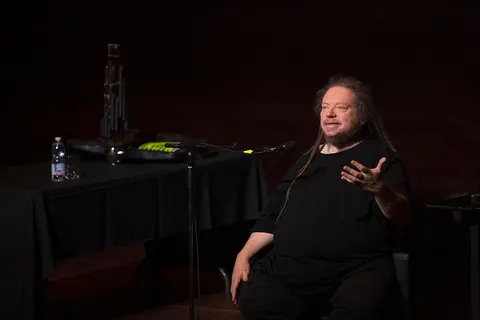
A Larger-Than-Life Character
“We have created a world in which any time two people communicate online, it is financed by a third party who believes they can manipulate the first two.”
It would be hard to describe more briefly and precisely the position of the internet giants that have swallowed our lives. According to Jaron Lanier, they stopped being companies long ago and became spy organizations whose sole purpose is to collect their users’ data and sell it back to those very users.
The author of these ideas knows what he is talking about. In 1984 he created the first startup dedicated to virtual reality. He worked on the pioneering projects for goggles and gloves meant to transport us into a different world… Yes, the topic recently came to the fore once again with the notorious renaming of Facebook and the buzz around the metaverse.
That is why right now is the moment to hear what Jaron Lanier has to tell us.

Maestro, Music!
“Spy agencies like Facebook and Google try to capture people’s attention by destroying societies,” he says, speaking of how easily we turn bitter against one another online and shut ourselves into our own filter bubbles.
“We live in extraordinary times, we receive extraordinary benefits. We have found a way to detach ourselves from reality, but we have lost the ability to discuss real problems,” Lanier says.
“That is why these are not happy times; only music lets me feel good and survive,” he adds. He is famous for his proverbial love of all kinds of exotic and ancient musical instruments. At his home in California he has more than 1,000 of them, and he recently showed off a flute from Asia Minor of the kind the biblical King David once owned. Lanier has played with stars such as Philip Glass, Yoko Ono and Sean Lennon. He also loves to paint and has had solo exhibitions in quite a few places around the world.
At another presentation he pulled out a Laotian mouth organ with 16 pipes, as a kind of symbol of digital communication, which can and should take place on many levels that complement one another, rather than turning into a trade that is toxic for everyone involved.

The Virtuoso of the Virtual World
The idea of virtual reality first came to him when he was at the side of… Richard Feynman, the Nobel laureate and one of the greatest minds of the 20th century. At the time Lanier was a young man who happened to find himself next to the physicist in his final days. The scientist was in the advanced stages of cancer and, to ease his suffering, turned to LSD. Beside him sat Lanier, listening to his accounts of the world the hallucinogen took him to.
By then Lanier was already captivated by technology. He says he never tried hallucinogens himself, but thanks to Feynman’s vivid descriptions, the idea took shape in his mind of how computers could carry us into worlds like that. And this in an age when technology was very far from today’s capabilities.
Young as he was, Jaron had already seen many of life’s sad sides and been hardened in battle. His mother was only 15 when she ended up in a concentration camp in Vienna and survived by a miracle. His father’s family, for its part, fled Ukraine just before the years of the Holodomor. Lilly and Ellery met in the émigré circles of Greenwich Village; she was an artist and dancer, he an architect who loved art.
In 1960 their only child was born, and the family moved close to Mexico. His mother disliked American education, so every day he had to cross the border to attend a Mexican school that taught by the Montessori method.

The Builders of Modern Digitalia
Jaron was only 10 when his mother died in a car crash, and his father barely survived after a long recovery. For a long time he would blame himself, believing she had been driving distracted because, just before she set off, her son had told her he was being bullied at school.
Then their home burned down. Jaron was 12; he and his father lived more like friends, and his father let him design their future house in the New Mexico desert. Later, when the boy was already far away, part of the house collapsed and nearly killed his father.
For the two years it took to build the house, the two of them lived in a military tent, freezing through the harsh winters and melting in the scorching desert summers. Neither of them ever mentioned the mother.
The boy was often ill and depressed. He went to school reluctantly, but from an early age two fields drew him in: music and technology.
They didn’t have many friends in the area; among the few was Clyde Tombaugh, who worked at the nearby missile base. The elderly scientist, who in his youth had discovered Pluto, showed Jaron the beauty of the night sky through the telescope in his yard. And it was he who advised the 14-year-old boy, who had already dropped out of school, to start attending open lectures in mathematics and physics.
When I Was a Goatherd
And so he began studying at the local university at just 15, and by 17 he was at Bard College in New York. To support himself, he sold goat cheese from a small herd he looked after. He got his first car, a Dodge Dart, in exchange for taking care of the previous owner’s child while the man was in prison.
Chasing an unrequited love, he then ended up… yes, where all tech stories begin, in the heart of Silicon Valley, which is also where the encounter with Feynman took place.
Then came the small step that turned him into one of the first tech superstars of the second half of the 1980s. As he himself writes in his autobiography, at times his life sounds like magical realism. Yet it is the true story of this larger-than-life character.
Of that period he says he found himself among 20-year-old entrepreneurs and hackers raised by the book of Dr. Spock, who had enjoyed calm childhoods and were now playing at being rebels. The exact opposite of his own case. That, in his view, is why the counterculture so quickly turned into a technological plutocracy, which is what today’s world of technology is.

Atari and Avatars
In 1983 Lanier developed his first computer game, Moondust, which got him recruited by Atari, the video game supercompany of the day.
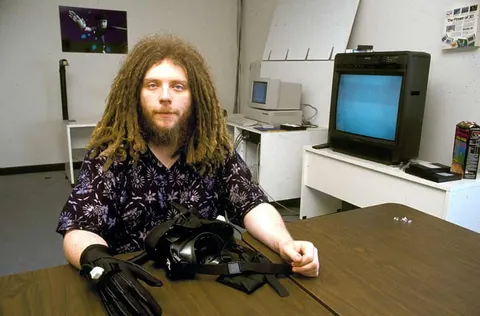
A year later he founded the startup VPL Research Inc, which developed goggles and gloves for virtual reality. He described it as “something between cinema, jazz and programming.”
Some of his attempts look rather naive by today’s standards. One of the goggle prototypes had to be counterbalanced with sandbags so the viewer could stand upright. Still, interest was huge, and virtual reality looked like the next big thing. Lanier became a celebrity, and it was then that he showed his prototypes to some of the biggest names in the world.
With him was Tom Zimmerman, inventor of the first data glove. At VPL Research they created virtual cameras and three-dimensional graphics. Theirs, too, was the first computer project for an avatar—a virtual image of the user.
For all this, the Encyclopaedia Britannica today ranks Lanier among the 300 greatest inventors in human history. They even landed a contract with NASA for research in “visual communication.” They had reached an annual turnover of $6 million when, in 1990… the company went bankrupt. Jaron turned out to be a better researcher and popularizer than businessman.
How the Silicon Was Tempered
In the 1990s he took on several ventures, and his attempt at a prototype virtual reality headset failed.
It was then that he first began speaking with alarm about the technological changes just appearing on the horizon. “In 1995 I wrote the essay ‘Agents of Alienation’ about the danger that one day computer networks would have automated agents of a sort—today we call them bots—that could manipulate the advertising market and politics. And that this would destroy all the useful sides of technology.”
Then… he turned against all of it for good. In 2006 he sold his facial recognition project of the time to Google. And he began speaking much more about the dangers of the new internet. His most popular book appeared: You Are Not a Gadget. His latest project is part of Microsoft’s innovation labs.
Today Lanier lives in California with his wife Lena, a child psychologist, and their 14-year-old daughter Lilibell. He teaches at Berkeley and, as mentioned, travels often to speak about the issues that matter to him. The very ones we most often discuss here at Digital Stories.
A Silicon Philosopher
“We must never separate the discussion of technological innovations from their purely human sides and the effects they will have,” the digital guru is convinced.
“The most important characteristic of a technology is how it changes people. Today we want to suffer in the name of some false sense of freedom. For example, cars are built to reach enormous, illegal speeds because that gives us a sense of freedom. And then, on top of that, they install airbags. There’s an example of the absurdity of today’s engineering.”
“The computer today is becoming a form of life that understands people better than they understand themselves. So that machines can appear smart all the time, people deliberately degrade themselves,” Lanier sums up.
It is time to rid ourselves somehow of the current model of the internet giants. The scientist with the dreadlocks calls it “digital Maoism,” “a world of ‘internet intellectuals,’” “a period of social catastrophe.” Today everyone is famous online simply for being famous, and the idea of “the wisdom of crowds” has proven to be a ruinous solution for society, run some of the other tenets of the tech philosopher.

The Hippie Who Became a Guru
“We once believed that ‘the wisdom of the crowd’ would lead to constant, rising enlightenment. But it turned out that the group can just as easily turn into an online lynch mob.”
“I was among the first to proclaim the idea that information should be free. To me it was perfectly normal to steal, pirate and share the work of writers, musicians and other artists. I very quickly realized what a mistake that was. Today not only artists but all of us are being robbed by the internet giants; they monetize the work of the crowd. Google Translate, for instance, is a magical service: you put in a text in English and it comes out in Spanish. But for that to happen, the artificial intelligence was fed tons and tons of translated texts as input data; it uses the work of millions of translators and of every one of us.
And so we are ‘sold’ a service that is in fact the result of our own work. Just as Facebook sells people—their advertising profiles, interests, habits—back to those same people. Or Google sells people in the form of advertising, through their own searches and profiles. In my view each of us, every single one, should be paid for our informational contribution. That is the only road to a more meaningful digital future.”

We Won’t Pay, We Won’t Pay!
“People who give their data to the giants for free help concentrate wealth in the hands of a handful of billionaires. And that undermines democracy. Because today, more than ever, knowledge is power.”
“We already live in a dystopia,” Lanier says. “Their logic goes like this: ‘You have no reason to know how we use your data or what we need it for. We don’t know who you are, we don’t want to know, you’re unnecessary, we won’t pay you. We take your data, and you yourself are unnecessary, in the dark, hopeless. The robot made from your data will soon replace you. The robot is needed. The robot is God, and you are garbage.’
“Facebook may already have won this battle, and that means the end of democracy, at least for this century.”
Somewhat strangely, Lanier remains positive about virtual reality. One day it may allow us to communicate with people beyond the use of language, and that, in his view, is a good thing. “I call it post-symbolic communication. Because instead of using symbols that refer to things, we will be able to simply create new reality in communication and in collaboration. It is something like an intense, shared dream, and we can see it happening little by little.”

We of the Resistance
According to Jaron Lanier, the virtual reality his generation created back then is today, to a large extent, simply reality. “If you look out the window, you won’t see a single vehicle that wasn’t first designed in virtual reality.”
And what does Lanier think its “even more perfect version,” which has become popular as the metaverse, will look like? “There is something funny every time a new medium of communication appears. It needs time to find itself. Early cinema is valuable, but today it’s unwatchable. There are already cases where virtual reality proves its worth—for instance, in treating post-traumatic stress or in the fight against addiction. I think it will eventually become a good medium for art and culture, but there’s no way to know when that will happen.”
Besides, to get there, a lot of things have to change.
What is the way forward? “I think we need to stop seeking AI algorithms that control our behavior and thoughts. And instead let people come together in groups again, try to achieve great things. Let them be motivated by normal commerce, not by the commerce of surveillance.”
Critical Materialism
It will hardly surprise you that one of Lanier’s main pieces of advice is to delete all our social media accounts immediately. Rather extreme, but that’s just who he is. To use Google only in incognito mode, replacing it more often with anonymous search engines.
“For me, criticism and optimism are one and the same thing. When you criticize something, it is because you believe it can be changed for the better.”
And truly, what impresses most is not so much Lanier’s penetrating reflections on today’s digital world. It is his optimism that even the biggest problems have a solution. Still, for such a change to happen, a critical mass of people is needed. So let us say it as a parting word, quite apart from the cliché… just as the hero of today’s digital story stands apart from every cliché. A better future, more meaningful and fulfilling online communication, a wiser way of making use of the blessings of technology—all of this depends on each and every one of us.