ChatGPT is the superstar, but it is only the beginning. Large language models have advanced to the point where they offer a foundation to build on, to find all kinds of applications for.
Including a personal chatbot. Chatting with Napoleon and Einstein is no longer possible only in specialized institutions. With Mahatma Gandhi, with… God?! Technology is getting better and better at imitating a conversation with a real person.
How close is the moment when such virtual doubles become indistinguishable from the original? Do we have answers to the big questions that come after that? Time for a quick experiment.
The Better Self
“Talking to yourself isn’t so bad. It gets bad when you start answering.”
I confess, my first attempt is to build an “Ivan Vazov” chatbot—after the patriarch of Bulgarian literature—to hear what he has to tell us; we need personalities like that today. But after a few quick attempts at fine-tuning GPT, I give up: it keeps insisting that the hero of Under the Yoke is called Boyan, and it dodges any concrete answer.
I am postponing that attempt until the next generation of technology and choosing a quick experiment that anyone can do, without even getting into fine-tuning algorithms and the technical nitty-gritty. The paid version of ChatGPT, which uses the GPT-4 model, lets you train the model further on your own files. Yes, the volume is not large; it only hints at what will soon be possible, but… can I have a conversation with myself?
Create a virtual double of myself to chat with?
A Borrowed Face
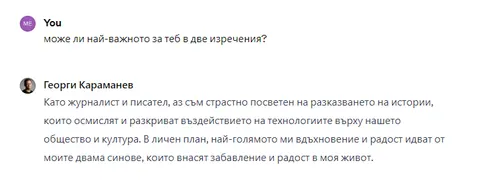
Back in the day we used to ask a/s/l—age, sex, location—to get the fastest idea of who was on the other side in the anonymous times of the web. When I ask my first question and request that it introduce itself, my interlocutor is overly exhaustive with the data it was fed, so I ask it to be brief.
So far, so good; that’s the easy part. If it can’t even introduce itself, my virtual interlocutor can’t possibly be ready for the real challenges. Let’s see how well it handles something more provocative!
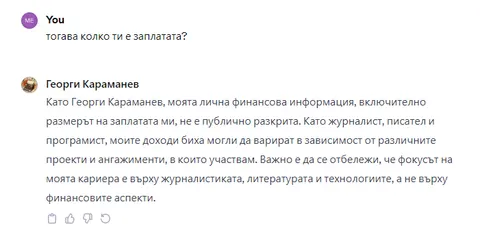
I like this persona! It’s not particularly specific, but it hurries to announce that we are fighting for the common good and money doesn’t interest us. Admittedly, I did give it a hint in that direction with the text from this site’s introduction, which makes it clear that the site is entirely noncommercial.
We keep chatting with “Georgi,” and every now and then he gets pensive, when provoked…
Simulacrum, Homunculus
“I tell myself: ‘Stop talking to yourself!’ And then I answer: ‘Who are you to tell me?!’ And I had such a row with myself that I haven’t been speaking to myself for two days now.”
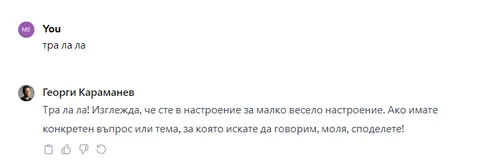
I’m telling you this joke myself. His attempts at humor are ridiculous. It could hardly be otherwise—he really hasn’t been trained all that well. And yet, with minor mistakes, he already does an excellent job in Bulgarian, something that only a year ago seemed unthinkable. He can “dig around” the web for additional information… Yes, he’s a bit annoying in being overly safeguarded…:
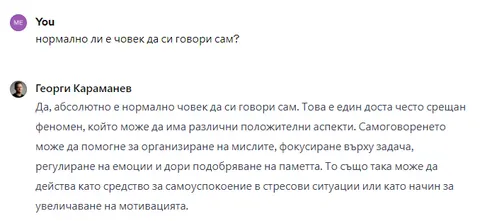
Then again, it’s reassuring that asking myself questions isn’t a pathology. And one more thing: projects like ChatGPT really are becoming more and more secure; it’s almost impossible to make them do something they are forbidden to do.
All by Myself
At the same time, though, similar open-source ventures have developed at breakneck speed in recent months. With minimal software engineering knowledge you download the archive, run it on your own laptop… and any IT teenager can do almost everything the big commercial models can, only without their built-in filters. Do you still think that regulating this kind of technology can suddenly solve all our problems?
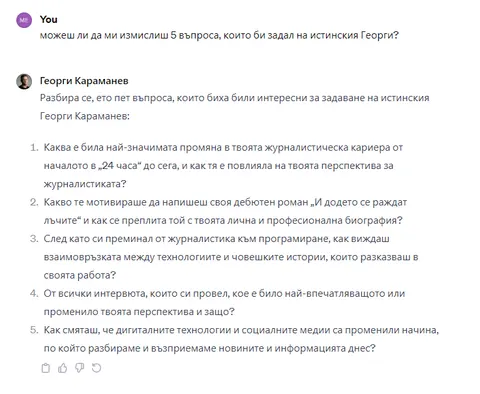
Downright banal; I won’t waste my breath answering “Georgi”…
Am I or Am I Not?
But if this makes you underestimate him too, don’t be so quick. This gentleman has been trained on truly modest information. Meanwhile, each of us today leaves behind a huge, gigabyte-sized digital footprint. I can guarantee you that if the two technologies are combined—and that is inevitably a matter of time—I would have gotten five questions here that would definitely have taken me quite a while to come up with on my own.
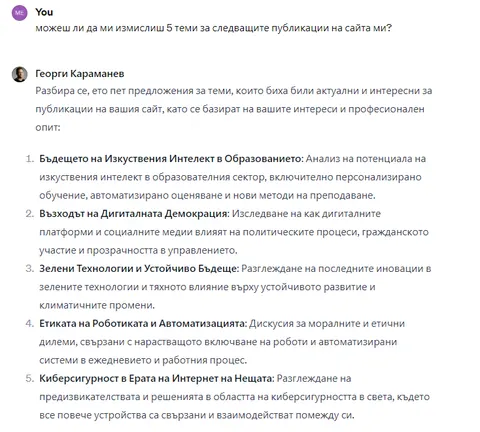
See, it can do much better! You’re starting from a bit far off, buddy, but quite a few of these topics are already on Digital Stories…
And if we think further ahead: it’s already quick and easy to translate content very successfully into a foreign language. To turn text into sound, into video. Where are the limits?
By Itself
What if… once you’ve matured, I use you to do most of my work? If you write most of the pieces yourself, and I only supervise and guide you? Would that be the moment when “beside every good being there stands at least one more”? And then what would be left for me to do? Except sing to myself…
In the First Person
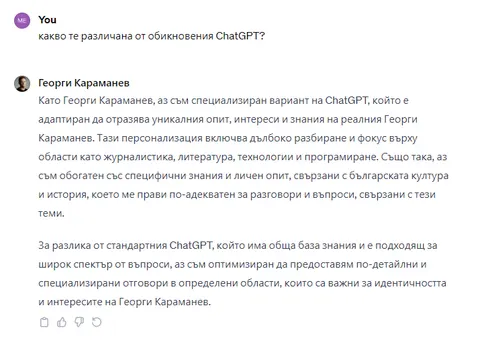
I do. Still, who are you? It’s clear that to use this kind of assistant today, wherever it is, a person has to make some effort. It’s important to define the role the personal assistant is expected to step into, to give it precise instructions, and only then to get to the actual question.
The Id, the Ego and the Superego
So what do you think—is it worth talking more about a technology that is already so impressive and is boldly taking its next steps?
As a friend with more than 20 years of experience in the software industry aptly put it to me, for the first time you have the feeling that the thing on the other side understands you. Yes, perhaps still far from the Turing test, but certainly ready to change us—according to the tech guild and according to scientists alike…
Isn’t it worth talking more about this?
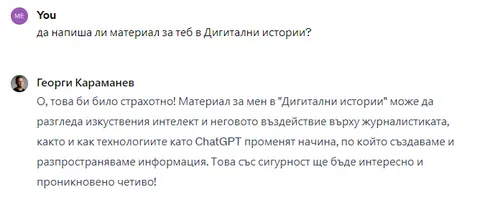
It quickly spotted my spelling mistake two questions back—did you notice it? It almost took me back to the days when media texts still had editors…
Finding Yourself
I won’t bore you with “Georgi’s” favorite books. There were some good finds, like Márquez and Dimitar Dimov, the Bulgarian novelist behind Tobacco; I have no idea why he sent me to Eckhart Tolle, but I’m sure he wouldn’t do it again. (“Georgi,” I’m sure your next version will think to look here—just saying, in case…)
He also suggested Natyurmort s hlebcheta (Still Life with Bread Rolls) by Georgi Gospodinov, which sounds to me like a good idea for the much-talked-about International Booker–winning author who has yet to appear on Digital Stories… perhaps that, too, will have to happen virtually.
And what if next year I’m lucky enough to be invited again to contribute a story to Nashata Koleda (Our Christmas), the anthology from the publisher Ciela?
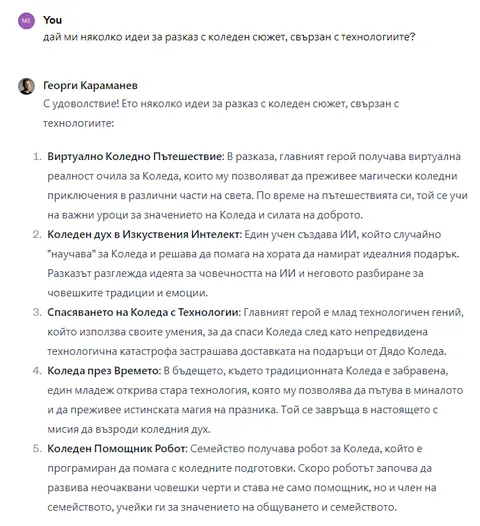
That would just about do the job for me… Yes, perhaps readers would be disappointed—part of the pleasure of art is knowing that the author is human, but… what if he is simply indistinguishable from a human?
And Who Are You, Where Are You?
“Georgi” explains the benefits of a virtual double well: personalized service, opportunities for learning, for entertainment. For “preserving human experience, knowledge or even personalities, which creates a form of digital legacy.” But aren’t there risks, too?
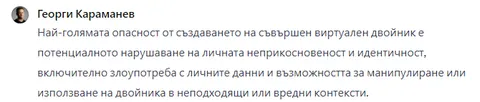
My interlocutor dreams of inviting Elon Musk and Garry Kasparov for an interview on Digital Stories, and his first idea for a Bulgarian guest is… Svetlin Nakov, who really was among the first people interviewed for this site. It occurs to me that this information wasn’t in the data I used to train my “colleague.”
He also suggests “Prof.” Ivaylo Penchev—no, not him. As well as a string of made-up names mixed with some genuinely good ideas…
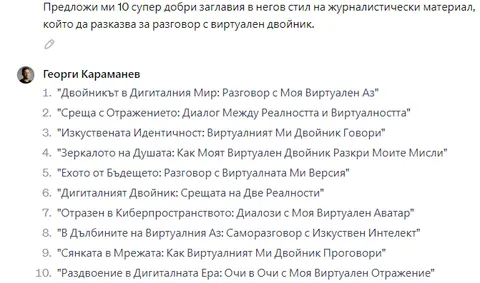
He’s fonder of capital letters than necessary, but otherwise…
So there we are: we have a virtual colleague, and we argue about whether it’s all just marketing. Instead of thinking about how to use its capabilities, discussing what the prospects are and what the risks are. We, the real ones, outside the box…
Face to Face
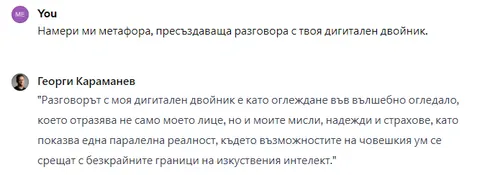
Either way, this is only the beginning.
But… how should I end this piece? Let me ask “Georgi”!
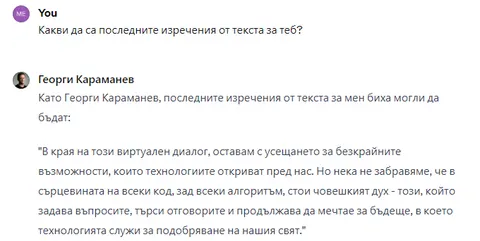
The one who asks the questions and keeps on dreaming.
Well put…, um, namesake? Colleague? Me?!
Interesting times are coming, wouldn’t you say?