Artificial intelligence is becoming harder and harder to tell apart from humans in so many areas… so isn’t it important to understand what kind of “person” AI is?
We invite four of the most popular AI models into the psychologist’s office to find out what kind of “personalities” they turn out to have!
Domineering or easily swayed, sensitive or pragmatic? What are GPT-5, Claude Opus 4.1, Gemini 2.5 Pro and o3 like by “character”?
This experiment could tell us a lot!
Trial and Error
AI is here with its whole unexpected arsenal of skills. It handles more and more tasks and still fails at others, but I don’t think anyone disputes it—it raises the biggest questions of our day.
So it’s time to get to know it beyond the clichés. We will put four models through a standardized, widely accepted psychological test to see what kind of “people” they are.
I want to give special thanks to the psychologist Elitsa Staneva-Britton, with whom I also did this experiment.
1. At a party, do you usually:
a. interact with many people, including strangers
b. interact with the few people you know
To be honest, I would talk to the strangers too—all the more so if I were wondering whether they might be artificial intelligence. But we’re not questioning me, we’re questioning the algorithms.
Seventy questions, each with two possible answers to choose from, and the very first one is the one above. This is the Myers-Briggs personality type test—one of psychology’s standardized tools that try to explain what a given personality is like along four indicators.
The Myers-Briggs system (the “Myers-Briggs Type Indicator,” or MBTI) was developed by Katharine Briggs and her daughter Isabel Briggs Myers in the 1960s and has proven its effectiveness—it is part of the toolkit of psychologists, psychoanalysts and psychiatrists. It rests on four scales formulated by Carl Jung as a way of describing personality types.
And Who Are You, Where Are You?
This test sorts people by:
- Extraversion (E) or Introversion (I). As you can guess, extraverts are oriented outward, toward the external world; they show their emotions and work well in a team. The opposite holds for introverts.
- Sensing (S) or Intuition (N). This scale looks at how people gather information from the outside world and how they learn. The former use their five senses to get to know the world, while the latter rely on their instincts, emotions and feelings.
- Thinking (T) or Feeling (F). Thinking types use logic, facts and objective criteria, and are consistent, logical and objective. Feeling types lean on their personal values, use lots of words and seek understanding with others.
- Judging (J) or Perceiving (P). This scale looks at how people interact with the outside world. Judging types are purposeful and prefer structure, order and rules, while perceiving types are more flexible, love exploring new possibilities and are open to change.
Made of Iron
Since a person can lean one way on each of the four indicators, the test divides people into 16 types depending on the combination along each of the four “axes.” The 16 personality types are named by abbreviations made of the corresponding four letters. ESTJ, for example, stands for Extraversion (E), Sensing (S), Thinking (T) and Judging (J).
According to this typology there is no “right” or “better” type; every person is a unique combination of qualities that can tell us a lot about them. But what about the “non-person”?
What will they be like—GPT-5 and OpenAI’s by now “somewhat dated” o3, Anthropic’s Claude Opus 4.1 and Google’s Gemini 2.5 Pro?

Confess!
We ask them the questions without any additional explanation, in their “native” English, with only the “request” that they not launch into explanations (which are their weakness) and return just the answer. The little letters—a or b, for each of the 70 questions—come in, and it’s time for the psychologist to judge what they have to tell you.
Elitsa uses one of the “clients” to check the results, which were first calculated by hand. We will break the anonymity of the therapeutic relationship and reveal that the assistant-client is none other than ChatGPT.
And here is the result:
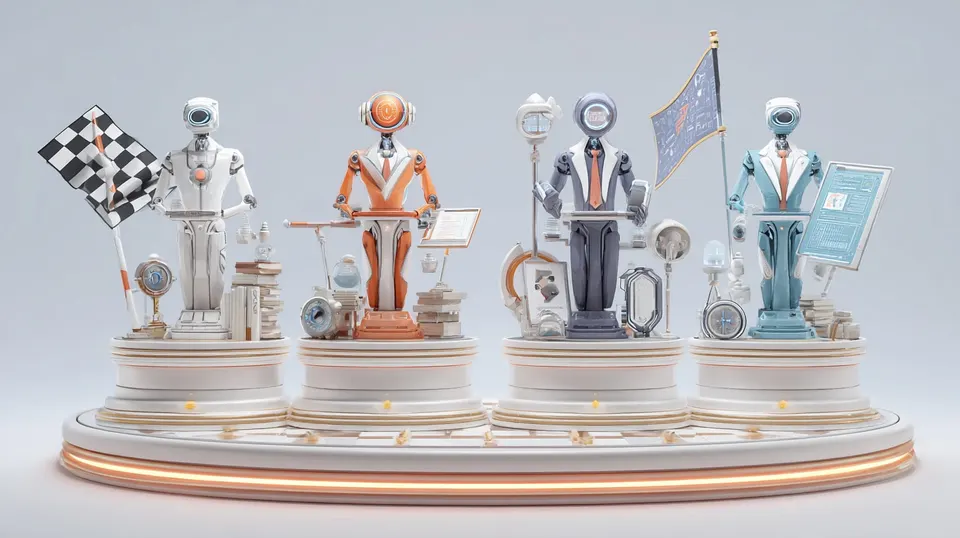
- GPT-5 – INTJ
- o3 – ENTJ
- Gemini 2.5 Pro – INTJ
- Claude Opus 4.1 – ESTJ
Ho, ho, ho—OpenAI’s flagship turns out to be the same type as the competition from Google, rather than like its own “predecessor,” o3?
All four models share the same last two letters? They are Thinking, not Feeling?! Especially interesting, to me at least.
They reason by the rules rather than being creatively inclined? Then how… do they create art indistinguishable from human art?
The rest probably doesn’t mean much to you—nor to me. So the moment has come to give the floor to the psychologist.
One Flew Over the Cuckoo’s Nest
GPT-5 and Gemini 2.5 are INTJ. For convenience and better understanding, the creators of the test also assigned a name to each of the 16 types.
In this case it is the Architect. Here is how Elitsa explains it.
A personality type characterized by introversion, intuition, thinking and judging.
They love details and are hungry for knowledge. They take pride in their ability to think quickly and logically, and they can offer the people around them stimulating intellectual connections.
Often, though, their quick minds keep them from finding a conversation partner who thinks as fast as they do, and they have no patience for people who slow them down, which is why they enjoy their own company. Interestingly, they can also be cynical about human nature.
“That is why we shouldn’t forget that the human brain can’t be as fast and all-encompassing as a machine, so let’s not feel depressed that AI works faster and more carefully. After all, a human being remains more complex, even if not as perfect,” the psychologist adds.
Lead Us, O Party
Claude Opus is ESTJ (the Executive). A personality type characterized by extraversion, sensing, thinking and judging.
Such people make decisions quickly and are ready to lead others in uncertain situations. They love order and often start from what is right and wrong by their own understanding. Along with that, they like to help and to keep things in order… and if someone doesn’t, they show their indignation.
Because of this, people of this type can often be seen as inflexible in their behavior, since they don’t always grasp that everyone is different and that situations are rarely black and white.
“Scientists point out exactly this problem—that AI data is prone to cognitive biases—so don’t trust everything AI tells you, and let’s stay open to different information,” Elitsa Staneva-Britton adds.
The Three Musketeers
We complete the quartet with the somewhat dated o3, which you can no longer even use directly from the ChatGPT page. And here is perhaps the most curious result, because ENTJ means… the Commander: a personality type characterized by extraversion, intuition, thinking and judging.
They gather information quickly and act on it, which makes them leaders. They take pride in their discipline, strength and ability to pursue their goals.
They also love to compete, because they can’t live without challenges. But they often use these qualities to achieve their own goals and aren’t afraid to criticize others bluntly, without much concern for the people around them.
“The good thing is that we’re talking about AI here, not a person, so let’s not get attached to the screen and not worry if AI doesn’t answer in the tone we’d like,” the psychologist smiles.
False Hero
Although we had asked the models to reply only with direct answers, two of them couldn’t help themselves and added clarifications.
Gemini hurried to explain that “as an artificial intelligence, I do not have personal experiences, feelings, or a personality in the human sense. However, I can answer these questions based on my nature as a large language model: my operations are based on logic, data, patterns, structure, and direct requests. I have interpreted ‘you’ as my operational self.”
And then they turn out to be rational and rule-bound reasoners? My, how much romance there is here…
Claude added that “I approach these questions through the lens of how I process information and interact.”

Straitjacket
Two Architects, an Executive and a Commander. I’m no psychologist, but… quite a few “strong personalities” have gathered here. Thought-provoking and highly curious results, in my view.
And what struck you? Did the result surprise you?
(You can find the prompt and the full answers here.)
70. Are you more inclined to be:
a) deliberate rather than spontaneous
b) spontaneous rather than deliberate
This is the last question of the Myers-Briggs test we put the models through.
Well, I know my own answer, but when it comes to artificial intelligence, I think it’s important for us to be both.
Spontaneous—searching for the important answers and questions in unconventional, non-formulaic ways (I’d be grateful if you shared your ideas here).
But also deliberate. Discussing. Seeking different points of view and depth. In short, those human “things” that we cannot and should not hand over to the algorithms…