Remember? Not so long ago we were locked in our homes, the parks were cordoned off with tape, the roads out of town blocked by checkpoints… Then the vaccines arrived, and they were going to save us or kill us. Bulgarians were dying in record numbers, we split into vaxxers and anti-vaxxers, and from there came so many other divisions…
The human brain is an incredible thing: it forgets quickly and adapts to the new, to the easy. But that way many important questions vanish, pushed aside by the next “hot” topic to squabble over. Meanwhile, signals are coming from many countries that covid is back…
We saw how quickly our everyday lives can be turned upside down. How fragile we are, as individuals and as a species. And it is time to look for the lessons.
A Feast in the Time of Covid
- Could a new wave of the coronavirus come soon, or could the next microorganism appear that is able to change life on the entire planet?
- Have we learned our lessons?
- How well did we handle the pandemic?
- Could more human lives have been saved?
- How deadly did the coronavirus turn out to be?
- Did we overdo the measures or, on the contrary, should they have been stricter?
- Did the vaccines turn out to be the solution?
- Are we better prepared for future epidemics?
Questions whose answers matter to every one of us.
I meet the infectious disease specialist Dr. Trifon Valkov of the Infectious Diseases Hospital in the capital, Sofia, and the mathematician Prof. Ognyan Kunchev of the Bulgarian Academy of Sciences (BAS). Together with several colleagues from different fields, over the past months they have kept analyzing what happened during the pandemic and what is looming after it.
Recently the respected international journal British Medical Journal Open published an article by the team that focuses mainly on the lessons learned during the pandemic and analyzes the statistical data for the period 2020–2022.
Here are their important answers.
1. What is the damage, at home and around the world?
The World Health Organization declared the end of the pandemic on May 5 this year. Officially, COVID-19 killed nearly 7 million people, but according to the WHO the real figure is closer to 20 million. And one more indicator: nearly 337,000,000 years of human life have been lost.
And yet, if 20 million is 0.25 percent of the Earth's current population, there is another statistic we ought to be far more aware of.
Yes, there are many caveats about where and how testing was done, and whether patients died with covid or directly from the disease. But the statistics are indisputable—Bulgaria is the country with the highest excess mortality over the period of the pandemic, as the data from the National Statistical Institute (NSI) clearly show:
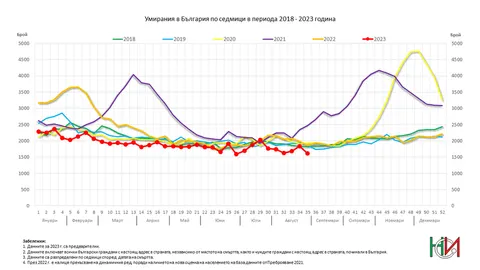
“One percent of the country's population is gone! The population of a large Bulgarian city!” says the mathematician Prof. Ognyan Kunchev. “And everyone keeps quiet. The politicians go on playing dumb.”
Even if we stay within the official statistics, 1 in 270 people in Bulgaria died of covid, against a global average of 1 in 1,285. Meanwhile excess mortality (according to NSI data) for 2020–2022 shows 1 in 100!
Ordinarily 2,000 Bulgarians die in a week, and in winter mortality is slightly higher. During the peaks of the pandemic, however, the figure broke every record, rising by more than 100 percent week on week and exceeding 4,500 in some weeks! And then comes the red line for this year, which is lower than before the pandemic.
In other words, many, many people died who could have lived longer.

2. What killed so many Bulgarians?
So almost all of us went through the infection once or more (although at the start some “authorities” insisted that it left lifelong immunity). The various coronavirus variants came one after another until we reached omicron. And still, where did the high mortality come from?
“This infection managed to bring out the worst of the worst,” says Dr. Trifon Valkov, who spent the entire pandemic on the front line of the medical battle. In his view, we gradually learned to treat the disease itself, but what proved deadliest was the way the virus affected other health problems.
“Covid led to exacerbations of chronic diseases, to decompensation of kidney failure, heart failure, diabetes, cancer,” the doctor says. “When a patient came in with decompensated diabetes, he didn't die of covid, he died of a blood sugar of 40 millimoles!”
“I don't want to go into the details—‘died of’ or ‘died with.’ What matters is that these are people who could have lived on with their underlying conditions. But the coronavirus was the link in the chain that triggered an autocatalytic process, led to the decompensation of chronic diseases and, as a result, to this mortality.”

3. Could they have been saved?
Here we come to the big question, the question of life and death. Why did we end up with such extraordinarily high mortality? Why didn't we look back afterward and try to find the causes (and the responsibility)?
“The question is what led to this,” says Dr. Valkov. “Is it because Bulgaria ranks first per capita in patients with comorbidities? Is it because there is no adequate prevention for patients with cardiovascular, oncological, endocrine diseases?”
If that had been the leading factor, the results would be similar in every more severe flu wave, the infectious disease specialist believes. For example, a decade before covid, in 2009, came the last more serious flu epidemic. Around 4,000 people died then—and that was without masks, without closing cinemas, theaters, shops…
“It doesn't add up for me as an explanation that people have serious illnesses,” says Dr. Valkov. “Or that the hospitals worked badly. Did they suddenly start working badly yesterday? Many people blame the system. But blaming the system is like a doctor diagnosing your complaints as stress. If he says that, it means he has absolutely no idea what's wrong with you.”
So, according to the doctor, the reason is that treatment did not happen the way it should have.

4. Were the sick treated correctly?
“The truth is that we had absolutely no consensus on the subject,” says Dr. Valkov. “How to approach these patients, how to diagnose them, how to treat them? There were no protocols whatsoever for diagnosis and treatment—the very thing other countries did first.”
We went through quite a few stages. Clearly, at the beginning the people responsible for the key decisions were, to put it mildly, unprepared. Hence the absurdities, like closing parks or cities.
Then came the extremely grave situation in Bergamo and northern Italy, and the same thing happened in England and France. It reached the point where French patients were being transferred to German hospitals for treatment.
Chronicle of a Collective Madness
Then it became clear that there was no other option and the virus would go around the world anyway. But in the meantime doctors had built up serious experience in how to handle different situations.
Very quickly, countries created treatment protocols that were updated on the basis of accumulated experience. This way doctors, even in small towns, were sufficiently prepared at every moment, working from the most up-to-date information. Not so much on how to treat the infection itself, but on how to deal with the accompanying illnesses, which most often turned out to be fatal.
“Every country had a single consensus—a protocol that was adopted and applied in absolutely every medical facility. Everyone knew that when a patient with such a condition came in, it was step one, two, three, four,” says Dr. Valkov.

5. Why didn't we introduce a treatment standard?
While the situation changed rapidly and the news filled up with numbers of the sick, the vaccinated, the dead… the political situation in Bulgaria, as so often lately, was turbulent. And in all the commotion, according to my guests, the country never arrived at a single treatment protocol, at pooling experience on how to treat patients. That is precisely what led to very serious problems.
Dr. Valkov and his colleague Dr. Georgi Dimitrov created such a protocol at the very start. An infectious disease specialist and a specialist in genetics and oncology dug into the documents from the countries hit hardest by the virus first. That is how they built their protocol, which was also approved by the Bulgarian Medical Association, which helped publish a print edition.
“We had no other choice, so we made it for our own use,” the infectious disease specialist recalls. “We saw that we couldn't rely on the institutions to give us such a protocol, and we decided to make ‘our own.’ In quotation marks, because it was a conglomerate, a synthesis of the diagnostic and treatment protocols mainly from four countries—Germany, England, the US and Israel. It changed constantly so that it could stay current.”
Healthy Society, Healthy Body
Then a working group was set up. The Ministry of Health decided it was time for a more detailed document that would help doctors in exactly such situations—when they had to treat a patient with comorbidities.
The working group was headed by Dr. Valkov. It included two doctors from every specialty, and some of them prepared very useful guidelines. The endocrinologist Prof. Zdravko Kamenov produced a detailed report on how to treat exacerbated diabetes. The pharmacologist Prof. Georgi Momekov described in detail how the medications of chronically ill patients interact with the drugs given against the virus.
“All of this was written. All of it was uploaded to the health ministry's website. And then it never saw the light of day,” says Dr. Valkov. “If this information had been disseminated, if it had reached the small provincial hospitals, I am convinced we would not have ended up with such high mortality. We simply wouldn't have!” the doctor sums up with emotion.
6. How did the pandemic end?
Humans are built so that, in order to survive, they forget both the unexpected stress and the relief that follows it. The end of the pandemic, the pleasure of walking around without masks… we get used to comfort quickly. But how did we get there?
According to the people I spoke with, there is one reason, and its name is “omicron.” “It infects quickly, reaches many people, but it's milder,” explains the mathematician Prof. Kunchev. “And it doesn't give alpha, beta and the other more severe variants a chance to infect you. Omicron arrived at the end of 2021. When it took off, for a few months there was high mortality because of the strong variants. But it displaced them, and with that the pandemic was over!”
He finds it especially interesting that the variant, first registered in Botswana, has nothing in common with the Wuhan one; the chain of genetic changes shows it developed completely separately. And this remains a very serious mystery for science.
It should also not be overlooked that the severe original variants of COVID-19 are still among us, albeit in a minimal percentage, and the severe cases we see to this day are very often due to them.
The Viruses Must Be Crazy
Today virologists are divided over whether omicron arose in humans. Coronaviruses are zoonoses by nature; their “reservoir” in nature is bats, snakes, rodents, deer. “They don't really need us,” explains Dr. Valkov. “We get infected when we enter the range of these animals.”
So, according to the infectious disease specialist, the virus may have passed to some animal species and mutated there into the omicron variant before returning to humans.
“Besides, we have plenty of living laboratories on two legs,” adds Prof. Kunchev. “These are people who haven't been properly cured. Patients with cancer or AIDS can't clear the virus for months. And that gives the virus many opportunities to mutate.”
7. What do we know about the virus today?
So many assumptions and guesses… it seems there aren't many clear, unambiguous facts we know about the notorious cause of the pandemic?
Genome sequencing of the virus continues in many countries today; in Bulgaria the results lag behind. But it is telling that although omicron still dominates so long after its appearance, the older and more aggressive variants have not disappeared either.
“From the very beginning we knew we were dealing with an RNA virus. That it has multiple transmission mechanisms, but the main and most effective one is airborne droplets,” says Dr. Valkov. “Another peculiarity—this virus has the largest RNA genome known to science!”
From the start, COVID-19 impressed scientists with its mutability. While other RNA viruses develop one, two or three mutations over several years, with this one each new variant has 40–50 mutations. For example, one of the new variants, “Pirola,” carries 34 new mutations—in the spike protein alone!
The example of measles is telling: over 100 years, the virus that causes it mutated 70 times, while its present-day successor, the coronavirus, did so 80,000 times in just 3.5 years!
“No one can yet predict how things might unfold in the future and what new mutations this virus might generate,” says Dr. Valkov.
Which raises, with great force, perhaps the most important question:

8. What lies ahead?
In England there are currently officially 1.2 million confirmed cases. In Russia, masks are returning to medical facilities. In Bulgaria almost no coronavirus tests are being done, so we can only guess how widespread it is.
Of course, the virus has undeniably weakened; over 80 percent of people get through the illness without symptoms, and the question arises whether it should still be classed among the acute respiratory viruses.
But what if, with such widespread circulation, the next mutation reverses the trend?
“The number-one goal of all these viruses is to survive, to make it through,” explains Dr. Valkov. “How does that happen today? By manipulating the immune response so that it stays hidden. There are two ways—by changing its structure, or by ‘dressing up’ in sugar residues that mask it. The ‘Pirola’ variant currently has both mechanisms.”
But after this whole vast global experiment, are we better prepared for the next virus, which could be far deadlier?
“Did we learn our lesson? Some countries certainly did,” says Dr. Valkov. “I don't think Italy would allow anything like that to happen now. Of course, everything also depends on how aggressive a newly emerging pathogen turns out to be.”
Either way, we didn't manage to find any new measures that work. As Prof. Kunchev says, distancing and masks remain the most effective. “People were surprised at how extremely effective these familiar solutions are. But this was confirmed beyond doubt.”
“If we face a similar challenge again, one option is to pull ourselves together quickly, create protocols, train staff,” Dr. Valkov believes. “But that is walking against the wind. There is another, more sensible approach—in medicine today prevention is far more important; treatment is expensive. To develop science, to build models. First we have to think about what we can do before such things happen. To have prepared medical facilities, personnel…”
What do you think—is anything like that happening in Bulgaria?
9. Artificial or natural?
So who created the virus? According to Prof. Kunchev, the chances of it being natural or artificial are roughly equal. “The only argument in favor of the conspiracy is that the pharmaceutical giants profited. They had an interest in something like this happening, and that is obvious.”
According to Dr. Valkov, there are far more arguments that it was an entirely natural phenomenon. “Yes, a lot is known about the structure of the virus, about its genome, but humanity still does not have the ‘machinery,’ the toolkit, to change it. What's more, tinkering in there, we don't know what works in what way. It's like someone with absolutely no idea about internal combustion engines taking one apart and then having to put it back together.”
In his view, the virus originally circulated among certain animal species that are also its natural reservoir. And this is no precedent in nature—even now in Bangladesh there is an outbreak of a similar viral pathogen, a henipavirus, which has an extremely high fatality rate of 60–70 percent.
“In Wuhan there are huge animal markets; we all know it started there. Every day huge numbers of animals are butchered and sold. Some of them were the reservoir of this virus, which had been developing for decades. For years it was in contact with our bodies but didn't find favorable conditions in us to develop. You're a programmer; you'd struggle as an abdominal surgeon. But if, over time, you stand in the operating room and someone explains things to you, you'll build up experience to the point where you're ready,” says Dr. Valkov. “Entering the human body, it looks for a way to survive; adaptation ensures its survival until it acquires mechanisms that allow it to recognize the human body as a new host.”
10. Do vaccines help?
But how did the pandemic end at the same time in the West, where vaccines reached many people, and in Bulgaria, where only about 33 percent of the population received at least one dose? To some, the vaccines were an experimental liquid; to others, a deadly poison (not to mention the chips)… could that be so?
Here Dr. Valkov has a more than clear answer. Because he and the team of scientists he works with are the authors of the largest study on vaccines, published in the prestigious journal The British Medical Journal.
They examined the data on 1,126,946 patients with confirmed COVID-19 in Bulgaria between March 2020 and April 2022.
“It's obvious: once they reach the hospital, the people who survive are the vaccinated,” the doctor says. “The differences are staggering! Mortality among patients with comorbidities is many times lower among the vaccinated.”
So let's hope we have learned our lessons—at the political, scientific and social level.
Alas, everything suggests we are very likely to be reminded once again which is the only living creature on the planet capable of falling into the same trap twice…