The question of the jobs AI is already taking over is only now reaching the agenda. How exactly will the technology change the professions? Whom will it replace, and what new careers will it create? Will there be any work left for people at all? Isn't it time we thought about introducing an unconditional basic income?
Important and ticklish questions, every one of them.
Upheaval in the labor market is inevitable, and it has already begun. In the lines that follow, we'll try to look ahead from the vantage point of two undisputed specialists when it comes to work and professions.
Ryan Roslansky is CEO of the professional network LinkedIn and the Microsoft executive vice president in charge of the Office and Copilot apps. Aneesh Raman, for his part, is an economic adviser who has worked at Facebook, written speeches for Barack Obama, and served as a war correspondent.
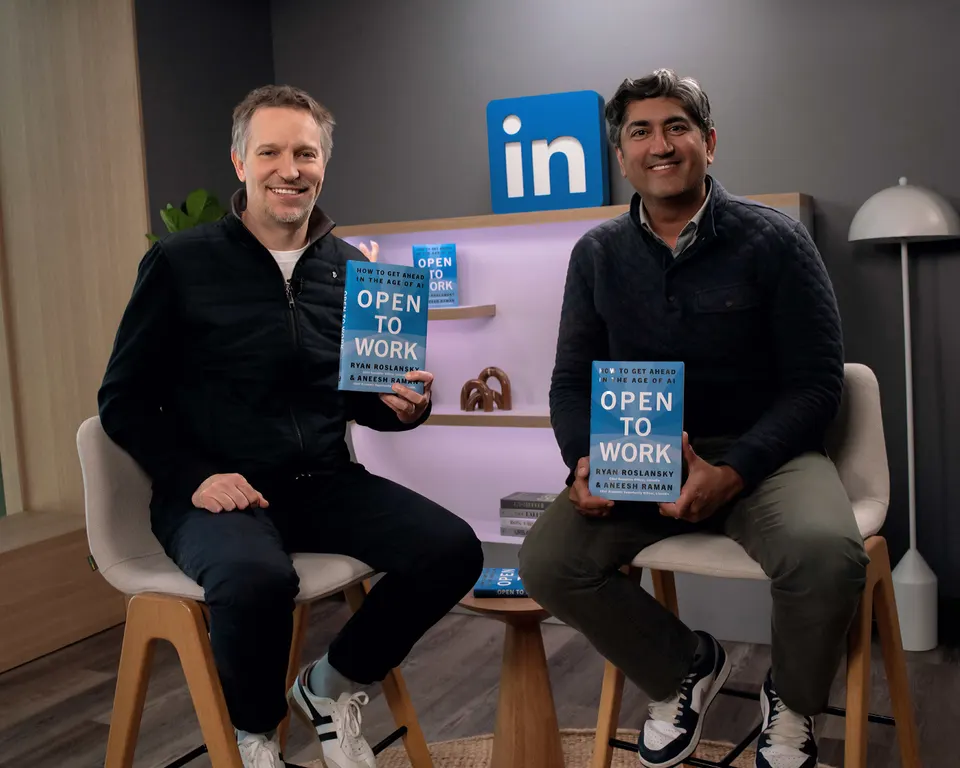
Two months ago their book Open to Work came out and quickly became a bestseller. The title comes from a typical LinkedIn status, the signal that you're open to job offers. In the book the two give their take on how the professions will change and which skills will survive in the era of hyper-advanced artificial intelligence. You can come away from it charged with optimism, with the idea that the future belongs not to AI but to the person who knows how to use it.
I picked 13 quotes for us to discuss, to think through and, where necessary, even to argue with. The translation, of course… is the work of AI.

1. No Time to Lose
“It's clear that artificial intelligence is rewriting the way we work, learn and create. From automating the familiar to opening doors to new opportunities—the future is unfolding fast. Now is not the time to stand still. As the saying goes: ‘The secret of getting ahead is getting started.’”
After this pronouncement, Messrs. Roslansky and Raman tell us, with the pathos typical of their home country, the story of Apollo 13, when the spacecraft's crew managed to survive because they decided to ignore the rules, began making complex and unexpected decisions, and showed the very best they were capable of.
I don't know whether this means each of us is expected to become an astronaut in order to solve the problem of the vanishing jobs that Yuval Noah Harari also talks about. And it's certainly wonderful to get started. Knowing what artificial intelligence can do and using it where it can help you, make you more successful, save you time on the tedious chores in favor of the meaningful ones… that's certainly useful.
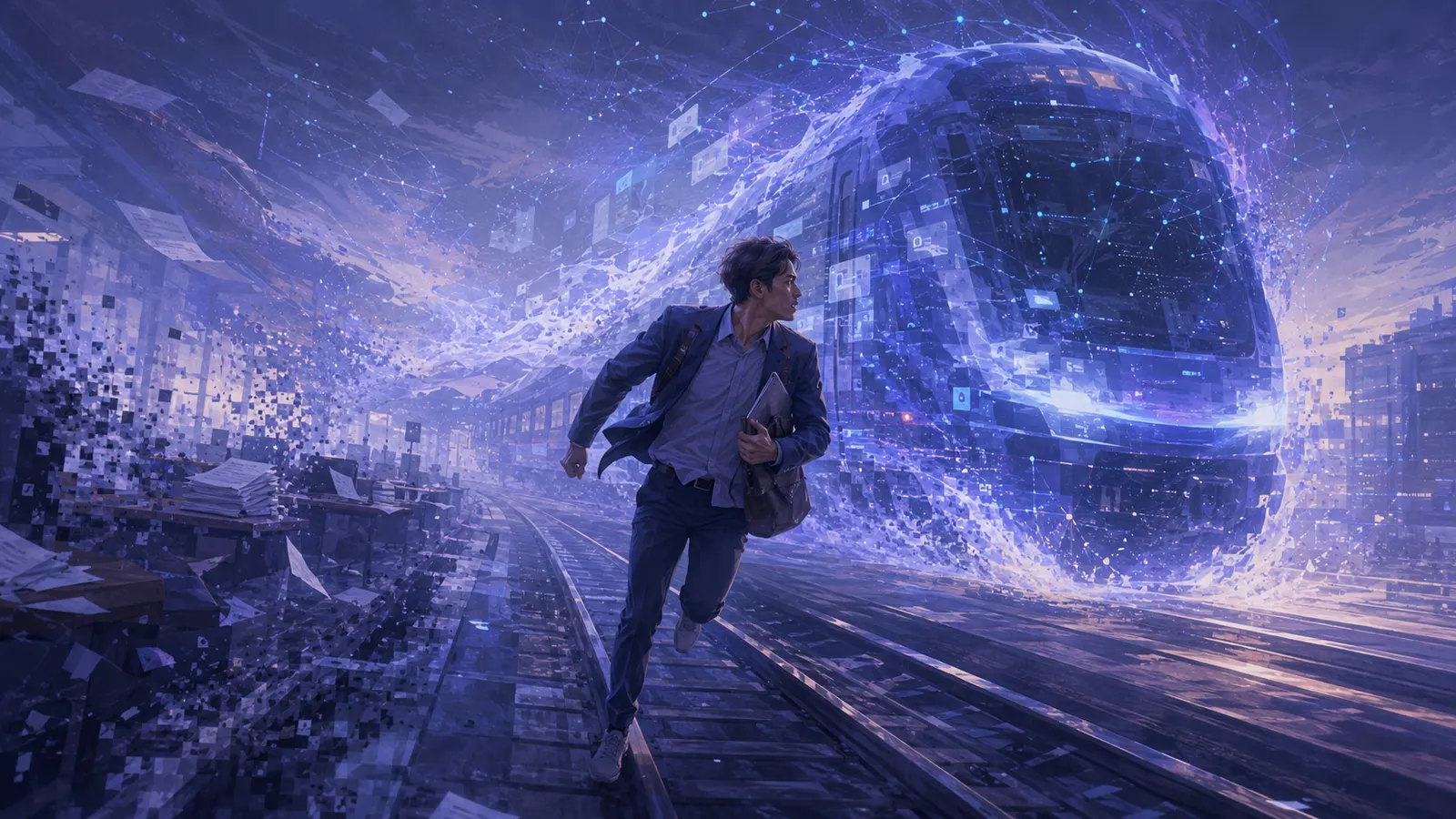
But how? The authors give no answer. Nor do I think they could, for one simple reason. Nobody is able to, at a time when new AI models appear every few weeks, each with its own demands, expectations and capabilities. People who use AI certainly have better prospects than those who don't, and that hardly depends on their profession. But it is only a small step taken while running ahead of the train that—by all appearances!—is relentlessly chasing us.
2. Relax, Will You!
“AI isn't the first disruptive change we've seen unfold on our platform. Just a few years ago, in June 2020, we launched the Open to Work feature on LinkedIn at another such moment. If you're not familiar with it, Open to Work is that little green ring you can add to your LinkedIn profile photo to show you're open to new professional challenges.
When we created it, the world of work was going through the COVID-19 pandemic. Layoffs and job insecurity were spreading across industries of every type and size. Corporate offices were sending their employees to work from home. Small shops and restaurants on main streets were closing their doors without knowing if or when they would open them again.
Today we find ourselves once again at a moment of great change—one that will require all of us to be open to new ways of working. Open to building new skills. Open to experimenting with new tools. Open to starting new chapters in our careers.”
How did it go—“let's duck, let's duck, and it will pass,” as the line attributed to Todor Zhivkov, Bulgaria's communist leader, said of perestroika. Yes, fine… It passed about as much as the thing the author of that famous quote was warning about (and on computers, by the way, he turned out to be rather right).
Until very recently we thought technology would first put out of work the people doing uniform, repetitive labor. Except we now know that isn't the case. Once AI writes indistinguishably from an author who spent 35 years building his style; once it can imitate us at practically any task, the paradigm is different. The question remains what it is that we will add. I don't have an answer, and if Mr. Roslansky and Mr. Raman do, they don't give it away within the covers of their book.
But relax, there'll be water for everyone.

3. Soft Power!
“For decades, our 5 Cs were dismissed as ‘soft skills’—nice extras that took a back seat to the ‘hard’ skills our economy valued most. In the coming years it will become clear that soft skills aren't ‘soft’ at all. They are the key to our survival. The way work is structured today, however, means we rarely get the chance to truly use them.”
These 5 Cs, which according to the authors are what makes us unique and what we must develop in order to survive professionally, are Curiosity, Courage, Creativity, Compassion and Communication.
If you run into the authors, would you please ask them which of the five AI is not yet able to imitate indistinguishably from a human?
4. Workers of the World…
“In the end, we humans decide what comes next. The steam engine, electricity and the internet didn't arrive with ready-made instructions for use. In each case, the choices people made about how to deploy, regulate and integrate them into society determined their impact. AI is no different.
We are not passive observers waiting to see what will happen. We are active participants writing the next chapter of work. And if we choose to use AI to amplify what makes us human, rather than replace it, that is exactly the future we will build.”
Oh yes, the wisdom of societies will save us—nothing complicated about that.
We often talk on this site about the haphazard, uncritical way we embrace technology. For us as a society not to be passive observers, we would need public debate, political competence, a sensible conversation, a way out of our filter bubbles, a publicly recognized scientific community, social mechanisms suited to the new world we live in.
Do we have any of these? Is it looking like we'll have them anytime soon?

5. We Have Data
“Workers in every field are already using AI. As they do, they're learning which parts of their jobs AI can take on and what that means for their future. The data is striking: LinkedIn researchers found that 24% of the skills needed for the average job changed globally between 2015 and 2022. Looking ahead to 2030 and factoring in the impact of AI, we estimate that share will jump to 70%.”
I'd bet on no less than 72 percent. Though as a specialist who has turned to helping people and companies bring AI into their work processes, I do have a few observations of my own.
And so far they show that the technology is being adopted rather chaotically, unexpectedly, in avalanches and spontaneously. The numbers in this case simply have nowhere to come from and nothing to tell us.
6. The Good News
“If you're skeptical of AI—we get it. If you're tired of hearing about AI—we get it. If you feel you have to nod along when someone talks about AI even though you have no idea what they're talking about—we get that too.
Here's the good news: to get ahead in the age of AI, you don't need to build AI. You just need to know how to use it. You've probably done something like this before. At some point you most likely learned to type, to send emails, to make a PowerPoint presentation and to use a smartphone. None of that required you to learn how to build a computer or write code. For the vast majority of us the process is the same—except this time you work with the tool by talking to it the way you would talk to another person.”
And so we arrive at curiosity. Yes, we have a technology that is so different from what the science fiction writers predicted. I'm convinced anyone can use it one way or another in their daily work (and their hobbies, and every area of life) if they're brave, if they're in the mood to experiment, if they approach it unconventionally and set aside enough time to learn every next step AI takes.
7. Why I Believed, Why I Ran
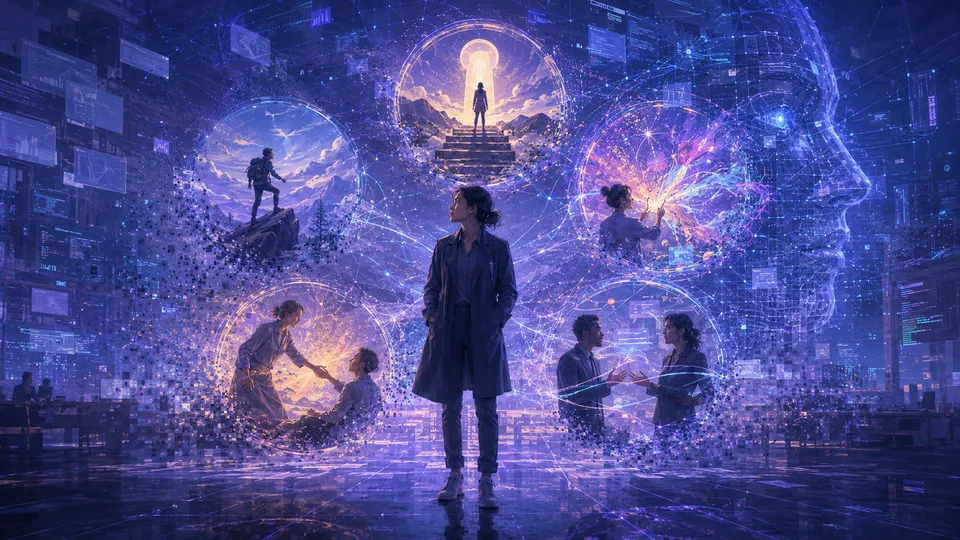
“White-collar work became a cultural ideal. The closer you were to designing and running the business itself, the more valuable you were and the better paid you would become.
White-collar work promised an escape. You get the right education and start using your mind. With a white-collar job you could create instead of merely executing. Innovate instead of repeat. That was the promise. But it was never fully realized. In the end, for most people white-collar work simply carried the factory's focus on efficiency into the office.”
The interesting question here, which has no answer either in the book or in the ideas of the authors, whom I follow, is what color the next collars will be. Isn't it too simplistic to explain that they'll just be the people who have learned to handle the new technology the way they handle a keyboard?
8. The Engineer Yesterday, Today and Tomorrow
“The software engineers of tomorrow will spend less time writing code and more time understanding what code needs to be written. Less time fixing bugs and more time collaborating to define the problems worth solving. Less time optimizing algorithms and more time navigating the ethical implications of what they build.”
In other words…, as has already been discussed here, software engineers will no longer be exactly… programmers, but something else. But what? What will their work look like? With this latest step toward high efficiency, how will their tasks change? Is it just me, or does it seem utopian to the point of naivety to believe the work will be directed toward ethics?
These are huge questions, and in Bulgarian terms they're tied to the IT world, the part of our economy that in recent years has been pulling all the statistical indicators forward.
Are we having a deep enough conversation about how it's changing?
9. And? And?
“AI remixes; humans create. AI is extraordinarily good at remixing what already exists, but it can't come up with anything truly new. Use it to take on routine tasks and broaden your perspective, but don't let it think for you.”
Sounds wonderful, except… if I know it writes indistinguishably from me, how exactly could I hold myself back and not let it write my next “own” text? I wouldn't, and I don't—you can tell from the imperfections of these very words. It's remarkable, by the way, how today a text's imperfections are the sought-after sign that it is human.
AI has long been able to create. The example I can give you is poetry, perhaps the most intuitive and human of the arts.
But the bigger question is this: how do we protect ourselves and go on loving things being hard when they could be easy? In writing code, words, in creating anything at all…
10. Intelligence? I Don't Think So
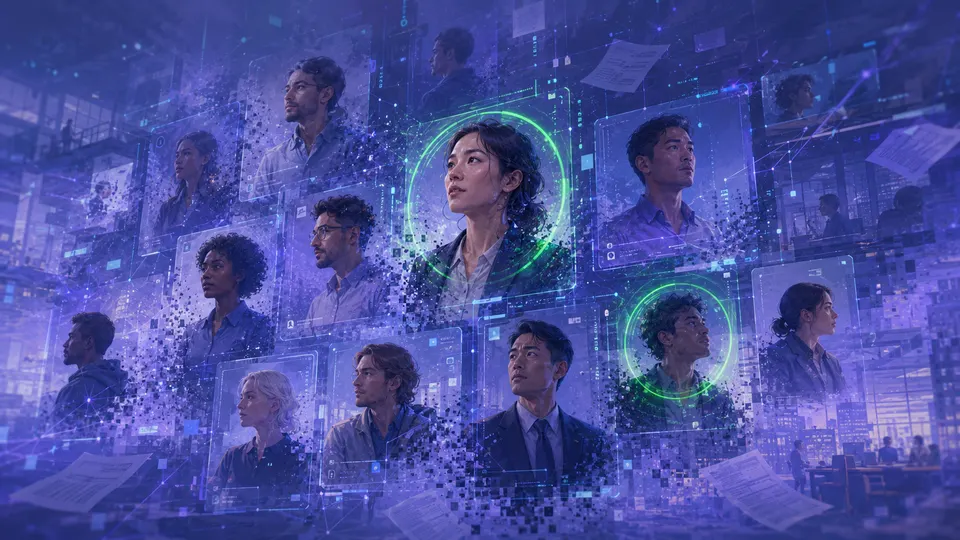
“Over time the idea of IQ—the intelligence quotient—gained popularity, and we arrived at the claim that human intelligence comes down mainly to solving puzzles quickly and memorizing facts.
The term ‘soft skills,’ often used to describe the 5 Cs we've examined, comes from a time when technical skills were seen as the main drivers of success. That was then. Now it's different. As AI takes on more and more routine and technical work, the abilities that make us human become ever more important. In the coming years, we believe these so-called ‘soft’ skills will be among the hardest and most valuable to build.”
No need for… classical intelligence? Yes, I too was saddened that ChatGPT is already beating Dimo Padalski, Bulgaria's best-known quiz champion, and company. Didn't the previous quote already say it may not be very useful to delegate everything to algorithms—so is that the very thing we should hand over? What if knowledge, the ability to solve unconventional problems, which has given birth to every great human leap, is precisely what remains human?
I don't know, but nobody knows, including the authors, who have the confidence to claim otherwise.
11. Breakthroughs
“The human brain is our most underrated asset. AI is about to change that. For a century we measured intelligence through metrics of efficiency, while our real advantage lies in abilities that go beyond efficiency.
The 5 Cs are what make us irreplaceable in the age of AI. Curiosity, courage, creativity, compassion and communication are the abilities that make us most human and that underpin our competitive advantage as people in the workplace in the age of AI.
Innovation takes time and learning. The greatest breakthroughs have always come from minds given the freedom to explore, to fail and to connect with other people. As AI takes over efficiency, we finally have a chance to reclaim the time and skills that human innovation requires.”
The ability to make full use of your freed-up time is something that worries me almost as much as loving things being hard when they could be easy.
The experience so far—from the arrival of social media, for instance—hardly gives much cause for optimism, I'm not sure. Technology frees up more and more of our time from routine tasks, but… what are we to use it for? Let whoever knows the answer cast the first stone.

12. The Human Way
“Adaptability is key. Like bank tellers who went from dispensing cash to solving customer problems, your ability to adapt is crucial. Adapting will serve you better than predicting.
Your career is now a climbing wall, not a ladder. The predictable path is gone; it has been replaced by multiple routes that will reward creativity over conformity. Just as Mo Beck invented new climbing techniques, you will invent new career sequences that turn your unique combination of skills and interests into advantages.”
And… are we supposed to adapt and change professions every week to keep up with the furious pace at which technology advances? No, that stopped being human long ago. But what remains human, the thing we must never delegate—that's the bigger question.
When the author of the words above is no longer the head of LinkedIn, what does he plan to do to develop his unique combination of skills and interests? What if one day he, too, has to… look for a job?
13. Children of Mother Earth
“The best way to learn more about AI tools is to return to the state of mind you had as a child in your favorite class. To that moment when you first fell for your favorite subject, or read the first few pages of a book that led you down a deeper path of discovery. Try to bring the same curiosity and energy to exploring AI tools and to your first steps with them.”
Here the book goes on to a detailed 30-day plan for how to start working together with AI. Presumably, if you follow it, success can't possibly pass you by. Or can it?
It's definitely worth being curious. And knowledgeable, too. And asking ourselves far more questions than answers. Because the time we live in is truly special. And the attitude of children toward the new, which the authors chose here, is definitely a wonderful example.
It's no time for prejudice, and no time for easy solutions either. Adaptability and traditional human skills look like possible paths, but the most important things, to my mind, remain the questions.
What will you be working at tomorrow? What's the most interesting and incredible thing technology will never manage to imitate? If you have an answer, come and let's discuss it and tell everyone else…