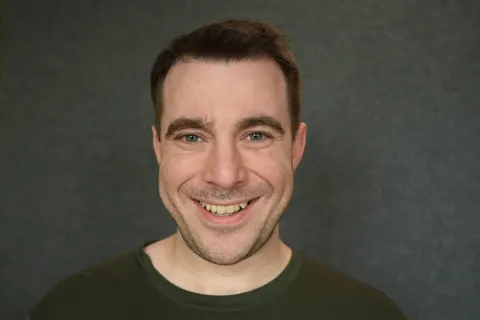
No matter how thirsty you are, you can't drink from a fire hose, says Kostadin Milov.
If you don't believe it, try.
The same goes for technology. We push it thoughtlessly into more and more corners of our daily lives, handing it one new role after another, until we suddenly find ourselves chained to our screens like Prometheus to his rock.
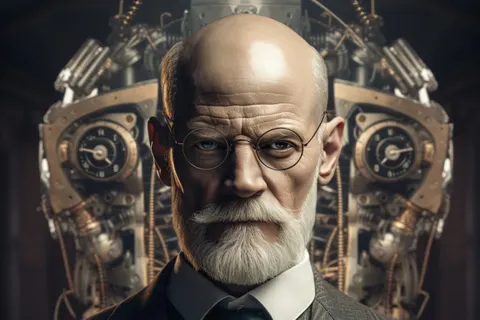
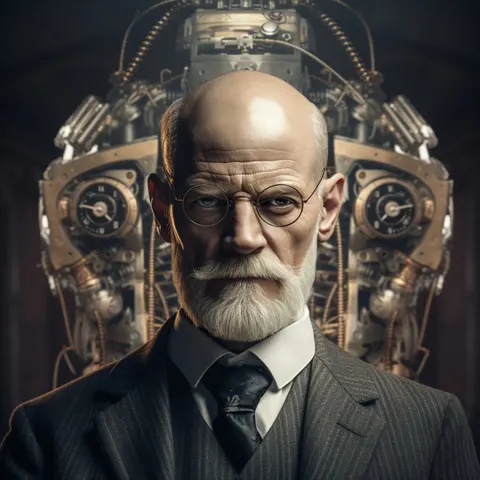
Information technology is a huge opportunity. The dose makes the medicine, but… what is the dose? We will look for the answer to that question, along with another one: when will the Freud of our time appear, and who will he be? The person who will grasp the psychological challenges facing Homo sapiens at the height of the technological revolution. A Freud who will lift the taboos and make sense of the bond between people and information technology.
Eros and Computers
The more technology we add to our daily lives, to our work, to every single second… the better, right?
Of course not. Yet we think less and less often about the need to impose some measure on ourselves, to find the spot where the barrier should slam shut. Today we talk about limiting screen time only for children; once we grow up, we try to delegate more and more to our devices. There has long been no recommended number of hours to devote to the magic lights on our desks or in our pockets, for instance. And the subject is barely discussed at all. In the dawn of the internet we were frightened with the danger of computer addiction, and now that we have all developed it… we pretend it isn't there.
Psychology, meanwhile, is called upon today to help the people who have lost their way.
What would Sigmund Freud have to say about it?!
Desire and Suffering
Before we get to the famous Austrian, though, let me introduce our other hero today. Kostadin Milov comes from Smolyan, a town in the Rhodope Mountains of southern Bulgaria, and a decade and a half ago he decided to turn to psychology, and to one of its less typical fields at that: occupational psychology. As he puts it himself, the idea behind this field is to humanize work. “At its very core, it tries to explain scientifically why we should be humane in the workplace.”
Over the following years he studied at the Technical University of Sofia and at Sofia University, then selectively attended lectures by teachers from various places he judged he could learn something from—at the art, film and architecture academies—with the idea of finding through them a path to the art of information technology.
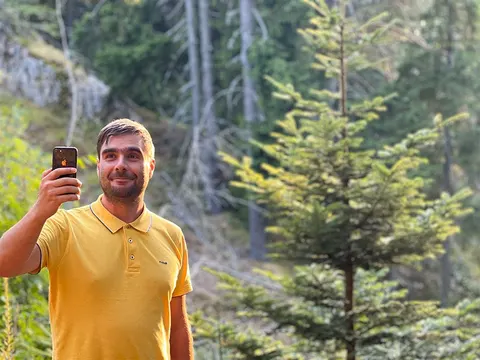
All the while he splits his professional time between two callings. Being from the Rhodopes, he adores the mountains. He often works as a mountain guide, and up there he can see in practice all the solutions he is searching for on the other side. Namely, as a specialist in occupational psychology, as a researcher who believes it is time for the field to meet the demands of the present day. To keep pace with the development of technology and to make sure we use it in our daily lives and at work in such a way that we still draw the line where it starts to become too much. Or too little, because he wants to bring people to think rationally about it.
Anatomy of Feelings
For several years now he has been returning to the big subject of his student days, and he says one of the reasons is the Digital Stories site, which in his view collects perspectives that will be appreciated years from now.
But something else matters more. The intriguing questions our guest today raises through the prism of the digital.
“I still don't see a psychology of information technology. At the moment everything on the subject is descriptive. There is no foundation, no model that tries to explain where the line runs, when, from a human point of view, we should limit technology, and how to determine the way we use it.”
But where does our other hero, Dr. Freud, come in?
Great ideas and great personalities appear when society needs them. That is exactly how the father of psychoanalysis appeared in Vienna, to lift the taboo on sexuality as a source of motivation. And as a source of problems, too, whenever we fail to turn inward and fail to look for the causes of our inner torments where they most often hide—in our childhood.

Computeranalysis
According to Kostadin, we need to talk more about the limits of technology so that together we can arrive at an assessment. “Sooner or later someone will draw attention to the idea that information technology is a good thing, but not without limits. He will define the parameters of that limit. But who will be the next Freud, who will lift the taboo, strip information technology bare and declare that the emperor has no clothes?”
Today we hold in it a weapon that, by all appearances, we still don't know how to use. The psychologist offers a vivid comparison with a hoe that has fallen into the hands of people who don't know how to use it. “At first they would swing so hard that someone would hit his foot and someone else would cut off a finger. These unwanted effects would stop once there are limits, a lower and an upper bound of usefulness. When it comes to technology, we only look at one of them, while the upper limit is taboo. And that is why we cut off hands and feet, why we inflict mental wounds on ourselves that go unseen for a long time and are slow to heal.”
In his view, a future model for the psychology of technology should be aimed both at the organizations, managers and teams that use information technology and at those who create or distribute it.
“Right now we only talk about capacities, about possibilities, but in my opinion the right measure is usefulness,” says Kostadin Milov. “Usefulness relative to need, because information technology is a kind of accelerator of thought, a catalyst. We try descriptively to reach some kind of truth, but it is fragmented. What's missing is a unifying model that shows how to act in different situations, even in our daily lives. How much should we use a phone, and how? How much and how should we work at a computer?”
Monitor and Taboo
Such a model, the psychologist is convinced, must go through standardized questions built around meaning, and it must define the need for applying technology. He gives the example of a former job of his in the human resources department of a large factory. There, introducing too many innovations would have slowed down and hampered the work, because the organization of labor couldn't have handled it and the people weren't trained.
And still, how do we determine this usefulness? “If you're at work today, we first need to see what your motives are, what the goal of your work is, and how it should be done, seen from the outside. We build these three foundations and examine them against your function. We link them to meaning, and from there we can extract a great deal of information. But above all, we can see what your marginal usefulness relative to technology is, and how large.”
Writing software, for example, is mental labor, it isn't linear, and yet we largely treat it by the standards of the industrial era, Kostadin adds. “There is still pressure on people to work eight hours a day, for instance; employers are very slow to understand that this model doesn't work, and COVID helped sober everyone up quickly. To arrive at an effective recipe, you have to go through the limits. That way information technology and its management would become more human, and to me that is what matters most. They would go back to the person. They would ask: ‘How can I help you work?’ and not: ‘I want you to work more, because your computer can.’”
Algorithms and Dreams
Kostadin is persistently searching for specialists in data processing and software development with whom he could test his model for the usefulness of technology. But it is important to him that they be kindred spirits. “I believe that with information technology the dose makes the medicine, but nobody knows what that dose is. And right now that is exactly what is causing terrible harm to people's mental health and to the development of societies. I'm fighting to help bring about good managers who show understanding toward their colleagues. For goal-setting to be based on some adequate model. I'm looking for the place where the idea will take root, because it is very specific and abstract.”
And along with it, he believes, come the other important questions of our time.
What is useful and what is harmful?
Is information technology progress in itself, or are we mistaking it for human progress today?
How do we judge up to what point artificial intelligence is useful in a given situation?
Sins are the warning signs of dangerous behavior. Are we perhaps walking the sinful path of technology rather than the virtuous one?
Have we reached the zone of incompetence described by the Peter Principle?
Would we even hear the long-awaited Freud of our day? Or is it left to us to search for the answers ourselves, along the thorny slope of everyday experience…