The global chip shortage has shaken the whole planet. In Bulgaria the subject gets little attention, even though it has hit our wallets just as hard as it has in the West. The lack of semiconductors has sent prices soaring for cars and for almost every tech gadget we now need every day.
And although it affects every one of us, the topic still rarely sneaks into our (or at least my) online space.
In fact, lately chips have mostly been discussed by one particular group of people. Maybe they turned out to be right after all—those who expected good old Bill Gates to implant a chip in us with every vaccine—and that is exactly where this nasty shortage came from?
Now, seriously. Let’s look together for the answers to a few interesting questions. How did the chips suddenly run out? Why did this problem hit even the biggest players? Will it lead to a permanent rise in the price of everything tech-related, or is it a temporary phenomenon?
Can Bulgarian industry, of all things, take advantage of this situation, as the specialists from the Professional Association of Robotics and Automation are convinced it can?
The Little Chip Says Goodbye
Last year was a brutal surprise, with everything the pandemic brought upon us. And 2021 surprised tech geeks in a similar way. First it became hard to get hold of the newest game consoles and the long-awaited next-generation graphics cards.
Then came the turn of the real big shots, impatient to drive their new Tesla over the yellow cobblestones of central Sofia. Musk’s luxury ride, along with the models of the other leading carmakers, is still suffering from this crisis. Production fell dramatically behind, and while everyone waited for chips, losses running into billions began piling up.
It wasn’t only rich countries and rich people who suffered. Because of all this the market for new cars collapsed, many people had to hold on to their old vehicles, and suddenly the prices of Bulgaria’s beloved “second youth” cars—used imports from Western Europe—also shot up faster than a billionaire’s rocket (the only vehicles that were spared by this crisis).
Then problems started appearing with almost every tech product. Some new models were delayed by months, others came out with less impressive hardware, and still others… simply got more expensive.
But haven’t we known microchips for ages? Humanity has been making and perfecting them for more than half a century, so how did we end up in this crazy situation?
No More Chips, Buddy
Whether we call them “chips,” “microchips” or “semiconductors,” in this case we are talking about the same thing.
In the world of technology, when you call something “rocket science,” you mean there is nothing more complicated and incomprehensible. In Bulgarian we also say that something “is nuclear physics.” Well, chipmakers often joke that they are the only ones for whom “rocket science” isn’t just the usual idiom. Because their work is, for many reasons, even more complex than building rockets.
The last two years changed our lives so drastically that we will be assessing it for decades. Yes, the root of the chip problem is that small, nasty little virus we are all sick of; I won’t say its name. It struck the chips too—because it got scared they would be put into the vaccines aimed at it, is that it?
Forgive the joke once again. Covid (and/or the measures against it) locked us at home for a long time and paved the way for the much-touted new era of the home office (and its colleague, “home school”). Suddenly a lot of people had to buy electronics in order to do their jobs. And not in one city, country or region, but all over the world.
The retail network didn’t buckle. Neither did the warehouses or the manufacturers; in the end everyone got the goods they were after.
Then everyone had to step up the pace, because the crisis dragged on.
The Little Chip That Tipped the Cart
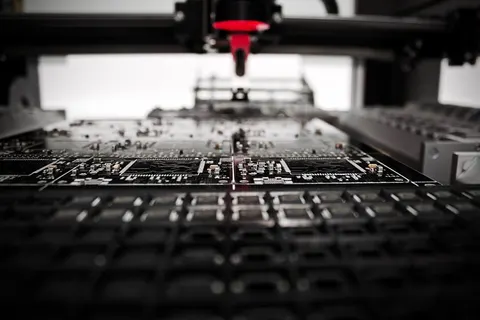
There is one thing that unites the makers of any product connected to digital technology today: whatever they make, they depend on… yes, exactly, on chips. It turned out that the world’s capacity simply wasn’t ready to absorb the enormous demand. Yes, the chip market had been growing steadily over the years—in 2018 and 2019 sales rose by 5–6 percent a year—until 2021 came along and in May they were suddenly 26 percent higher than a year earlier.
“This year semiconductors, next year conductors,” goes the worn-out joke from such dinosaur times—the days of socialist plans and promises. But as we said, making chips, the tiny wafers cut from semiconductor materials, is fiendishly delicate work. Building new capacity is not only expensive, it also happens very slowly.
Raw materials turned out to be another difficulty. The materials chips are made from are varied, and some are very specific and mined in very few places in the world.
Then the problem started snowballing like an avalanche.
No Bread? Let Them Eat Chips!
Carmakers had scaled back their capacity, because in the first months of (I won’t say what) nobody cared about traveling. Even people who had ordered cars canceled en masse, the highways stood empty, the cities were locked down. The human mind quickly forgets unpleasant things, but only a year or so ago anyone who wanted to travel from Sofia to Pernik, a town just west of the capital, needed a good reason and a signed note to do it.
Soon things changed, people felt (or actually were) unleashed, and orders for new cars took off. Good luck for the carmakers… or not, because they had already “lost their place in line” for microchip deliveries. They had to queue up again, in a line much longer and more expensive than the one for bananas back in the days of that little “joke” about conductors.
And so companies that had already suffered heavy losses from (I won’t say which) suddenly found themselves facing very serious new losses, just when it seemed they were on their way to smoothing things over. So far the losses to the car industry are estimated at no less than $47 billion and are growing every day.
Where Have You Gone, Wonderful Chips?
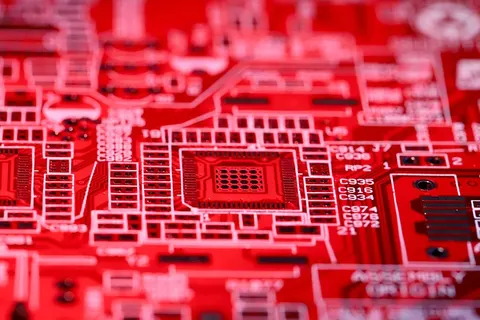
Just think how messed up the situation was when even Apple, the world’s biggest buyer of semiconductors with an annual budget of $58 billion, was forced to delay its long-advertised iPhone 12 by two months because of chips.
Even more telling is the story of the second-largest buyer… Samsung. The company also postponed the launch of its new flagship phone, even though it is at the same time… the second-largest microchip manufacturer.
Ford, for its part, decided to build its cars without the chips and only afterward rework them to add them in.
Chip ’n Dale
The subject didn’t echo in Bulgaria the way it did around the world. Among Joe Biden’s priorities in his first year in office, there is increasingly talk of a massive campaign for the United States to start building large-scale chip factories. Even the European Union, after a rather convincing appeal by 13 member states, a few days ago made creating an ecosystem for semiconductor production a priority.
The problem is so serious that maybe even here, if we take a break from politics for a while, a movement will be organized to convert village rakia stills—rakia being the Bulgarian fruit brandy—into chip factories?
And again, joking aside: does this mean there is nothing to worry about and the problem will soon be solved?
Well, that was supposedly the case with (the thing I really don’t feel like writing about) too. We isolate and it will pass. We get vaccinated and everything will be fine. It still isn’t fine. By all indications, it won’t be fine with chips anytime soon either. Here is why.
Chips on Break
Most specialists assume things will normalize in the second half of next year or at the beginning of 2023. Others believe the crisis will become permanent. Forecasts in this field are beyond even the most professional prophets, because conditions are dynamic, while the work itself is exactly the opposite—precise, slow and conservative.
Companies in this business are, broadly speaking, divided into those that design and manufacture microchips and others that buy them and only process them for the specific needs of their production.
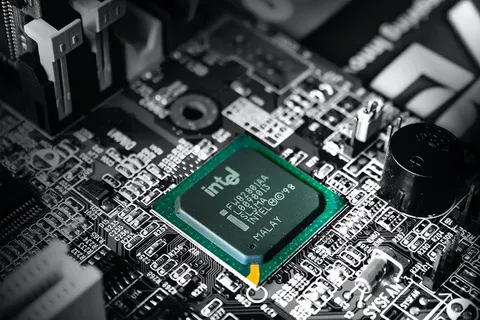
The first group contains not that many big players, and most of them come from East Asia. The Taiwanese company TSMC (Taiwan Semiconductor Manufacturing Company) and South Korea’s Samsung and Hynix are the biggest and best known in the business, holding a huge share of the market. Intel is one of the few exceptions on the list—it makes a large part of its own chips, unlike Nvidia, which designs them but has no serious production resources of its own.
The Taiwanese Trick
So companies like Apple, Nvidia and AMD depend directly on the production of TSMC and Samsung.
A huge share of the roughly 1.4 billion smartphone processors made every year are built with TSMC chips. Intel, in turn, holds 80 percent of the processor market.
Today three-quarters of production is in Taiwan, South Korea, China and Japan. And it’s no accident that we start with Taiwan again—it is certainly the leading country in the business. And if you have followed world politics over the past 50 years, you will know that the island is a particularly ticklish subject for China, for the United States, for the battle between the superpowers.
Americans produce only about 10 percent of the chips used in the country. In 1990 the United States accounted for 37 percent of global production, while now it is only around 12 percent.
Micropro…blems
For a long time in Bulgarian we called it “Silicone Valley”—we do love our silicone here—but the truth is that it owes its name to silicon, the material that made it possible to create microchips.
At the risk of repeating myself, this is very, very complex manufacturing. Any new capacity in the semiconductor industry takes an average of two years to bring online.
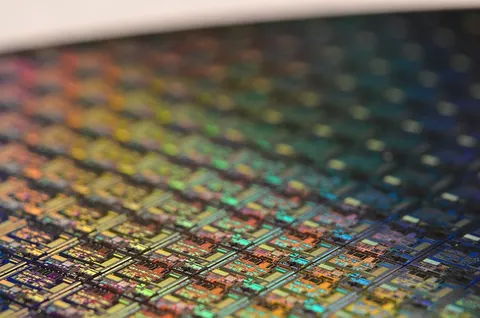
The wafer of every semiconductor is made terribly slowly and precisely. Sometimes, with the most complex chips, the whole process can involve 700 or even 1,400 separate steps. It takes up to 20 weeks, sometimes around 300 different raw materials are used, arranged in more than 100 layers on the tiny chip.
In the factories, silicon is processed into a huge cylinder, which is sliced with extreme precision into wafers, most often 30 centimeters in diameter. They are polished and polished, long and precisely, until they become flawlessly, perfectly (and I mean truly perfectly) flat. Then they are cut again into smaller chips, and the real work begins, until the desired functions are achieved.
Chipped Thoughts
Chip factories could easily serve as sets for science fiction films. Just think about what it means to manufacture a tiny part in a process that involves more than 1,000 steps and takes four months.
1,400 steps. Even if 99 percent of them are done perfectly and only 1 percent have a minimal error, the chip ends up in the trash. Every single step has to be taken with precision.
For a factory to work efficiently, at least 90 percent of all the chips it produces must meet this standard of perfection; otherwise the weeks lost making them “eat up” the profit.
That is why chip plants have to be kept even cleaner than operating rooms. Every speck of dust can cost millions of dollars.
Building a very basic facility producing around 50,000 chips a month can cost up to $15 billion. To justify the expensive and complex equipment, the factories run around the clock, without a single day off.

Terribly Micro Chips
This is exactly what has made the market what it is. Concentrated in a few big companies in one particular part of the world, which invested and worked long and hard to earn their positions. Something like a British lawn, but from high-tech times.
Add to all this the difficulty of sourcing all the necessary raw materials.
So far we have lumped all chips together, but as with any other product, there is a serious difference in quality between individual ones.
The enormous challenge with chips is to fit as many transistors as possible into each one. Intel’s first contender, the 4004, was introduced in 1971 and “housed” 2,300 transistors at points measuring a minuscule 10 microns, or 10 millionths of a meter. Today the two big rivals create points as small as 5 nanometers, 5 billionths of a meter, or 0.005 percent of the width of a human hair. Individual transistors are becoming smaller than even a virus.
In practice, all production of the finest chips, built from “nodes” 5–10 nanometers in size, is in Taiwan and South Korea. Elsewhere they simply lack the expertise to make them, and it is almost inconceivable that this will change in the near future.
Oh, Little Chip, Where Are You?
Many companies are determined to deal with the problem quickly. TSMC announced it would invest $100 billion over three years in new capacity. Intel has set aside a “modest” $20 billion for two new factories, and for the first time it will make chips for other companies too, among them Amazon.
Suddenly governments that had never shown the slightest interest in semiconductors sprang into action as well. Everyone started talking about self-sufficiency, perhaps sensing that this is an open niche that could bring in a lot of revenue. Against the sums announced by the Eastern players, the $50 billion the United States plans to invest in supporting local companies isn’t all that much either.
Building such a precise factory is delicate work, and experience matters a great deal. That is why it is considerably more likely that the big Asian players will do well at expanding capacity than that the West will make up its serious lag.
Chip by Chip
One very interesting angle on the subject remains for the end: can Bulgaria turn this global crisis into an unexpected opportunity, and how?
The EU is determined to produce 20 percent of the world’s semiconductors by 2030. And where does our country fit in? It is no secret that we have had huge achievements in this field, which, unfortunately, over the past decades were practically forgotten and crossed out…
Some experts say the crisis will end in 2022, others that it will become permanent. Bulgaria, back in the days of that crude joke about conductors, was among the leading microchip manufacturers.
How do things stand today?

The Rose Valley vs. Silicon Valley
The Professional Association of Robotics and Automation (PARA) is an organization that has set itself the goal of promoting Bulgarian successes in these fields. And, along with that, of working to make those successes more numerous.
In the global chip shortage PARA also sees big opportunities for Bulgaria, says the organization’s deputy chair, Yonko Chuklev.
“There are many companies in Bulgaria directly connected to this industry,” he says. “We have Milara, a company in the global top 10 for making robots for the semiconductor industry. We have Smartcom, half of whose team was acquired a few years ago by GlobalFoundries, one of the industry’s hegemons. There is Melexis, which this year is investing 75 million euros in its chip plant in Gorublyane, a district of Sofia; Strypes, which does preventive maintenance for one of the big chipmakers… A whole mini-ecosystem operates here, and it has very serious potential!”
At the same time, Yonko Chuklev believes, the subject of chips and the semiconductor industry is almost never discussed in Bulgaria. Our country isn’t even among the 13 in the European Union that launched a serious initiative to stimulate the sector.
…Next Year, Semiconductors
“Since we hadn’t seen anyone talk about this seriously, we thought it was important and interesting for us to raise it,” Yonko says. He believes there are niches in the semiconductor industry that can be developed in Bulgaria, and that it is time for companies and institutions to think together about how we can break into the field.
That is why our country’s positioning in this huge global crisis and opportunity is the lead topic of the upcoming Forum on Robotics Strategies, organized by PARA.
Do we really stand a chance in this enormous global commotion? Hear more about it firsthand and share your own thoughts at the forum next Wednesday (September 29). Registration is free.
“The boom in investment in chip production and development is only just beginning, and the niche opportunities for Bulgaria are real,” Yonko Chuklev is convinced. Tiny chips bring big chances—let’s hope there is room among them for our industry too.