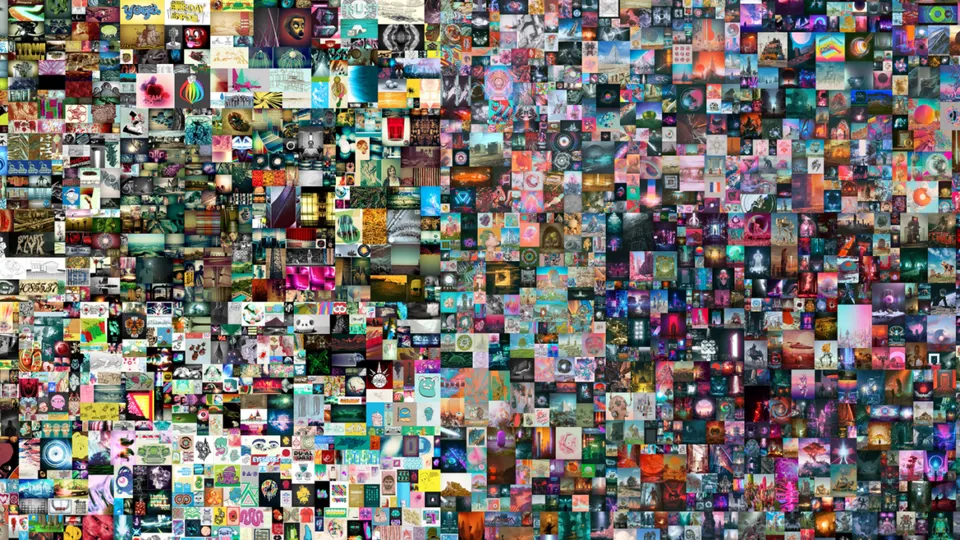
In March, a single file was sold by Christie’s for $69,346,250. Not just any file, mind you: a collage of 5,000 images. The sale made Mike Winkelmann, a relatively unknown 40-year-old graphic designer from South Carolina who goes by Beeple, one of the three most highly valued living artists. The anonymous buyer received in their inbox… a 319-megabyte file and their NFT, a string of characters that serves as a guarantee of ownership.
Then, at the beginning of June, the digital work CryptoPunk fetched a rather more… ahem, modest $11.8 million, paid at auction at Sotheby’s. It is a collection of 10,000 digital images created by the artists behind the Larva Labs project.
Jack Dorsey, the creator of Twitter, sold… his first tweet for $2.9 million.
Fine, these are serious sums, and we all know that sometimes people simply don’t know what to do with their money. But the more interesting question here is… how exactly can you buy a file or a tweet? Aren’t these things that can be shared just like that, for free? It isn’t particularly hard for everyone to own the very same digital image, to copy it and send it around as much as they like (copyright, of course, is a separate matter).
So what exactly is all this money being paid for? The answer lies in an abbreviation you’ll be running into more and more often in your news feed: NFT.

Tick-Tock-Token
The abbreviation stands for non-fungible token: a token, or a chip, if you’d rather avoid jargon. Either way, it is the embodiment of something we are given so that we can prove, in the simplest possible way, that we hold the rights to a given asset. And they are “non-fungible” because that is their defining feature. You can always exchange a 10-leva note (about $6) for two 5s. You can buy a bitcoin and then sell it. But these tokens have no equivalent; they represent something unique that cannot be swapped for something else in the same category. Simply because nothing else falls into the same category.
If that isn’t entirely clear yet, don’t worry: plenty of examples are coming.
The fact that we are dealing with something that has no counterpart quite logically pointed their first application toward art. Further down the road, though, all sorts of things are coming: even real estate and… nonexistent sculptures.
Although the technology has been around for more than five years, non-fungible tokens have become a hot topic only in recent months. It’s no accident that we began with the examples from Sotheby’s and Christie’s: even the biggest names in the business now trust it and use it actively.
Lately, NFTs have become an obligatory entry on every list of the best places to invest money in the volatile global economy that followed the arrival of the coronavirus.
Blockchain Under Pressure?
Not long ago we told you about blockchain technology, how it works and how colorful its possible future applications are. Well, NFTs are precisely one of them. The whole idea of blockchain is that once information is placed in the mass of the network, it stays there forever, for as long as that blockchain exists. It is unchanged and unchangeable, which is a kind of guarantee, the most valuable feature of systems of this type. Of course, there are quite a few technical details hidden beneath this, and you can read more about them, once again, in our earlier article.
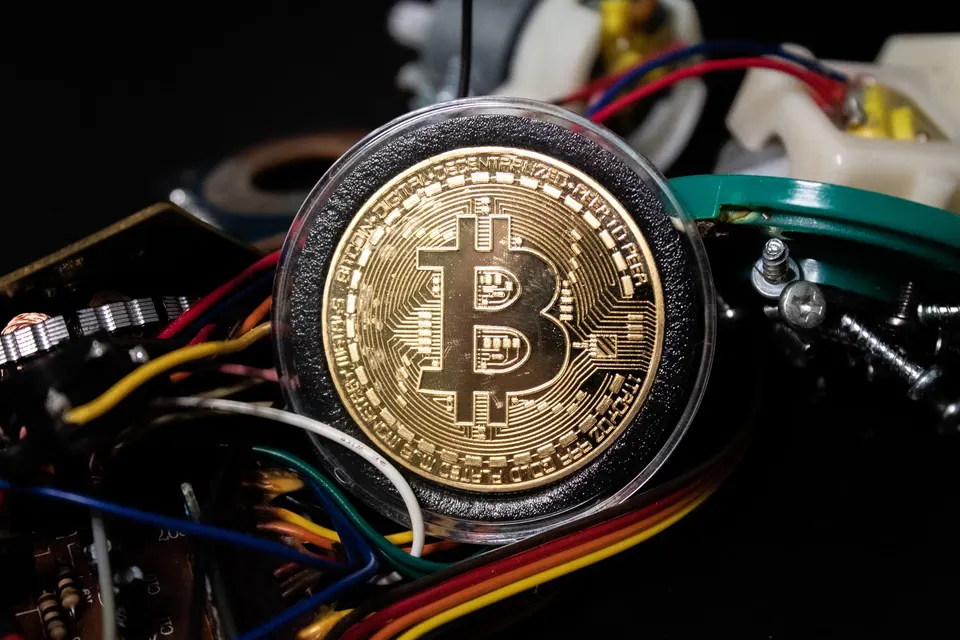
When you buy an NFT, you are essentially buying ownership of a token, which can then be transferred to your digital wallet. In practice, it is exactly the same as buying bitcoin or ether.
With one difference: non-fungible tokens add uniqueness to the mix. You are not simply buying some part of the records in the network, but a very specific part, directly associated with your purchase. Whether it’s a physically existing painting, a digital file or a tweet.
An NFT for a Chicken
Does this sound to you like buying a plot of land on the Moon, or like one of the four hundred “relatively honest ways of separating people from their money” in the arsenal of Ostap Bender, the smooth-talking con man from Ilf and Petrov’s The Twelve Chairs? Well, you’re unlikely to convince Sotheby’s of that, or the enthusiast who paid 69 million for a collage of images.
Several bands are already selling their performances exclusively through NFTs. True, they aren’t especially famous, and this is more a form of advertising than a mass phenomenon. But even if we’re not talking about the sums I used to grab your attention, it is a fairly reliable way of protecting their copyright, because, at the risk of repeating myself, once information lands in the blockchain, it stays there forever. Nobody can claim authorship of a song without “showing” an older record.
In that sense, we can also think of an NFT as a certificate of ownership of something unique, one that offers complete guarantees and cannot be forged. The certificate is the tokenized asset, its representation in the form of an NFT.
Now You See It, Now You Don’t
This leads to some rather strange possibilities. For instance, the object itself could be destroyed while its NFT lives on, carrying the object’s entire value. Whether that makes sense or sounds more like speculation, I’ll leave for you to decide.
The next example is interesting not for its price but for something else. For a mere 15,000 euros, the Milan auction house Art-Rite sold… an invisible (and nonexistent) sculpture by the Italian artist Salvatore Garau. The work is called I Am, and its main selling point is said to be that it doesn’t pollute the environment. I liked the apt comparison with The Emperor’s New Clothes.
In this particular case, the sale wasn’t done through an NFT but in the classic way, yet… quite a few experts predict that deals like this will become more frequent precisely thanks to the technology.
NFTs for Swapping
Elon Musk’s wife, the singer Grimes, has already sold some of her digital paintings as NFTs for more than $6 million.
The American basketball league, the NBA, has also invested serious money in a project that sells NFTs for video footage from certain games. This way you may not have the right to broadcast the content, yet you can be its owner. And you can resell that ownership: something like a new version of the old trading cards of athletes that fans used to buy, sell and swap.
In a peculiar way, just as cryptocurrencies have thrown down the gauntlet to traditional currencies, non-fungible tokens are doing the same to collecting. Because they offer the advantage of uniqueness in the way we can best imagine it with, say, art collectors. You can buy as many reproductions of the Mona Lisa as you like, photograph it, keep a print of it at home, but there is still only one owner of the painting itself, in this case the Louvre.
But with one addition. The prospect that one day they will also make it possible to buy real estate. And anything else the market figures out has an element of uniqueness.
Money Goes to Money
Have the tech geniuses invented something brilliantly new? Are old ideas being reheated with new technologies? Or has the world gone completely mad? My personal answer, for now, leans toward the last one.
Is this a fad that will soon pass? Or the financial system of the future, one that will give artists a new way to make a living and earn more serious income? We’re yet to find out. Either way, the idea is quite unconventional and requires a serious shift in thinking before it can go mainstream. Then again, if you don’t believe in the future of blockchain, go and look at how the price of bitcoin and its siblings keeps climbing and climbing.
Clearly, the global economy needs new forms of exchange that match the new technological level. And perhaps the strength of non-fungible tokens lies in uniqueness. In owning something no one else could ever have.
And since things in this field are far from well regulated, there will certainly be room for enormous scams. It matters who chooses which blockchain for the transaction, and the usual rules for any deal apply too: it has to be clear that the seller really can lay claim to ownership or authorship.
According to The New York Times, the NFT market reached a record $250 million in 2020. In just the first three months of 2021 it has already hit 200 million. It is expected to grow very, very fast… or else to collapse as nonsense. But of course, the road to the digital future is paved with crumbled predictions. So all we can do is sit back and watch… at least until we decide to set aside a few million dollars to buy some especially impressive, colorful GIF of a kitty…