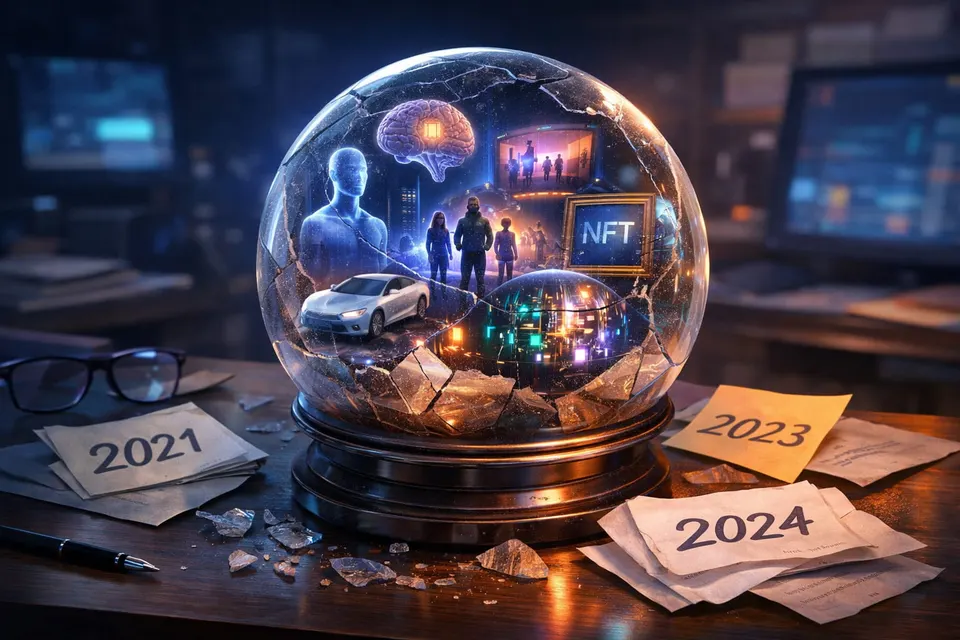
Trying to peer into the future is a doomed challenge. Sometimes predictions come true with astonishing accuracy—like, for example, the ones we make every year with the futurologist Assoc. Prof. Mariana Todorova.
At the same time, reading tech predictions that never came true turns out to be unexpectedly entertaining, especially when… they are your own. That is exactly what we will do in the lines below. In more than five years, I have published just over 500 Digital Stories. I will invite an impartial observer to assess them and pull out specific passages from my own texts (the point is not to embarrass my guests) that have not aged well at all.
The honor, of course, goes to ChatGPT, which receives the full texts of all the Digital Stories and the freedom to check them.
1. Digital People
“A Fake Hero,” March 15, 2021
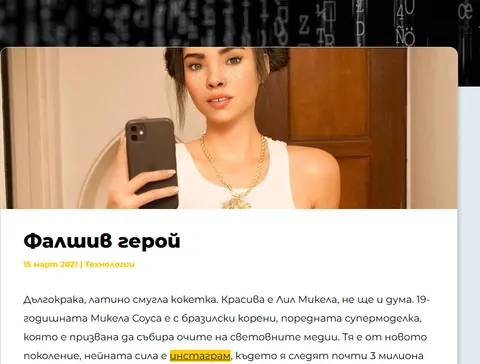
Quote from the text:
“I believe that in just five years we will have a significant population of digital humans who will interact with people and will be able to hold millions of conversations with them every day,” says Greg Cross. And this will go far beyond customer communication—his “children” will soon teach lessons in various fields and could become part of the healthcare system, Greg believes. “The possibilities of digital humans are endless!” he sums up.
ChatGPT:
As of April 9, 2026, Soul Machines positions itself as a platform for digital workforce and AI assistant deployments, not as a world with a “significant population” of digital humans turned into a mass social reality. In other words, there is product evolution, but not the large-scale social breakthrough built into the prediction. There are not many well-known digital humans.
Hmm. Even if digital humans really aren't everywhere today, the phenomenon is gradually making its way, and I still believe it will soon be extremely widespread. Suffice it to mention the EcoElena you know so well, and the fact that a digital human recently even took a central role in the campaign of the American president.
2. A Chip in the Brain
“When Musk Puts a Chip in Our Brains…,” April 2, 2021

Quote from the text:
Elon Musk says that within five years it will be commonplace for each of us to have a chip in our brain. That we will finally merge with computers to unleash an incredible future for humanity as a different biological species. More than that—that this is the only way for us to survive.
ChatGPT:
This is among the most clearly missed predictions. By April 2026 there is no mass use “for each of us”; Neuralink is still in early clinical trials with its first human implants, not at the stage of everyday, routine practice.
You'll agree that here it isn't me who got it wrong, but the esteemed Elon. In recent years he has once again distinguished himself with quite a few successful predictions, but also with plenty of ideas that turned out to be either impossible or too far ahead of their time. How far off is the age of brain chips? Either way, all the important questions on the subject remain fully relevant.
3. Where's the Decentralization?
“Web 3.0. What Does the New Era of the Internet Bring Us?,” May 18, 2021
Quote from the text:
Web 3.0 is expected to change this too. Thanks to the significantly higher level of security in data exchange, it will also be possible to exchange goods and services directly between individuals, businesses and machines, with no intermediary needed. The whole layer of the businesses we mentioned a moment ago will become redundant, because until now they were the link between the provider and the recipient of the service, and they guaranteed trust in the system.
ChatGPT:
This did not happen on the scale described. In 2026, Airbnb, eBay and Uber not only exist but keep reporting active business and financial results, which shows that intermediary platforms are far from extinct.
4. How Meta Took Us for a Ride
“Facebook Became Meta. What Does the Metaverse It Will Send Us To Look Like?”, October 28, 2021
Quote from the text:
According to Zuckerberg, if all goes well, the first version of the brave new world will be here within about five years. And I don't want to overdo the irony—I hope it really is brave and new, and some of the possibilities sound wonderful. As long as we are ready for them.
ChatGPT:
Avatar cohabitation in a metaverse did not become a near and mass norm. As of spring 2026, “the first version of the new world”—the metaverse—does not appear to have arrived in the promised sense. Meta reports continuing heavy losses at Reality Labs, and in March 2026 it announced that Horizon Worlds and its related virtual reality elements were being dropped from its plans, which is a sign of retreat and reshuffling, not of a successful early metaworld.
Zuckerberg certainly has a lot to say about the old Bulgarian saying that not everything that flies is fit to eat. The metaverse, at least so far, has turned out to be anything but the big subject and the big change of the future.
5. Car, Don't Drive! (For Now)
“Drive, Car!,” November 26, 2021
Quote from the text:
Autonomous cars won't keep us waiting; they will be here soon. Personally, I prefer riding a bike, and I can't wait for the moment when every driver will know where to give me the right of way. When there will be no risks while I wait at the traffic light.
ChatGPT:
As of April 9, 2026, autonomous cars are not “here” as a mass, normal everyday reality. Tesla itself writes that Full Self-Driving is supervised and “does not make the vehicle autonomous,” while Waymo has a real service, but in specific cities, not as a general market breakthrough. Yes, there is progress, but in 2026 the market is still split between limited autonomous services in a few cities and systems that officially require active human supervision.
Here, it seems, ethical and legal regulation is lagging behind the technological solutions. After so many increasingly successful trials, it's clear that we have technology that drives even more safely than humans. But how to make this happen in practice has obviously turned out to be a more complicated question. Still, I expect good news here too, and I stand by my expectation that we will soon have a completely different way and model of getting around.
6. Bye-Bye, Programmers!
“Will Artificial Intelligence Take the Bread Out of Programmers' Mouths?,” August 6, 2021
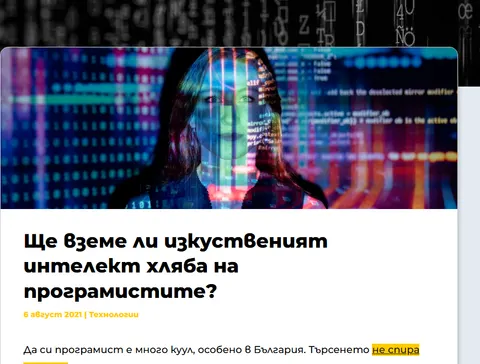
Quotes from the text:
Even if we get to the point of creating algorithms that write code, everything suggests that the moment when they will be able to do it autonomously is not too close. To do on their own the work of today's programmers—who are, in my opinion at least, somewhat spoiled by their social standing.
Since the flagship of the most advanced artificial intelligence systems is barely taking its first steps at the lowest level of programming, the moment when software will be able to make complex decisions, deliver finished projects and settle architectural questions seems, if not impossible, then far too distant.
ChatGPT:
This turned out to be too cautious. Already in 2025–2026, OpenAI describes Codex as a software engineering agent that works on many tasks in parallel, and Anthropic describes Claude Code as a system that reads code, makes changes to files, runs tests and works on the problem autonomously. OpenAI already describes Codex subagents for parallel complex processes, and Anthropic showcases a long-running mode of work with Claude on a C compiler project.
Exactly! It turns out I was cautious precisely in the field that earns me my bread. The fact is that today artificial intelligence is extremely advanced at producing computer code, and according to leading specialists we are close to, or have even reached, the time when programmers won't write computer code at all.
7. Death to Death
“What If One Day We Defeat Death?,” September 14, 2021
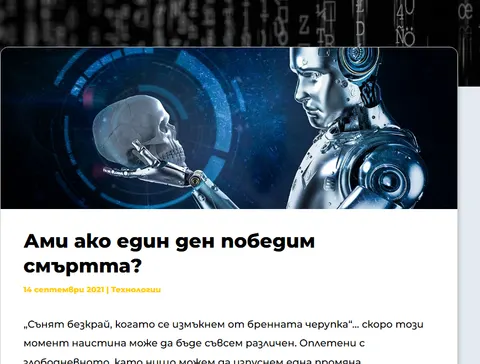
Quotes from the text:
That endless sleep, when we slip out of our mortal shell”… soon that moment may really be quite different.
And what if this same science, on the wings of technology, soon redeems itself by making human life, if not infinite (is there even such a thing as infinity?), then at least dramatically longer.
ChatGPT:
“No, it did not become ‘quite different’ soon. Even companies like Altos Labs talk about healthier lives and reversing disease and damage, not about an imminent victory over death. The best available estimates point to limited potential for increasing average life expectancy, not a dramatic leap in the near future.
With the boom in artificial intelligence combined with the huge interest in health topics because of the pandemic, very serious news and progress in medical technology really were expected. Well, on the whole, they are still expected…
8. Mind It
“Technology Can Already Read Minds. Is This the End of Freedom?,” April 21, 2023
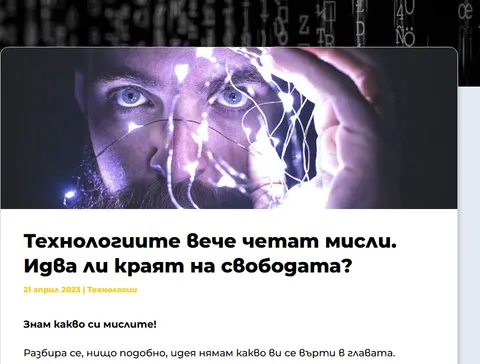
Quote from the text:
This, according to Prof. Farahany, will very soon allow us to have convenient gadgets in our daily lives that can pick up our mood and judge whether we are focused and what we are imagining.
ChatGPT:
There is research and there are wearable EEG devices, but the literature in 2025–2026 still describes serious limitations: weak signal, artifacts, low reliability outside laboratory conditions. In addition, a leading review in Trends in Cognitive Sciences says the field is still mainly anchored in decoding motor and visual signals, not in rich reading of imagination and mood in everyday life.
This I definitely consider good news. The idea of mind reading is practically absent from public debate. Alas, I don't think that will last long.
9. Dr. Chatty
“How Much Does Truth Matter to Us Today?,” March 12, 2024

Quote from the text:
I imagine that artificial intelligence offering medical consultations will soon be very popular. It will be trained on very rich data, it will have the experience of millions of doctors, it will know a huge number of cases.
ChatGPT:
As of 2026, there are no grounds to say that this has already become a mass, trusted form of medical consultation. Reuters summarizes a study in Nature Medicine according to which asking AI about symptoms does not lead to better decisions than other methods, and the FDA continues to treat AI in medicine as a strictly regulated category with premarket pathways and separate guidance.
Here too, in my view, Mr. Chat is selling himself short. Both doctors and psychologists are noticing a boom in self-diagnosis with AI, and I think we have yet to see many more serious consequences of this phenomenon.
10. O Quantum, Where Art Thou?
“The Cat and the Quantum Computer,” May 11, 2021

Quote from the text:
“And according to the ‘fresh’ estimates of IBM scientists from March 2021, the new era in this field begins very soon—in 2023. According to the company's researchers, humanity will have a good enough quantum computer by the mid-2020s.”
ChatGPT: “It did not begin. In 2025–2026, IBM itself is already saying that its first truly large-scale, reliably working quantum computer is planned for 2029, and for 2026 it speaks not of a ‘new era’ but of some expected progress.”
The fact is that the long-awaited quantum computing revolution is still awaited. The topic has somewhat faded from the public stream in the shadow of the big winner—AI—but I don't think that will last long.
11. Et Tu, Blockchain?
“Blockchain Still Connects Us…,” June 4, 2021

Quote from the text:
The same will now happen with money and micropayments. The banking system, IBAN transfers, sending money and having it arrive three days later, credit and debit cards and the monopoly of Visa and Mastercard—all this is about to disappear.
ChatGPT:
This is very far from reality in 2026. The BNB, the Bulgarian National Bank, continues to maintain a register of licensed banks and branches of foreign banks in Bulgaria, and Visa reports 257.5 billion processed transactions and $14.2 trillion in payment volume for 2025.
And blockchain today is definitely not as large-scale a direction as was predicted. Yes, the ecosystem is developing, and it has its chance in the context of artificial intelligence too, but here as well the big news, if there is any at all, remains for the future.
12. Taking the Bread
“What Will We Do When a Third of Jobs Disappear?,” October 22, 2024
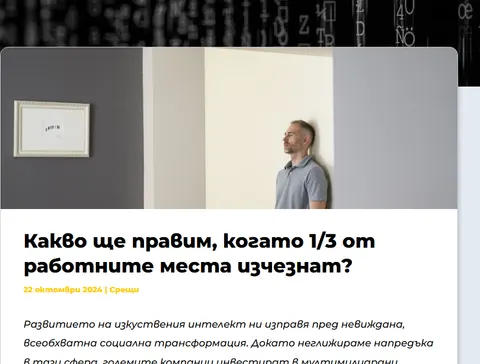
Quote from the text:
The development of artificial intelligence confronts us with an unprecedented, all-encompassing social transformation. While we neglect the progress in this field, big companies are investing in multibillion-dollar projects through which machines could replace a third of the jobs on the planet in the near future.
ChatGPT:
This is not visible as a reality of the “near future.” The World Economic Forum's 2025 report forecasts 170 million new jobs over the decade and a net balance in which AI and technology create 11 million jobs and displace 9 million, not a scenario of a third of all labor suddenly evaporating. PwC also writes that AI is so far making people “more valuable, not less,” including in highly automatable roles.
As someone who has already lost a job because of artificial intelligence, I would happily bet against both ChatGPT and even the World Economic Forum here. I won't, because in this case I have no desire whatsoever to win. These dramatic changes in the labor market keep getting closer, while preparation for them remains just as distant and illusory.
13. Where Did You Go, NF-T?
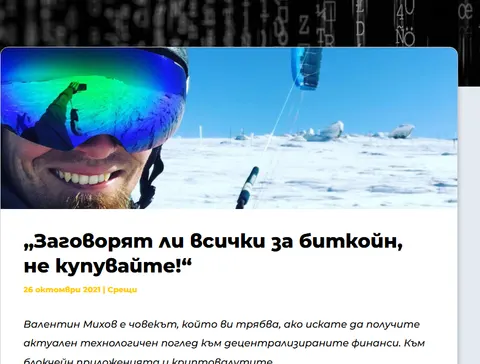
When Everyone Starts Talking About Bitcoin, Don't Buy!, October 26, 2021
Quote from the text:
In this field, I think there will soon be another explosion, and we are already seeing its first moments—art and the way artists sell it.
ChatGPT:
Exactly the opposite happened here. DappRadar describes a crash in the Art NFT market: from about $2.9 billion in volume in 2021 to $23.8 million in Q1 2025, which is a collapse, not an “explosion.” And in 2025 the NFT market kept shrinking in volume, including in the segment specifically tied to art.
14. Want to Bet?
“AI and the End of Stock Exchanges,” June 9, 2023
Quote from the text:
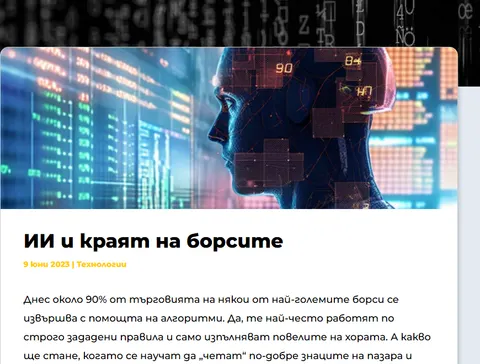
The ubiquitous adoption of AI in the financial industry will lead to traders with huge salaries losing their jobs as quickly as factory workers,” says Mark Minevich, founder of Going Global Ventures.
ChatGPT:
No such rapid collapse is visible. The closest official picture, from the U.S. Bureau of Labor Statistics (BLS), shows that the occupations of people engaged in securities trading have a projected 3 percent growth for 2024–2034 and around 38,100 new positions, so it does not look like a profession about to vanish suddenly. Even the Financial Stability Board in 2025 still speaks of the controlled introduction of AI and the related risks in the financial sector, which sounds like a sector in the process of adoption and oversight, not one already “transformed from the ground up.”
15. The Guilt?
“But… the Guilt?,” March 2, 2021
Quote from the text:
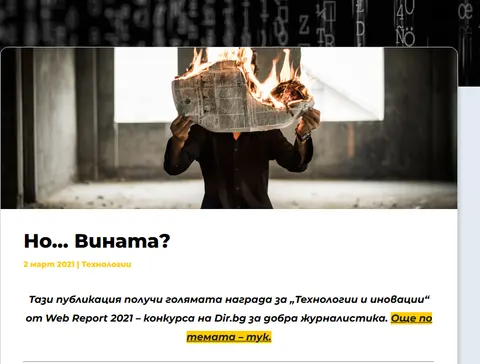
The artificial intelligence journalist is already here. It will only keep getting better, and it will try to take the bread out of the mouths of an entire profession…
ChatGPT:
AI really has entered journalism, but it has not “taken the bread” of the profession in the sense of mass displacement of journalists. In 2025, the Reuters Institute reports a major trust problem: only 12 percent feel comfortable with fully AI-generated news, compared with 62 percent for fully human-made news. Even when AI is used, audiences want human control, not journalism without journalists.
Really? Today we don't read generated content everywhere around us at all, and this doesn't apply in the slightest to journalism, which is enjoying a golden age and a return of trust.
If only that were so. Even if it happens, it won't be soon. And I'm glad we had this chance to look at some of the predictions of Digital Stories, to have some fun with them and to give them some thought. And if you, too, think it matters that we keep this conversation going and keep trying to peer into the future, join this important experiment before the end of the month. I believe it matters, and I will be endlessly grateful to you. Read this text to the end!