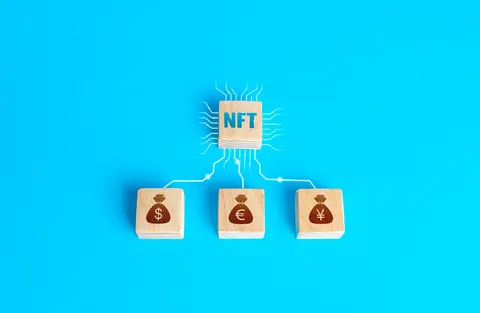
These days, who isn't talking about bitcoin? Its price has turned it into a hit. It keeps swelling and drawing attention. By all signs, the few quiet years on the subject, known in professional circles as the “crypto winter,” are now behind us. There is more and more talk about NFTs too: a system for selling virtual, and also perfectly real, art and who knows what else (more on NFTs coming soon). And yet behind all of this stands blockchain. This technology holds enormous promise in so many other fields beyond the world of payments. But how does it work?
Kryptonite
That was the name of Superman's Achilles' heel. And cryptocurrencies may have found the weak spot of today's global banking system. Thirteen years have passed since the mythical Satoshi Nakamoto created bitcoin. Before that there had been quite a few attempts at something similar, but they always ended in failure. Things started timidly. In 2010 one user took a key step: he managed to buy two pizzas for 10,000 bitcoins. A bargain, you'd think, a snack for some imaginary money… but not from today's point of view, when the price of a single one of those units has passed 60,000 leva (about $37,000). We'll leave the math for the pizza delivery guy to you.
So: how can virtual money exist? In fact, it's the good old “Money, commodity, money prime,” the formula Marx left us for the ever-growing value of those precious slips of paper, only in electronic form.
Enough people gathered in one network that can carry out transfers of value, with the key factor: a guarantee. The bitcoin network is 1,000 times more powerful than the entire ranking of the planet's top 500 supercomputers combined. And there is no longer any way to stop it. Over this decade it has become clear that the principle behind bitcoin, the so-called blockchain, works.
The Bitcoin Ledger
We need to go digital for a moment. We turn to the right person, Svetlin Nakov, the founder of SoftUni, a private software academy. Three years ago SoftUni was also one of the first academies to offer training for blockchain programmers. “It is a technology that lets us record data on many computers around the world, which can't be changed afterward,” Nakov explains. “Imagine a ledger, but not on paper, an electronic one. And it isn't stored on a particular server, at some small company or at Google, but duplicated, repeated on thousands of computers around the world.
Thanks to this, once data is written, it can never be changed again. No single participant in the system, nor any group, can change it.”
An easy example of this kind of network is torrents, which often cause headaches over copyright infringement. But they can't be stopped, because the files are exchanged directly between users linked in a network. Still, they have trackers, the places where people connect, and these add an element of centralization. With blockchain, that is no longer needed.
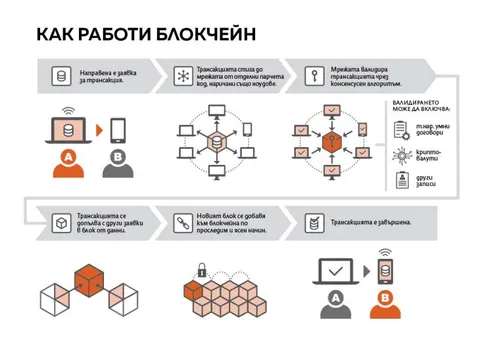
As the name itself suggests, blockchain is a sequence of data that keeps growing at the end, while each of its elements, the little blocks of code, holds information about its predecessors.
Give and DAO
And here we reach the most important part: what this mechanism can do for us, and why we talk so enthusiastically about its possibilities. Behind the otherwise well-known little word “dao” lies not only the Eastern principle of the way, but something else, this time tied to the future. It is also the abbreviation of “decentralized autonomous organization,” the type of system that blockchain makes possible. When you hear “organization,” don't picture a big office full of employees. It is computer code, but it can act in a similar way: it guarantees that the program cannot be manipulated. So the first DAO actually working in practice is bitcoin itself. Its only goal is to keep existing, and in return it offers people the ability to transfer money.
“This is starting to become a very powerful technological foundation, because it has applications in many fields,” Nakov says. “In the media, for instance. You add a news story to the blockchain and it can't be deleted or changed because someone paid or someone didn't like it. The distributed ledger makes it possible to decentralize whole sectors of the economy. For the first time we have the chance to build an unstoppable organization. An organization that is software, and software that doesn't run on one computer, so that when that computer disappears, it disappears too. What will you do to stop it?”
For several years now, with varying success, a content network of this kind, similar to a media outlet, has been running. It's called SteemIt. Its concept is very interesting and we will certainly talk about it in more detail soon.
Bakunin's Dream
So what, has technology come to revive the messages of anarchism? Not exactly, and yet the key word really is decentralization. Today's online world seems ironclad and indestructible to us, but in order to log into Facebook and Google every day, we send and receive data from the central servers of the two companies. What would happen if at some point they decided to make them expensive, or simply shut them down, in a world of corporations far more powerful than any state?
If today we use social networks owned by a particular company, search online with the help of a multibillion-dollar company too, and have no way of not depending on them, then blockchain makes possible a network that belongs to no one. One in which participants are equals and set the rules themselves. Governance is democratic and distributed among all users.
Just as the internet managed to spark the information revolution we live in, the future of many specialized blockchain networks will bring us decentralization, along with all the benefits and responsibilities that come with it.
More pilot projects are gradually appearing that demonstrate its applications.
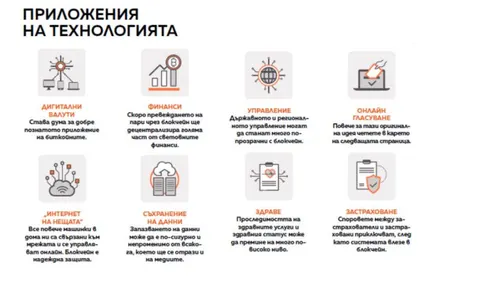
All kinds of data, processes, information processing, even the management of organizations can end up in the “shared ledger.” “And this is a conceptual change. It's not just the new phone or the new currency, it's a technology that transforms entire industries,” Nakov says. Waiting in line are the social networks of the future, which can be democratic again, video-sharing networks, even hotel booking networks: calculations show that if they ran on the same principle, prices would fall by 15 to 20 percent.
Mining, Man
It makes sense for everything to start with means of payment, but even here bitcoin and the many cryptocurrencies that swarmed after it are not the limit of what's possible.
“The moment every phone has a crypto wallet and can send payments, you realize how many businesses will change, what opportunities will open up? Right now we pay with bank transfers, with text messages, and that's technology from the last century, it's absurd! It was the same with phones, and now calls are practically free. The same will happen now with money and micropayments. The banking system, IBAN transfers, sending money and having it arrive three days later, credit and debit cards and the monopoly of Visa and Mastercard: all of this is about to disappear,” Nakov adds. Which doesn't at all mean that we will suddenly all start paying in bitcoin, or that paper money will stop being printed. “For now, the only thing keeping many businesses from entering that space is the constant fluctuation of cryptocurrency prices.”

Not Worth a Bent Coin
Another future, but already entirely possible, application: thanks to blockchain, systems can be developed that guarantee the quality and origin of everything we buy. One pilot program is an internal blockchain network at a large hypermarket chain, which is testing it with eggs. The cartons have unique numbers entered into the blockchain, so at any moment you can check the journey of every egg from the moment it was registered, see its expiry date, every step of its history. Soon, when blockchain makes its way here too, we'll be able to stand in a store choosing a piece of clothing, a perfume or a car part, scan the code, and have the network return all the information about its origin. Information that can't be swapped or faked, precisely because it is duplicated with all participants.
And here again we are talking about a different paradigm. Even now it's no problem to create, say, a website for tracking goods, but it would belong to someone, someone would control it, and that completely changes the level of trust. It stands to reason that trust in some centralized company is lower to begin with than in a public system that no one runs.
Today brands play the role of guarantee: people buy expensive jeans because a famous name stands behind them. When origin can be traced from the first step to the last, it will make quality easier to reach and change the rules of the market. The other guarantee today is institutions. They are the points of trust. When you think about it, with a notary's work or a bank's, what you pay for is precisely trust. And trust is the defining built-in feature of blockchain networks.
A Bit Is a Bit, a Coin Is a Coin
After bitcoin's success there is more and more talk about Ethereum, programmers' favorite network, which is also growing steadily. It's important to note that it isn't exactly a cryptocurrency but a platform for creating and storing various blockchain applications, among which, of course, there are currencies too. It is the first platform that allows the execution of so-called smart contracts.
Of course, carried away by enthusiasm, we mustn't overlook the risks the new paradigm brings, or the important questions. “There is the other side too: the bubble,” Svetlin Nakov admits. “Give us money, we'll build blockchain solutions. Something similar happened when cloud solutions, machine learning, the ‘internet of things’ appeared.” Maybe that's why we ended up with the “crypto winter” mentioned earlier, which dampened the enthusiasm quite a bit. And yet in recent months it has returned in full force, especially in the context of the economic changes that came with COVID and the promising investment that cryptocurrencies and blockchain suddenly turned out to be once again.
The Call of the Digital
What about the well-known danger of hackers? The salvation, again, is built into the principle itself. The blocks are linked cryptographically. The successes of bitcoin and other cryptocurrencies clearly show that the system is secure enough. To crack the code behind your crypto wallet, the most powerful computers would have to try the countless possible combinations for billions of years.
Of course, in cryptography things are always evolving. Within a decade, quantum computers are expected to become a reality, capable of volumes of computation unthinkable today. The code behind bitcoin would be no problem for them, but new cryptographic solutions have already been developed that would hold up even then.
New variants are gradually appearing too. Under the proof of stake principle, used by many of the newer descendants of the bitcoin network, each participant buys a share of the network and in return receives a proportional share of the resources from its operation. Soon there will also be more private networks running on the blockchain principle: where outside users don't need access, simply as a system for, say, quality control or transport.
Turnkey
Today, if someone loses the key to their crypto wallet, it's almost impossible to regain access. That is also because of the very principle of blockchain: everything there is transparent, but anonymous.
Another natural worry: in a system not regulated by legislation, states and supervisory bodies, how will the creation of a monopoly be prevented?
But decisions in a network are usually made by all its participants, who vote on a democratic principle. The smaller ones band together against the bigger ones. And if a large group of participants disagrees with a given decision, a parallel network is created, a so-called fork. The two exist side by side and quite often merge again later, once it's clear which decision was the right one.
So the aim of modern blockchain networks is to have a large number of small participants. If someone holds 80 percent, they can run it, and we're back to the familiar model. But there's little logic in that happening. Bigger participants have nothing to gain, because that way they directly kill the network's value. Sensing a monopoly, the others will rush to leave it. What would happen if someone today bought half of the world's bitcoin “mining” capacity? The price would collapse at lightning speed. The fact that the big players have no incentive to control the network is the essential difference from previous models. The system encourages participants to build valid blocks on top of other valid blocks, that is, not to try to cheat or reward mistakes already made. The “miners” don't work for a person or an organization. They get their income from the blockchain itself.
Hidden in the Script
The network has many participants, let's call them nodes, which hold copies of the entire chain. And when a new block is added (in bitcoin, for example, this happens once every 10 minutes), it is sent to all participants, who check whether it is valid: whether it follows the rules of the network, which are public and well known to everyone. If it does, the block is accepted and its data can no longer be deleted.
Of course, many more important questions are waiting for answers. Take, for example, the network we mentioned that could decentralize taxi services: quite a few things still need to be worked out there. The absence of middlemen and the democratic nature of the venture are undoubtedly gains, but also challenges, and a responsibility. With no intermediaries and no hierarchy, who will keep the participants in check? Do they meet the requirements, will they deliver the promised service? There are many options. What matters is that they are thought through and built into the consensus. One of them is ratings: at first participants work at a lower price until they earn trust. Another approach: introduce clear criteria for joining. Besides, despite the platform there can still be intermediaries who add an extra service: insurance, for example, a guarantee that you'll get your money back if you're not satisfied.
And here's something even more unconventional. Democracy… based on blockchain?
The Dao of World Revolution
The idea is quite a few steps ahead of everything we've told you about, but it is certainly provocative enough to make us think. What if elections became not a right or a duty, but a source of investment, even of betting? The notion of DAO democracy belongs to economics professor Robin Hanson and Ethereum's creator Vitalik Buterin.
The prediction market is used in gambling, but it is also an important principle on stock exchanges, and something we encounter every day in our lives. Programmer Vladislav Zorov, who has serious experience in the field, gives the following examples. Statistical studies prove that sports betting odds predict the outcome of a given competition more accurately than the opinion of leading experts. Bets on who will become president of the United States are more precise than polls. Bettors ask around, take an interest, add their own experience and point of view. Another striking example of the “wisdom of crowds”: a jar filled with a huge number of candies is shown to 100 people, who are asked to guess how many there are. Then the results are averaged: 4,515. Amazing! There are 4,510 candies, and the estimate is closer than that of any single participant. The majority, however, tends to underestimate certain risks, so it's important to somehow add the experts' opinion as well.
Vote Buying Is… Encouraged
The principle is this: a prediction market opens, say on who will win the next match between Levski and CSKA, Sofia's two great football rivals. Bonds are issued at 1 lev (about 60 cents), sold to each participant, and after the match 2 leva are paid out only to those who guessed right. Very soon the price of the bond will show what the two teams' real chances are.
In recent years, similar experimental polls have been run on questions such as whether the next SpaceX rocket launch will succeed, or how Ethereum prices will change. And the results unerringly predict the actual outcome. DAO democracy combines blockchain and decentralization, and uses prediction markets to gather citizens' opinions. The principle is the same: a question is posed, for example “Under which party's victory can incomes rise by 20 percent by the end of its term?” and, again, the correct bets are paid out afterward. “Then buying votes becomes a civic duty. People don't vote on sympathies; the sensible approach is rewarded. Even if a candidate looks good to you, you won't vote for them, but for the one you think will get the job done. But the questions have to be chosen very carefully,” Zorov says.
Let's end with what is most characteristic of every blockchain network. Every block keeps every memory of its past; only the future changes. A wonderful principle: it is precisely the future, and its more advanced society, that this technology promises us. Whether it will succeed, and whether it will stay only in the realm of finance… only time will tell.
Published: Spisanie 8 (8 Magazine), issue 4/2018
Last updated: June 4, 2021