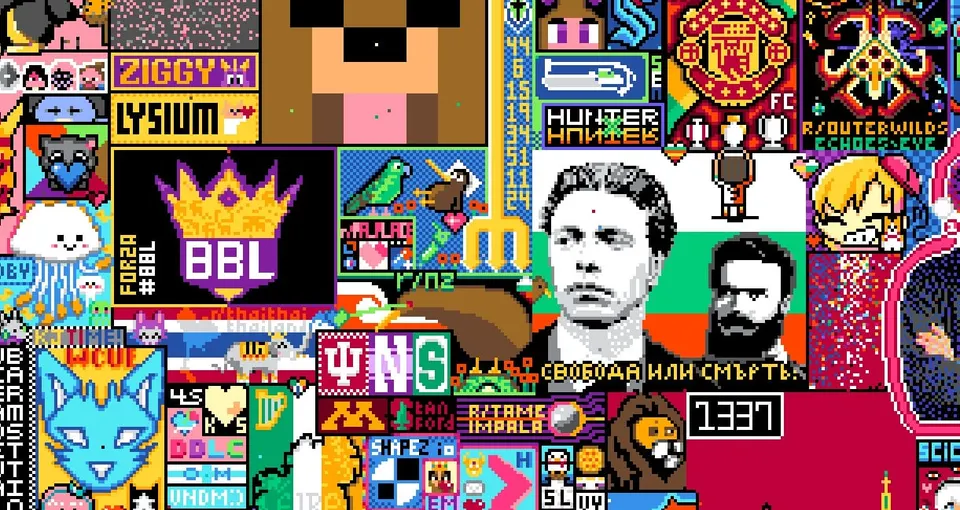
r/place. The Place project on the social network Reddit showed, all at once, that people can work together online for a beautiful idea; that social networks sometimes make sense; and that we can build wonderful messages when we come together.
April 1 this year was not a particularly jokey day, given what is happening in the world. But it did produce an impressive social experiment in creativity and art.
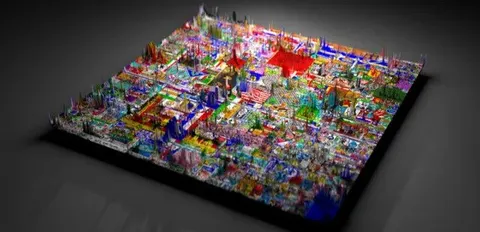
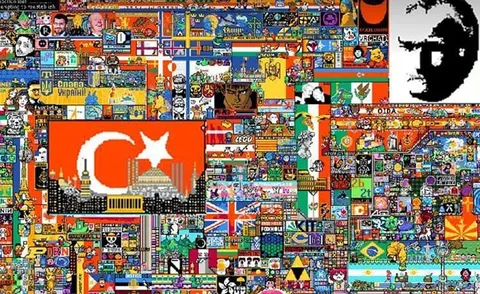
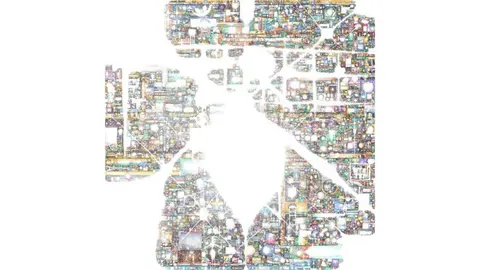
For four days and nights, anyone could join in painting one shared, vast picture—a small part of which is the unusual image that greeted you above. Everyone could fill in a single dot of it, in a color of their choosing, once every five minutes. The result was an impressive computer picture that was written, altered, added to and developed, and that spelled out countless messages.
Straight to the Pixel
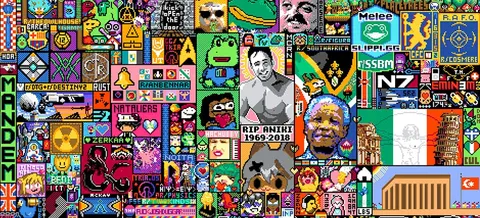
The six million people who took part in the project banded together in groups built around shared ideas, preferences and wishes, so they could coordinate and manage to paint larger images on the “whiteboard.” Rivalries and aggression there were, but far more meaningful and beautiful undertakings showed up on the picture. Unconventional solutions. Countless exciting stories.
So, r/place. As you may know, “r/” is the trademark of the social network Reddit, where people gather in themed groups, or subreddits. These are often sensible little corners where constructive discussions happen, where you find like-minded people, and where communication is cleaner, free of the hate and the watered-down chatter of more traditional networks.
A Strange “Place”
Place, r/place, however, is not just another ordinary chat room, but the field of the social experiment, the collective creativity we are talking about.
The project became quite serious, even though it is closely tied to April Fools’ Day. The first edition, in 2017, began on April 1. The rules are simple. We could also call it a game: there is an empty field on which every user can leave their mark. Once every five minutes, they can color one pixel, the smallest possible dot, in one of the 16 colors chosen for the purpose. You can put your dot wherever you decide.
From there on it gets complicated, because it is time for strategy. On your own, you can’t do much beyond placing dots that are quickly “swallowed up.” You need allies, so that together you can make something bigger and grander.
Jokes and Teasing
After its success five years earlier, on April 1, 2022, Place came back with renewed strength and much more noise. Anyone who wanted to take part had four days and nights to do it (versus three in the first edition)—until the final moments of April 4, when everything that had been created… simply vanished. The Place was filled entirely with white, and all that massive labor went into the archive. Curiously, the users themselves were given the chance to destroy what they had made. From a certain point on, only white pixels could be added, and very quickly the picture was buried under the snow.
Six million people took part in this edition of Place, compared with about a million five years ago. The first time, 16 million dots were placed; the second, a whopping 72 million, at an average pace of about 2.5 million an hour!
The size of the “canvas” was different too. The first time it was 1,000 by 1,000 pixels; in the edition that ended a few days ago, 2,000 on each side. So there was more room to paint, and yet fierce battles were still fought over many of the zones.
A Brawl with Brushes
Each day, additional permitted colors were unlocked:
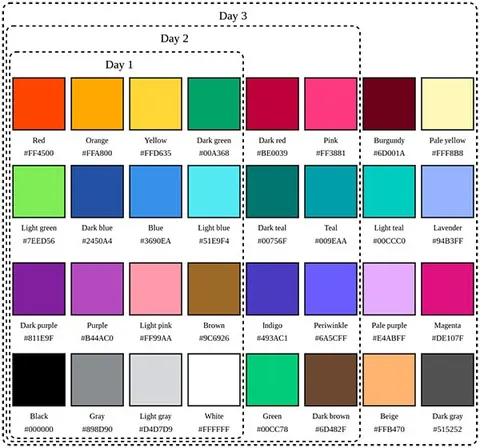
Impressive pictures appeared and disappeared. At one point, a few hours before the end, the participants struck a kind of pact not to destroy works of art.
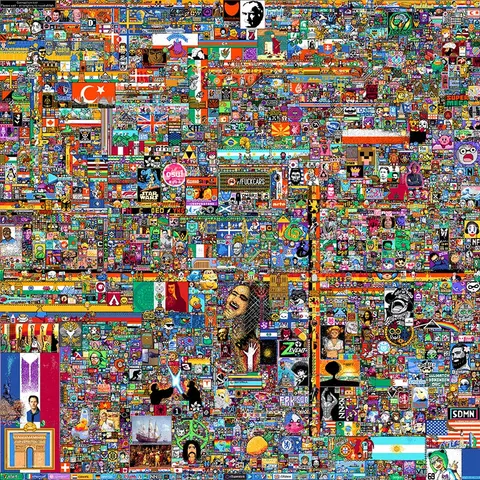
And the strategies were quite colorful. Often knee-jerk. For instance, many groups rallied around painting and preserving a particular national flag. You had to judge carefully which part of the canvas to try your luck in, and whether the scale was within reach of the number of people who would pitch in.
Things got more interesting with the more complex images. As you saw at the beginning, in the final seconds while the interactive picture still existed, you could even make out the faces of Vasil Levski, the revered hero of Bulgaria’s struggle for liberation from Ottoman rule, and Hristo Botev, the country’s great poet-revolutionary.
It is genuinely fun to read through the discussions and strategies in the individual subreddits, where people coordinated how to paint this or that. But it is even more fun to play the video of how things changed and look for yourself at what happened where.

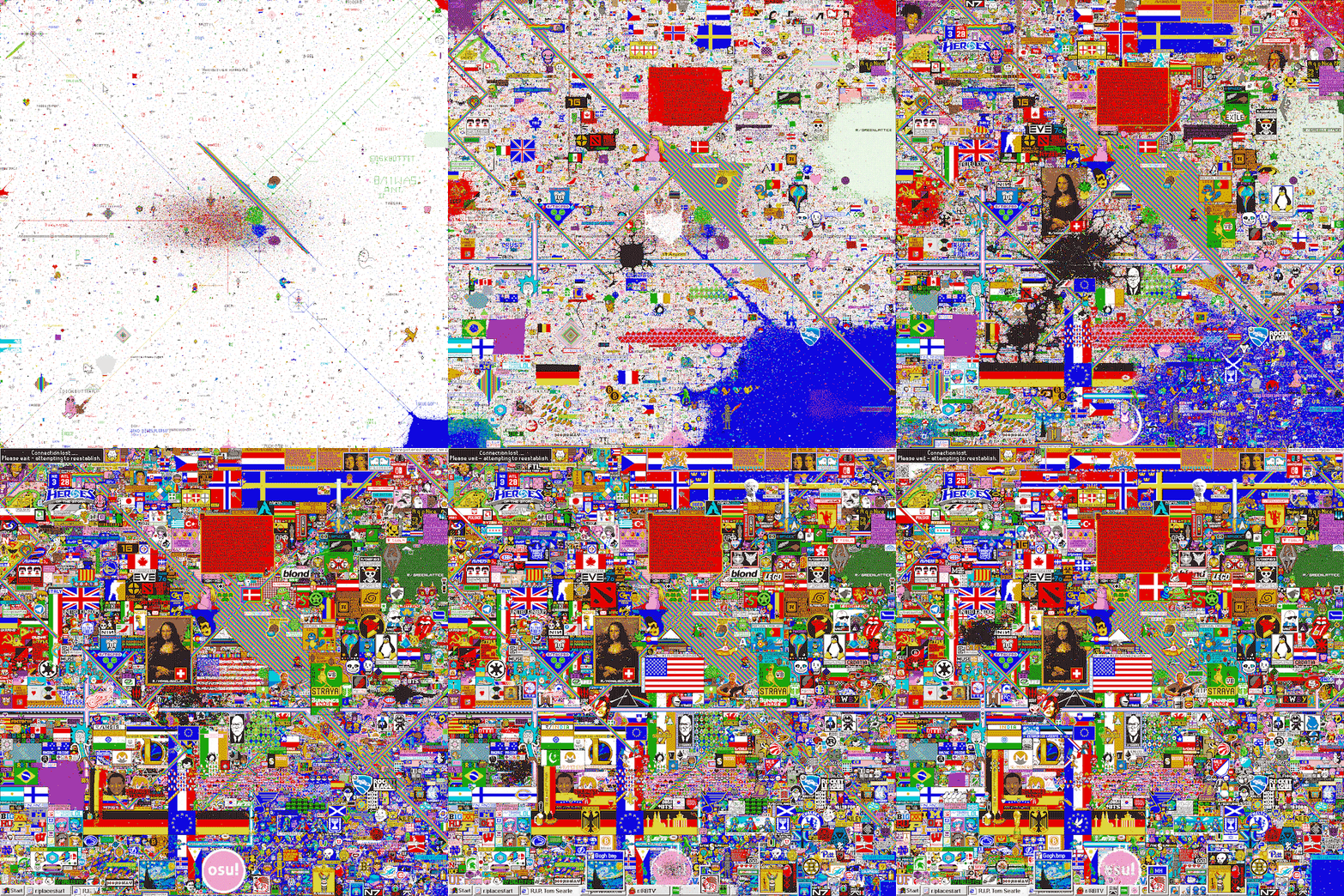
At the start of both editions, what you could see were random structures rather than deliberate pictures.
In 2017, one of the first larger structures was a big corner in pure blue, and then a picture of Pokémon appeared. Almost the same scenario repeated itself a few days ago.
Pixel by Pixel
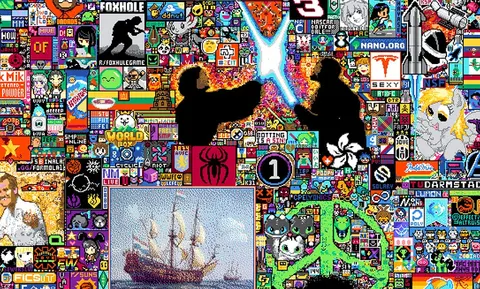
Classic works of art were painted—the Mona Lisa and Van Gogh’s famous The Starry Night. Cartoon characters and typical meme images. At one point, Windows fans added a taskbar, and the whole picture began to look like the screen of an old version of the operating system.
Of course, on the whole, various kinds of fan loyalties and attempts at advertising dominated. Quite a few influencers mobilized their followers to get themselves free advertising. There were many national flags blending into one another. And, of course, this time the war in Ukraine was a strongly present theme.
It was interesting to watch a swastika turn into a peace sign within minutes. To see Atatürk drawn over the flag of Turkey, and then Erdoğan. The new bridge over the Bosphorus and other landmarks of the country. There were similar curious examples with the United States, France and Germany.
The Bulgarian participants were quite active too, especially considering how relatively unpopular this network is in Bulgaria.
Networks Versus Bots
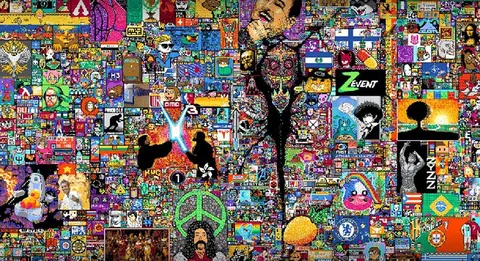
In fact, it is completely impossible to sum up all the interesting images and developments, and that is the most fun part of the project. Anyone can play one of the many videos that captured some part of Place’s transformations and discover something new.
As the project’s creators note in this interesting and more technical piece, building the project was a serious challenge from a purely software point of view. And the next big difficulty was preventing any attempts at automated interference—quite a few groups tried to be clever and get around the rules, but it didn’t work for them.
“From the original experiment, we learned that people online are actually inclined to cooperate with one another, that redditors are more creative than we are, and that Reddit is a platform where beautiful undertakings blossom,” says Alex Lee, one of the project’s initiators. In his view, it is also a story about how people can be inspired to create meaningful things. Every year on April 1, the platform looks for unconventional projects in this spirit.
Let There Be “Place”!
It is also worth mentioning that the project was inspired by a much older idea, from 1986—a distant age in computer terms. That year, Olivier Auber created the game Poietic Generator, which works on the same principle, albeit over primitive local networks and on a drastically smaller scale.
Either way, Place has left behind an interesting digital story, and there are already petitions for the project to become annual. Whether that happens, though, matters less than the message the whole undertaking leaves us with.
Together we can create beauty and meaning. We can also destroy them.