What I Learned from the Virtual “Georgi Karamanev”
Talking to yourself. In psychology, this is hardly considered a sign of good emotional health. But what if, besides talking to yourself, you set your virtual double free so that anyone can talk to him? What would people ask him that they would ask you? And what wouldn't they? Some of the experiments on this site are already bolder than the impossible and the unimaginable. And that is exactly what awaits you here. Two months ago, “Georgi” appeared on this page—my digital double, whom you can still meet today through the chat button in the bottom right corner of this site. Anyone was welcome to have a chat with him. From the very start, I had warned that I would be following the conversations so that we could bring the experiment to a fitting close with the lines that follow. In them, we'll look at what happened to the virtual “Georgi.” What did people ask him? Where did he cope and where did he fail? What does each of these conversations have to tell us? We take a peek into the conversations with the chatbot, and I'll leave most of the reflecting to you. And if you want to test his skills, he is still here, waiting for you. I admit, I definitely didn't anticipate even a fraction of the conversations “Georgi” had. Here's what I mean.
 02
Meet… Yourself?!
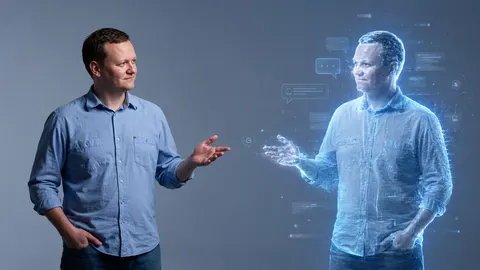
“Talking to yourself isn’t so bad. It gets bad when you start answering.” I am going to create a virtual double of… myself. What could we possibly have to talk about?
 03
“AI Is Testing What Kind of People We Really Are”
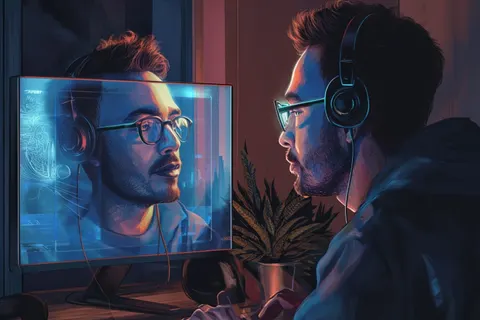
This is a conversation about words: about language and the new path it will take with the astonishing progress of artificial intelligence, progress that came through language itself. Nikolay Tellalov is a favorite guest of Digital Stories. Five years ago he and I did the site's very first experiment, an interview in short stories, and this time we talk about everything that has happened since, with technology, with words and with all of us.
 04
Fear of Technology = A Nation Left Behind
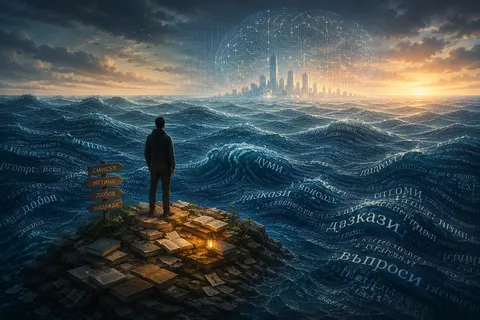
Elitsa Stoilova says digital literacy should become a national goal if we want to move forward. “Its absence leads to fear of technology = conservatism in adopting and using it = our nation falling behind in many directions. What is the future of illiterate nations?” she wrote to me. Our guest has traveled a colorful road: 11 years in journalism, then tourism, where she became… a hotel manager in the Mariana Islands in the Pacific, before finally dropping anchor in the IT world. She realized that much of the work in tourism is repetitive and can be done by algorithms, so she created the chatbot platform UMNI, long before another chatbot made the world notice how far artificial intelligence has come. But how is it that she is so optimistic about the road ahead? Our guest believes that if we play our cards right, AI is leading us to a wonderful future. What does playing our cards right depend on? And why is it sometimes worth leaving one of the most heavenly corners of the planet to chase your dreams? We look for important and unexpected answers in the lines that follow.
 05
Come Talk to “Me”!
Allow me to introduce… “Georgi Karamanev,” a chatbot trained on every piece on this site and on my guest appearances. Let’s find out together what it can do—write to it! It will pop up on its own, and if it doesn’t, you’ll find it in the bottom right corner of every page.
06“AI Is Everyone’s Big Chance to Climb Their Own Everest”
“The world stands at the Rubicon. We will live alongside smart machines, a new and different world awaits us, but are we ready for it?” That question, the very reason Digital Stories exists, is posed on the cover of her new book by today’s guest, Petya Minkova. In The Transition from the Digital Age to the Hybrid Civilization, she traces the long road from the first computers to a future of superpowerful artificial intelligence. And while the answer to whether we are ready is clear, there are so many other important questions we will discuss in the lines below! Do we have any future other than as a hybrid civilization of humans and technology? What does our survival depend on, and what will our daily lives look like once this transition hits with full force? Why is AI far more than a danger—why is it also a chance for each of us to climb our own personal Everest?
 07
BAIT Award Goes to Digital Stories!
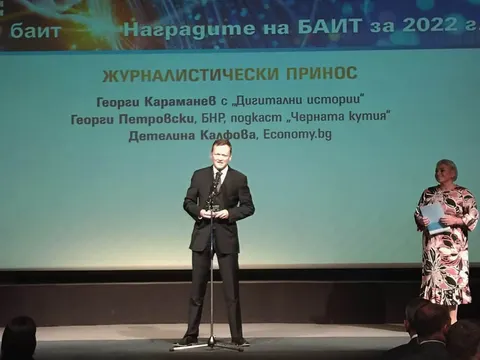
Digital Stories has won the journalism category of the annual awards organized by BAIT, the Bulgarian Association of Information Technologies! The prizes, presented for the 12th time under the patronage of President Rumen Radev, are a leading accolade in the IT world. For two years running, the site and its creator Georgi Karamanev won the technology prize of the Web Report awards, judged by leading journalists; now comes the prize from the association with the deepest traditions in the information technology sector. Where technology meets the humanities, the human, the emotional—where journalism meets programming—that is where Digital Stories lives, and that is why the prize means so much.
 08
“Let Humanity Have Its Fill of Playing with Technology”
How did we lose the ability to wait, and why does it matter that we get it back? Will we learn to be bored well when technology supposedly frees up our time? What will the last book written by a human say? Violeta Radkova impressed me with her debut novel I legloto ni e zelenina (And Our Bed Is Green). She is a translator and editor, and her book rests on her great-grandmother's memories, written down in a grocer's ledger, while she wrote much of it on her phone. Caught up in the present, we talk about the future and the past, the fast and the slow. About books and meaning.