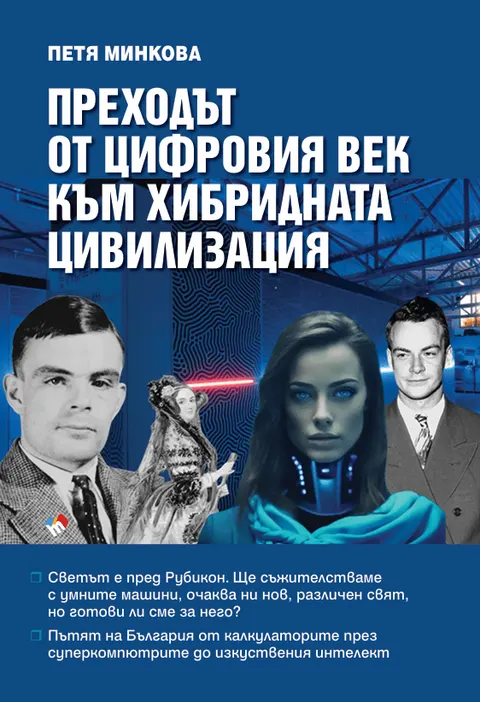
“The world stands at the Rubicon. We will live alongside smart machines, a new and different world awaits us, but are we ready for it?”
That question, the very reason Digital Stories exists, is posed on the cover of her new book by today’s guest, Petya Minkova. In Prehodat ot tsifroviya vek kam hibridnata tsivilizatsia (The Transition from the Digital Age to the Hybrid Civilization), she traces the long road from the first computers to a future of superpowerful artificial intelligence.
And while the answer to whether we are ready is clear, there are so many other important questions we will discuss in the lines below!
Do we have any future other than as a hybrid civilization of humans and technology? What does our survival depend on, and what will our daily lives look like once this transition hits with full force? Why is AI far more than a danger—why is it also a chance for each of us to climb our own personal Everest?
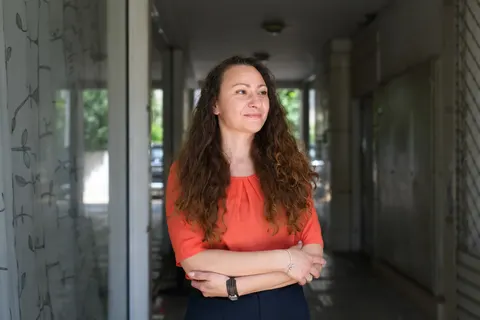
Petya Minkova
is a journalist with 30 years of experience. She is the author of four books that have become bestsellers. The first two are documentary investigations: one devoted to the legendary Bulgarian policeman Nikola Geshev, Geshev ostava zhiv sled 9 septemvri 1944 g. (Geshev Survives September 9, 1944—the day of the communist takeover in Bulgaria), and The Truth About Kim Philby, also translated into English, which draws on documents from the British archives that build a new portrait of the Spy of the 20th Century. The third is Hipersaznanie (Hyperconsciousness), co-written with the psychologist Monika Balayan, which explores innovative techniques for reprogramming at the subconscious level. And that brings us to the newest one—The Transition from the Digital Age to the Hybrid Civilization.
Petya has been a journalist since 1995, when she started work at 168 Chasa (168 Hours), the first free private newspaper in Bulgaria. From 2012 to 2023 she was its deputy editor-in-chief, after which it was transformed into the special project 24 Chasa – 168 Istorii (24 Hours – 168 Stories) within the daily 24 Chasa. Since 2018 she has also been deputy editor-in-chief of the popular science magazine Kosmos—a true legend from 1962 until the early 1990s.
– In your new book you write about humanity in transition “from the digital age to the hybrid civilization.” What will this civilization look like? Is it already here?
– The transition began long ago. It started the moment we realized that the smartphone is a mini-computer that is always with us, that we can ask it any question and get an answer. The arrival of ChatGPT was the next turning point. Never before in history has there been such massive investment in a single technology.
Last year alone, private investment in this field reached $109.1 billion in the United States; in China it was 9.3 billion according to official data, though specialists say it exceeds 160 billion; in the United Kingdom, 4.5 billion. Forecasts say the global AI market will be worth around €1.9 trillion by 2030. Investment in the field last year alone was $33.9 billion, 18.7 percent more than in 2023. That is why I believe the next hyper-leap in a revolutionary technology won’t be far off.
– And even if we set aside the purely financial side, I think even the biggest skeptics have been convinced that AI is capable of incredible things.
– For me, the most interesting thing about this transition to a hybrid civilization is that
we adapt slowly and seem not to notice it.
For example, I feel uncomfortable going on vacation without a laptop, but very soon it will be technology from “the age of the dinosaurs,” like the reel-to-reel or the cassette player. We’ll carry some small device everywhere that connects us to a cloud, and through it we’ll have access to humanity’s knowledge from the dawn of civilization to the present day.
Scientists will analyze existing knowledge and build on it faster and faster. So we are already on the fast track to the hybrid civilization, and what lies ahead is exponential growth in knowledge and technology. Unless we do something extraordinarily stupid or fall victim to a catastrophic cosmic event.
In the book I have published the reflections of various scientists and their scenarios, and for people hungry for knowledge they will be enormously intriguing. The most important thing in this process of gradually merging with machines is
not to forget our human nature, that kindness and love are our natural states, that we belong to one and the same species, Homo sapiens,
inhabiting our insanely beautiful Blue Planet, teeming with life. Our priority is not only to preserve it for future generations but also to teach them to take better care than we have of the Earth, of our species and of this miracle called life.
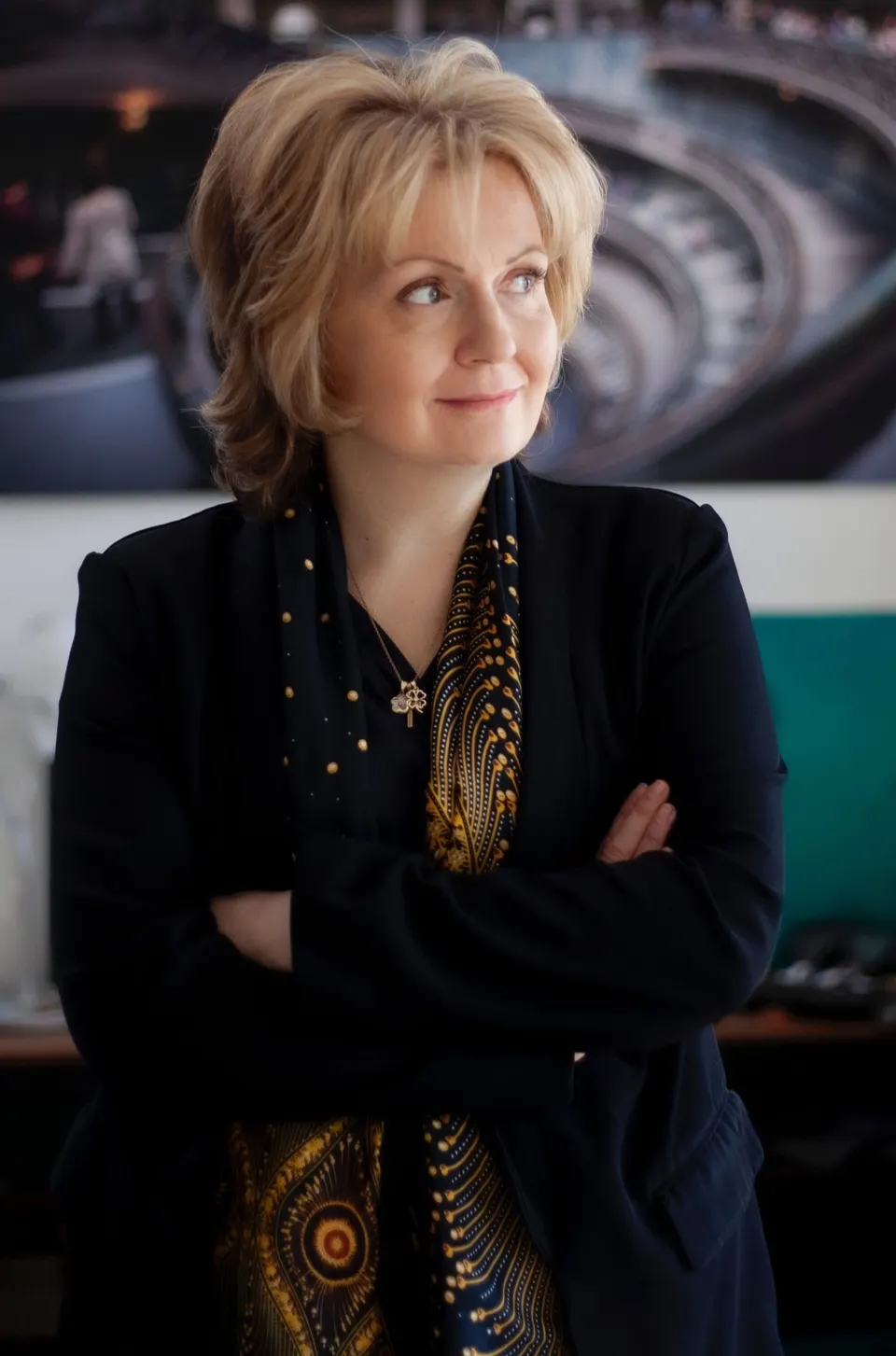
– And thank you for contributing a key line, with your book, to this conversation about the future—a vital one, in my view—that never quite manages to happen… I know how impossible it is to predict the future in the technological era, but I think it’s just as important never to stop trying, because that’s the only way we can get closer to the positive scenario. What do you think a day in the life of an ordinary person will look like in the era of the hybrid civilization?
– I’ll stick to solid facts only. This year there will be more than 1,000 humanoid robots worldwide, and forecasts say they will number several billion by 2040. Gradually they will become service staff in hotels and restaurants, entire factories will be run by a handful of experienced engineers, machines will help us with housework and care for the elderly.
We’ll have autonomous cars that “see” and find their way better and better, whether in thick fog, smoke and so on.
The scenario of Silicon Valley’s techno-utopians is that people will have access to far more goods at far lower prices.
But I have spoken with many scientists, and they are not quite so optimistic. In fact, the book hints at some very deep processes, and they come from people with an “X-ray gaze” fixed on the future.
Obviously there are fears of uprisings against the machines, but let’s not forget the World Economic Forum’s forecast that by 2030 there will be 170 million new jobs, offsetting the 90–92 million lost to robotic systems. In other words, employment will grow by 78 million jobs. And since we will need to work less and less to acquire goods and services,
the greatest danger is facing the question: “What is the new goal, what motivates me?”
At the same time, new industries will develop that we can’t even imagine today. Gradually we will become an interplanetary species, seeking resources on asteroids and other planets. With the help of machines we will crack the secrets of that black box, the climate, so that we don’t let the atmosphere “thin out.”
Seen from this angle, every hardworking and creative person who wants to leave a better world to their children can find an unimaginable number of inspiring goals and achieve them together with like-minded people.
– What is the most important conversation we must have about this transition before it’s too late? What are the biggest mistakes we must not make under any circumstances?
– There are many conversations we need to have, with facts, with precise forecasts and with top scientists of proven expertise in various fields. The first is
what will the millions of people whose jobs are taken by machines do?
Some may retrain, but what do we do with the others, who refuse to learn, to acquire new skills?
The second important conversation is about what guarantees there will be for humanity’s survival in its contact with the artificial intelligence of the future. Right now it is a perfect librarian that uses codes to find us the information we ask for. But
what if one day it begins to become aware, to teach itself, to reason independently, wielding the knowledge of humanity?
Then we, with our wonderful biological brains—creative, combinatorial, curious, juggling ideas and knowledge with skill—will face a very interesting challenge. The insurance policies need to be taken out now, because in a few years it may be far too late.
I am truly glad that one of my favorite visionaries and futurologists, Assoc. Prof. Mariana Todorova, is part of the UN group focused on precisely these problems.
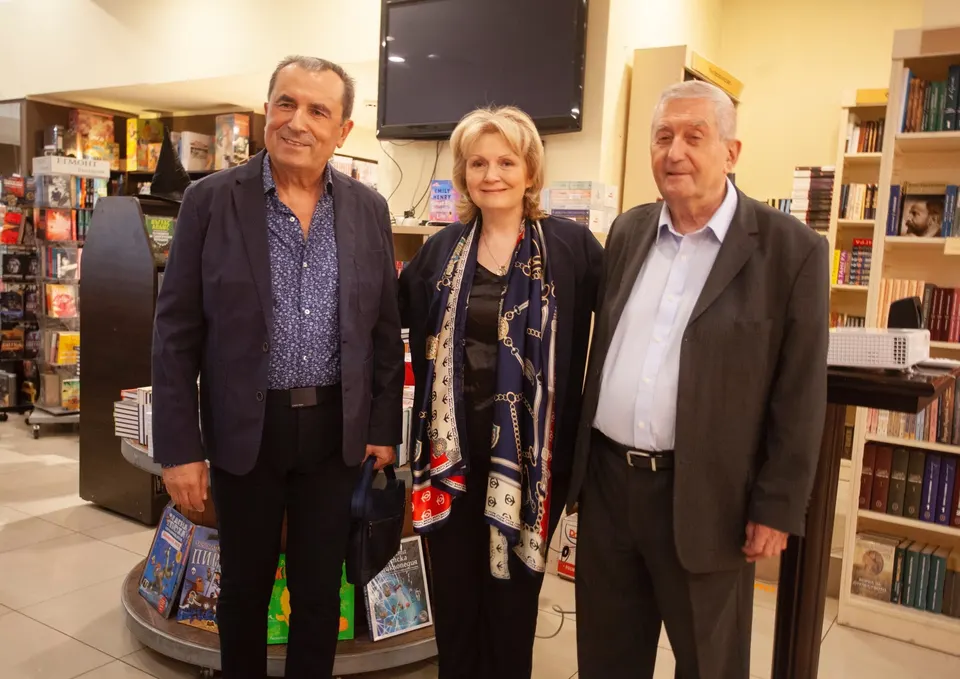
– So am I! Ever since my site has existed, she has been the guest with whom I greet every new year; we sit down and look ahead… But in your book you also look back, to the half-forgotten story of how our country was among the pioneers of information technology during the Cold War. Could Bulgaria be among the leading tech nations today?
– While I was preparing the book over the course of 22 years, I learned an extraordinarily curious fact—
in the 1980s, Bulgaria was one of four countries with a supercomputer—the others being the United States, Japan and the United Kingdom.
Our machines were used for highly complex space missions to Venus, for studying Halley’s Comet, and for a test flight of the uncrewed Buran shuttle—26 years before Elon Musk launched his reusable rocket. Our electronics industry lived through a real “golden age”; we developed ever more powerful disk drives—achievements beyond the reach even of a mastodon like the USSR.
– But then things changed quickly and drastically. Today we have a fairly well-developed IT sector. Can our country lead in this field again? What will decide whether it happens?
– That is also the mission of The Transition from the Digital Age to the Hybrid Civilization—to introduce the scientists building the supercomputers that will house the far more advanced artificial intelligence of the future. The aim is for it to inspire more and more young people to turn to science, to explore the possibilities of software for supercomputers and to realize how much time they can save.
From the book they will also learn where Europe stands. How, with a great deal of intellect and innovation, European scientists—among them Bulgarians such as Prof. Stoyan Markov and Dr. Kristina Kapanova—may soon allow us to overtake even the United States in some respects. This duo created the Bulgarian supercomputer Discoverer, and thanks to their efforts, to the EuroHPC Joint Undertaking (EuroHPC JU), to the team at Sofia Tech Park and to that of Prof. Martin Vechev at INSAIT, the Sofia-based Institute for Computer Science, Artificial Intelligence and Technology, Bulgaria will have an AI factory.
Now Prof. Stoyan Markov and I aim to get as many students as possible to learn about the potential of these machines and their applications, so that they can match their European and American peers in level and knowledge. And why not surpass them in some fields?
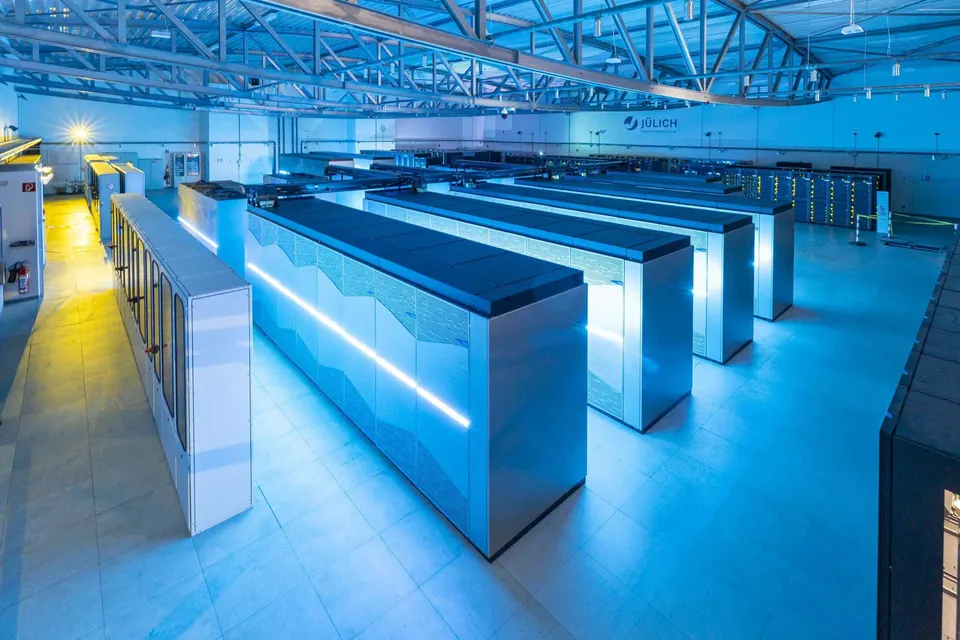
Photo: Julich Supercomputingg Centre (JSC)
– You have met many leading scientists from the world of information technology. Tell me about some who are heard of far too little and deserve to be mentioned more often.
– Three top my personal ranking. The first is Prof. Stoyan Markov, who has spent his whole life breaking down walls with his head and not only has never given up but has never put himself forward either. Quite the opposite. For almost 20 years I tried to convince him how necessary such a book was, but for that I needed to conduct very in-depth interviews with him. He was adamant, but I didn’t give up either.
He agreed to take part sometime after 2023. But the truth is that he was the engine that made us the fourth country in the world with a supercomputer in the 1980s. In 2008, with the help of Finance Minister Plamen Oresharski, Bulgaria became the first country in Eastern Europe with a modern supercomputer. We were admitted to PRACE, the European partnership for supercomputing, and the National Center for Supercomputing Applications provided the software needed for it to be used in scientific research and industry.
Prof. Markov and Dr. Kapanova built our second supercomputer, Discoverer, which is a prototype of the central module of Europe’s most powerful machine, JUPITER.
And JUPITER is a multifunctional machine with the monstrous performance of a billion billion operations per second. It is capable of housing a far more advanced artificial intelligence that will definitely not be an ordinary “librarian” like today’s models.
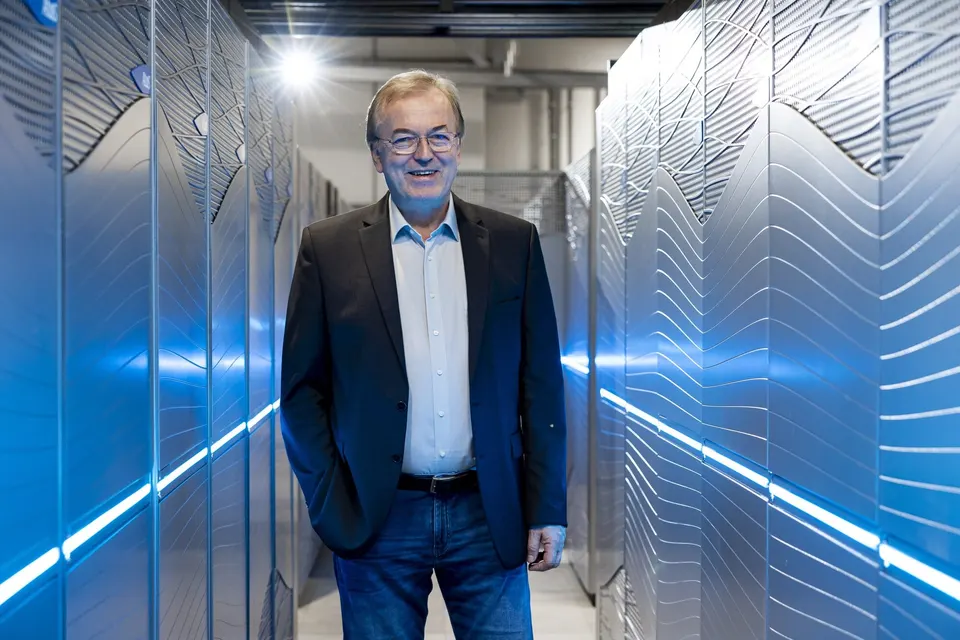
Prof. Thomas Lippert, head of the team that built JUPITER, has, like Prof. Markov, never put himself forward, and little is known about him. He is a one-hundred-percent genius who not only invented modular exascale technology for supercomputers and not only took part in creating the European quantum computer, but now wants, with his team, to combine it with JUPITER to give it unthinkable superpower. Throughout history, extraordinary figures like this have always appeared, figures who seem to compress time and fling us far into the future.
To this male company I would add one lady—Prof. Katrin Amunts, scientific director of E-Brain, the second phase of the Human Brain Project, who with her team created the first 3D anatomical atlas of the brain. I can’t shake the thought that without this scientific breakthrough, bordering on a heroic feat, the training of neural networks would still be stuck in the Era Before ChatGPT.
– You go deep into the idea of digital twins—of people, of nature, even of the planet. What should we never make a twin of, or what will we never manage to?
– I spoke with many scientists, the details are described at length in the book, and opinions differ.
I suspect the brain will turn out to be “Mission: Impossible.”
We shouldn’t play God either, but the creation of synthetic DNA has already begun. Existing animals are being gene-edited to resemble the dire wolf of 13,000 years ago, to give us an elephant resembling a mammoth, and so on. Sooner or later some scientists will realize they have crossed yet another dangerous red line.
– Yet you say that today’s technologies will allow everyone to climb their own personal Everest. I believe that too. What is your personal recipe for not becoming a victim of artificial intelligence but using it sensibly and meaningfully, so that it helps you climb your peaks?
– The most important thing is to understand the technology itself—AI doesn’t understand; to it our words are codes, it isn’t aware of them, it simply rummages through the library and, if it finds a match close to our question, hands it to us. Once we are clear on that, there is no way we can accept the answers AI serves us without reservation.
All the more so because it makes desperately stupid mistakes. From this point of view, critical thinking is our most reliable compass.
It’s important to give ourselves time to analyze the answers, to think them over—what are the cracks in its argument—to run checks that will “arm” us with additional facts, and gradually we will reach a genuine, deep understanding of a given phenomenon. Only when we are critical and constantly broaden our personal horizons, but consciously, can we lead in this interesting partnership.
Otherwise, AI bots have the potential to become perfect manipulators, with all the dangers that follow. It is very important to stay alert, to follow the latest developments in this technology, to know its advantages and be clear about its limitations. Then we wouldn’t trust it without reservation, except in the areas where it has the edge. And one warning. The Massachusetts Institute of Technology (MIT) recently published a very curious study which found that 83 percent of students using ChatGPT fail when asked to recount what they had written with its help. They can’t remember what it was about. By contrast, when they had found the facts themselves and checked them, such a failure happened in only 11 percent. In other words, when we make someone else search and write for us, we ourselves kill our ability to think, to expand our knowledge, to develop our brains, our neural pathways and so on. And then we arrive at organized, deliberate dumbing down.
– Are we ready as a society for the technological future, or do most people not even suspect what is coming? How do we “wake them up”?
– I took my own step toward that awakening with The Transition from the Digital Age to the Hybrid Civilization. I very much want it to reach people who believe that learning is lifelong, and young people, so that they don’t wander aimlessly but see where the people “forging” the future today are heading, and focus on exactly those fields.
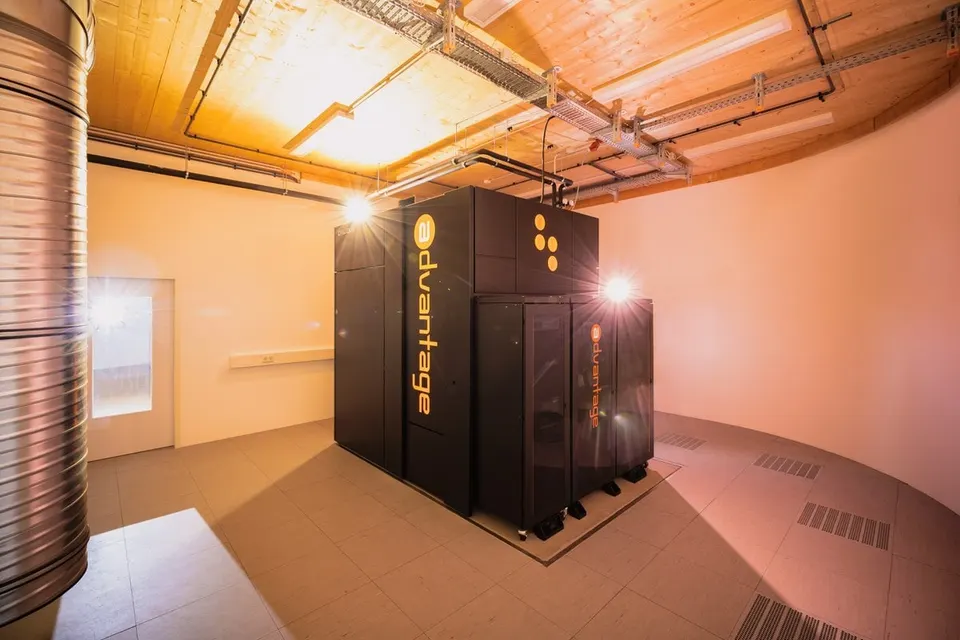
Photo: Julich Supercomputingg Centre (JSC)
– How can we solve the problem of Yuval Noah Harari’s “useless people,” or the fact that for the first time in history the elite will no longer need everyone else, as Assoc. Prof. Mariana Todorova so aptly put it?
– That is a question worth several trillion dollars, and it hasn’t been solved even in elite think tanks such as the World Economic Forum in Davos. Some of the smartest people on the planet are asking it—from IT billionaires to futurologists, politicians and ordinary people.
On the one hand it is frightening, because autonomous robots and multifunctional machines are already part of our lives, and it is a matter of two or three years before they start taking jobs. On the other, the trend in the Western world is relentless—older people live longer and longer, while the birth rate keeps falling.
That means young people will have to keep upgrading their qualifications so they can run entire plants and factories and write code, while older people will work longer and longer. I sincerely hope that as we stand on the threshold of this second Enlightenment, when we will wield the knowledge of humanity and the opportunities for growth in every field will be endless, this process will not be marked by bloody uprisings and revolutions.
To avoid such clashes, some scientists believe the only solution will be a basic income. At the same time, new professions are yet to emerge. I never imagined there would be so many young, highly paid social media specialists with practically no fundamental education. The fact is that they are among the most sought-after people right now and easily rise to management positions, because they are able to present companies’ products in a way that appeals to the public.
At the same time, society has always had a certain percentage of idlers who don’t look for work and won’t look for it as technology develops either. Unfortunately, in this complex quantitative equation, where resources are in the column and potential goals are in the row, there are still far too many variables, and their dynamics are immense. So the truth may lie somewhere in the middle, and it is still too early for predictions.
– How do we prepare the next generation for life in this hybrid civilization? Should children learn programming, robotics and digital skills from an early age, or is it more important for them to develop flexibility, critical thinking and the ability to adapt constantly? For me the topic is enormous, and it is the reason for a long series of Digital Stories.
– For me the most important thing is to teach them to think critically, to know digital technologies with their advantages and drawbacks. To know that the climate is changing and that they must be ready for sudden changes,
to adapt, to be mobile, to think fast, to be creative and to constantly look for different uses of the resources at hand.
In other words, to be like our ancestors, who came out of the caves and boldly conquered the whole Earth with their crazy curiosity and inventiveness. But the most important thing is to teach children to be good people, never to forget that we are all one and the same species, and that the most natural thing in the world, when we need help, is to help one another.
– What would a super-advanced artificial intelligence learn about people if it read your book?
– At this stage, nothing; to it words are code.
– I think that line is blurring; it crosses it more and more successfully. But in recent years we seem to talk far less about humanity’s progress in space, even though technology offers huge hope in that direction—you mentioned it a moment ago too…
– Space agencies, and above all NASA, are struggling with chronic funding shortfalls; missions and experienced staff are being cut. One of the most promising technologies is fusion rockets: Sunbird is working on the Pulsar project, which in just five years could reach 800,000 km/h. Right now SpaceX’s Falcon 9 is designed to reach 28,000 km/h.
From this point of view, we live in exciting times! For the first time humanity has a chance to explore space and “peek” beyond the edges of the Solar System. In this way
we will sharply compress the time it takes to find new and perhaps cozier worlds suitable as our second home.
In the book I have published many fascinating scenarios on this question, seen through the eyes of exceptional scientists.
– What was the last thing artificial intelligence impressed you with?
– At MIT they already have well-trained networks that detect future breast cancer at a very early stage, when preventive measures can be taken so that a diagnosis never comes at all. The signals are invisible and imperceptible to the eyes of specialist doctors.
– And which next technological step can’t you wait to see taken?
– An autonomous robot that teaches itself to be aware of its own actions, to control them and to improve itself.
Again, MIT is in the early stages of this work. It will be a magnificent experience! Priceless for science in absolutely every field, for our transformation into an interplanetary species, for building a society of abundance and the new Enlightenment. On the other hand, I sincerely hope we won’t climb back up into the trees if this technology falls into the wrong hands.
– …whether that happens, I’ll say it again, depends in my view on whether we manage to start a more meaningful conversation about the future. Thank you for making this cause a shared one! I’d be glad to continue our conversation some time from now and see whether it worked out…