Have you ever read an interview made up of nothing but stories, short ones, each prompted by a few words and finished with a literary answer? That is exactly what our first meeting with the writer Nikolay Tellalov was. But he has plenty of other valuable words, ones that deserve a real interview. About the stars and happiness. About love and meaning. About the words that someone, sooner or later, has to say. To write down.
– Have science fiction writers stopped dreaming so much, or has technology overtaken them? Why is there practically no science fiction in its classic form today?
– Well, the world itself is no longer in its “classic” form either!
When I set the present against my childhood, it turns out I am living in the science fiction of times past. Yes, some of the hopes we once nursed were betrayed. Quite a few of them. But others arrived uninvited, unexpected. We also became eyewitnesses to the rise and fall of entire technologies—cassette players, for instance.
Let me put it this way: science fiction has finally left its childhood behind. It is shaken by an “identity crisis.” It is at a loss:
what new dreams should it offer?
Will readers want to dream these particular dreams, or those? Do they even feel like dreaming at all?… And then, science fiction asks itself, what am I, what kind of cultural phenomenon have I become?
– So what is left for it to do?
– The torment doesn't stop. Science fiction can't decide which role to stress: the abstract storyteller and seer? The active provocateur pushing for what is desired to become real? The sea is no longer knee-deep, not every day is a holiday, and it's not enough to untie your purse and pour out fantasies—you have to justify them in more detail. Many childish illusions about the limits of what is really possible have dissolved; it turned out there was no ground firm enough to set the springboard of imagination on. The time has come… for the illusions of maturity. Among them, the illusion that maturity has actually arrived. And the confidence of a grown-up makes self-deception all the more stubborn.
I think one of the reasons we distinguish “old” science fiction from “new” is that
the world as a whole is approaching the limits of its growth.
In its present form, humanity cannot go on. Change is coming. Sensing its nature and direction is a classic challenge to one's worldview. It stuns and inspires at the same time. Whoever sees that beyond the horizon there will be more horizons does not worry.
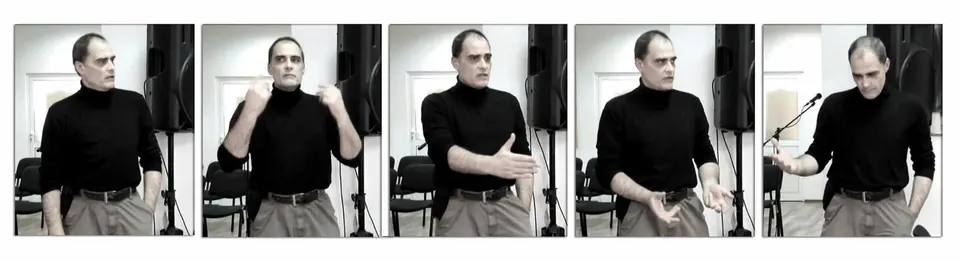
– After our first meeting I came across a comment saying that “a beloved writer shows up online, at least for a little while.” On the internet everyone loves to appear often and at length, but that isn't you. We live in strange times, and it seems even stranger ones are coming… Will writers end up out of work?
– Writing is not work. It is a way of existing. It needs readers, but it doesn't strictly require them.
It is a need, an itch, if you like, that you can't help scratching. To tell someone something, even if only yourself. Whether you write it down or not doesn't matter.
– A popular meme shows Yuri Gagarin asking how we're doing 50 years later—have we set foot on another planet yet? And when he hears the answer, he replies: “…You don't leave your homes?” How did it come to this?
– Sadly, space exploration has reached its limit. Not the technical limit, but the limit of its idea of what to do with the vastness beyond our small planet.
And so today's world cannot see what it might do outside the rut of the familiar, outside Earth's gravity well. Space is simply not needed by a world that thinks in terms of “profit,” “politics,” “competition,” “market,” “return on investment,” “capital.”
Look how
stubbornly the search goes on for reasons not to fly, to send robots instead of cosmonauts,
to swap plans for scientific bases for plans for “space hotels”—for fat-walleted tourists! There is no systematic approach.
– Still, will we reach the stars? Or do we no longer want to?
– We will. Not in the ways we got used to from the pages of “old” science fiction. And not as the society we have right now—it truly doesn't want the stars. It doesn't know what to do with them.
– Has humanity stopped creating things worth showing to another civilization?
– I don't know. Do we need to create something with the idea of showing off to some outsider? Don't we make things first of all for ourselves?
It's like writing. You create because you can't do otherwise. And if someone happens to like it—all the better.
– Does the pursuit of happiness at any cost enslave us?
– It depends on how you define happiness. That definition decides whether it is moral to chase it even over dead bodies…
Three things are worth it: freedom, love, a clear conscience.
In fact, they are one and the same.
– The modern mantra is that we should be masters of our own lives. Aren't we supposed to be living in times of equal rights?
– The mantra is a plain lie—from the first word to the last. There are already masters, and have been for a long time; they are a tightly limited minority, and there are no vacancies among them. And how can anyone in practice be “master of his own life” when, say, the protection of that life depends on whether or not he has health insurance? When the range of “services” (what a word in this case!) under that insurance is set by bureaucrats authorized (by whom?) in line with a “policy” chosen by politicians?
Equal rights are a lie too. A lie in principle.
Not because “there were vicious practices that perverted the idea.” The concept itself is flawed. Whenever we speak of “rights,” we assume “obligations.” Obligations—to whom? A mature, mentally healthy individual intuitively knows, it comes from within, how to get along with those around him.
He doesn't need a list drawn up by “sages.” And are those “sages” equal in rights to the “non-sages”?
That's why, instead of “rights,” I prefer to talk about freedom. Unconditional freedom for each person, from which freedom for all grows. And the freedom of society strengthens the freedom of the individual. In this understanding of mine, the notion of “rights” is as superfluous as a filler word in speech.
– Do you really believe the consumer society will come to an end?
– That end has to come, because it is a matter of survival. Wastefulness in the face of a whole monstrously huge Gordian knot of problems—social, technological, ecological and simply, let's call them “existential”—is a textbook example, by Arnold Toynbee's scheme, of how not to respond to life's challenges.
– Yes, but today's young people don't rebel. Have technology and easy entertainment robbed them of social sensitivity? Or do they have it, but it's so different we can't understand it?
– The lack of rebellion is a mystery to me. Maybe because here in particular, in our impure and unholy land, the young are literally a minority? We are a country of pensioners! And not only us.
Or maybe because new and improved versions of the traditional pacifiers have been invented, ones that distract people and talk them out of rebelling? That even
make the young blind to the very possibility of rebellion?
That it has been drummed into them that rebellion won't end well?
And, of course, social insensitivity has been carefully cultivated.
I don't know.
– “New and improved pacifiers” is a pretty accurate definition of social networks, really! Are they a chance for genuine contact with many people, or an imitation of communication? I suppose I'm presuming the answer…
– Of all the “social” networks (not a very apt name, in my opinion), I prefer forums, which by now are probably seen as an “outdated” form. And, paradoxical as it seems, the networks are both—a chance for genuine contact and an imitation. It depends on the user. On what he is really looking for, even if he isn't fully aware of it.
As I see it, instead of collectively raising communication itself to a new level (more self-discipline, more tact, more listening and understanding, less empty talk), we carried our old habits of back-alley “communication” unchanged into a different environment, one full of opportunities to be irresponsible with no consequences for ourselves. In other words, we collectively chose the easier option. Following consumer reflexes, and the worst ones at that—take a bite and toss it away.
I still sometimes ask: since
on the internet our faces are made of our words, why do you prefer to wear ugly mugs?
Alas, I have yet to get a sensible answer. To the “decent” crowd, my question sounds like nonsense, and for the “ugly mugs” it lies outside their frame of understanding.
In the end I answered it myself: online forms of communication work like a magnifying glass, which, unfortunately, enlarges the flaws in our ability to communicate in general more effectively than anything else. In short—whoever behaves like a cretin becomes a mega-cretin online.
– In your view, does the information society we live in give us enough real information?
– And what exactly do we call information? Which information actually tells us something new, something useful? And which is evidence only of people's ability to make things up—for all kinds of motives—and to spread their own and other people's inventions, sometimes for no purpose at all?
We sense instinctively that buckets of disinformation slop have been dumped into the barrel of honeyed information.
When trust is lost, the easier approach is to declare devaluation
rather than struggle to separate the decent from the rotten-to-the-core.
Yet we do value our chance to shine at any moment—oh, I know that one! It says so somewhere or other! An illusion of omniscience, without real knowledge, without any effort to make sense of things. The ease of finding data by typing a few keywords into a search engine—there you have the know-it-all's false confidence. That phenomenon doesn't help us value information either.
– The moment when technology will do almost everything for us isn't far off. What will we do then? Are we ready for that time?
– We will never be ready. Not all of us, not consciously.
Was anyone ever “ready” to be born into this world?
To grow up? To grow old? To die?
As for the rest—there will always be something to do. For those who need it. Strictly individual, for each person—whatever they truly want. I think the question is not so much about “something to do” as about “the meaning of life.” And naturally, that meaning differs for everyone; it is whatever you forge for yourself, if you bother to do it at all. Drifting with the current is easier. We “borrow” other people's meanings. We let someone cram their meaning into our heads without stopping to think whether it does us harm, without asking ourselves, “Hey, is this really my idea of the meaning of life?”
I consider it a blessing, a positive gift of technology, to be freed from having to do unpleasant, harmful, tedious, dangerous work.
But
if we try to get rid of everything… what are we living for?
People will simply split along the line of how they make sense of their own existence.
– Nanotechnology was supposed to be the big thing that would change everything; one of my favorite books of yours is devoted to it. But then it seemed not to develop much. Now we have artificial intelligence and blockchain. Which technological directions do you think are worth following and hold the greatest potential?
– Nanotechnology can still become “the big thing.” As long as it gets a shoulder to lean on, the way the atomic bomb got the shoulder of the Manhattan Project. A concentration of every kind of resource on the task of creating something—or at least of establishing that creating it is impossible, and why.
In my opinion,
the future belongs first to additive technologies
—I see even today's most advanced 3D printers as prototypes of far more sophisticated machines.
In a notional second place I put swarm robots, including ones measured in millimeters and microns, and I see them as working in tandem with additive machines—and the result is systems I call “technoreplicators.”
I think this is important: a technoreplicator has to rely on more general technologies that can work with a limited number of raw materials to achieve the same or similar results as the technologies of waste—the ones that use all sorts of rare chemical elements and compounds simply because they can still be mined from sufficiently concentrated deposits.
And, of course, the main prospect is AI in the form of Machine Reason. The most powerful tool for studying natural phenomena, for every kind of modeling, for managing technological processes and planning the next steps of progress.
But I am convinced the capitalist world doesn't want Machine Reason; it is afraid of it. It wants an obedient, reliably controllable Half-Reason. Only, reason is better at solving complex problems than half-reason. Competition pushes toward that critical line between “just a supercomputer” and true AI.
Why is there fear of AI?
Because
those who fear it project their own worst traits onto it
And so they have every reason to fear that a monster will be spawned. Monsters will give birth to a monster.
They fail to take into account the inalienable trait of every mind—the drive toward self-improvement. And when they do take it into account, they suspect—once again, with good reason!—that Machine Reason will recognize them for what they are: social parasites, obstacles to progress, a problem.
And since your question contains the phrase “that would change everything” (which I read as “would change the world”), let me state the motto of my views on the Universe, life and everything:
technologies are keys to the doors of the future.
But once a door is unlocked, it has to be pushed open. And then we have to step over the threshold. That is, social action is needed for us to end up in the version of the future that attracts rather than frightens us.
Not all of us are attracted. The parasites are doing fine in the present. And in a future that is a continuation of the present, with no change in substance.

– Would it be wrong to say we live in a digital Middle Ages?
– I wondered what “Middle Ages” is supposed to mean. I did a little digging. Perhaps I'm jumping to conclusions after such a cursory analysis, but here is what occurred to me: the main feature of the Middle Ages was the absolute dominance of one or two clearly defined dogmas about the order of the world, planted in people's minds; and that dominance drew its strength from mass ignorance.
“Things are as they are because they were given from above! Not only must we not try to change them, it is not even possible to change them!”—such were the slogans raised by the apologists of dogma.
Today the illusion of “all-informedness” I mentioned earlier is being vigorously cultivated—and it can play the role of ignorance, a more arrogant kind at that, because the ignorant of the past at least knew they were ignorant compared with, say, the rare men of letters, while today's ignorant fiercely deny
their actual ignorance, their inability to make sense of information. The traditional dogma that “things are the way they are forever” is also growing stronger—though, at least for now, things are far from the unshakable, unquestionable status of total Authority.
So my answer is: I don't know. The resemblance is alarming, but I'd like to think it is only skin-deep.
– What stage of its life is humanity at? Is it still learning to walk, or has it reached a midlife crisis?
– Analogies between the life of a species and that of an individual are acceptable as metaphors. Humanity is not a monolithic block. It is a statistical mass. That it is in crisis—true. On the threshold of a crisis unlike any in its history so far.
It can walk, even run and jump. The problem is that
a small part of humanity has created effective demotivators to kill the majority's desire to run,
and even robs it of the confidence that it can.
And, of course, as a species we are far from “middle age.” We are still at a level where, on the whole, we react like an animal population. We don't decisively choose the rational. Not because we aren't smart enough. But because we are divided. And the part of us that is “strong for the day” doesn't want the path of development in which it would cease to be “strong” and privileged over the other parts. It is hard even loosely to name stages in the life of a single person that would hold for everyone as a whole (which, I stress again, is not whole at all).
In any case, the interesting times are yet to come.
– Who does the future belong to?
– The anthropologist Stanislav Drobyshevsky, popular on the internet, answered a similar question without a moment's thought: to our descendants.
Although the purely biological evolution of humans has slowed because of the social factor, which is more powerful, it has not stopped. And technology, especially information technology, opens up prospects for self-evolution—instead of blind changes to the genotype and phenotype, we might one day move on to selecting for ourselves the traits we consider useful now and in the future.
Those same technologies, so far close to us but still physically separate, are starting to “move closer” and closer. In “old” science fiction this option was called “cyborgs.” A rather crude and approximate picture of what might really happen. Our physical merging—not only mental and functional—with the machines we have created, machines that will logically become ever finer and more like biological systems, seems to me a good solution.
But not before the human world changes radically. In the current type of social relations—and it shows in science fiction novels, films, games! Even against their authors' will!—there is simply no room for “posthumans.” They come into conflict with everyone else, even when they are “good superheroes.” They clash even with themselves. They are of no use to themselves as they are—different from the rest. Lonely.
As Nietzsche said… actually, I'm not sure whether he said it outright or whether it's purely my own conclusion from Thus Spoke Zarathustra:
the superman cannot be born while there is even one slave left in the world.