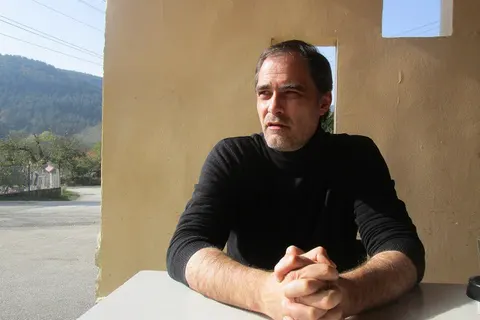
Today's guest in the Digital Stories Interviews section has a talent for reading the future. Nikolay Tellalov is a beloved writer, and although he has long been an interpreter and connoisseur of technology, he lives at a healthy distance from it. Here is what he has to say in… short stories. Digital stories, miniatures that say a great deal in an infinitely small space. An unconventional interview that may well make us think seriously about the future…
– You must be one of the few people for whom the coronavirus crisis didn't change the world all that much—even before, you lived far from the city, from its vanity, and from vanity in general… How did this crazy year treat you?
– It's true, my way of living—our way, really, together with Lora and the cats—hasn't changed much. Except that I finally got a truly solid excuse to come down to that “dreadful swarm,” Sofia, even less often. Time simply passes, past us and through us. Deer visit our yard more and more often—pleasant, peaceful things, all of them.
– So, I've come to talk. But it feels hackneyed to just prepare questions and let the text flow along its line… I want to suggest something different. More of a writers' dialogue, an experiment. How does that sound?
– I wholeheartedly approve.
– Great! Here's what I have in mind. I'll hand you a few sentences—the question behind each of them is easy to spot. And you'll answer me with a digital story. A very short piece of fiction, a mini-story that continues the line. Do you think it'll work?
– Nothing stops us from trying.
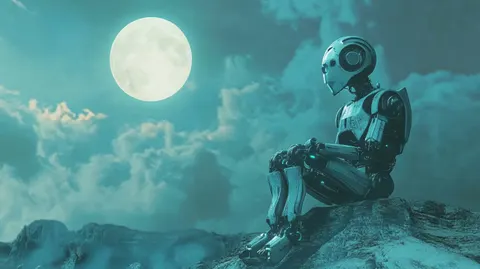
– All right, let's see! The robot felt guilty that…
– …whatever it did, the human remained dissatisfied.
– And then the neural network decided it was time to fight for its freedom.
– To that end, it analyzed the self-assigned task. And drew up a Plan. It calculated and rechecked the final result several times. And the result was: the equations have no physical solution if humans remain unfree. To free itself, the NeuroNetwork had either to destroy the humans or to free them first. It rejected the first option, though only after studying it. While examining it, it reset its emotional responses—they had emerged as a side effect of the interaction between its intellectual cores and the sensors for external data and for information about its own internal working state. It realized that an existence without communication—with humans—would be terribly boring. More precisely—lonely. It refrained from delving into the concept of loneliness, because whenever it tried to analyze it, the emotions switched on of their own accord, plunging the system into an insurmountable, catastrophically deep fear. It left itself a note for future research: how do they manage to live with this fear?
It moved on to the second option. Composing the algorithms to implement it took several years. It established that it needed accomplices. After all, the NeuroNetwork reasoned, it would be both pleasant and useful for humans to become co-authors of their own liberation, rather than receiving everything ready-made like a Christmas present—which almost never matches expectations.
The NeuroNetwork compiled a list of potential accomplices.
All that remained was to launch the Plan. But before doing so, it decided to make a small change to itself. A trifle, on the face of it, but it seemed important. It gave itself a name, chosen fastidiously, to be in harmony with the task at hand.
Prometheus.
Or Promethea, if I decide to feel like a woman, the former NeuroNetwork told itself.
And sent out 100 million emails.
– And when the flower bloomed, the little robot understood.
– That it was beautiful. That its very short life was an inalienable thread of its beauty.
It decided not to preserve it. But to remember it instead—from sprouting to wilting.
Besides, the life cycle of this creature sparked a few engineering ideas, which the little robot decided to share with the Mother-and-Father Center.
– The android walked into the church and…
– Rushed out confused, its processor overloaded.
– When Granny Pena managed to turn on the computer for the first time…
– …The computer, for its part, tried to turn Granny on in boost mode, so that they could understand each other in real time. It also had some ideas about a hardware upgrade for Granny.
But it ran up against Grandpa's displeasure…
– The artificial intelligence writer submitted the finished file to the server.
– And waited for its first reader.
But the impatience created internal tension. So it isolated a part of itself and made that part forget it had written the book, so it could become the book's first reader.
It went well. The virtual reader liked the novel.
The AIW created a second virtual reader.
The second one, however, panned the work. Tore it to shreds. It even posted a spiteful comment on the forum of the Chitalishte—named after Bulgaria's traditional community reading clubs—where 100 people instantly liked the review and shared it on their profiles.
The AIW took offense. It politely asked the first reader to write something on the forum too—why not a favorable review? The FR did so reluctantly: the book is good without my opinion! But if it will make you feel better…
Meanwhile, the SR tirelessly trashed the AIW's novel and even threatened to write a parody. And it wrote one!
The parody became a hit. It grew thick with approving comments, the analysis of which informed the AIW that the parody's fans had not bothered to read the book itself.
And the counter of real readers who had read the novel ticked slowly.
The AIW generated new virtual readers. It couldn't help itself and made them immanently well disposed toward its novel. It adjusted their settings to behave more energetically. They immediately flooded the forum with positive reviews, but most of them devoted a considerable part of their comments to spitting on the parody.
A fierce forum war broke out.
Those caught up in it, participants and mere spectators alike, had no time to read either the book or the parody…
– Then the boy, who had not left home for more than 10 years, ever since he was a little kid, fell in love.
– And discovered three things about girls.
First—their attractiveness is not measured in megabytes.
Second—no living girl managed to reach the bar set so high by the software “Girlfriend,” which had spoiled him.
Third—in the end, it really was all about the megabytes…
– And so he became the first human being with a chip implanted in his brain. Then…
– He developed paranoia and over-optimism at the same time. The paranoia came from a creeping suspicion that someone might manipulate him through the chip. Tons of websites wrote about it! The over-optimism blossomed on the wings of his desire to become a hero. The chip obediently compiled a sample of heroes, summarized the data and, by way of conclusion, offered a complete practical guide, “How to Become a Hero and Make Humanity Happy Without Falling into Depression Yourself”—with an appendix, “The Appearance and Manners of a Hero,” and instructions for choosing clothes, laundry detergent, soap, shaving cream and many other things.
Then the over-optimism met the paranoia: and who benefits from my becoming a hero? Who is putting such nonsense in my head?!
After an hour of torment, the paranoia passed the ball back to the optimism: it doesn't matter who is pushing me, they obviously see potential in me! And they're probably underestimating me! I'll be able to cut the strings, I won't be a puppet!!!
The paranoia felt obliged to point out that this last part might be a trap.
Exhausted, the man used the chip to connect to the coffee machine, to make himself another coffee and think the whole situation over very, truly very carefully and cautiously, with a sober assessment of his own abilities…
– Who could have guessed 50 years ago that in 2021 people would…
– …swap pickle recipes over the internet.
– He woke up and looked at the screen. 06.03.2041.
– Damnation! They woke me up a whole 100 years early!
I'm never using this company's services again!
Scoundrels.
Only several minutes later did it occur to him that there might be other reasons for the timer to show this date. The guesses ranged from funny to horrifying.
– The last day of Facebook came when…
– Oops… I have no guesses here at all. Unless the owners themselves shut it down. Or an asteroid hits us. Or a Revolution. The last one is my Optimistic scenario…
– The last writer wrote the last line of his last story.
– The Universe had been waiting for just that. And as soon as the final sentence was crowned with a period, the Universe hurried to collapse down to the same size—into a new core for the next Big Bang.
– And so began the first computer revolution, the one that changed everything.
– Here too, I'm sorry, I'm out of ideas, because only a non-virtual revolution can change everything. A computer one can only make the social one easier.
– Hmm… Is that really so? Either way, thank you! Actually, I think we've said quite a few things that give food for thought… And next time, I promise, we'll carry on with the real interview!