The fifth industrial revolution has already begun, and everything is changing from the ground up. But what makes it different for us is that, for the first time, we have the chance of an equal start with everyone else—as a country, as companies and as individuals.
Dobroslav Dimitrov _has been talking about this stubbornly for a long time. He was a guest on Digital Stories three years ago, and the words from that conversation now sound like a prophecy come true.
But how do we make the best of this chance? How do we prepare, how do we succeed in the new world of advanced artificial intelligence? Here is plenty of food for thought, along with some practical ideas.

– You often talk about the fifth industrial revolution that has begun, and say that for the first time our country has a chance to take advantage of it on equal terms with everyone else. But can we really do it as a country, and what does it depend on? Should we somehow try to change the policy of the European Union, which is clearly restrictive toward innovation?
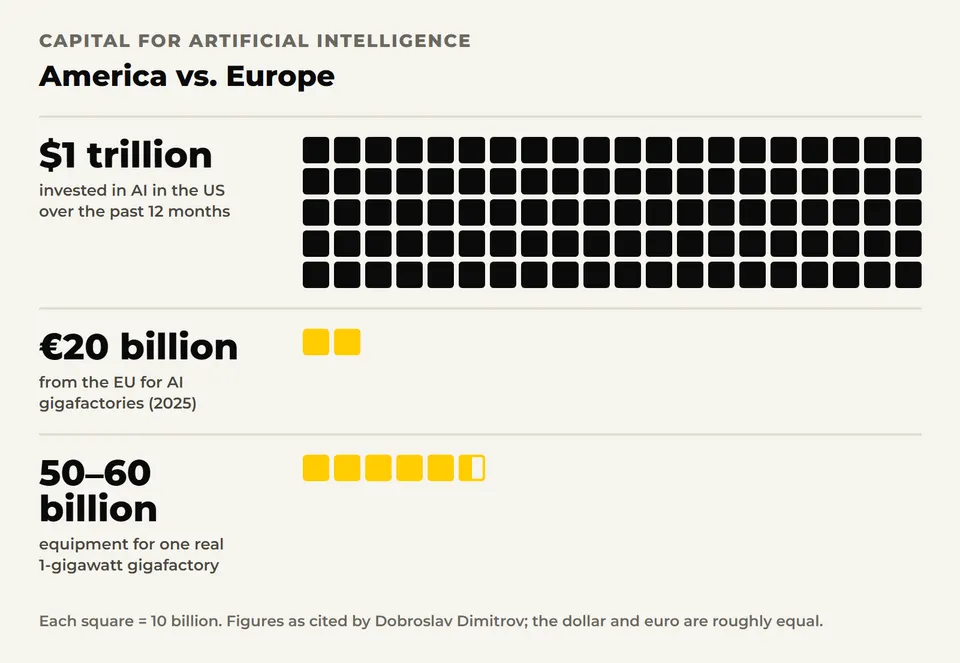
– There are several directions. How much can we influence the EU? As a European member we certainly have to take part in that conversation and lobby. The drama of the European Union, apart from the regulations, is that we don’t have a unified capital market, so no company in Europe can mobilize the kind of capital American companies have. In America
a trillion dollars has been invested in AI over the last 12 months,
which is simply mind-boggling. Against that, last year the EU set aside 20 billion for gigafactories—I have no idea why they called them that. Twenty billion is enough to prepare the construction sites and nothing more. For one real gigafactory, the hardware alone runs to around 50–60 billion per gigawatt of capacity.
These tiny steps by the European Union simply cannot do what is needed for us to catch up.
But beyond the global picture, three levels matter—what we can do as a country, what companies can do and what people can do as individuals. There is work to be done on every one of them.
– Let’s go through them one by one. What is the state’s role?
– It is critically important that we try to become as big a hub as possible for the high-tech segment of the economy. I mean projects like Endurosat’s in Dobroslavtsi, a village just outside Sofia—Starbase Europe. It is entirely privately funded, but the state has to do its job too. The faster it moves the paperwork, the faster these investments will pour into Bulgaria, and this project, for example, is a development center not only for Endurosat but for other companies from the EU and the US as well. It will be the largest development center in the space and defense sector in Europe.
The state has a role in it, because this isn’t like software, where we can grow even without it. Real infrastructure projects simply can’t happen that way.
Endurosat is already the undisputed leader in Europe in its field. With the memorandum it signed with Arianespace, a Bulgarian company will buy entire rockets directly, skipping the middlemen. That puts us on a very short list of countries.

We have everything we need to attract big computing centers to Bulgaria—spare energy, a modernized grid with very large capacity, specialists. Over the last five years something incredible has happened: Bulgaria now has installed battery capacity equal in absolute numbers to Germany’s. That’s one of the reasons we are currently a major net exporter of electricity.
It was announced recently that there are negotiations with Tesla to carry out three huge projects in Bulgaria.
Bulgaria can position itself in an entirely different way on the world’s technology map.
The next way Bulgaria can benefit from the current revolution is the enormous investment now starting in defense, specifically high-tech defense. We have experience in the traditional kind, but what lies ahead for the sector can be seen in what’s happening in Ukraine. Their IT industry has mobilized to the maximum, and they are working miracles.
Bulgaria has specialists in the automotive industry, which is suffering across Europe. But those specialists can move almost automatically into robotics and high-tech defense involving drones.
My new company does exactly that—a group of software industry veterans got together to build a technology for coordinating large numbers of drones that work as an anti-drone system.
Everyone else is investing in drones that go out to destroy. Crashing into a building doesn’t strike me as the pinnacle of engineering,
but hitting a tiny drone in midair and destroying it strikes me as far more important and far more noble.

But even the Dobroslavtsi project alone could transform Bulgaria’s entire economy, because the space industry will be worth trillions, and if Bulgaria positions itself early and becomes an attractive center for companies working in high-tech defense and space, we can be absolute stars amid the billions being invested.
– Listening to you, one gets carried away and even starts imagining that all of this is practically possible, and that with a little focused effort a brilliant future awaits us. And if we come down to the level of companies, what matters today? I have the feeling AI is being introduced very clumsily and chaotically…
– That’s true. Many of our companies have a serious problem, and an awful lot of business models need to be rethought. Pure outsourcing is certainly on its way out. More companies are trying to turn toward building solutions for the real world.
We have a new paradigm that leaders need to find their way in. The situation is completely different. Right now, for example, we,
with a team of fewer than 15 people, are doing something that previously even 150 wouldn’t have been enough for.
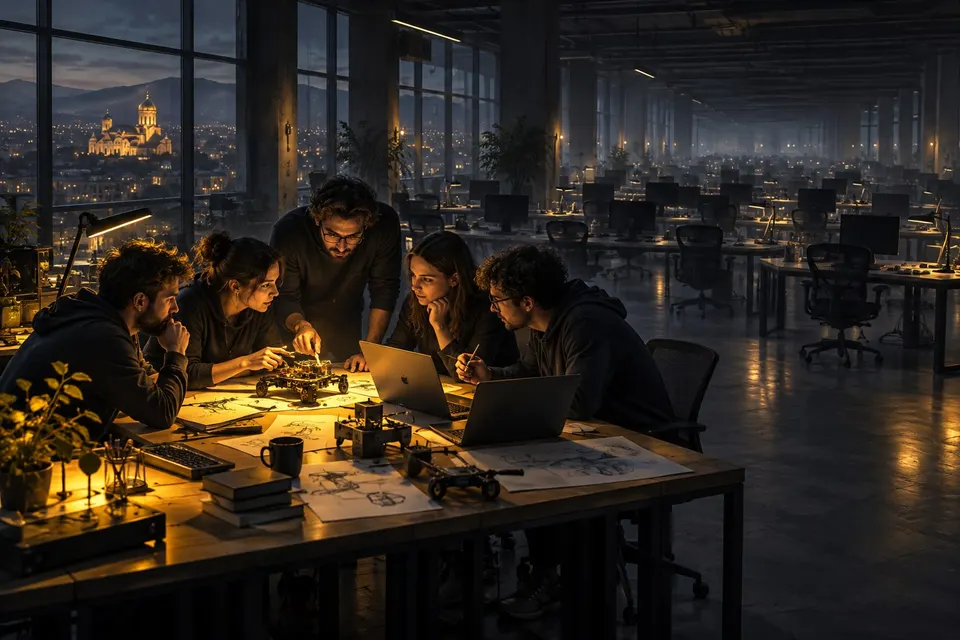
With a very small number of very dedicated engineers, with brutal added value in engineering terms, phenomenal results are possible today. In all kinds of domains we wouldn’t have dared to enter before. Because
with artificial intelligence you can gain expertise in any field in a very short time. And when that’s combined with smart people who can learn, things become mind-boggling.
With outsourcing you know what you’re looking for; you have to find clients. The risk isn’t all that great, whereas with a product venture you can make the best thing in the world and have zero revenue. That’s a risk that has to be taken. But fortune favors the bold, not those who play it safe.
There are many opportunities. The Bulgarian economy ranks last in the EU for digitalization. That means there are so many unsolved problems at the business level that can now be solved—but they have to be approached in a radically different way.
– I hope there’s the will for it, because I talk to quite a few people in the sector and I don’t see it, and even less outside it. Which brings us to personal effort.
– I think freelancing may come back into fashion. For a while it wasn’t so widespread: you do something and there’s a risk you won’t get paid. Much better to sit on a high salary at some company with all the perks. But
what a proactive person who solves people’s problems can do today in two days would previously have taken him six months.
And there are an awful lot of opportunities here. Games are just one small example. I’ve had millions of ideas for games but never made them, because it would have cost enormous sums. I had one such idea years ago and gave up on it, because it would have cost two million to develop over two years and might have earned nothing in the end. Now we made a prototype in half a day! From notes I had written by hand four years ago. I scanned them, showed them to Claude, it drew up a technical specification, then a prototype. Everything was ready in 3–4 hours.

– I have a very similar example. For a long time I wondered how to rebuild this site. One evening Claude and I sat down, and by the next morning it was ready to welcome visitors—amazingly fast, beautifully designed and costing next to nothing in hosting.
But many people—Altman and Amodei, for example—say this will widen the gap. Because people who find their bearings, who are curious and proactive, who learn and adapt, remain a minority. Even in our IT industry, which should be the quickest to adjust.
– What I’ve noticed is that with the new technologies, a person’s background makes absolutely no difference. Whether you’re an engineer, an artist or an accountant, the odds of being proactive and curious are exactly the same.
There are software engineers who, with not so much knowledge but a lot of curiosity, perform feats of daring. And there are those who kept philosophizing to the very end. “Vibe coding isn’t serious,” and off they go into long explanations. I’ve heard the same from artists, from lawyers.
Some think until they’re all thought out, while others play until they’re all played out.
– Still, how do we get more of those who experiment and make full use of the new possibilities?
– Unfortunately, there are people, and by no means a small number of them, who really will be in trouble.
I completely disagree with Elon Musk’s thesis that an era of abundance awaits us.
AI and robots will do everything, and we’ll just live and work only on ourselves.
That’s something only people who have completely broken with human nature can say. For most people, their profession is part of their identity. And when you take it away from them, even if you give them money, a universal basic income, will they feel happy? Most of them certainly won’t. And that’s a very serious problem to solve, one I have no answer to.
My only fight is for us to walk into this problem with our eyes wide open. This problem is coming, and for the software world it is already largely here.
– That’s my big goal too, for more people to open their eyes to the new reality, but in six years I don’t see things changing on a broad enough scale.
– You and I keep doing it, but,
unfortunately, sometimes the trouble has to actually happen for people to understand.
Right now there are people who haven’t been able to find a job for 3–4 months and keep making demands, while not bothering to get better at AI. Many people think this is some temporary state and that if we keep our heads down, it will pass us by.
Well, it won’t pass us by. Keep in mind that many of our younger colleagues have never seen a time when things weren’t going well. Our sector was hit fairly lightly in the last financial crisis, and that was long ago—2008–2009. A whole generation has changed since then. The 13- to 15-year-olds of that time didn’t grasp it; for their entire conscious lives they’ve been used to one permanent state of affairs.
During the pandemic there was a boom in IT, then another at the start of the war in Ukraine, when Ukrainians and Russians vanished from the global market. Many people thought it would be like that forever.
Well, it’s very hard to explain to those people what’s happening and get them to take you seriously.
“Back in the day, in 1912, in the deep snow”—the stock opening of an old man’s war story—that’s what they hear when we talk to them; that’s roughly the level of the conversation. On the other side are the older people, and they don’t like change at all.
So I’m not particularly optimistic. Our role, yours and mine, is to talk as much as we can, so that whoever can hear us will hear us now.
– I completely agree! Even if only two people read our conversation and realize it’s time for bold changes, it—and this site—will have been worth it. And if they realize that to stay competitive, they need to take action as soon as possible.
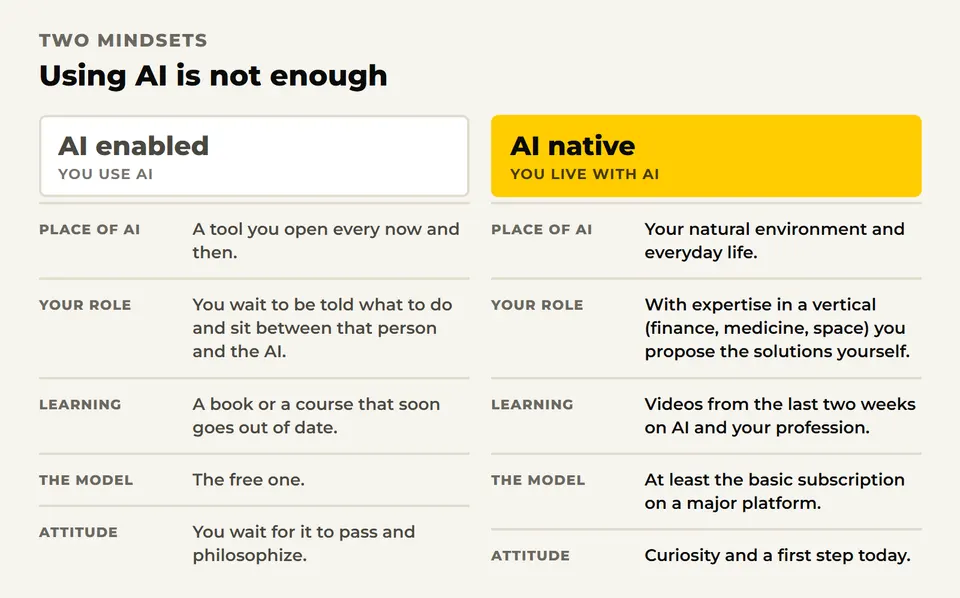
– That’s right. In the beginning, people said everyone had to become “AI enabled,” to use AI. No, for a long time now you’ve needed to be “AI native,” with AI as your natural environment and your everyday life. Think about the difference.
This applies to every profession. Recently I was asked about journalism. A curious writer who wants to do investigative journalism—good lord!—can now carry out monstrous investigations that used to require a team of dozens. Soon at BRAIT we’ll present a project like that, related to checking public procurement. We are capable of miracles there! Finding out whether a tender has been rigged for a specific winner—something completely impossible until recently if the little paragraph that does it was on page 800 of the specification.
– And what should those of us in the IT world do, in your view?
– As for programmers, I think that, among other things, they need to rapidly build up expertise in some vertical.
It’s already clear that code will write itself. But there’s a huge difference between it being done by an experienced programmer and by someone with no experience.
And if you have expertise in some vertical—finance, medicine, space—that gives you a huge advantage over anyone else. If you work for a fintech company and have serious financial literacy, you can be the one proposing the solutions. Instead of waiting for someone to tell you what to do and being just the middleman between them and the AI.
That’s how the programming profession is changing, and that’s why I talk so much about needing more technology high schools. No, these are not high schools for programmers, as many people think. Programming is a horizontal skill, and on top of it you build vertical expertise in some direction.
Besides, the cheaper something of value becomes, the more demand there is for it. Right now a great many things that could be digitized, especially in Bulgaria, mostly aren’t. An awful lot, simply because people couldn’t afford it.
I had a case like that with a secondhand clothing company that sent us an inquiry about a project. It turned out to be much harder than ordinary stores, mainly because you have, say, 250,000 unique items—every garment is photographed, logged, it’s one of a kind, not “we have 50 pairs of these trousers.”
We make a first estimate, we calculate and calculate, and we arrive at around 350,000 leva (about $200,000) to do it properly. It seems insane to us—how can we ask that much money for an online store?—so we hand it to a second team in the company. Exactly the same figure. In the end we gave it to the elite team of the “empire”… and it still came out the same.
The client despaired and said it was absurd. Then they disappeared for 2–3 months, but apparently no one had given them a better price anywhere, so they came back to us and we did the project. As the work went on, it objectively turned out there was more, and more, and more, and it came to about 500,000 leva.
What kind of business do you need to have to afford half a million for a store?! Well, now it would be so much easier and cheaper, and so many businesses need it.
That’s why I say we don’t just need to loosen up, we need to approach business in a completely new way! There’s so much in the economy waiting to be digitized…
– Before we part: if we’ve convinced someone and they decide to set out on the “AI native” path tomorrow, what should their first steps be?
– I always give the same advice. Open YouTube and start watching videos about AI and your profession uploaded in the last two weeks. Because anything from four months ago is out of date. You need to see what some clever person manages to do with the latest model and follow in their footsteps. Things change so fast that whatever book you recommend, whatever specific thing you recommend, it will soon be hopelessly obsolete.
The next step is very specific to each person, because only they know their own work. If they’re lucky enough to work at an innovative company, there will be an internal AI team going from department to department and making sure they set out on this path.
If you’re a tech company but can’t afford a whole department, you need at least one curious person like that, an evangelist who pulls the others along.
But the head of the company has to back them very strongly, because it doesn’t work without pushing. It isn’t enough to explain it and answer questions; people will very quickly slip back into the old ways.
If you’re an independent expert, the responsibility is personal. If you don’t know where to start… go and ask your favorite AI; it will give you plenty of ideas. And be sure to pay for at least the basic subscription on one of the big platforms—the free models won’t help you. The most important thing, though, is still to want it and to take the first step…