Can you imagine what it was like for the coachmen when they saw the first automobiles? At first they probably felt safe. “Who would ever climb into those strange little boxes? Instead of enjoying a calm journey in harmony with nature” (and its aromas)… Then, almost imperceptibly, cars made their labor unnecessary. But they also created a new calling—the driver, which survives as a profession to this day.
Well, I, along with several tens of millions of software engineers around the world, have found ourselves in that very same role. Our profession is unnecessary in the form we know it. We cling to computer code the way a coachman clings to his horse, while more and more of it is being written by artificial intelligence. What's more, we don't have the luxury the coachmen had: a new technology that made their familiar work obsolete, but took decades to take hold. And then only a century and a half later came the self-driving cars, set to make the next logical calling—their salvation—pointless as well.
Everything is happening here and now, and nobody even knows how to be prepared.
In just one month, some of the undisputed authorities from different generations and corners of the computer world rallied behind the same idea. Today, humans no longer need to write computer code. Because artificial intelligence already does it better than we do.
This Digital Story matters not only to the tens of millions of programmers but also because it is a powerful example. It is unfolding in the software world, but there is no reason it won't repeat itself in every other field where AI is arriving more slowly, yet just as relentlessly.
Maybe it's time to get off our “horses”—or our keyboards.
But… what do we take up then? What does the steering wheel of AI look like? What will programmers do when they no longer write code?

Code for Code's Sake
What do software engineers—or, as we more often call them, programmers—actually do? No, it's not just arguing fiercely about the meme of the week and sipping soy lattes. The truth is that the profession is far more complex than it looks from the outside. It involves constant communication, discussion, learning. It involves huge stages of analysis, planning, testing, preparation.
And yet its core role is (or at least was) to arrive, at some point, at creating and developing software. Which in turn happens (or happened) by writing and reading computer code.
We have talked about Margaret Hamilton—one of the first programmers. Back when the profession itself didn't even exist, she wrote the software needed to send people to the Moon—something that six decades later we, as a civilization, are only just timidly on the way to repeating. If you know her story, you probably remember this photo:
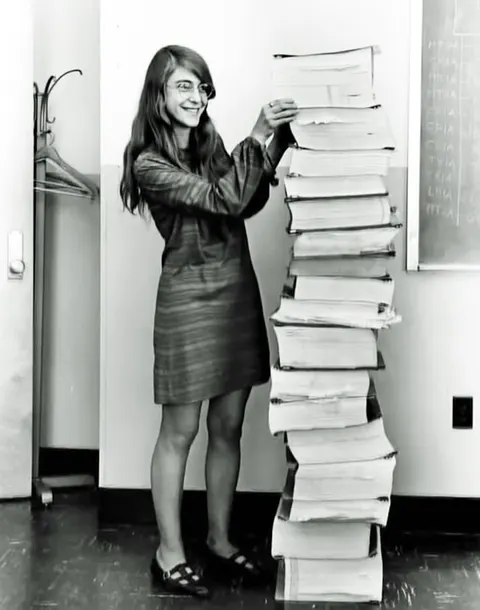
Here the programmer stands next to the computer code she has written. And indeed—in the beginning, computers were mystical “creatures” running on binary code that had to be written bit by bit.
Schrödinger's Code
Then computer science emerged as a discipline of its own, and creating software moved to an entirely new level. The C programming language appeared, and after it came a swarm of others, similar to it and built on it. With their help, software could be written in a language close to English, which was then processed down to the low level the machine itself executes.
Isn't that great? “Computer, do this,” and it does it. This made life much easier for the people who create software—they now had a far more convenient tool with which to build the edifices of their creations brick by brick. Creations that work the way users expect them to.
Somewhere around here the software world became a suitable calling for people without that much background in mathematics and the exact sciences. Yes, some projects still demand very serious and deep knowledge, but a huge share of the work in the software industry became accessible and comfortable. And that turned the profession into a pretty good place for people coming from entirely different industries as well—which is my own experience, too.

And so we arrived at today, when a colleague and I got to talking about the fact that… although we earn our bread as software engineers, we haven't written a single line of computer code in the past month.
Has the moment come when programmers stopped programming?
Buggy
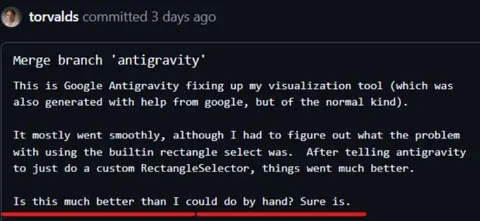
“Is this code much better than anything I could have written by hand? It sure is.”
Even the most progressive minds in software circles could not have imagined that, at the very start of 2026, something like this would be written by Linus Torvalds. The man who, with his own keyboard, wrote the foundations of the operating system that runs on a huge share of the devices around us today. The creator of Linux, but also of Git, yet another concept and platform that is an inseparable part of every software specialist's daily work…
If he admits that AI can write better code than he can… where does that leave the rest of us, who are far from perfect in our software knowledge?
Perhaps the main idea is that the level of abstraction is simply rising. For now, that's certainly the case. Just as modern programming languages let us write readable, understandable code, now comes artificial intelligence, with which we simply need to discuss very carefully what exactly we want to achieve, then let it do its job, and finally check how well it did.
Yes, we're swapping the horse that helped us reach our destination for a car, but we're still the ones driving it.
But are the self-driving cars of our metaphor lurking just around the corner, a few AI models away—the systems that will make our labor redundant?
Programmers, the Optimistic Kind
Online you can run into opinions that all of this is needless hype, that code written by artificial intelligence doesn't save us any time at all—quite the opposite. At the same time, you often hear the other extreme too—that we programmers shouldn't even glance at AI-generated code anymore; it's enough to watch how it runs.
And yet something big is already here, and it has already changed our profession to its foundations. At first we saw AI as an advisor we could ask for help in a chat window when something didn't work as it should. Just as we used to do before, searching for information online. The site Stack Overflow was the programmer's best friend; then ChatGPT and its relatives pushed it aside.
Almost without our noticing, AI moved into the software we use to create software. It started finishing our lines, saving us time, taking the tedious, routine commands off our hands. And then… then came Claude Code, and everyone else decided they would be like it.
Today, in our work, we programmers have an integrated “friend” who does almost everything. Whether it is a friend… is still up to us, but perhaps that's too strong a word for software that optimizes your work so thoroughly that it replaces you.
Still, all you have to do is launch that software, discuss carefully and in depth what you want to achieve, and the magic happens… Just as Linus admits, you see code that is very often so good you feel you couldn't have written it yourself.
Step Away From the Keyboard
I often ask the writers who are my guests how they would feel if they read a generated text so good that they could never have written it themselves. Yes, that moment is probably still far off, but I, and many other programmers, know what it will feel like for them.
We can even stretch the metaphor further. Because with these platforms we get not just a friend but a whole team. If we take the trouble to “put our house in order” at work, we delegate it to a series of AI agents. One sets the task, a second evaluates and improves it, a third carries it out, a fourth checks it… So you don't just have a “writer” better than yourself—you have an entire publishing house.
And, what's even more interesting (the good part or the bad part?), the readers unmistakably benefit from it…
Sounds pretty demotivating, wouldn't you say? Maybe there's no longer much point in learning to drive a car—or whatever the equivalent of that task is in the software field?

A Rock and a Hard Place
Meanwhile, we adapt… as best we can. We learn the new rules, such as so-called context management—choosing what to feed the model for a specific task, and how. By all appearances, it's yet another skill that will soon be completely unnecessary, just as the idea of prompt-writing craftsmanship as practically a profession of its own came and went.
Or maybe we're close to the limit, and AI can't advance any further and keep “pushing” us toward the edge of the flat IT earth? Let me just tell you that last week both OpenAI and Anthropic released their next coding models with even more impressive capabilities. Without even looking things up on the internet, several Claude Code agents running in parallel are already capable of writing an entire C compiler—not long ago not merely a hard task, but one for large teams of the industry's top specialists.
“We see that we are moving from a world in which programmers had a monopoly on software development to a new one, in which they are the specialists, the engineers, the people who handle the difficult tasks and the big projects. But small projects are done by the business side, and medium ones in a business–programmer collaboration. Yes, this is a new concept, and for some it may come as a real shock,” Svetlin Nakov told me on the DEV.BG podcast. It happened in a conversation I recommend to anyone interested in the future of the IT world:

“If AI isn't applicable to a given project, that means the project is so specific, serious or critical that junior and mid-level engineers can't work on it either. Such projects do exist, really. There are also technologies where it isn't good yet, simply because it had nowhere to learn them from. But from now on we'll do everything with AI, except the things we can't. We have to get used to the idea that writing code is a machine's task,” Nakov added.
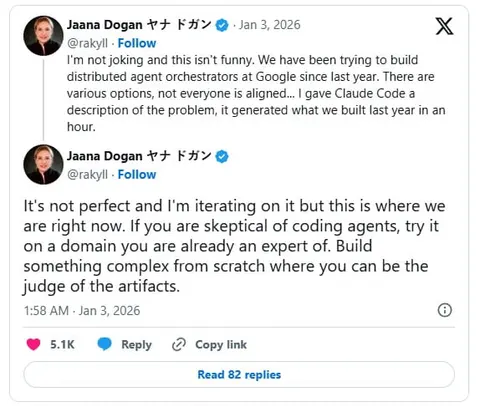
Let me give you a few more examples. Jaana Dogan, who leads the team behind the Gemini API—Google's AI flagship—began one of her posts online like this: “I'm not joking and this isn't funny.”
The Man Who Laughs
I agree, it isn't funny. Because Jaana went on to describe how her team had spent a whole year working on something that AI then recreated in an hour. “We have been trying to build distributed agent orchestrators since last year. There are various options, not everyone is aligned… I gave Claude Code a description of the problem, it generated what we built last year in an hour. It's not perfect and I'm iterating on it, but this is where we are right now. If you are skeptical of coding agents, try them on a domain you are already an expert of. Build something complex from scratch where you can be the judge of the artifacts.”
If it hasn't happened to you yet, I definitely advise you to try it. Just don't blame me for the idea afterward.
As early as mid-2025, Sundar Pichai revealed that well over 30 percent of the code at Google was already being written by AI. Microsoft's chief, Satya Nadella, also mentions around 30 percent.
And Claude Code itself—the platform that made all this possible? One of the lead engineers at Anthropic, its maker, noted that over 80 percent of the code Claude Code runs on was written by… Claude Code itself. The team's leader, Boris Cherny, says he hasn't written a single line of code himself in months.
Dark Thoughts
Of course, there's no reason to put too much trust in him in particular—he's selling his wares, and that gives us no grounds to accuse him of objectivity. Except that the same conclusion is coming from everywhere, and the questions it raises are far more numerous and complex than the simple observation that humans no longer need to write computer code.
How far can we trust AI? Is all this a ticking bomb for the entire IT industry, and for the world that rests on it? How can the change in the whole working process of such a huge number of specialists happen logically, thoughtfully, with as few risks as possible?
How do we teach beginner programmers from now on, when they will have to oversee software written by AI, knowing that every answer is just a keystroke away?
Will humans be needed in the process at all, beyond the role of the one who sets the task?

Game, Set, Match
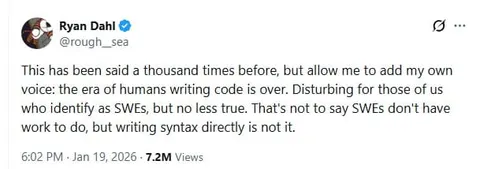
“This has been said a thousand times before, but allow me to add my own voice: the era of humans writing code is over. Disturbing for those of us who identify as SWEs, but no less true. That's not to say SWEs don't have work to do, but writing syntax directly is not it,” wrote Ryan Dahl, the creator of Node.js.
All the quotes in this piece come from opinions published over the past month, and that is no coincidence.
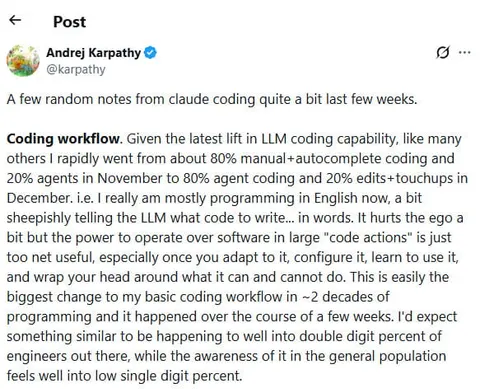
Andrej Karpathy weighed in with a particularly interesting post—one of the founders of OpenAI, a veteran of Tesla, an undisputed scientist and visionary.
In short:
“Given the latest lift in LLM coding capability, like many others I rapidly went from about 80% manual coding and 20% agents in November to 80% agent coding and 20% edits + touchups in December. That is, I really am mostly programming in English now, a bit sheepishly telling the LLM what code to write… in words. It hurts the ego a bit, but the power to operate over software in large ‘code actions’ is just too net useful, especially once you adapt to it, configure it, learn to use it, and wrap your head around what it can and cannot do.”
Handmade Bread
“LLM agent capabilities (Claude & Codex especially) have crossed some kind of threshold of coherence around December 2025 and caused a phase shift in software engineering and closely related fields. 2026 is going to be a high-energy year as the industry metabolizes the new capability.”
By the way, I recommend reading his entire post. It contains both the enthusiasm and the fear of the great change.
From the awe of watching agents tirelessly toil away at a task until they achieve what's asked of them, to the rapid atrophy of your own abilities when you no longer need to do the work yourself.
From the endless time freed from tedious chores, which you can spend on more important decisions in your work.
To the idea that these platforms will widen the gap even further between good engineers and their mediocre colleagues.
At least for as long as they are still needed.
Whoever Doesn't Jump…
It's interesting to live in interesting times.
Before we part, I'll let you in on a secret. Writing computer code is actually a rather pleasant, absorbing, thought-provoking pursuit. Very different from, but not without similarities to, writing an article or a book.
Some time ago, a guest of Digital Stories aptly suggested that the class divide of the future will run between the few who are able to concentrate long enough to write or read a long text, and everyone else.
I believe the same goes for programming.
What lies ahead, hardly anyone can say, but the important questions are approaching at dizzying speed. Just as, almost imperceptibly, while we were debating whether they were even possible and waiting for them, the systems arrived that write code better than we do. Or instead of us.
This is the time for conscious effort. For making sense of things. The time to remind ourselves that it's easy to have it easy. But that effort is worth it, and it makes us not only good specialists. But also good people.
Right, ChatGPT?