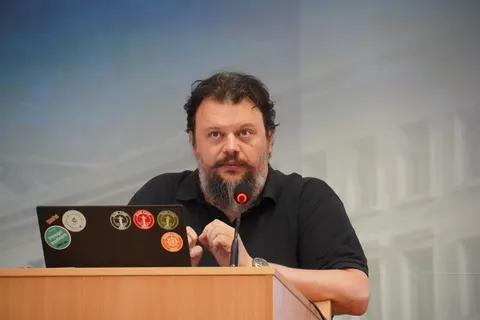
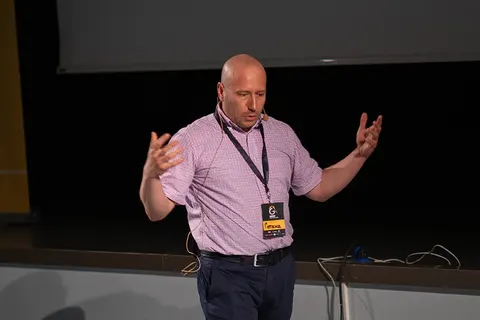
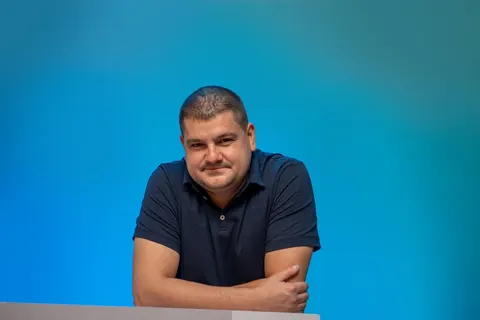
Dobroslav Dimitrov is a co-founder of Imperia Online, the Bulgarian video game company, and chairman of BASSCOM, the Bulgarian Association of Software Companies. When progress in artificial intelligence caught everyone's eye, he stood out for his positions:
- That nothing would be the same after the arrival of ChatGPT and its kin;
- That no area of our lives would be left unshaken to its foundations;
- That this is also our chance, as a country and as a tech sector, to make enormous progress.
A year later his view remains the same, now backed by experience. We talk about the coming social changes and the role of the tech sector, in Bulgaria and abroad, and about the demand for programmers. About the gradual and irreversible advance of artificial intelligence. About the technological divides that confront us with an existential risk, and the other big questions of the day.
“We need to dial down the arrogance. We technocrats, the tech community, have to step into the role of responsible leaders of what is happening, not people profiting from their amber towers. Otherwise this will not end well.”
– You are one of the few tech leaders in Bulgaria who, from the very beginning, when ChatGPT appeared and all the noise started, warned that this changes everything. A year later, I think it is clear you were right.
– Oh, yes! I am actually very proud of the label. I had to live through several months of criticism at the start of the year that I was overestimating what was happening; I had to pay the price for playing the “alarmist.” But I think that by now, at least in our circles, the skepticism is long gone. Most people are fully aware of what is going on and are already using these technologies.
– What are the next interesting things in the world of artificial intelligence that you can't wait to see happen?
– For it to become more user-friendly. I give a lot of lectures around the country, to teachers, managers, lawyers, all sorts of people outside the IT world. With each of them, once you win them over, the next logical question comes: “How do I use all this for my own thing?” That little step is tiny; we are very close to the moment when
artificial intelligence becomes like electricity. None of us knows exactly how it works, except the technicians and engineers, but we know how to use it.
This is the part people familiar with the technology argue with me about most often. It is not a question of whether it is possible; they think the time frame is different, that the big change will come in five to ten years.
The creators of artificial intelligence did not expect us to be where we are now for at least another 30 years. Everyone was surprised, Geoffrey Hinton, the “father” of AI, for example. We cannot predict the exponential nature of this development, and any of us could be badly wrong.
What I imagine will happen, and what I am eagerly waiting for, is for it to become accessible to the point where we don't think about how we use it. That will be an important equalizer, because right now there is a huge disproportion between those who are up to speed with technology and everyone else.
– People at OpenAI are talking more and more about artificial general intelligence; perhaps all the upheaval around Sam Altman has to do with this. Is it already here, are we close, is it even possible?
– For me it is inevitable. I am convinced everyone is trying to achieve it, because whoever succeeds will have a colossal advantage over everyone else. Here you are either first or last. The appeal, that letter signed by so many people in the spring, was aimed more at raising awareness of everything that is happening. Those people know that
this race is currently driving utterly irresponsible behavior.
A flag was raised that nobody is going to back out. Why hadn't Google and the others released their chatbots first? Because they couldn't guarantee safety. When OpenAI showed ChatGPT, they started releasing theirs too, one by one. This technology has not reached the point of being controllable, but there was no way around it, because of the competition.
If we take it one level higher, states can't possibly afford to let one of them gain the upper hand in a field like this. Unfortunately, I mean the US and China; nobody else is really in the race.
Everyone is taking part in this race, whether they admit it or not. There is too much to win and even more to lose. And that is where things come from that, in my view, we as people truly have no idea of—what we are about to create.
It is an interesting philosophical question
how we have charged full steam ahead toward something that could make us… redundant, unnecessary.
– Kurzweil may well turn out to be right. That is exactly how I feel the development too, which is why this site exists. I try to gather more points of view, because we don't talk enough. We run from the problem, which is a typical human instinct, but in this case it could be fatal.
– That is why I have focused on the things within our power. Whether there will be a superintelligence that decides we are superfluous to the planet, I don't know; that is a very deep philosophical question.
But whether there is a danger of human intelligence, wielding this powerful tool, making a whole heap of trouble—that is very real indeed!
The one is completely unknown to us, but the other hasn't budged in 10,000 years. What was the first thing we did back then? Make axes to crack each other's skulls. It is the same with nuclear weapons. Our human nature hasn't budged; we are the same savages roaming the fields 10,000 years ago. That is what should truly worry us and what we should work on.
Society has always had divisions, elites. First it was the stronger, then the richer, but there was always some kind of balance. Whether you are an aristocrat, rich or strong, you need the others. Whether you do it cooperatively or exploit them, there is some kind of conversation between the two groups either way. The problem now is that a new technological elite is being born under conditions of a multiplier. When you multiply someone hundreds of times, there is no way the others can catch up. If we split like that, the second group, the people outside the elite, won't be exploited—there simply won't be any need for them. That can't go on well. An imbalance like that in society cannot possibly end peacefully.
– Sam Altman also says he can imagine hundreds of ways in which artificial general intelligence could destroy society. And we delegate the important decisions to people whose job this isn't. Why should Altman decide what is safe?
– It really matters a great deal what we do as a society. Azeem Azhar describes this phenomenon as the “exponential citizen.” Nobody elected him, nobody delegated to him the right to control public conversation. Ever since Ancient Greece there has been the forum, the square, a public place where neither the king nor the aristocrat has a seat. That is where we people gather and talk freely; it is public space. Suddenly it turns out that
public space is entirely under the control of people who were never delegated such powers.
Nobody chose them to be there, be it Musk or Altman. Think about the whole conversation happening on social media. Twitter banned a sitting US president! Whether you like him or not, 100 million people voted for him. And who are you? That is a serious conversation!
And here, perhaps, we come to our own community.
We need to dial down the arrogance. We technocrats, the tech community, have to step into the role of responsible leaders of what is happening,
not people profiting from their amber towers. Otherwise this will not end well.
– I completely agree. The thing is, even the forums—the media—are gone. And when you see how we talk online, from the position of the final authority who knows everything, it is downright frightening where we are heading. Can we change it?
– We simply have to talk.
– Exactly! That is why this site exists. I think the future depends on this conversation, and I have two kids, so I care what kind of world they will live in. I do it in my own “bubble” as much as I can; I bring many people from our industry into the conversation, but all sorts of others too, from priests to poets. I see many interesting points of view that complement each other in a deeper conversation about where we are going.
– You know the saying that when you have a hammer in your hand, every problem looks like a nail.
Technocrats hold technology in their hands and decide that everything is a matter of a technological solution. Which isn't true.
There is a very serious part connected with human nature that can't be underestimated and has to be taken into account. To solve the problem, we have to take in all points of view.
You can't talk like the final authority just because at this particular moment you hold some illusory power. And it really is illusory. Look, the profile of the programmer is going to change too. All the mathematical thinking that has been crucial until now, the fact that you can talk to the machine directly—that is already transforming. The profile is changing. There will still be a need for people who develop the technology itself, but they are 0.2 percent. The rest will have to learn to talk to people.
– Half-jokingly, I like this development—I can interview people, and I can write code.
– A step ahead! I think we need to draw attention to this. At some point the tech elite will discover that there is such a thing as hard power. Ours is soft power, financial power. But in Bulgaria it matters who can bring the trucks, the tractors and the taxis out in front of parliament. That is hard power, and if you ignore it, you will learn the hard way.
– And yet, even when it comes to artificial intelligence, I still feel that people in our sector split into two extremes: “a marketing trick, an expensive parrot” and “nothing is the same anymore.” I fully share the second position—I even wrote a book to talk about these subjects—and I find it hard to understand that many colleagues think nothing special is happening.
– The denial, as far as artificial intelligence is concerned, is gone. Practical adoption is another matter; that will take more time. Really using it in your everyday life, unleashing its full power. That, unfortunately, still isn't happening.
– How did that process go for you at Imperia Online?
– We pushed it from the start, before OpenAI's chatbot even became available and known as ChatGPT. The conversation began very early and there was more time for adoption. The example being set helps a lot, in this case by co-founder Moni Dochev. He is a programmer, and it is different when the technology leader says something big is happening.
Even so, in May we had to hold a super-practical lecture led by Krasimir Stoev, the lead lecturer at IT Talents and the teacher of many of our programmers, knowing his advice would be well heard and accepted. It is simply a fact that we humans, because of our nature, don't like things changing us;
change is usually frightening, and it is more comfortable to deny it.

– And in which specific applications did it catch on fastest for you? I have witnessed how quickly it became indispensable in programming.
– I'm sure many people use it, but not all of them admit it. There is a certain hate around the subject, and it turns out the people it comes from use it too.
For us it was adopted fastest with images. We have many artists; drawing is a serious part of what we make. We started back in October 2022, before ChatGPT, when the first version of Stable Diffusion came out.
We saw what a monstrous thing had appeared—a multiplier of capabilities.
There was a period of persuasion. I saw real pain in the artists' eyes; they went through the five stages of accepting bad news. They were won over after several months of consistent work with demonstrations, and the program itself was changing fast as well.
Little by little we created workflows: where it makes sense to use it, where human input is important. And when those things started to fit together, adoption began.
The truth is that it is a long process. I'll tell you a funny story. After yet another sleepless night, Moni shows up at the office early in the morning, and we gather the whole company. “There's something I have to say.” He gives examples of what he had programmed overnight with ChatGPT, and a silence fell… Then our lead artist spoke up: “Huh? Huh? See now! It's not just us!”
When the paid version of ChatGPT came out, we told everyone in the company straight away that they had to use it, whatever their position and whatever they did. Our logic was this: it is so new that we can't even begin to map out which activities it could be useful for, and anyone might think of something new and original that hadn't occurred to someone else.
In the spring we did something else revolutionary. We said: “Three years ago we declared a COVID pandemic and went home without knowing how that would work for our business. Now we are declaring an AI pandemic, and everyone has to come together in the office.” So people would be side by side, sharing. Building on each other's ideas—there is no faster way than that when we still didn't know what we had or how to use it.
– And where did the weakest points turn out to be—in the hallucinations? What did it become clear we can't use these technologies for, when it looked like we could? Perhaps for finding a specific answer, for facts?
– The only weakness at the beginning, specifically for technology, was that the data went up to December 2021. But that has changed too.
All the other weaknesses people point to belong more in the column “natural intelligence didn't figure out how to ask it”
or how to adapt its workflow. It can't do the whole job for you, from 0 to 100, the whole project, but if you can break it down into subtasks and delegate, it can do a big part of it. That is also a large part of a programmer's work—to model a problem and break it into subproblems. If you get it straight in your head what you do at work, which processes can be automated and which can't, you can build on that seriously.
Yes, it can't write the code for you, but it can do ten 20-minute tasks in two minutes each and save you a whole working day!
People still miss these micro-savings of time or underestimate them.
We need a new way of using it, working with heightened attention to the fact that it may mislead us. Figuratively speaking, we are dealing with a person with an infinite number of split personalities. And that doesn't come naturally to everyone; we often expect it to work like a search engine.
– Whereas it is a completely different paradigm, and it has no self-assessment to judge when it is doing well. Do you think we still have a chance to use these technologies to develop the sector here?
– Yes! That is why I have embraced it and see it as a mission—to spread knowledge and awareness.
Using AI could drastically change the industry, and with it Bulgaria's economy.
In the global competition, so far we have only minuses: we don't have the financial resources Western countries have, we don't have the numbers of people. Whereas a technology that acts as a colossal multiplier could give us a very big advantage and could offset the other minuses.
We saw what happened with OpenAI—the power right now lies not in money but in talent.
700 people threatened to leave, and the company, valued at $70 billion, turned out to be about to cease to exist.
The power is in people! Much as we would like to, we can't expand our industry and become hundreds of thousands. But if the nearly 60,000 of us in Bulgaria's software industry became ten times more efficient, we would be two thirds of the economy!
That is a very serious opportunity and the only one through which we can truly grow a lot.

– What does it depend on whether we do it? Hardly on the state…
– That is why we have thrived: the state didn't know we existed. But we are very big now and can hardly stay off the radar. According to the new Barometer we presented last week, the software sector, although we are 58,000 people, ranks first by total payroll. Not by average salary—that's not news—but our sector pays over 4 billion in salaries, and there is no way we can be invisible. Another interesting thing is that software accounts for a third of the export of services!
We are not invisible, but we are here precisely because we managed on our own. The state didn't help us, and right now our big struggle is to keep it from getting in our way.
But to make the change happen,
we have to show our proverbial Bulgarian resourcefulness and adaptability.
In that respect we have the advantage of being a young economy: the original managers and entrepreneurs are still in the companies; we are not corporate structures that no longer remember their founders. These are highly adaptable people who have done business in circumstances close to impossible.
Right now we are well positioned.
The key will be the speed at which we can make the change, and our readiness.
At the next level it comes down to individual decisions. As many of us as possible who have realized what is happening need to carry the others along. Otherwise, from “this doesn't concern me” we will one day arrive at “what happened? I seem to be redundant.”
But I think we also need to work a bit on the brand. Because Bulgarian engineers are sought after for their quality; price stopped being decisive long ago. This isn't empty boasting. At international events we often hear that companies come to Bulgaria not for the cost of labor, and even less for the numbers—we don't have those.
They come to solve problems they can't solve anywhere else.
– One of my guests aptly put it that we are a startup country. And an example along those lines is Mira Murati, who says she succeeded because she is Albanian and learned to have it hard.
You mentioned this year's Barometer study, a large-scale analysis of the whole sector. It shows that growth in the sector is slowing; we all see demand falling. Some say the reasons lie in the overall economic situation. But could it be that teams are already more efficient thanks to AI, and fewer people are doing more work?
– It isn't that fast; cause and effect need more time. Yes, some teams are more efficient, but right now that efficiency is largely being spent on free time; it hasn't yet carried over to the business. It is a fact that some people may be working several jobs, because the requirements haven't changed yet. The companies themselves haven't realized that people can be three times more efficient. Someone can get the work done in two hours, but instead of going to the gym, they prefer to spend the next six hours at two more jobs and earn three salaries. That is the American approach; our version, unfortunately, is rather the opposite. We'll “invest” those six hours in watching clips or TV series. In the short term it's probably fun, but in the long term it erodes your skills.
In our profession, if you stop investing in yourself, you fall behind.
If you do it for two hours and the American does it for eight, a year later it will turn out that you are the redundant one. But that hasn't happened yet.
Right now something is happening, and people haven't grasped how quickly it will affect us. Last year the giants laid off hundreds of thousands of people. Those people didn't really end up unemployed, because there weren't enough specialists anyway. Suddenly you have 200,000 people who have started filling the vacant positions at other companies locally, and many of them have started their own businesses.
If before, because of the huge shortage, they looked for developers on the other side of the world, now they don't have to.
On top of that, last year there was a sudden hunger for IT specialists because of the war in Ukraine. Between 400,000 and 500,000 people dropped out of the global labor market in our field, because Russia, Ukraine and Belarus all have strong traditions and many specialists. Now, though, most of those people are back at work.
And then there is the economic crisis, which is obvious to everyone except our politicians. The five leading economies in Europe are entering recession, and we tell ourselves we will grow by 4 percent next year. Well, I envy the optimism…
So many factors pile up. All crises come and go, and this one will too. The problem is that
when it passes, the critical window for adopting these enormous technological changes will have passed as well.
And it may turn out that the new jobs never appear.
– And perhaps we are more vulnerable because outsourcing accounts for a huge share of the people working in the sector. Shouldn't we work toward having more product companies, more startups?
– Yes and no. Pure outsourcing hardly exists in Bulgaria anymore. Most outsourcing companies are hybrid: precisely because they are vulnerable, they invest a lot in developing their own solutions while working for their clients. We don't depend all that much on pure outsourcing; it is on its way out.
We stopped being able to compete on price long ago. The only way we can keep doing business is added value.
It is a kind of evolution. Outsourcing gave us the chance to develop product companies, because it brought in many of the working methods that are now the industry standard. Everyone envies product companies like Imperia Online. Yes, in outsourcing the profits are much smaller, but so is the risk. The client pays for the risk. Whereas you can make the most wonderful product in the world and the market may not appreciate it.
This crisis even pleases me a little. I hope it awakens the entrepreneurial spirit in people; the alternative is just comfortably drifting with the current…