The story of two brothers and a black swan sounds like a fairy tale. And it is a fairy tale, only from the digital age. In a somehow very Bulgarian way, it begins with a conversation about how to send a tin of sirene, Bulgaria’s white brined cheese, abroad… and today it is perhaps the most promising and original Bulgarian startup, one that carries within it the enormous potential to change the entire industry of moving goods.
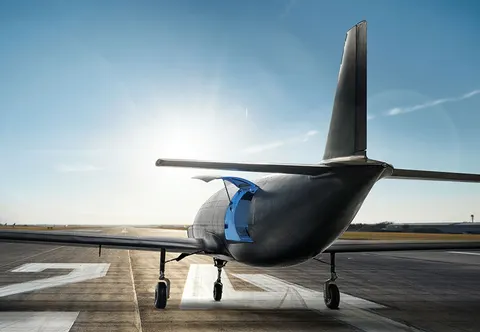
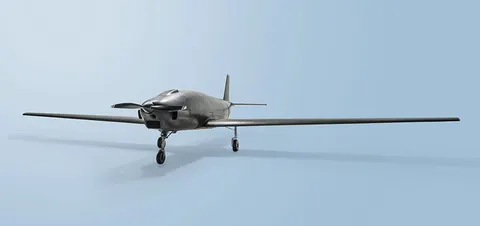
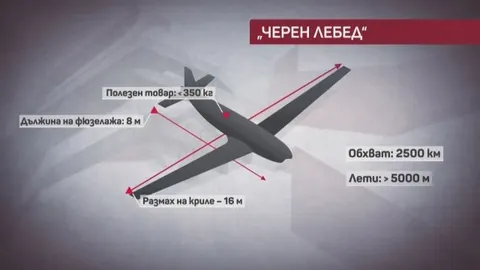
The two brothers are years ahead of rivals like Amazon and DHL, and before the end of 2022 their prototype drone, the “Black Swan,” is expected to take off on its first commercial flight. In less than eight years they have proven they have what it takes to build a new generation of aircraft, one that could form the world’s new transport system. The drone carries 350 kilograms of cargo over 2,500 kilometers at almost 200 km/h, with a fuel consumption of… under 7 liters per 100 kilometers.
The startup Dronamics has won serious funding and the partnership of giants like DHL, and since this year it has held the first license in history for a drone to fly cargo.
“A flying banicharka,” Svilen Rangelov calls it—after the humble corner shop that sells banitsa, Bulgaria’s everyday cheese pastry. The story is as digital and as global as it is typically Bulgarian. Svilen and Konstantin studied finance and aircraft engineering at prestigious universities.
Dronamics is one of the most exciting and hope-filled ventures in Bulgaria today. We meet Svilen to hear the colorful story so far. How does a project started in Bulgaria lead Amazon by several years? What will the incredible future of the transport industry look like if the Black Swan successfully flies through the last steps of its long road to success? And why haven’t the two brothers shaved for eight years—and why is it worth all of us keeping our fingers crossed to finally see them without beards?
Fasten your seatbelts! We’re taking off!
– I read a wonderfully fresh story—that the idea for Dronamics was born while your brother was studying in the Netherlands. And you wondered… how to send him a tin of cheese. Is that really how it happened?
– That’s exactly how it was. I was visiting him and we were talking about the little drones Amazon was developing—how on earth would they reach homes in Sofia, past dangling internet cables, neighbors who open your mail, kids with slingshots, glassed-in balconies. A few months later we spoke on the phone and he asked me: “When are you coming to visit again, so you can bring me more cheese?” I couldn’t be bothered, so I cut him off the way an older brother cuts off a younger one: “Leave me alone.
You’re an engineer, aren’t you? Build a drone and I’ll send you some.
But don’t bug me, I won’t be coming anytime soon.”
Then we started thinking: “Okay, fine, Bulgaria is close to the Netherlands, but you’d need something that flies and can last around 2,000 kilometers. So it has to be a bit bigger. It definitely can’t run on batteries; it needs some kind of normal fuel.”
Around the same time I had just come back from a trip to India. My smartphone broke and I asked my hosts to help. They recommended a website—Flipkart, similar to Amazon but local. There are no addresses there, just a field for “nearby landmark,” and I had to pick a school that probably had 10,000 children. For one more dollar, delivery was next day. The guy came, sent a text message five minutes early and somehow found us. I was very impressed and told myself: yes, those little Amazon drones won’t work in Bulgaria, but they won’t work in India either. There, even the big brands need 11 days to get from one end of the country to the other. A different kind of delivery makes much more sense.
– Which is what Dronamics actually goes on to offer… When did things get serious?
– When the idea was born, we first discussed it with some of my brother’s professors—whether, if we built a machine the size of a two-seater plane, but without a cockpit and a whole bunch of parts that aren’t needed for cargo, it would be cheaper to produce. Was all of this achievable?
They encouraged us, and meanwhile I dug into the economics. I came across plenty of data on how urbanization is bleeding smaller towns dry. One World Bank study made a particular impression on me: if a developing country improves the state of its transport infrastructure, that has a bigger positive effect on its economy than any other measure or policy.
In other words, all those ideas—privatize, cut taxes—nothing has an effect like simply unclogging the arteries so that blood reaches even the smallest organ and it doesn’t wither. That encouraged us even more, because
the truth, when it comes to moving goods, is not inside the city,
where you have lots of couriers and a hunger for jobs; the problem that needs solving lies between cities.
– Today it’s believed that all your big competitors are years behind you. How did you end up in such a strong position? How come you have a stronger product than Amazon? Is it only because they headed in the wrong direction?
– Nationality played a big role.
If we’d been Americans from Stanford, we’d not only have raised much more funding, we’d also have had much more competition.
Aviation is a terribly hard business. A program for a new machine in this class can take as long as ten years. Certification for passenger transport is brutal, and for cargo there wasn’t even a regulatory framework.
At some point all the big companies took wrong turns. They thought the last mile of delivery was the most expensive and that it was important to develop that. A bit like with autonomous cars. Nobody says anymore that they’ll be here next year; people talk about five to ten years.
In aviation it’s supposedly simpler, you have lots of space. But when you’re small and take off vertically, you don’t have much thrust. Besides, if you’re in an urban environment, you have obstacles of every kind. Electricity and batteries haven’t grown much at all in capacity, and their supply chain is very unstable.
A while ago we announced a partnership with DHL. Two months later they shut down their own small-drone project—they had worked with universities in Germany and gone through four generations. An example of an organization that said: “This is a super-complicated problem, we can’t solve it, let’s look at something else.” Whereas the other big organization, Amazon, decided that it was a super-complicated problem but that until it succeeded it wouldn’t try anything else.
– So the competition has no way of catching up with you soon?
– There will certainly be competition. That’s why our ambition is to position ourselves as a logistics company, so that if someone does catch up with us technologically in the future, we can buy their machines too. But until that moment comes, we’ll put every resource we have into extending our lead.
Cargo is the most thankless industry imaginable, because it’s the most price-sensitive, and new technologies are by definition more expensive. That’s why it makes more financial sense for everyone to balance the value by building “passenger flying cars” and then ripping out the seats to put cargo in, rather than saying, like us: this aircraft is only for cargo, and that’s all we’ll build it for.
As the saying goes,
do today what others won’t, so that tomorrow you can do what others can’t.
That’s what we decided too: we can see this is the future, we’re hugely confident in it, and we don’t care about the others. And we found ourselves in the position of first player in the sector. Now the goal is to stay first.
– What are the next big steps?
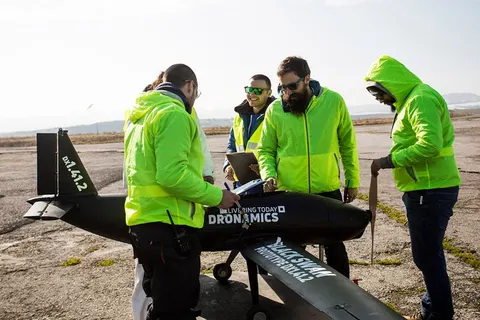
– Our program of ground and flight tests continues, and once those are finished we’ll be able to start commercial operations. We’ve already announced manufacturing partners in Australia, we’re about to announce some in Europe, and we’re in negotiations with several more regions. We’re producing the first units in Bulgaria, but the idea is for other companies to manufacture locally while we are their sole operator. To grow from here as a logistics company and an airline.
The most important thing was to have a working prototype, because aviation is a very hard business with very thin margins. I think it was Richard Branson who said:
The easiest way to become a millionaire is to be a billionaire and own an airline.
– What are the biggest risks that things won’t work out from here on?
– The more we work, the more the risks shrink. The initial risk with startups is the team. We’ve managed to build a very solid team of 150 people, about 100 of whom are in Bulgaria. The product risk—whether the idea works at all—will very soon fall away; we’re very confident of that, because we’ve already been through a whole bunch of tests. There’s regulatory risk, which has already been resolved: for three months now we’ve had a license to operate in Europe.
Next comes market risk—whether the market wants the product at all. Right now we’re at the stage of collecting orders. Our customer buys a certain tonnage at a certain frequency on a certain route. And even with current pricing, which will improve significantly,
there’s far more demand than we can supply, which is why we need as many manufacturing partners as possible.
What mainly remains is operational risk, which arrives once commercial operations begin. Making sure we hit the targets we’ve set for flights.
– Is the idea to have regular flights, or dynamic ones only when a particular shipment is needed?
– We’ll start with regular flights at first. Otherwise a customer would have to buy a whole flight even to send 2 kilograms from Sofia to Varna. So we’re starting with a schedule, and in a year or two we’ll also be able to do more flights on demand.
– If everything goes as expected, isn’t there a risk of “overloading” the sky? Of starting to cause problems for civil aviation too?
– We don’t think so. People constantly say the skies are very crowded. Even before COVID, when aviation froze completely, there were about 100,000 flights a day around the world. And there are 2 billion cars on Earth! Even if just 10 percent of them travel every day, that’s 200 million cars moving on just one plane, and only along tiny little “hairs” of it—the roads.
Yes, they’re slower, moving at 80 km/h rather than 800, but the difference with the air, where you have countless planes, remains huge. One of the problems today is specific points—at a mega-airport like Atlanta, for example, you need slots. The other thing is that air traffic control isn’t automated; you always need a human in the loop.
Of all those 100,000 flights, more than 80 percent are commercial aviation, which flies mostly above 10,000 meters. A two-seater Cessna “climbs” no higher than 3,000 meters; above that you need oxygen. While we fly at most up to 7,000 meters, so we operate in one huge empty space.
On top of that, our business model is to land at smaller airports—in Haskovo, Targovishte, Burgas, Varna. If our destination is Frankfurt, we’ll land at some small airport there, not the international one. There’s lots and lots of room for more machines in the sky. As long as everything is automated, you can guarantee that reactions will be very fast.
– One operator will be able to control 12 “black swans” at once. How is that possible?
– Before we even started, we did careful research on this. It turned out that in the military sphere—at that point the only place with large drones—one operator can monitor and control up to 15 machines at once. And that’s in a military context, when they have to constantly watch what’s happening. Whereas in the cargo world you’re traveling from Sofia to Varna, you’ve set the coordinates. Everything is deterministic, you can program it and step in only if there’s some exception, if something out of the ordinary happens. So we’re only starting at 1:1, we’ll move on to 1:12, and later one operator will be able to control many more.
– Your drone is called the “Black Swan.” Isn’t a black swan something many people associate with something negative? A sudden event that changes things, but not in a particularly good direction…
– Yes, during the global financial crisis of 2008 there was a lot of talk about The Black Swan, Taleb’s book. But our inspiration came from elsewhere. In the Middle Ages it was something like the Bulgarian “when the wooden clogs bloom”—a way of saying something doesn’t exist, like “when pigs fly.”
Then, around 1700, sailors discovered black swans in New Zealand, and the meaning of the phrase in Western Europe changed.
Something everyone thinks is impossible turns out to exist.
We knew we were starting such a project from Bulgaria, where no aircraft had been built for 70 years, where there were no trained people and no established supply chain. That it would be very, very hard. We knew what an American startup would do—first put an autopilot on an existing plane to validate the model. But we saw that this had already been done back in 2010. It clearly doesn’t work, because you’re using very expensive machines built for people, not cargo—small, cramped, with high maintenance costs.
And we told ourselves: so we need to skate not to where the puck is now, but to where it will be later.
Our aircraft has to be cheap to build and cheap to operate,
just one of the two isn’t enough. We named it that to remind ourselves that what we’re doing is actually super hard. So the engineers wouldn’t despair on the tough days.
Today our aircraft burns under 7 liters of fuel per 100 kilometers, carries 350 kilograms on board and flies at almost 200 kilometers an hour. A “flying banicharka.” But we’re also lucky that the technologies we use couldn’t have been created until about ten years ago. Neither in terms of computing power nor materials. So we’re the first company in the world to take advantage of the most modern things in the industry.
– Usually, with startups, everything ends in an exit—either a sale or going public. What would make you sell the company?
– It’s hard for me to imagine such a scenario. We simply want to do this. Being bought isn’t the optimal plan; we’re more likely to list on an exchange, most probably in the U.S., since that’s the most dynamic market and the one with the highest valuations. The idea is for that to happen in three to five years, with my brother and me continuing to run the company. We’ve put in so much time, desire, energy and work—I don’t think there’s anything else at all we’d want to do.
– Is it hard for two brothers to work together?
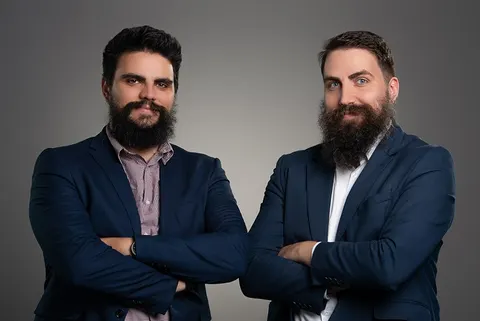
– For us it’s useful. Our families are different, but we’re very, very close, we grew up together. We trust each other completely, and on the other hand—an incredible bonus in any partnership—our areas of expertise complement each other. From the very beginning we’ve had a well-established respect for each other’s field.
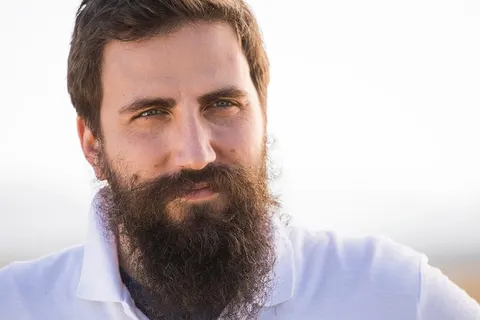
– You told each other you wouldn’t shave until your venture succeeded, since beards really annoy you and that would give you extra motivation. But what’s the criterion for success—when will you shave?
– When the big aircraft lands successfully for the first time. So we expect to shave before the end of the year. I can’t wait—this month marks eight years with beards…
– I hear your next idea is to look toward space…
– We’re building a business that is generative. Surely, if we manage to pull this off in such a hard sector, other horizons will open up too. Humanity will always want more, faster, farther, so space really is the next goal.
– I wish with all my heart that things turn out the way you imagine them, and I’d be glad to do another interview just about space.
And you yourself… what do you dream of?
– That in 2100, when they rank the most significant companies, we’re number one. The one that contributed the most with something positive. Not Tesla, not Apple, but us. Companies lasting a long time is not a given at all… but dreams have to be ambitious!