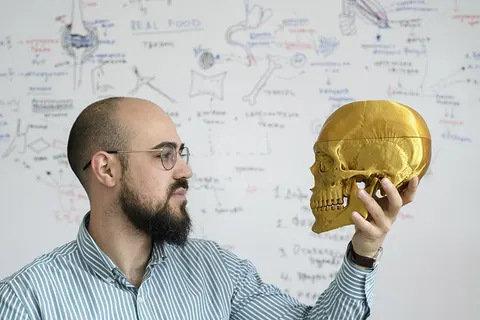
“The world of startups is a roller coaster,” says our guest today. He has spent 15 years working with startups in the software world, and his latest venture has achieved impressive success in just three years.
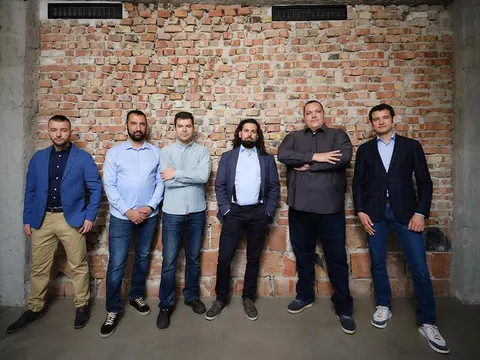
Orlin Radev is the CEO of AMPECO. He founded the company with five like-minded partners; today it has 60 employees, and by the end of the year alone that number will double.
The company has quickly proven itself on a global scale in what it does: the full range of software that owners and operators of electric vehicle charging stations need. AMPECO has swiftly settled among the biggest players in this niche worldwide and is expected to reach the top spot soon. Today its products are used on six continents, the company leads the market in the United Kingdom, and it is taking a serious look at the American market.
How do you build a world-class venture so quickly? Will electric cars soon go mainstream? What unconventional decisions do startups make in order to succeed? Is Bulgaria a good place for building a startup? We meet exactly the right person to answer these questions about this exciting side of the software Digital Stories.
– As someone with serious experience in this field, how do you see the startup environment in Bulgaria? Is our country a good place for ambitious ventures like yours?
– If I had to put it in one word: yes, it's a good place. The good thing is that here, on the whole,
there is an attitude toward entrepreneurship, there is that kind of spirit.
It's very easy to set up a company, and the bureaucracy at the start is relatively light. There are good funding opportunities to match companies' needs and their stage of development. If you have a good idea, you get a real chance to get started.
There is talent, even though many people believe there are no people. That isn't true. There are people—we simply want more than we have. At the same time, the talent is there.
From there on, some things aren't especially easy. The legal framework isn't good enough when it comes to startups. You can't do things like stock options or different shareholder rights. These aren't big obstacles while you're at the idea stage, but when you have to build an organization, a business, and make it grow, at some point they force you to register a company somewhere else. As a concept, that has always annoyed me a great deal, but right now AMPECO's parent company is registered in the US, even though we don't have a single person there and we are an entirely Bulgarian company.
– I'm surprised by what you say, that there are actually enough skilled people. Everyone in the software industry complains that there aren't enough…
– There are never enough people anywhere. We talk to a lot of colleagues; if you ask a German startup, they'll tell you the same thing. Nowhere are there enough people in the IT sector. There's nothing specific to Bulgaria about it.
– How did you end up in this niche? I read that the idea was born after you tried to drive an electric car from Germany to Bulgaria and ran into enormous difficulties…
– To tell the truth, the trip was part of our research into the current state of the charging infrastructure and the problems facing people who buy an electric car.
We believe that one day we will all switch to electric cars. So we did this experiment to experience the difficulties firsthand before rolling up our sleeves to solve them. We gathered quite valuable firsthand experience, but we combined it with serious research into the problems in this field and into how we could solve them in a way that would let us do something truly meaningful.
– The answer turned out to be that there was no comprehensive infrastructure bringing together the management of charging stations. Is that right?
– The answer turned out to be that the cars and
the technology are very advanced and ready for the transition, but the infrastructure is not
ready for charging. Literally wherever you touch it, there's room for improvement. From how to find a charging station to how to use it. Whether there's any information at all about whether it's free, what power you can charge at, how you'll pay. We ran into all of these problems. From stations that didn't work, to ones that were occupied, to stations we simply didn't know how to activate.
At first we convinced ourselves that if there were so many problems to solve, there must also be great opportunities. We'd roll up our sleeves and solve them all. Our enthusiasm, of course, far outstripped our initial capabilities, and we had to focus on exactly what we could offer, so that our contribution would be significant but also achievable.
That's how we found our thing: building software that enables operators to solve their customers' problems in the best possible way. Software that lets them avoid all the inconveniences we ran into as users.
– Who are the operators, most often?
– In some markets, electric mobility is still not very developed, consumers are skeptical, and the vast majority of new cars aren't electric. There, the operators of public charging infrastructure appear first, and they build fast charging stations. The biggest prejudice today, which is no longer really justified, is: I'll buy an electric car and there'll be nowhere to charge it. When I head to the seaside, I'll have
to call roadside assistance, because nobody can pour me a jerrycan of electricity.
That worry disappears with the arrival of fast charging stations for intercity travel.
In markets where electric cars are becoming more mainstream, most charging stations are in places where cars sit parked: at work, at home, in the garage, outside the hotel. These are slow charging stations, and this infrastructure appears after the electric cars.
In Bulgaria, the first operator was Eldrive, and they started with public stations. We can expect that in the future, as more and more electric cars arrive, we'll see more and more operators focused on slow charging.
– Which is a good thing, because then the price drops dramatically too. I read that in England, with your app, people can track prices, and since the system sometimes has a surplus of electricity, prices can even be negative. People get paid to charge their electric car…
– Here's another myth with no basis. Electric cars are often seen as a big danger to the power grid, and we worry about what will happen when everyone plugs in their cars to charge. Will there be enough electricity, will fuses start blowing and transformers exploding.
The truth is that electric cars are a resource that can be used to balance and optimize the grid. With the right technologies to make that possible, of course. Part of what we do is precisely about managing power and balancing the grid. So in the end, electric cars will have a positive effect.
– Right now things look pretty rosy for you: you're growing very fast in a niche that is expanding at a dizzying pace worldwide…
– Every startup is a roller coaster. You climb up and then
you plunge down sharply. So that you can appreciate the next climb.
Yes, right now we're going up, and I hope we'll keep going before the next drop comes. But if we look at the bigger picture, things are developing extremely positively. The growth of the sector contributes to that too—it's developing very fast. That tailwind matters, but the fact is that we're growing faster than the sector.
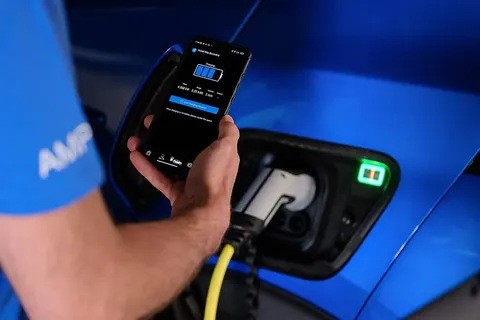
– What does it look like when you feel you've started plunging down that roller coaster?
– For us, the start of the COVID crisis coincided with the moment our initial funding ran out. We had started with enough financial resources to get us to the point of having our first customers and raising the next round of money to keep going.
The arrival of the first lockdown in 2020 thwarted our plans. We made a tough decision: to act as we would have if we'd had more substantial funding. If it hadn't worked out, it would have sharply cut short the company's life.
We managed to get over that unpleasant moment. Of course, for many other sectors it was even harder, but our customers literally couldn't go out and install stations. It was hard for them to make decisions about software and platforms while their business wasn't running. Even so, we managed to convince them, get them to sign contracts, help us, and move forward.
– I imagine the sector will grow even faster because of the war. Because of the energy transformations the Western world is being forced into.
– It's hard to predict the war's impact in this respect. Many of the things happening today, had they happened five years earlier, would have severely slowed the development of electric mobility. The supply chains disrupted by COVID, the shortage of chips, of batteries. We'd had a steady trend of falling battery prices, and last year, for the first time, they started going up.
And yet the share of new electric cars keeps growing, and this transformation is happening despite things that not long ago would have been catastrophic.
The wheel has turned. There's no doubt that the future of mobility is electric.
– When do you think this trend will reach Bulgaria?
– Here the market is still heavily dominated by second-hand cars. That means we have to look at which car models between five and ten years old are bought most widely. Unfortunately, five years ago there wasn't much choice of electric cars. So things are happening with a delay, but I don't think it will be any longer than the usual dynamics of our market.
We're certainly moving much faster when it comes to infrastructure.
The ratio of charging stations to electric cars is one of the best in Europe.
That shows business initiative, since in Bulgaria it's mainly private companies that are building the charging infrastructure. The exceptions are Varna, the largest city on Bulgaria's Black Sea coast, and a handful of other municipalities that have one or two stations each. The main initiative is private, and it shows that this is the future—and that it isn't coming in ten years, but much sooner.
– Do you have direct competitors globally?
– Even when we started, there were several companies building a very serious product we had to compete with. Lately I've been thinking that if I'd known everything I know now, we wouldn't have been so bold. But in my view, every startup needs a certain dose of naivety.
So that you can be bold enough to stand up to what would otherwise be unequal competition. Which, in fact, is never quite so unequal. There are objective reasons why
a new company can develop faster, be more agile, and so be able to beat giants.
We didn't start out swimming in a blue ocean, as the saying goes, where we're the only fish—quite the opposite. From the very beginning we landed in a highly competitive environment, but at this stage I'd say we're the company with the most suitable product.
And if we're not yet the biggest company offering this kind of solution, it's only a matter of another year or two.
– I read that many of the technical decisions you make have no equivalent anywhere, simply because nobody has faced a similar problem before. There are obviously competitors, but little know-how. Is that really so?
– The know-how really is scarce, and having competitors doesn't help much. In many other fields, of course, you copy good ideas and build on them—many startups do exactly that. We, however, had nothing to borrow, and maybe that helped us avoid quite a few mistakes. But it's a challenge we overcame through a great many meetings before we started.
There was a big dose of experimentation and trial and error, but also a lot of research. Thanks to that, we now have the largest concentration of expertise in electric mobility in Eastern Europe. We have to be at the heart of everything, in many markets, across a wide variety of businesses. We have to be able to give everyone the strongest weapon, so they can fight for the leading position in their own market.
– On the software side, I was really struck by your model, in which you have no QA engineers—specialists who test the software—and no hierarchy with team leads. Based on my own experience, that sounds adventurous.
– It is adventurous, I admit. Each of these things is subject to change, because I believe there's a right organization for the right moment, for the specific stage of development. We've experimented this way, it has worked for us, but we'll probably change it one day.
That's at the heart of every fast-innovating, fast-changing company: experiment quickly, apply and change, and don't set anything in concrete. Having no QA specialists doesn't mean having no tests; it's mainly driven by our strong desire for programmers to be responsible for the quality of what they build and for having enough automated tests.
– What motivates programmers to work hard in this setup?
– I can't speak for them. My role has always been more about creating an environment where people feel good, can be creative, and can do their job. I think what we do matters a great deal. There aren't many companies in Bulgaria where you can work on something connected with electric mobility, and do it at a high level, with global reach and influence.
On the other hand, I think we work well both in purely technical and in organizational terms. The right attitude, the right intentions, and having things well organized have been there from the very beginning, and I think that's quite an important factor.
Part of our motivation is to develop not only the product, but also the organization and the people in it.
At some point our company will come to an end—it will go public or merge into a bigger one. For me it would be wonderful if, by then, it had constantly been producing people who are experts in what they do, but also in the sector as a whole. People who have seen the best practices, who have learned and grown, who have had the chance to experiment and give their best.
And who become the next stars of the other startups they'll go on to build.
– You said your top priority is creating a good working environment. What's the most important thing for having one?
– There's hardly a single most important factor. I've always believed that a person needs a certain freedom in what they do. And also to believe that it matters. If it doesn't, nobody would want to do it in the long run, whatever the temporary reward—high pay, good status or something else.
If what you do doesn't bring you meaning and purpose, sooner or later you lose your motivation.