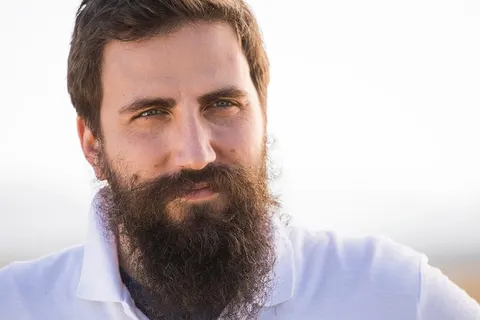
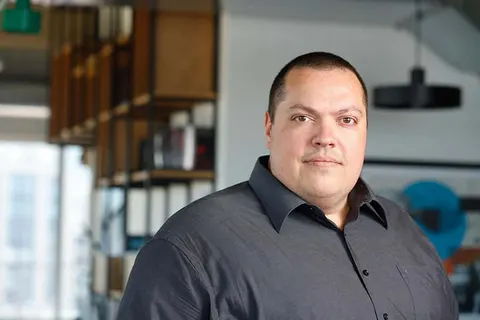
How far off is the 3D printing of more complex human organs? Will we one day manage to replicate the structure and functions of the brain? What comes after that? Is technology changing us as a species, and what do the next steps in evolution look like?
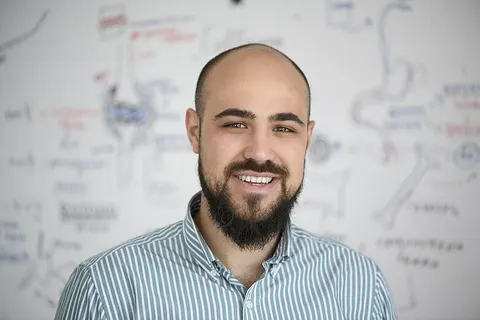
Dr. Vanyo Vezirov’s story is as colorful as the man himself. Driven by curiosity since childhood, he graduated from a mathematics high school and, for unusual reasons we will get to, turned to medicine. Before he had even finished his second year, he and a friend founded a startup focused on bioprinting—the three-dimensional printing of living structures. Later he stepped away from the venture to pursue one of his own.
His new big idea is called Oscar—a 3D-printed human skull that could solve an important problem in the training of future doctors. Meanwhile, Dr. Vezirov also prints… personalized bow ties.
A young entrepreneur, a doctor, a science communicator, a man with a broad worldview and an unexpected take on the world: we meet Dr. Vezirov to talk about the big questions of medicine and the big answers each of us is looking for today. About fear, and about the decisions we should make not with our brains, but with our hearts…
– I recently came across an article from about ten years ago that said 3D printing would be everywhere: we would be building houses, printing human organs and transplanting them. Why hasn’t that happened yet?
– I think it is happening, but I don’t see it as a single stage. It’s a process that began long ago with the invention of 3D printers, and it’s still going.
Houses are already being printed—there are huge machines that lay down fast-drying cement layer by layer.
The technology is used in engineering and in biotechnology. The first bladders and the first ureters have been made; there are already an iris and a cornea. All of this is happening! Maybe not at the pace we’d like, but sometimes the challenges simply turn out to be bigger than the dreams.
– Which achievements in this field impress you?
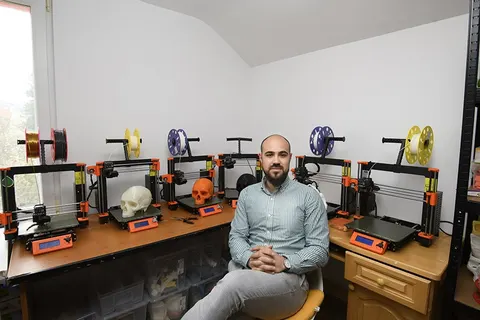
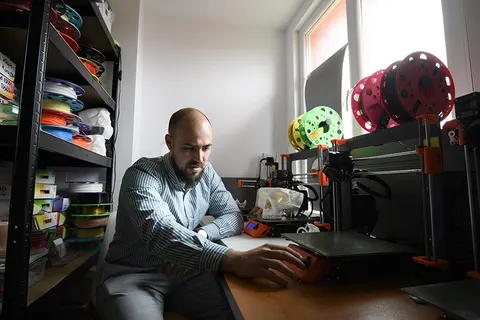
– What impresses me about 3D printing is the incredible flexibility. It inspires me enormously—you can create anything, from car parts to all sorts of everyday knickknacks. Instead of buying a fridge magnet, I print one at home, and at a much higher quality.
I’m impressed by the limitless possibilities and the repeatability—with a printer like that you can make 10 identical things at once, which multiplies what you can do. You can change your business overnight. You don’t have a factory that makes one specific thing; you have the freedom to change.
When COVID came, for example, I switched to face shields. I started making them right away, and thanks to that I was able to keep supporting myself as an entrepreneur.
– Today you mainly work on anatomical models made with 3D printing. The idea came to you when you were a medical student.
– That’s right. I don’t like getting up early, and by the time I got to the university I had no chance of getting hold of the specimens, as we call them. The bones you study anatomy on.
On top of that, the bones in use are decades old. You pick up a skull and it’s chipped all over, because it has been handled for so long. Half its structures are simply gone. A student takes it, the teaching assistant comes over and says: “Imagine this structure here, and that one there…”
Am I studying medicine, or am I at art school, that I have to imagine things?
The university’s specimens are becoming less and less usable, which creates serious problems in teaching. That’s when it occurred to me that 3D printing could produce extremely accurate models for students to learn from. Then I did some research, found out the problem is far from just a Bulgarian one, and decided this was a pretty good opportunity.
– You named your prototype Oscar. What lies ahead for it?
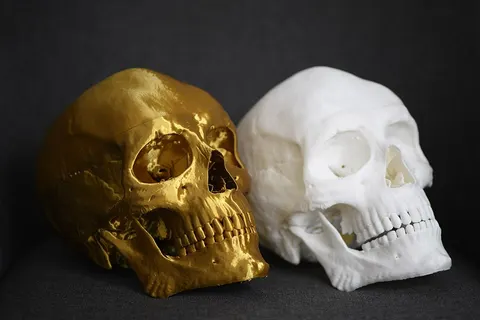
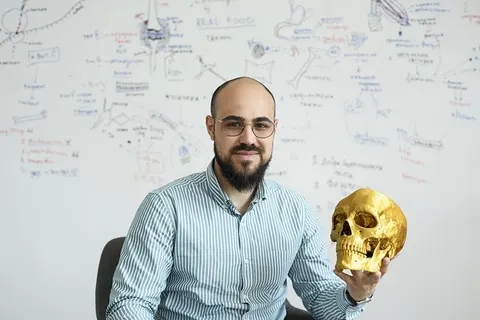
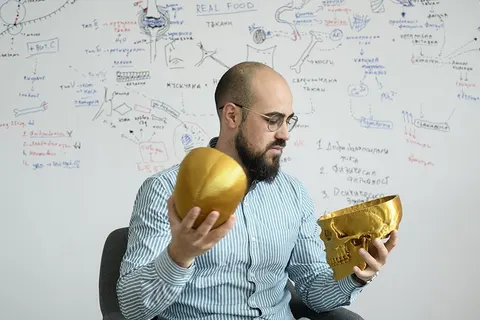
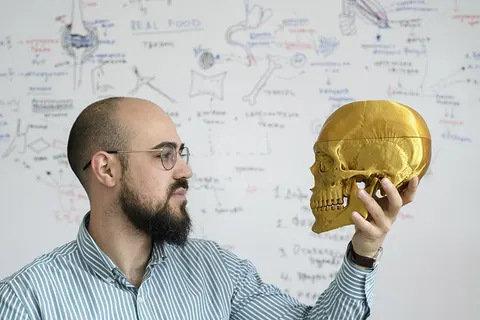
– I want Oscar to become the most popular model of a human skull in the whole world. It’s better than all the other prototypes because it’s a 100 percent anatomically accurate copy—you can observe more than 400 structures on it. Its precision is under 1 mm; I’m the first to have made it that accurate. Most people underestimated it as a business, but I think it’s an incredible opportunity.
There’s also an augmented reality app that goes with it. I can show the structures right on the skull itself, so the student can examine them.
What sets the approach apart is the scanning itself, and then printing at a very fine resolution—0.2 millimeters. And, of course, the marketing. Because when you create a good enough product, it can be copied. The next question is who will sell it better. When all of these come together, you get a complete, innovative approach to creating this kind of biotech product.
– How many Oscars does the world need?
– In Europe alone there are 520 universities, with more than 700,000 students starting medical school every year. I work on the project with love, and I know it will succeed.
Oscar is already used at 5 universities—3 in Bulgaria and 2 in Romania—and this summer I plan to make that ten times as many.
It’s made of polylactic acid, a starch-based polymer, the most standard material in 3D printing. The innovation here isn’t in the technology itself but in the model it uses. Anyone can print a skull, but not everyone can print one like Oscar, because nobody else has such a precise model.
It’s a copy of a specific human skull, but I decided to name it this way because of the wordplay—os is Latin for “bone,” and the name is popular and easy to remember. And if it’s painted gold, it becomes a “Golden Oscar”…
– Before that you worked on bioprinting. Progress there seems slower. What’s harder—replicating the structure or the building material?
– The hardest thing is printing the blood vessels that feed the tissue, which is why only small prototypes are being printed at the moment. To make them bigger, you need 3D-printed blood vessels. The difficulty lies in printing the endothelial cells that make them up, because they are very sensitive and the procedure is complicated. NASA announced a $1 million competition for the person or team that creates the first printed blood vessel, because they believe it will be a big step toward taking humanity to another planet.
– Will we one day be able to print brain cells, or a whole brain?
– Yes, definitely! There’s a great book, The Terminal Experiment, in which the author writes about copying human consciousness into digital form. In other words, we will be able to print brain cells, but so what? What’s interesting about them isn’t the cell itself, but the connections they form with each other through synapses.
With brain tissue, the value lies in the psyche. That’s where its expression and its function are. Anatomically speaking, it isn’t like printing a blood vessel. Blood vessels have a clear function—a tube that “delivers” blood from one place to another. Brain cells are very different.
It will be possible, but the question is: what good will it do?
– Transferring our consciousness, for instance? That would certainly change how we see ourselves, and death… Except we still don’t understand exactly how the brain works.
– Logically speaking, the whole psyche, all of thinking, is just neural circuits—a complex of cells communicating with each other to give birth to a thought. If we could take cells and print them into a damaged area so that its function is restored, that would be interesting. But it’s still far too complicated.
Everything will be printable one day. The questions are when, and what the point will be.
– What are the next steps in this field that you can’t wait to see taken?
– The organs that can most effectively solve the problems of tissue rejection in chronic diseases. The kidney—more people suffer from chronic kidney disease than anything else. Then liver cirrhosis, which affects a large part of the population.
We can divide organs into three levels of complexity. The first are flat organs—that’s skin, and it’s no coincidence that the first successes were with skin. The next level is hollow organs, a closed surface—the stomach, the bladder, a blood vessel. The third level of complexity is the so-called parenchymal organs, which have a more intricate structure.
I can’t wait to see the first people with a transplanted 3D-printed kidney, heart and liver, and that will certainly happen within 10 to 15 years.
But the brain… that will raise a lot of ethical questions. If we print a brain, some neurons that start communicating with each other, that means consciousness, a new person.
Big dreams and big goals are the strongest incentive for maximum technological progress.
– Sadly, I think few people today are driven by motives like that.
– Unfortunately. What drives the modern person? Fear. And ambition born of some trauma. Being ambitious means running away from something, not running toward something. Which is a problem. In my view,
a person’s main driving force should be inspiration, not fear.
When a person isn’t self-aware, they can’t recognize what drives them, and they’re run by the algorithms programmed into their mind. Even a man of 50 or 100, if he isn’t self-aware, is an algorithmic child, with an extra algorithm added here and there if something more apocalyptic happened to him—a trauma, the death of someone close.
Awareness is the key issue. When a person is self-aware, they can truly make decisions.
– Will 3D printing be the next paradigm that dramatically extends human life?
– Average life expectancy keeps rising thanks to advances in medicine. But I don’t know why it has to be dramatic.
– Because we want to live, we’re in no hurry to go, everyone wants to make it to 200…
– Depends on whom you ask. A young person wants to live 200 years, but ask the elderly, ask people close to death. Many of them feel tired, they’ve had their fill of life, they feel they’ve completed all their missions. And they’re ready to change the form in which they exist, because the energy of this world is never lost, it only changes form.
– I’ve seen hundred-year-olds who still want to live. Maybe that’s part of the secret of how they got there.
– Exactly.
The length of your life, the Buddhists say, is determined by your desire to live.
– Is that why our nation is so unhealthy, that we don’t take care of ourselves?
– I think the reason is hyper-professionalism. It leads to suffering in the other areas of life. I believe that
a balanced way of life is the key to a long life and to high levels of happiness.
A balanced life means investing your time and attention in 4 areas—your professional life, your own personality, your family and friends, and your spiritual growth. The reason for much of society’s suffering, including physical suffering, is, I think, that we neglect the other areas. Why?
Because of the motivation produced by the hooks of the capitalist way of thinking.
Because right now it isn’t cool to be healthy, to be balanced. It’s cool to be super-successful, to have the flashiest car, to be a super-professional. You have to have your own business, lots of money, seminars. Above a certain threshold of financial stability, your life doesn’t change, even if you have more money. But you forget that.
– Speaking of motivation, you graduated not long ago. What kind of people go into medicine today? What motivates them?
– Most of them aren’t self-aware either. When you’re 18, how well do you know what you want to do? Dreams and ideals. You’ve seen how cool it is to be Dr. Shepherd from Grey’s Anatomy, you want to help people, your parents support you.
Why did I decide to study medicine? I had an emotional reason, a rational reason and an ego reason. The ego reason was that I pictured how cool it would be to walk around hospitals in a white coat with the power to help other people. I only realized that much later. The rational motive was curiosity. I was curious to find out how the processes in the human body work. It’s so interesting! Why is poop brown, why is blood red? Why do we breathe, why can’t we survive without oxygen? Questions like that were going around in my head.
And the emotional reason was that I saved a little child from certain death, completely by chance. It was in front of my apartment building—his mother carried him out in her arms, and I happened to be in the right place at the right time. He had “swallowed his tongue” because of a high fever; he’d had a seizure and his mother had found him like that. When something like this happens, you have to lay the child down and tilt the chin up—that opens the airway and helps him.
– Of all the questions you used to ask yourself, which ones can medicine still not answer?
– The biggest one, I think, is:
What is the meaning of human life? Yes, medicine has one answer—to reproduce yourself.
But that isn’t enough for a self-aware person. We see it as something primal—the point is to pass your genes on, to be a messenger of the future. Beyond that there are plenty of other questions: how does a person’s psyche exist? How does a personality take shape? How does a group of neurons physically create something immaterial?
How is a person’s inner world created, their beliefs? The human brain has always been fascinating, of course. It’s a pretty good computer.
The way it structures and processes information is very efficient, and there’s still no computer that comes close to it.
– Have we evolved in any way as a species because of technology?
– Yes, the way we take in information has changed. But biological change is slower. Biology always follows physiology, which in turn follows the psyche. I believe a person’s way of thinking can even determine their physiological phenomena—it’s called somatization. In any case, when we talk about evolution, we have to say it unfolds over very long periods of time—10,000, 20,000, 30,000 years—before you see a noticeable difference. What can you see in 200 years? Nothing.
As for biological evolution, in recent years it has shown itself in the significant extension of human life expectancy. We’re paying more and more attention to the brain, and perhaps
once machines take over a large part of physical labor, we’ll start getting weaker and weaker,
because there won’t be any need for strength. And more and more self-aware and intellectual.
What did a person think about 200 years ago? How to feed themselves—the focus was on the first level of Maslow’s pyramid. Today you have all your basic needs met, so the evolution of society is focused on self-improvement. More and more attention goes to the psyche, to psychology. Hyper-professionalism, education, learning.
As we become more and more self-aware as a society and as a race, we’ll move to the next level—we’ll start caring not about ourselves but about something bigger. That awaits us within 50 to 100 years.
– Could artificial intelligence overtake us as the dominant species?
– I think we’ll learn from it, if we’re wise enough. We shouldn’t be afraid of it; we should learn how to use it. I’ve thought for a long time about what will be valuable over the next 5 to 10 years. Until now it was having information—knowing things so you could do things. That’s no longer the case; what matters is asking the right questions. Because ChatGPT knows more than you do—what matters is how you ask it.
Then comes the role of critical thinking, because of information overload and disinformation. These are the two valuable skills of the person of the near future—they
have to ask questions and verify that information.
For that, they need skills and knowledge different from what we had before. But it’s important to realize that you can take advantage of technology instead of being in conflict with it. To see the opportunity, not the problem. Opportunity gives you wings; the problem weighs you down.
– These technologies are expected to change medicine dramatically, in drug development, for example.
– Exactly. Artificial intelligence is already 10 times better at reading X-rays than a lab technician. Lab technicians will disappear.
– And doctors? Will GPT make a good GP?
– No. That’s one of the last professions that will disappear. Those are the ones tied to creative thinking. The mechanical will disappear. What will last longest is everything connected to art and everything that involves empathy.
Where is there empathy? With teachers, with doctors.
50 percent of treatment isn’t giving you the medicine, it’s taking the right medical history and suggesting to you that you’ll get better,
even in the placebo effect.
The question is when people will trust a machine to heal them. But that will happen eventually too. Even though machines will be far more successful at surgery, people will still be distrustful. Because we’re social animals; we want to see empathy. When machines learn to give it to us, then we’ll trust them. And they will learn…
– Do you think you’ll ever practice medicine?
– I don’t know—why not? What does it mean to be a doctor? To help. I help a lot of people. I fulfill my mission as a doctor, I just don’t do it in the operating room or by prescribing medication. I help people’s psyches by giving them an example, a direction, and I help future doctors become better through Oscar.
I’ve had a lot of inner conflicts. For a long time my family didn’t support me in what I was doing, either. It was very hard for me to cope with that and to find something to lean on within myself. But I follow my heart, not my brain.
The brain is a machine—a wonderful servant but a very bad master. The brain is incredible at calculating processes, at doing things efficiently and in a structured way. But it isn’t good at making the big decisions about your life. You can’t choose a wife just like that, rationally. You see a person, they haven’t said two words, and they either attract you or repel you. That’s something more, something the brain can’t understand. It’s another sense—intuition. Modern society badly underestimates it! Because the brain doesn’t understand it, and it can’t be proven.
– Isn’t it interesting? We’ve known for millennia that the heart pumps blood and holds no emotions, yet the metaphor lives on.
– Because it’s part of us. We know it’s true, but we deny it. Two hundred years ago people thought a solar eclipse was magic, because the brain couldn’t explain it. So what did we do? We made things up.
Modern science denies many things simply because it can’t explain them yet, and that’s normal.
The point is to be neither overly positive nor overly negative. You have this intuition—use it.
Where do fears live? In the brain. Being afraid is so inefficient. You experience real physical suffering over something that hasn’t happened. Isn’t that silly?
Big decisions shouldn’t be made out of fear. The heart is never afraid. Great people before us have performed feats like that, and great people after us will too. Because they did it through courage, not through ambition. Be brave!