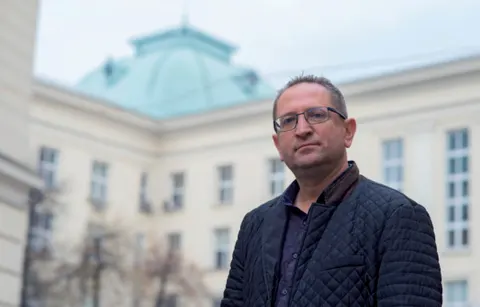
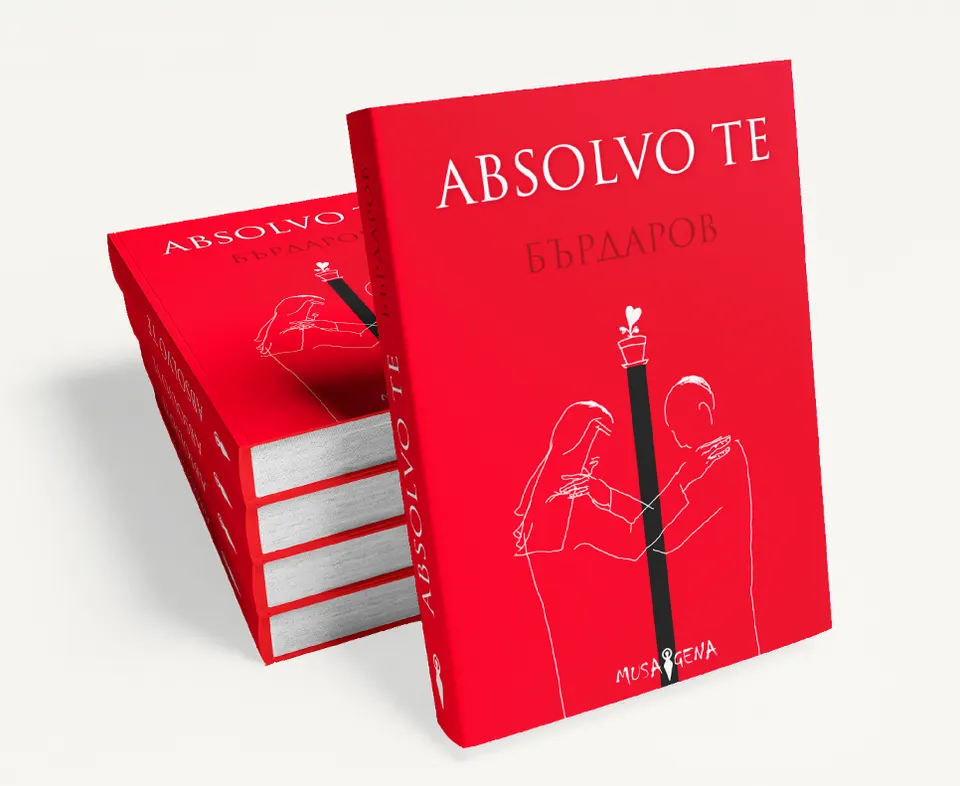
Bardarov. That is how he signs the cover of his new novel, “Absolvo te,” which recently won the European Union Prize for Literature for Bulgaria.
You probably know him as a spellbinding novelist, but he is a great deal more (you will find his biography at the end).
Our conversation with Georgi Bardarov begins and ends with the books and stories that make us human. In between, we talk about a way out of the demographic crisis, about our inability to build an elite that can lead us forward as a nation, and about the ease with which a human being turns into a predator capable of unleashing monstrous cataclysms like World War II.
– Your story as a writer began digitally, then moved to the analog world. Will you ever go back online?
– Yes, it's true, my whole literary career took off because one of my short stories became popular on social media. I've been writing since I was a child, but nobody ever paid attention; I didn't even get rejections. And if people hadn't simply started liking it and sharing it, my novels would never have happened. Whether I'll go back, I don't know. Time will tell.
– Both your novels deal with global themes, and both are tied to wars. If there were no wars, would you have anything to write about?
– Ten or twelve years ago
I chose to work on ethno-religious conflicts, because I am a pacifist and a humanist, convinced to the point of utopianism.
That's how things turned out at the university, and it carries on into the novels. I'd really like to stop writing about wars; I want my next novel to be on a subject that is, if not cheerful, then at least calmer, more normal.
But wars provoke me deeply with their senseless violence, their manipulation. And with something I gradually but completely came to believe—that
the natural state of the human race is war, not peace.
We humans never learn from the mistakes of the past; on the contrary, we keep repeating them.
I've always been interested in World War II and the Holocaust; in Bulgaria they used to be talked about a lot. I imagined them as some extraordinary evil that had somehow been allowed to happen in civilized Europe. Now, while working on the novel, I did very extensive research, and the more I read, the more I realized that it wasn't extraordinary. It was just one more evil, if on a vast scale. And that it will happen again, somewhere, someday.
– What could give rise to something so horrific?
– It springs from the very nature of Homo sapiens.
Sadly, that's what we are as individuals. With good and evil inside us, with aggression that is easily provoked.
The only creature that can kill for pleasure is man. In nature, animals kill for food, for territory, for reproduction. That is simply what humans are, and it's a very sad conclusion. But we have to stop glorifying or belittling the human being; he is what he is. I'm human too, I have my flaws, my weaknesses, a tendency toward aggression. I can't conquer my vices and complexes. The very worst and the very best are combined in a human being. He is capable of incredibly good deeds and incredible baseness.
– Technology, which now largely defines and shapes us as people—does it help or hinder in this respect, in generating the tension that grows into conflict?
– My thesis is that the human being as an individual hasn't changed from the first member of the species to the present day, and won't change. He is driven by the same instincts, passions, desires, complexes, dreams. What changes is technology, what changes is scale, because there have never been so many people on the planet. By the end of the century there will be 10 billion people! And 10 billion people did not live in total from the first Homo sapiens to the Industrial Age. The framework changes, but at heart the human being stays the same. Technology neither helps nor hinders. Perhaps it leads to more casualties in military conflicts, since weapons have been perfected, but in percentage terms that isn't so. In the Thirty Years' War in the 17th century, when there was almost no technology, up to 60 to 70 percent of the population was wiped out in the territories of the countries involved. Just imagine…
Technology can't change us. Every person on this planet, from the first to the last, will want his children to live better than he did, will want peace and quiet. And at the same time he'll be prone to violence without realizing it.
Technology, however, gives us practically unlimited opportunities.
We live in the most blessed time in all of human history;
people have never had the opportunities we have today. But that's both positive and full of risks.
– I, on the other hand, think we are evolving. In my view technology is changing us at the level of the species, and very quickly—in our attitude to the world, in the way we perceive it, in how we treat others.
– Yes, and yet in all the essential characteristics they stay the same. If in the past some rulers kept us as slaves by limiting access to information, now they manipulate us and keep us as slaves through that very same information.
What has changed with regard to conflict because we have technology? The way of thinking, the behavior… Israel and Palestine, the conflict I describe. We have technology, we have information. All these people know they descend from the same father, that they have equal rights to this land. And so what? They keep being manipulated with incredible ease.
– Almost 20 years ago, at the Faculty of Journalism, they used to joke with us: “Thank goodness for this conflict, there will always be something to fill the foreign pages of the newspapers.” Newspapers have almost disappeared, but the rest still holds true…
– That won't change.
– Then again, there's no conflict in history that didn't end at some point.
– That's true, there are no eternal conflicts. But what drives the conflict there are the interests of the Great Powers, the complexes of the two peoples, their fears. Ultimately, the impossibility of dividing a piece of land to which both peoples have absolutely equal rights and which each claims as its own. How will the conflict be resolved, and in what way? The Arabs' land keeps being taken from them; the latest escalation was in East Jerusalem, in an Arab neighborhood. They evict them, tear down the houses, build a neighborhood for Jews. How can they go on? One of the two peoples would have to evaporate, to vanish.
– But isn't there the UN, supposedly created, with every country in the world taking part, to solve problems like this?
– Supposedly.
– Meanwhile, the generation in Europe that remembers World War II is passing away. I've heard the metaphor that its memories are like a vaccine against a repeat of something similar, and the vaccine is now wearing off. Is there a greater risk of reaching such a moment again? Or is it calm here now, are the nations united…
– In a lecture just before the pandemic, I explained to young people that I feel a very great fear because Europe has been at peace for 70 years.
We have started taking peace for granted, democracy too. Rather than as super-fragile things we have to fight for every second.
We've forgotten what war is, and that's very frightening. Yes, the pandemic was perhaps some kind of substitute, but… our senses are dulled, our sense of how terrible war is. Seventy years is a very long period of peace, and the threat is very great.
Every so often someone, somewhere, has an interest in a conflict and provokes it through manipulation. In the former Yugoslavia people lived like brothers for so many years. As I talked with different people in Sarajevo, I was shaken. “How, how did this happen? You were held up as an example of religious tolerance, you lived so long and so peacefully without conflict?!” “Yes, that's right. Until one day we were living together and drinking our rakia, and suddenly—as if someone waved a magic wand—we started slaughtering each other…”
– Collective madness.
– Unfortunately, we come back again to whether human beings change. We are extremely susceptible to manipulation. It shouldn't be that way now! We have so much information. If in the past education was the privilege of a small elite, now it is the standard. And still we give in so easily.
– But then, as you say, the pandemic came as a sobering moment of sorts. Suddenly we all found ourselves in a situation that seemed unreal by the standards we had back then…
– Actually, pandemics are cyclical phenomena in human history too. The question, in my view, is the response. My opinion is very subjective, I'm not a doctor… But it strikes me as strange. The 14th century saw the last great outbreak of the plague pandemic. Humanity coped with masks and social distancing at a time when there was no science or education to speak of. Now, seven centuries later, we have technology, medicine, education. A pandemic comes again, which is a normal phenomenon, and how do we cope? With masks and social distancing. It really does seem strange, and I can't explain it.
– The pandemic, though, on top of everything else, made the demographic situation in Bulgaria even worse. Mortality exploded, breaking every record. Whenever we talk about demography you're always an optimist—has that changed with the new situation? Will we survive as a nation?
– Yes, mortality reached 18.1 per thousand, which is extremely high! Twenty per thousand is what you see in the most backward regions, in regions of conflict and severe epidemics. We're getting close, and that is terribly, terribly much.
But it doesn't change my optimism. If we work in the right direction, there is a way out of the demographic crisis. The point is to work in the right direction. We keep acting wrongly, both in our rhetoric and in our policies.
There are four processes that define the demographic crisis. Two of them are normal, objective, global phenomena that we cannot influence in any way. Yes, the birth rate is in fact low, but that is so throughout the developed world, and it's due to objective causes. The level of education, the pace of life, attitudes toward having children, increasingly responsible parenting. I'm very amused when people explain to me that young people today are irresponsible and selfish because they don't have six or eight children. Which is more responsible—
to have one or two children and give them the chance to make something of themselves, or to have eight and throw them out to fend for themselves?
It's not that people back then were bad parents; they simply didn't have the education.
– So in your view there's no way to drastically increase the birth rate?
– No way. It will stay like this for a long time. Africa and Asia will fall into the same rhythm too; by around 2060 or 2070 the world will be aging and its population will begin to shrink. It's a natural demographic process.
The second factor we can't influence is aging. Also a normal, objective, natural process, the result of technology, medicine, lifestyle. At the beginning of the 20th century average life expectancy in Europe was 35 to 40 years; now it's approaching 85, and soon it will be 90. And we keep talking nonsense.
We want to live ever longer, more actively, more healthily, and at the same time not to age as a society.
It's impossible. We will keep aging, it's normal, and it will happen all over the world.
But we also have two other factors, specifically Bulgarian phenomena, and they define the demographic picture. Extremely high mortality—and I'm not even talking about the pandemic. We were, and still are, first in Europe and among the first in the world. For a developed, modern country, which is what we are in fact, this is so shameful that it simply couldn't be worse. In Bulgaria people die in large numbers from diseases that are treatable everywhere in the normal world. And that's because of the state of the healthcare system, the poverty of the population, the lack of access to healthcare.
The fourth process, of course, is the lack of a young, active population. These are the two things that determine how severe the problem is and that we need to work on.
– Everything you say is clearly different from what most people imagine—that the main solution is a higher birth rate. Is it the politicians who lead us to the wrong conclusions? Not that the state has done anything in the last 30 years to raise the birth rate, but they do love to talk to us about it…
– I'm looking at the parties' demographic programs right now too. In pure populist fashion, once again they talk mostly about the birth rate. We won't change it. I'm not against it—God willing there will be children, young people, large families. That is the future of every society, but today miracles in that direction aren't possible. Orbán gives 33,000 euros to a family with three children. The program has been running for five years, and they've raised the average number of children per family from 1.4 to 1.5. There's no dramatic jump, and there won't be.
Bulgaria has enormous potential as a country. In many respects we are still an undeveloped niche, even from a purely geographical point of view. We are in the top 10 percent of countries with the most favorable climate. With climate change and waves of migration, Bulgaria will become an ever more attractive place to live.
– Even in spite of the politicians and a dysfunctional state.
– Yes, I'm absolutely convinced of it. Within 20 or 30 years we'll become an extremely attractive place. And from then on, if we don't populate this land with Bulgarians, it will be populated by others. It simply can't remain empty.
In northwestern Bulgaria, for example, we have massive depopulation. A colleague of mine introduced a perfectly objective term—demographic desert. She predicts that by 2040, 40 percent of Bulgaria will be a demographic desert if current trends continue.
– Could the pandemic have a positive effect too? Quite a lot of people realized they don't need to live in an overcrowded city.
– Yes, it's certainly changing attitudes. Quite a lot of people came back to Bulgaria—around 200,000, they say, but there are no official statistics. We're working on a project in Etropole, a small town in the mountains northeast of Sofia, covering the period 2010–2019. We were delayed by the pandemic and decided to include 2020 as well. It turned out that every village in the Etropole municipality grew in population! For nine years in a row we observed a downward trend, and suddenly they're all growing, even tiny, isolated hamlets… Whether this will be a lasting trend, though, is the big question. Because the pandemic will pass…
– Eventually, perhaps, someday…
– Well, yes, someday, but it will pass. Bulgaria is a wonderful place for digital nomads. People who can work from anywhere will come here, because the nature is so beautiful. It's a process that, in some form, should be supported by the national and local authorities. We need infrastructure, and not only roads but social infrastructure too. Schools and a hospital. Young people increasingly want to live outside the big cities; they just need the conditions.
– Are there examples in history of a negative demographic trend like this being reversed?
– There are many, very clear examples that show what needs to be done. Countries very similar to us were in a much worse situation and are now leaders in demographic terms. Éire is a brutal example in this respect. At the beginning of the 19th century Europe experienced a demographic boom; it came to Bulgaria a century later because of the Ottoman Empire. The birth rate stayed high, but mortality began falling fast thanks to medicine and education. At that point Ireland's population reached 8.2 million.
In the middle of the 20th century, by then an independent state, after World War II, they were in a collapse many times worse than Bulgaria's. In the 1950s, 80 percent of those born in the 1920s emigrated. Eighty percent! Socially, economically, demographically, they ceased to exist. By the mid-20th century they were down to 2.5 million people. That's almost three times fewer in just a century! And we are very far from that; we haven't gone from 9 million to 3.
– There's still time, if we carry on like this…
– These really are processes that can continue. But then they launched a program to restart Ireland. Today they have the highest fertility rate, the highest number of children per family, the largest share of young people. They did it in 70 years. Comparable to Bulgaria in territory, in population, in historical development, if you look at it. In their way of thinking and mentality too.
Finland is another such example. In 1907 it was the poorest province of the Russian Empire; today it leads Europe on almost every indicator.
– What do you think we lack to do something similar—political skill, will, vision?
– All of that, unfortunately.
– It's a fact that we don't have a political class with those qualities. And why can't we form one?
– That is the big question. In my view, Bulgaria suffers because throughout its modern history it has been unable to form an elite to lead it forward. The intellectual elite leads nations, and in Bulgaria it is periodically destroyed. The Ottoman Empire held back our development, and after that came coups, September 9 (the 1944 communist takeover), November 10 (the 1989 fall of the communist leader Todor Zhivkov). All of this disrupts natural development and prevents an elite from forming. And the other thing is that we keep starting from scratch. Within just 30 years, it seems we're now starting over for the fifth time. How long can this go on?
– Do you think Europe could one day become a single state?
– Yes, that's possible. These processes repeat themselves, in some form, over certain periods of time, in new variants. With the Roman Empire and the Holy Roman Empire, Europe was de facto a single state, only of an imperial, slave-owning kind. The European Union is something entirely new; there has never been a voluntary union of so many states within one supranational entity… But
the 21st century will offer so many different models, some of which we can't even imagine are possible.
We have a global reshuffling of populations. We have identities that are dissolving and others that are being formed through technology, travel, information, education. The world is heading toward some kind of unification, toward something almost like a world state. Which also has its positives and its negatives. The negatives are that traditions and cultures are being erased.
– Let's go back to writing. Is it different when you write for an electronic audience and a “paper” one?
– I've never thought about it and I don't make a distinction. The text has to have an effect on the reader; its messages have to reach him. Perhaps the digital environment allows you to add some extra elements to the text. But e-books are still books; nothing is visualized or added.
– To become popular, to go “viral,” though, you have to be much more of a conformist, to develop what's in demand.
– Yes, but it also gives you far more opportunities to reach people. After all, even the authors we publish are popular on social media. Thirty years ago I wrote and three people read me. Now you start, you write, you promote yourself, and lots of people read you. That wasn't possible before—someone had to create you, to distribute you. It's a process with both positives and negatives.
– Are stories the easiest way to make sense of history?
– Yes, they personify events and bring them close to people. Learning something from a textbook is one thing; telling it through a story is another. That way much more of it stays inside you. Right now, for example, I've got hooked on French history through Alexandre Dumas, and then I read Maurice Druon's series The Accursed Kings. Stories make historical events digestible and interesting for the audience, and yes, they definitely help.
– Why isn't your first name on the cover of “Absolvo te”?
– With this book I took a conceptual approach. First, the choice of themes—they genuinely moved me. I wanted to surpass the first book. And when the idea came to combine the Israeli-Arab conflict with the Holocaust, I knew I was aiming extremely high. I'm making a very big claim. Besides, after the first novel, expectations of me were very high. For the second one I could have hidden in a subject that was comfortable, easy for me. About my family, my native region. But I'm someone who loves a challenge.
The story really did move me. I wanted the title to be in Latin script, to be connected with forgiveness, to begin with the letter “A.” And I came across “Absolvo te,” which fit beautifully. I didn't know the phrase before, and it turned out to be very common in the Catholic Church. Leaving out my first name is also a statement of ambition. “Who does this guy think he is, introducing himself by surname alone?” Well, why not—is Ran Bosilek, the beloved Bulgarian children's author, really called that?
Yes, there is ambition in this book, and it's deliberate, meant to challenge the reader. It's a double-edged sword, of course.
– But if with your next subject you want to surpass this one too, I don't know what it could be…
– Until now I was very careful—when people called me a “writer,” it made me uneasy. Calling myself a writer after one novel didn't feel comfortable. That's why the second was so important—would it live up to the name? Well, it did. It has its weaknesses; it's far from perfect. Some criticism came up…
– Maybe there really is no such thing as bad publicity?
– At first I was startled and angry, but it turned out to have the opposite effect. There really is no bad publicity. There was criticism about facts, about dates, which turned out not to be my mistakes at all; the mistake was with those who criticized. As a university lecturer, I check my facts very carefully. The book does have weaknesses I didn't catch, that's true. But it builds on the first one. There's still a lot to develop in terms of style, even general culture. What the next subject will be, I don't know. But I'm now free of that responsibility. I can choose a super simple subject, even the story of a normal, ordinary person, as long as I tell it in an interesting way. Things are in my hands now; there's no more of that pressure.
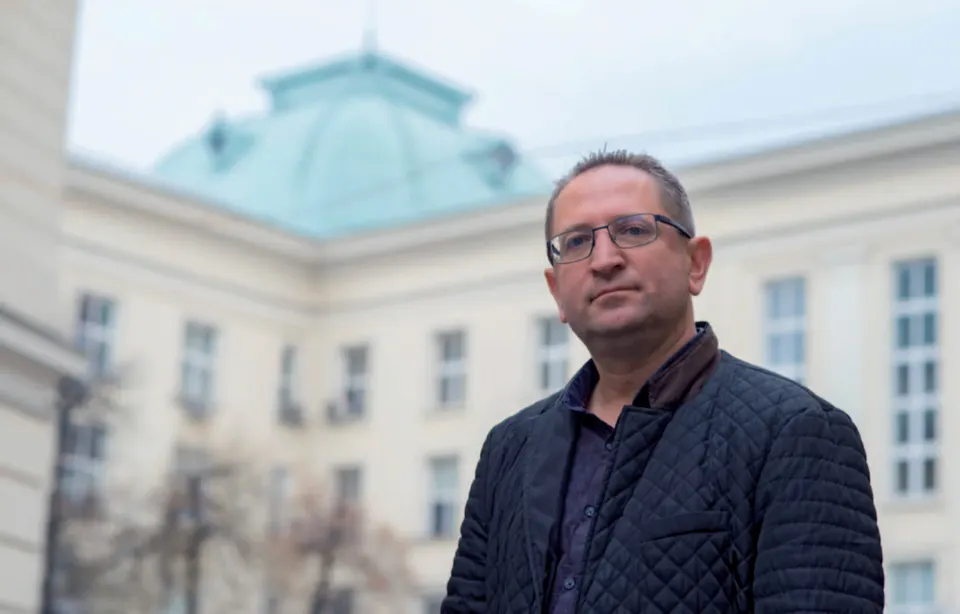
By profession Georgi Bardarov is a geographer, a lecturer at Sofia University “St. Kliment Ohridski” and deputy dean of its Faculty of Geology and Geography. His main research interests are ethno-religious conflicts and demographic problems. He has done postgraduate work in Germany and Austria.
He came into the public eye as a writer. Success, unexpected even to him, came first online with the short story “Za petata rakia ili kolko e hubav zhivotat” (On the Fifth Rakia, or How Beautiful Life Is), rakia being the Balkan fruit brandy. Several years after it was written and published online, one morning it became a sensation, read and shared like an avalanche across cyberspace. It now has more than a million readers, and the story still moves people with its wise, vivid and melancholy tale from the Rhodope villages of Gudyovitsa and Gozdyovitsa.
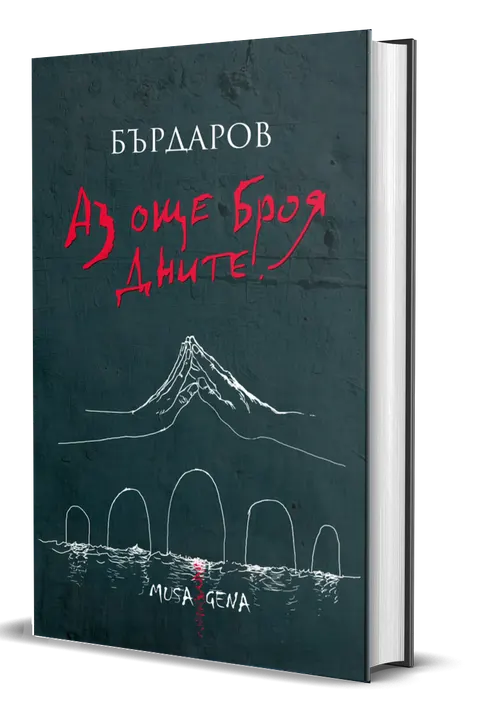
Bardarov then won the first and so far only literary reality show on Bulgarian television, Rakopisat (The Manuscript), and the book published as a result, Az oshte broya dnite (I Am Still Counting the Days, 2016), became a bestseller and one of the most discussed Bulgarian novels of the past decade.
At the end of last year his second novel, “Absolvo te,” came out, and it recently won the European Union Prize for Literature for Bulgaria.
With friends, he founded the publishing and production house Musagena, which places a strong emphasis on young authors in various fields of the arts.
For many years he was a scriptwriter for Stani bogat, the Bulgarian version of Who Wants to Be a Millionaire?, and he has also worked as a radio journalist.
He has a particular interest in sport and is the author of the book 27 veliki futbolni istorii (27 Great Football Stories).
He is president of the university club for pétanque, a game still little known in Bulgaria.
He also teaches at an academy for presentation skills.