TL;DR: Nobody has time to read long, complex texts anymore. Or do they? Do we need them to keep our brains from “blowing up”?
If you have ever come across these letters and don’t know what they mean, they’re worth learning—they turn up more and more often, no matter what reading you’ve “leafed open” on your monitor. Too long; didn’t read.
First they appeared in the comments on social networks, then the authors of longer texts themselves began slipping them into the very first line, in a desperate attempt to convey at least briefly what they had to say. And only after that, if there was any chance at all, to try to win a little of the time of whoever was still around.
Tolstoy Likes This
The eyes run and run, there’s no time. The headline, the first sentence. Scroll, scroll! Lots of paragraphs, boring, move on quickly! And again. The eyes run and run…
Like a hamster in a wheel.
Everyone has caught themselves at times simply scanning the content of yet another pointless article they opened on Facebook because of its tempting headline. Or rather “skimming,” as it’s fashionable to say—“taking a bite” here and there from the text, with no time to read it the way we used to “devour” the good old books, word by word, and pressing on.
So what?
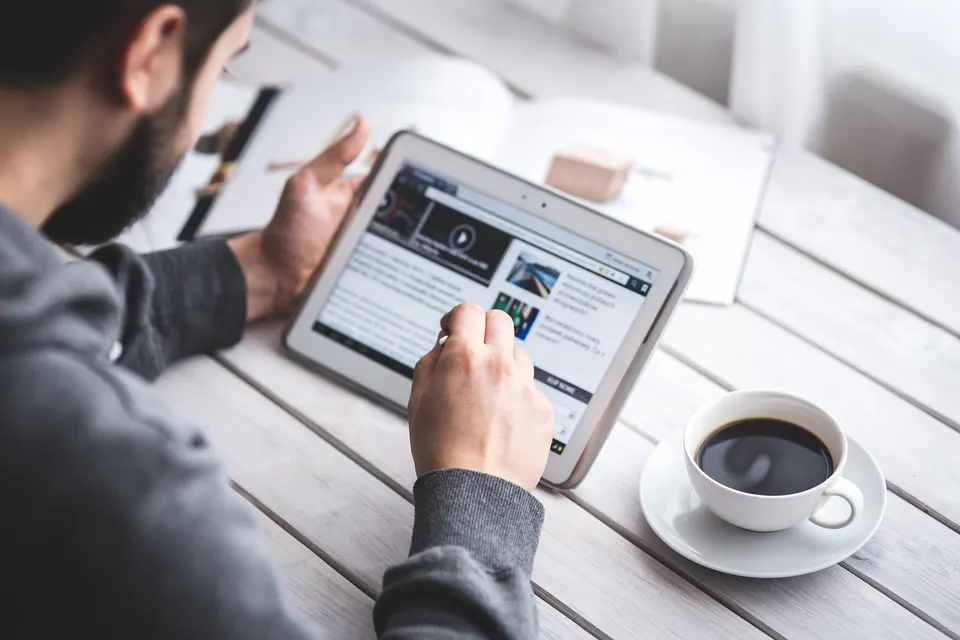
This phenomenon is certainly having a very serious effect on the way we perceive the world around us. The computer age has revolutionized not only our approach to texts, but our ability to take in information in general. We are growing ever more used to scanning for keywords, to skipping the nuances in an attempt to absorb more and more information, from our Facebook feed, for instance.
At 100 Kilometers an Hour
Somewhat strangely, given everything said so far, it turns out that longer texts do better online. According to a number of studies, where blogs are concerned, for example, the average length of successful posts has been growing in recent years. Today people even talk about more than 2,000 words. Such texts are also ranked highest by Google.
The paradox is only skin-deep. The truth is that longer texts score well simply because they gather all the information in one place. Not everyone comes in to read the article; most people pick it knowing that somewhere in the plenty they will find the little they need. By skimming the text, or even by searching for a keyword in the browser. The proof: although the average length of successful texts is growing, the time the average user spends on those pages is shrinking, according to most of the studies I came across.
In other words, the “TLDR problem” doesn’t come from the fact that we don’t read long texts at all. It comes from the fact that we are on the verge of finally unlearning how to read carefully, with concentration, word by word.
He Reads, He Reads It All
The biggest difference comes from our very basic attitude toward the text. Just a few years ago, for our words to reach a hundred or so readers, the only way would have been to write for some newspaper, mulling over every word for hours. Then an editor would carefully leave his mark on it and, if need be, send the text back to us for polishing. And finally, once the work cycle and the printing press had turned, it would appear on paper. Where it would live for a very long time—and years later some belated reader might call us about a factual error.
Today we write. And post. Then we write and post. We write and post, letters and words flying about uncritically. Yes, there are online media that somehow preserve the old way of creating (and possibly reading) texts. But they are a minority, and the market sweeps them away. The heartbreaking Facebook post gets shared and shared again with all its countless grammatical mistakes, all its haste, filler words, poor structure…
So the editing is left to us. As we read, we subconsciously try to get at the meaning through the fog, and gradually we get used to it. We forget to pay much attention to how the text is written; we hurry to like and scroll.
Facebook Is No Reader
About 6,000 years ago, the creation of the first proto-writing systems led to the last significant historical change in our brain as a species, neuroscience believes today. This change began with our ability to store elementary information—how many sheep we have, for instance—and ended with our being able to read, write, think abstractly and process volumes of information that no other species on Earth can manage even now.
The “reading brain” gradually unleashed phenomena such as critical thinking, analogy, an analytical eye, the weighing of different points of view (the cornerstone that allows us to speak of democracy at all), and even empathy.
The big question, however, is this: how much of all this could be affected by the fundamental change in the way we read?
As MIT professor Sherry Turkle writes, quoted by The Guardian, we as a society are not wrong to bring innovations into our lives. But we are seriously mistaken in ignoring the question of what we destroy or lose with a given innovation.
As far as digital reading is concerned, the past year has entrenched the change even further. At a time when whole generations are moving from paper entirely to the screen, it is worth asking ourselves what we may be depriving ourselves of.

Heads and Chapters
The first thing, for which we don’t even need to ask the scientists, is patience. Reading on a screen is always more distracting: on the one hand because of the very way we read from a screen—every study shows that it happens faster than on paper. On the other, because of the many temptations lurking online. Which brings us to the second big question—concentration.
Do you think that, for many people today, there is still that moment when we sit down with a book in hand and can’t tear ourselves away from it for two hours, following plot lines, circumstances, characters? Pretty hard, isn’t it? Yet it is precisely in the nuances, in the style, in every single well-chosen word that the true pleasure of reading lies. And the true benefit for our brain, too.
Even that isn’t the end. Things have gone so far that we are turning fast reading into an ideal and an end in itself. There is more and more talk of speed reading, fractal reading, meta-reading and other trends whose goal is to absorb more and more. Marketing leaders explain that to become like the most successful people, you mustn’t waste your time on random books; it’s enough to read the summaries, to flip through. To stop only at what struck you as extremely important, where there’s no way to avoid reading. Let’s turn books into TED talks so we don’t waste our time.
But enough musing—let’s invite the scientists into the discussion.
Oh, Pencho!
Our ability to read is not innate; it develops, and it needs an environment in which to do so. Moreover, it adapts to the demands of that environment—from the features of the writing system in use to the medium itself, paper or screen. If that medium is fast, geared toward multitasking, encouraging the rapid absorption of large volumes of information, then so will be the reading we learn.
In Stavanger, Norway, the psychologist Anne Mangen and her colleagues decided to study how students take in reading material from different media. They gave them a short story—a love story—with half reading it on paper and the rest on an e-reader. The first group turned out to be dramatically better when they had to give a detailed retelling and answer questions about various details of the plot.
Again quoted by The Guardian, the psychologist Patricia Greenfield believes that less and less attention and time is devoted to the processes tied to slow, time-consuming, deep reading. So children who read only on a screen don’t have time to develop skills like critical thinking or empathy. And this shows as early as the fourth or fifth grade.
Studies in the West show that fewer and fewer pupils and students are willing to devote time to the long, drawn-out, more complex and profound reading of the nineteenth and twentieth centuries. It is surely the same here in the East. It is logical to conclude that since this “cognitive impatience” is almost invincible, it will stay that way later in life. These same people won’t be able to read long contracts, to approach their everyday problems more deeply, to gather information in order to solve a difficulty. Or to form a reasoned opinion on the questions that matter to society.
Generation Z
Skimming itself is a more than interesting phenomenon, one worth switching on our self-observation for. The next time you open a long article on a subject that interests you, make the effort to check whether you are really reading all of it. You’ll be surprised.
One of the most valuable reactions from the first readers of Digital Stories came from a friend who said he had liked the texts so much that “I hardly scrolled.”
I thought about it. A decade ago that remark would have sounded like mockery to me; now it’s a huge compliment.
If you haven’t scrolled down yet (thank you!), let me add that a huge share of people read web pages with their eyes flitting across in the shape of the letter F or Z.
They read the first line.
Then they scan through everything else, and the eye either takes a liking to some later line in the middle of the paragraph or moves on to its end.
We all do it.
The Long Debt
Then we come to writing. Online, you write in order to try to please. In competition with millions of other authors, and in a discipline that isn’t particularly fair, there are no rules. So you learn to cater to those demands. To put in the right keywords so that search engines like the texts. To slot them into the right part of the paragraph.
To forget that a text is actually a whole. A living creature with a birth, growth, happiness, a climax, an end…
It’s no accident that the authors of successful texts on the internet are most often either anonymous, or one-day wonders, or known within their own specialized niches.
But in a race like this, we will very soon lose the battle with artificial intelligence. Because it knows how to write in a way that pleases. Or at least it will soon learn, make no mistake.
The new reading gives birth to the new writing. If this page is opened by 161 people, then according to averaged internet statistics, 61 of them, or 38 percent, will leave before reading even the headline. Five of the rest won’t scroll down at all. At best, 12 brave readers out of the huge cohort we started with will make it to the end of the text. So how should I write to be read online? Fast, digestible, attractive. With big headlines, chopped-up text.
No way.
The Long Way Home
In his book The Third Wave, the sociologist Alvin Toffler speaks of the birth of “clip thinking.” Modern people receive significantly more information than their ancestors did. More is an understatement—today, in a few hours online, we run into more information than people a few generations back received in their entire lives. To cope with this avalanche, we try to fragment the information and “take” only what will be of use to us. Instead of a film, our perception now consists of chopped-up images, as in a music video. The world turns into a kaleidoscope of facts and events with no connections and no plot.
Skim reading is the natural consequence, especially when it’s joined by our subconscious need to want more and more information, to scroll and scroll…
Neuroscience has long known the principle “use it or lose it.” That’s why it’s important, knowing what digital reading gives us and what it takes away, to move to the next level. To cultivate our ability to concentrate, to read carefully, to savor the text, whether it’s on our screen or on paper. Otherwise we risk failing to pass on to the next generations some of the most precious human qualities, which, as we’ve seen, are inextricably bound up with classic slow reading.
Perhaps I naively believe that the good old stories can help in this direction.
Because they are what keeps moving people online. Whether it’s news, culture, or communication with loved ones. Our life is a string of stories, and it seems to me that the moment will come when their value online will rise. We will move to the next level, from the touching Facebook status that simply moved us to the full, vivid story in which every detail and every word of the text deserves attention. Because it is in its place.
Avid Readers
Quite a few media researchers believe that long reads are the lifebelt of quality journalism online. And indeed—in-depth pieces, created with skill and care and enriched by the possibilities of multimedia, deserve to be what we set aside a few minutes a day for, taking them from pointless scrolling. It’s up to us.
Unusually for Digital Stories, this is the first text that actually has no story in it. I just wanted us to talk about something so important to how we take in stories.
Yes, I know you’re in a hurry; so am I. But save a little time for the good old book, or at least for a meaningful, exquisitely written story online.
Slow down, at least for a little while. You won’t regret it.
Breathe.