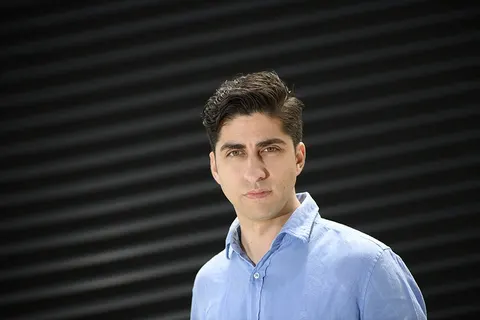
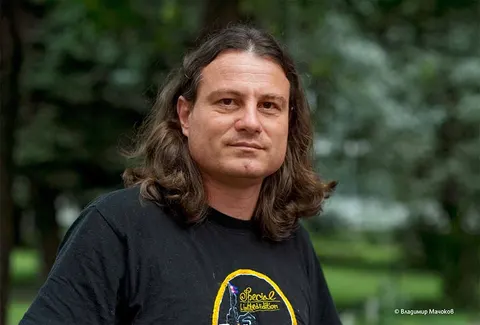
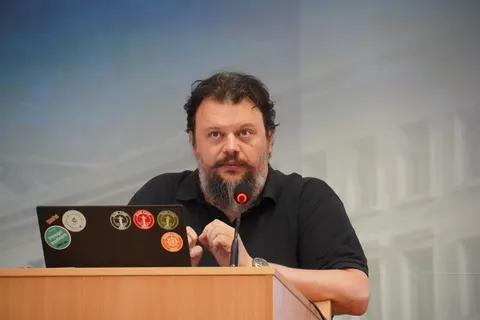
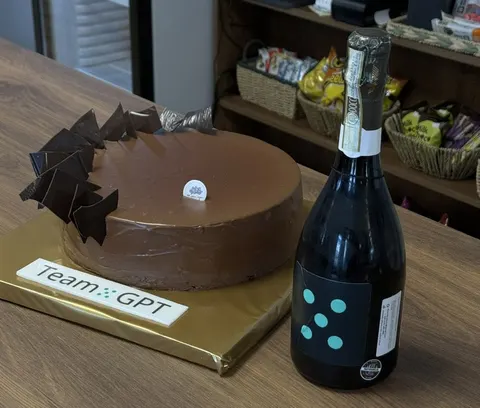
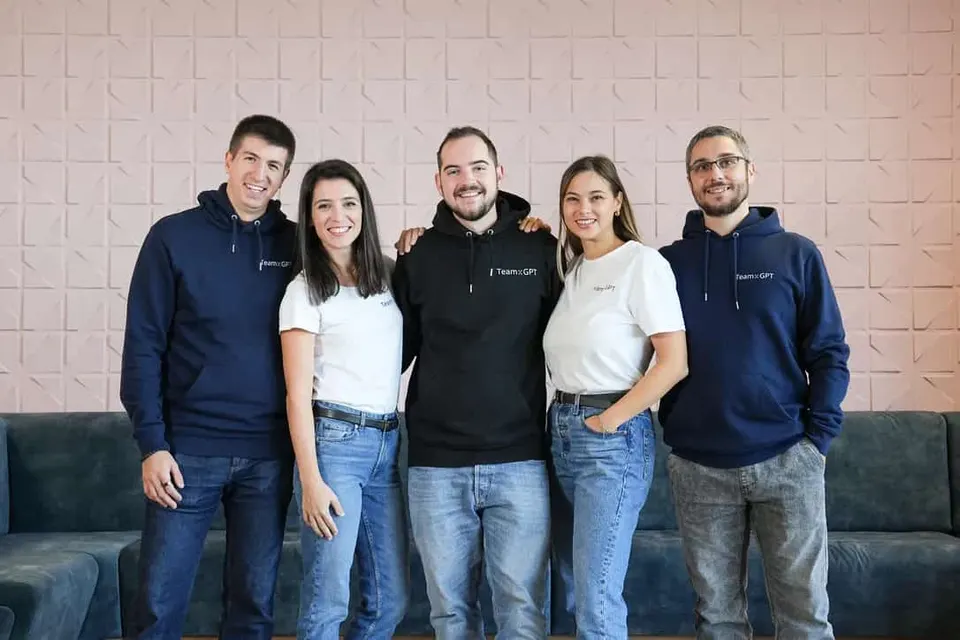
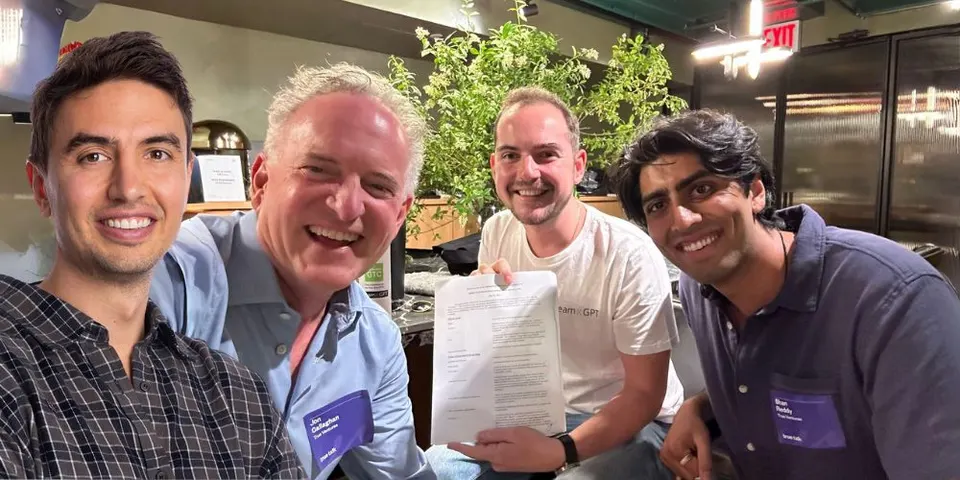
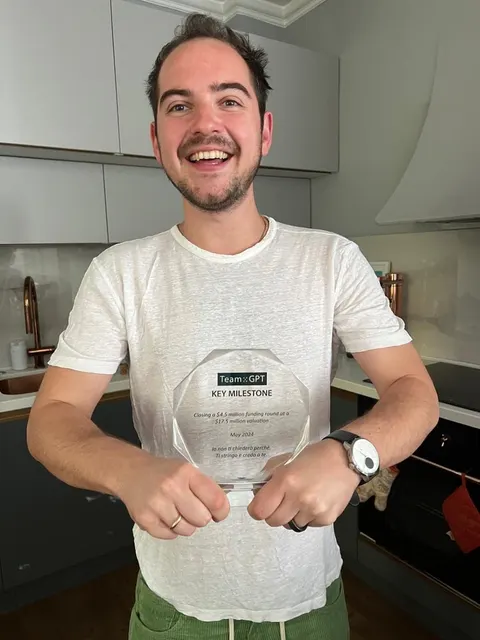
The day before I met Ilia Valchanov, the news broke officially that his startup Team-GPT had secured $4.5 million in funding, a record for Bulgaria!
Today’s guest leads a platform that helps businesses around the world use the power of large language models while guaranteeing the safety and confidentiality of their data. It is far from his first impressive achievement—for years Ilia has been building online courses in data science and artificial intelligence that have enjoyed enormous success. He personally already has more than 1,400,000 students on the Udemy platform!
He owes his remarkable success to a thorough approach, to a great deal of reading and learning, to courage and unconventional decisions. That is why we are meeting—to talk about the next big news coming out of the world of artificial intelligence. About how the technology will transform every area of business, but also about the risks it creates. About the important causes tied to the progress of AI, and the skills it will never manage to develop.
– Many people don’t believe that anything remarkable has happened in the world of AI. How do we convince them? My way is to test and show—look, poetry competition juries no longer just fail to tell the difference, they award prizes to poems written by ChatGPT. How do we convince people that there is now a tool that is extraordinarily good at so many tasks?
– Usually that is part of my job. There are many approaches, and different things impress different people. I prefer to show a person something that can be useful to them and save them a lot of time. That is what our product, Team-GPT, is about too. We get on a call with people, do a demo, explain how to use AI for their needs, and they start doing it.
Another approach is FOMO—the fear of missing out. “Do you want to fall behind while everyone else moves ahead, or do you want to be one of the first to take advantage of this technology?” Because
AI is a departing train—whoever has boarded it becomes better and faster at everything they do.
The truth is that the people who don’t believe are simply falling behind. It’s a big problem in many companies—the gap between the people who use it and everyone else shows up first in knowledge and skills, and then in pay.
I know a lot of people who already work several jobs thanks to AI. One of them is a programmer; he used to work at three places, now “only” at two. I asked him, “Why don’t you bring AI into your company?” “Oh, why would I tell them? If they find out, I’d have to work only for them, wouldn’t I? Right now I get a double salary and work less!”
That’s more or less the situation. In “statistical language,” we have a bimodal distribution: some people are way ahead, and the others can’t be bothered with it.
In the beginning I tried to persuade people, I put time and effort into training them, into trying to open more people’s eyes. I can’t fight the current. I can’t convince someone who doesn’t believe at all.
But if someone is a little curious and opens their mind, I can show them very well how to use AI.
Be more open-minded, be more curious—you can only win from it!
– Sometimes even authorities don’t help here. People often quote Yann LeCun to me, who says the models are “as smart as a cat.” Or Linus Torvalds, for whom AI is 90% marketing hype and 10% real applications. But that’s not how it is—we can see it.
– It depends on which bubble you’re in. I’ve been working on artificial intelligence for 10 years, and it’s crystal clear to me that this is the future.
All of science fiction for more than 100 years has been talking about it, and here we are—the time of artificial intelligence has come.
From here on it will only get “worse.” The course on deep neural networks I created in 2016 began like this: “Google Maps tells you where to go. People no longer choose which road to take; artificial intelligence chooses it. They no longer choose what to buy—from Amazon or eMAG, the big regional online retailer—AI shows them. They don’t choose which movies to watch; Netflix does.”
At some point you realize that AI has been here for a long time. I wrote that 7 years ago, and it had already been around for another 7 before that. Since 2010, AI has been deeply embedded at a mass, global level in everything around us. And we pretend it’s something new. This technology is 15 years old, and it has been in development for more than 50.
It’s just that now is the moment when something has changed more sharply. And my way of putting it into words is this: until now these algorithms could say 0 or 1, categorize, perform limited tasks.
The difference GPT brought is that artificial intelligence can now pretend to be a human. And be completely indistinguishable!
It won’t just win competitions—it is breaking the education system, the way we assess knowledge.
And the education system is broken as it is. I got a 6.00—the top grade on Bulgaria’s six-point scale—on the Bulgarian language matura, Bulgaria’s school-leaving exam, when I graduated. How? I went to the education ministry’s website and read the criteria used for grading. You have to use at least one simile, at least two metaphors… I memorized them and reproduced them. Well, artificial intelligence does that out of thin air, and it’s much better at it.
– But what are we supposed to do? And not just with poetry competitions, but with everything else, now that we can no longer tell the difference? AI, as you said yourself, has already changed the way we get our information, shut us inside bubbles and created all the big problems we have as a society right now. That we can’t talk to each other, that truth has become fluid…
– You’re asking me what the author meant. I rather think the way to look at these things is the other way around: beauty is in the eye of the beholder!
In fact, it doesn’t matter whether something was written with AI or not.
If this thing creates an emotion in you, if it makes you feel a certain way, it’s art, it’s something good. And if a poet is unhappy that AI is taking his job, he isn’t a poet but an egocentric who wants to be famous for his poetry. He isn’t doing it for the sake of poetry itself.
The people I know who write poetry do it to pour out their emotion, their soul. I write essays all the time; I can’t write poetry. All my thoughts take the form of essays, usually I aim for 300 to 2,000 words. I’ve published almost none of them, but I write them for myself. And,
fine, AI can probably write a better essay than me. But I write it for myself. What’s the point of using the artificial thoughts of artificial intelligence?…
– That’s exactly what I think too, and it’s the same reason I write Digital Stories. I don’t care whether better texts could be generated… But most people are prejudiced once they know something was generated. How long will that last? They’ll always say, “I don’t like it,” just because they know it wasn’t made by a human. I see it everywhere.
– There are many ways to approach this. The Luddites come to mind.
Every time there’s a technological revolution, there are two “tribes”—one is very excited, the other is against it.
Usually they’re driven by some fear that it will replace them. I think people simply need to be more open and try to see whether they can move from one tribe to the other.
What are we going to do? A hard question, and I can’t solve it.
What worries me is that people aren’t interested. Never mind that they’ll fall behind on technology—that’s their own problem. The real problem is that they can’t take part in the discussion about AI, because they don’t understand at all what it’s about.
– Exactly. That’s why this site exists. And my survey, which 750 Bulgarians took part in, showed how scattered we are on these topics. Meanwhile, one of the few things we agree on is that we don’t discuss it enough.
– If you want to make policy, for example to regulate artificial intelligence, you first have to get to know it. That seems to me to be a fundamental problem. Usually the people who are against AI haven’t gotten to know it at all.
– You help companies bring AI into their work. Everyone expected that very soon after the ChatGPT moment these technologies would make their way into practice. Elon Musk and 500 scientists even wrote a letter calling for a six-month moratorium. Two years have passed, and it seems these technologies are arriving more slowly than expected.
– Every new technology takes time to be adopted. There are various reasons, and people’s attitudes are one of them, but not the main one. A far more significant reason is that there aren’t enough servers, there isn’t enough hardware to run AI on. It isn’t fast enough, it isn’t cheap enough, it isn’t environmentally efficient enough. Half a year ago it was said that every ChatGPT request uses a glass of water to cool the servers. All these things need to be solved.
There also isn’t enough data for it to develop faster. We’ve already trained on all the data that is publicly available.
The next thing we’ll run short of is electricity—we don’t have enough to power all the AI things we’re going to build. Which means we hit one limit after another. We’re starting to solve them, but it can’t happen quickly. Building a new data center takes three years or more, even if you’re Microsoft.
ChatGPT came out in 2022, and GPT-4 came out at the start of 2023—for me that was the real revolution. So, by 2026 we’ll be securing more hardware. After that we’ll have more, but the models themselves will be even more powerful. There will be problems again.
If we look a bit more globally, I’d say that
this type of AI will take at least 20 years to be adopted on a mass scale in companies. I expect the first big, globally adopted software products to appear in the next 5 to 10 years.
Maybe their first versions already exist!
– Which sectors and which specific tasks will change first?
– AI is being adopted absolutely everywhere—take the whole technology sector, for example. Starting with hardware: chips are so tiny that we use AI to create them, while at the same time they are changing so they can develop AI better.
At the infrastructure level, it affects servers, data centers, cooling systems, energy consumption, and so on and so on. Only then do we get to software. There you can already create visual elements without writing code. You can dynamically spin up extremely complex systems in minutes.
But it’s a natural cycle. Ten or fifteen years ago everything happened on the computer. And when phones arrived, there were no apps, no websites ready for them—a complete rewrite began. Now everything is oriented mainly toward phones; 70% of our traffic comes from mobile users.
– It’s the same with Digital Stories, even though we’re talking about long texts.
– And just as everything had to be rewritten to meet the requirements of phones, chips became much smaller, we developed miniature cameras and sound systems, batteries became much more powerful, because they had to. In exactly the same way, AI will change the hardware and software industries from the ground up. There will be one enormous rewrite until all systems become AI-first.
Another comparison is cloud technology—everything used to happen locally or on your own servers, and at some point everything moved to the cloud. Software had to be completely rewritten.
The changes will be everywhere, but how can each person benefit? Everyone can do it individually, but naturally it’s faster and easier for some. When it comes to ChatGPT or similar models, the industries we see adopting them fastest start, of course, with software. Programmers and other IT professionals understand what it’s about and manage to adopt and use these models in creative ways much faster. Then comes the marketing industry—people in that business had long been waiting for something like this, and their work got easier. As someone with experience in the field, I know their problem is that they have lots of ideas that never get realized. In marketing the problem is always focus, but it’s clear that it’s better to experiment until you find the idea that works best. Generative AI makes it possible to test far more ideas in a very short time! You can create videos, texts, all kinds of content in hours instead of days.
The next area is business development and sales. We clearly see it in education too. All the teachers who use it are thrilled, because it can not only prepare their materials but also check homework and essays. We also work with universities that use AI technologies actively—Johns Hopkins, Columbia, Yale.
In law, they work only with documents—an ideal environment for these models. Finance is the slowest, because it works with a lot of numbers, and we know GPT doesn’t handle those well enough. But I’m sure very serious progress awaits us soon. Simply because the people developing these systems understand this above all—math and programming—so there’s no way the solution will be delayed.
– But could there be a winter? Many people say every technological field goes through this natural stage, and it has already happened to AI at least twice.
– Yes, 100%. The more investment pours into artificial intelligence… Imagine AI will create 100 units of value. If we invest 150 units in the form of money, there will be a winter, because we’ve put in more than the value even is.
That happened with cryptocurrencies—I’m not a big fan of them. Yes, there are cases where they can be used. But on a similar scale they’d bring 5 units of value, while 100 units of investment were poured in, and that’s why the bubble burst.
The same with real estate. Perhaps the biggest crisis of our time, in 2008, came from there—huge investments into value without sufficient backing. In the end, we can only live in one apartment. That leads to a lot of mismatches. With AI, the hype isn’t just hype. There are an enormous number of applications, and inevitably every field will be changed by it.
In my view, it should be compared with mobile phones, cloud technology and the internet.
Just as the world can no longer exist without the internet.
– But there was a kind of winter there too, the so-called “dot-com bubble” at the start of the century.
– It came because we didn’t yet have a distribution system. I want to read the Digital Stories site, but I don’t yet have Facebook to find you on. I don’t have LinkedIn to connect with you, or Google to land on your page. I’d have had to know exactly what your site is called and type it in by hand—and we didn’t even have the browser in its present form.
It took quite a few years to build the infrastructure so that we could make Team-GPT in two weeks, put up a WordPress website in four hours and have made $300 in sales the following week. That was impossible 20 years ago.
Everything takes time. In 2007 Steve Jobs unveils the iPhone; his competitors from BlackBerry are in the hall, stunned by what they’re seeing, realizing the future is here. Microsoft, meanwhile, laughs at the iPhone. Fifteen years later BlackBerry is gone, Microsoft has uncompetitive phones, and the iPhone is the best phone ever and everyone copies it. But it takes quite a lot of time to get here.
AI is something different, because we already have a lot of infrastructure—the internet, phones, cloud services. There’s a distribution network through which it can spread everywhere. You have a software development program, you add AI, and it gets better.
– I can see that you think these phenomena through and follow them closely. Can you guess what the next big thing in the tech world will be after AI?
– In 2014 I won a competition about what the next financial crisis would be, and Capital, a Bulgarian business weekly, published me. It later turned out I wasn’t right at all, but I took first place because they thought it sounded very smart. In the same way I could tell you something that might sound smart, but nobody knows.
There are definitely a few trends that will be very big. One is energy and nuclear fusion. Many companies around the world are working in that direction—you put in one unit of energy and get out more. It’s only a matter of time before that happens and scales.
Energy will become more and more important, both because of politics and because of AI. On the other hand, it’s a conservative field that depends on many factors, but the change will happen, sooner or later.
Biotechnology, healthcare, robotics—all fields we expect a lot from. There are already robots that plaster walls and paint. They’ll become widespread and good at their job. Whether in 10 years or 100, I don’t know, but I’ve already seen a robot that’s relatively good.
Biotechnology will be the most profitable industry there is, because people are interested in longevity. AI is now helping us discover new things in medicine, and I’m very enthusiastic about that direction. Above all because of eliminating diseases. Right now cancer and cardiovascular diseases are the main things killing us. They’re predictable if you have data. If you have good data with which to track these diseases and their progression, you’ll have very good predictability and prevention.
Genetics and brain-related technologies will also be very important. After AI, I personally would be very happy to devote myself to research on how the brain works.
Biotechnology definitely presents quite interesting problems that will be solved this century.
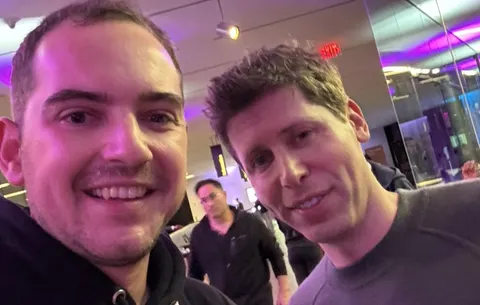
– Definitely. And robotics, AI in genetics, longevity are all topics I often write about in Digital Stories. And it’s no accident that people like Sam Altman are also investing seriously in this kind of technology.
But are there things that scare you? What could go wrong in this process of introducing artificial intelligence that would create problems for us?
– There are dozens of dystopias I can imagine. I always recommend Isaac Asimov and the classic science fiction writers—they predicted nuclear fusion, AI and who knows what else.
Many, many books of fiction, of science fiction, foresee these inventions. In part they steer people to think in that direction.
– And it’s no accident that this is a genre that has been in crisis in recent years, and in my view it has very few meaningful authors.
– Right now all the books on these topics are dystopias. They usually go like this: the world in 2100 has gone wrong in this and that way. Here’s what society looks like… it’s never good.
I can imagine the world “breaking” in many ways, but I don’t like doing it.
What interests me is how to make sure it doesn’t break. To give something good!
What worries me? The most fundamental, simplest abstraction is that bad people will have great resources in the world. What are the resources that matter today? Energy, data, access to artificial intelligence. Bad people having power is always a problem. What good people need to do is get to know AI and learn to use it, because the bad ones certainly are.
When Team-GPT came out, we had inquiries from military units, which is perhaps the equivalent of “we fight the bad guys by having more technology than them.” I stay away from such deals. But the military is always the first to mobilize when there’s a new technology.
The truth is that if we don’t take things into our own hands, the ones running the world will be the military (good or bad) and the porn industry. They’re always the first ready to jump on a new technology and use it for their own purposes. I don’t like that one bit, and if anything it frightens me.
– What frightens me is that it will make things too easy for us, that we delegate everything far too easily while we give ourselves over to hedonism and knee-jerk arguments online. Experience shows that when technology frees up our time, we don’t use it to read and write books and to get to know the world, but to scroll the feed.
Do you think we’re close to the limit of large language models? Will GPT-5 be better than 4 by as much as 4 was than 3?
– ChatGPT isn’t just a language model, and neither is Claude, nor Team-GPT. In our case it’s clear that we’re not a language model; we use other companies’ language models and add value in other ways.
A language model can’t work with files, spreadsheets, images. It’s a combination of hundreds of tools that together make up the ChatGPT product, and the language model is one small piece.
I believe that
the step taken with GPT-4 is already enough for us to build these applications that can be orchestrated and be fully capable for all kinds of tasks.
If you go to ChatGPT and tell it to write an article about Ilia Valchanov, one of its tools will look up who Ilia is and what he has said so far. Another will create images for the article. It will use additional tools to read a file—yet another technology. And in the end we create an article entirely with ChatGPT—the model has arranged the words, but it rests on the efforts of many other applications. Everything else is a combination of 10 to 20 tools.
The language model is just one piece of the puzzle—but, yes, a very important piece.
– What will artificial intelligence never be able to do? Is there anything like that at all?
– Hmm, a philosophical question. René Descartes says it will never think, because that is a human thing.
I think about this question more in three dimensions. We live in the world, we have a human body. You have to sleep, eat, go to the toilet.
Being human is much more than thinking. You have a brain, but you also have a body and an inner, spiritual life.
These three things are deeply connected. When you’re a self-aware person, when you’re happy, that has nothing to do with artificial intelligence. We keep saying, “Oh, artificial intelligence will do this and that.”
No, it will perform certain operations that are intellectual in one way or another. It may do certain things, but in the real world being human is much more than working, writing a text or creating an image.
Just like the poetry we started with. Being human means writing the verse, feeling it, trembling at what you’ve made—not churning out some text and winning some competition. To feel… that will always be reserved for humans.

Just a day after Team-GPT’s record funding was announced, Ilia was a guest on the podcast Creative Life, sharing fascinating stories from behind the scenes of the startup, from its long and thorny road, and about what the team faces from here on. Watch it also if you’re curious why it’s worth more men giving up shaving…