Who will admit that they have never searched for something online starting with the unambiguous “how do you spell…”? Only people who truly don’t care how anything is spelled, I suppose, and I doubt that people like that read Digital Stories of all things.
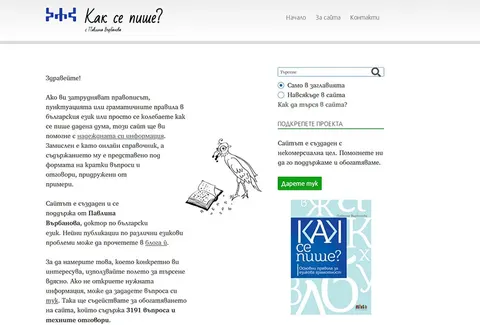
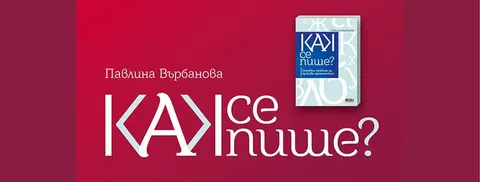
I’ll be honest: I search for something like that every day. And a thousand times I have silently sent my gratitude to the person who almost always supplies the right answer in the search engine. The person who knows how it’s spelled and runs the handy site Kak se pishe? (“How Do You Spell It?”), so that anyone can set their watch… and their dictionary.
Well, today I am meeting that person, Pavlina Varbanova. A PhD in Bulgarian linguistics, she not only knows how things are spelled but also shares that knowledge with everyone, entirely as a volunteer.
When she isn’t the superhero who rescues us from our “battle” with spelling, she is an editor and proofreader working with some of the most meaningful publishing houses. She is the author of Bulgarian-language textbooks. For 12 years she has also kept a personal blog, where she explores important questions about language.
– Today, if someone types “how do you spell…” into Google, they quickly land on your site and find an answer in no time. How was the idea born?
– How Do You Spell It? grew out of my blog. I started the blog back when there were lots of blogs, in 2009. At first it had no particular focus, but gradually it turned into a blog about the Bulgarian language; I still post in it, though very rarely. The blog has a page where readers can ask any language question they like. They ask, and I try to answer within 24 hours, but every answer takes some time. I thought it would be good to have a single website online with ready-made questions and answers about Bulgarian, mostly about spelling, punctuation and grammar. The main idea was for readers to find what they need right away.
I also noticed that whenever I look for information on the internet myself, it is always in the form of a question. So I decided the page would consist of very short posts, and people would get to the answer to their question very quickly.
Most posts consist of two or three sentences of theory and two examples. The reader gets the answer right at the start, and in a way that does me a disservice, because people see the answer in Google’s short snippet and never visit the site at all. Of course, I
am not chasing traffic (at least for now); what matters more to me is that readers reach the answers to their questions quickly and easily.
But I am wondering whether to make people actually come in and see the full answer, together with the examples. Otherwise a mistake can creep in, and besides, the user will see the explanations, learn the rule and understand why the answer is what it is.
– What are the most common questions? Which pages get opened most?
– To my great surprise, one of the most frequently opened articles is about uspivam se, “to oversleep.” It was published long ago—the site launched in 2012 with 850 articles, and that was one of them. Gradually it picked up speed, and I don’t know why; after all, it isn’t one of the most used words in Bulgarian. I am still looking for an explanation of this great interest in oversleeping.
Overall, the most opened article on the site is about imenik or imennik, the calendar of name days. Around the name days it gets shared a lot, and there I do have an answer to the question “Why?” In second place is the post about ne znam, “I don’t know”—whether it is written as one word or two. I have an explanation here too: I think people perceive it not as the negative form of a verb…
– …but as a separate verb of its own?
– No, more like a particle. Someone asks you a question and you answer “yes,” “no” or “I don’t know.” The negative particle and the verb have fused together very firmly here.
It surprises me too that “ne znam” in particular is the one most often written as a single word.
So is ne moga, “I can’t,” but much less often.
In third place comes the article on when to use the full definite article—the longer ending that Bulgarian grammar requires on masculine singular nouns when they are the subject of a sentence, as opposed to the short one everywhere else. For a long time it held first place, but it gave way under the pressure of “idunno” and the name-day calendars.
– Maybe people have despaired of the full article and given up trying to understand its logic. In online communication it simply doesn’t exist, even on sites with pretensions. All that’s left is to abolish it as a norm too.
– That rule won’t disappear from our grammatical norm any time soon. Not that it is all that necessary, or particularly useful. Ten or so years ago I was firmly convinced it would be dropped.
The rule of the full article is impractical, and non-functional too; it doesn’t do much work.
I haven’t found any purely linguistic benefit from applying it, and many other philologists share that view. Needless effort goes into mastering a rule whose application brings no substantial benefit. And this in our age, when—as never before—everyone values their effort and their time.
The rule seems outdated to me. But I don’t think it will be dropped soon, because educated Bulgarians are emotionally attached to it. It is considered an inseparable part of Bulgarian spelling, which would all but collapse if the rule were changed in any way or made optional.
If that ever happens, in my opinion only one article will remain—the short one; the full one isn’t necessary. Just as feminine and neuter nouns, adjectives and participles, and all genders in the plural, have only one article. I don’t know how many people stop to think about this: if standard Bulgarian had such a great need for a full and a short article, why does that need show up only with masculine words, and only in the singular?
I usually come under attack when I speak out against the rules (because there are actually about ten of them) for the full and short article, so I’d like my position to be perfectly clear. As long as society doesn’t agree to such a change, as long as it believes these rules are an inseparable part of standard Bulgarian, the change should not be made. But the corresponding price has to be paid—the effort of mastering them, which is by no means small.
– For me the rule does a very good job. By how well it is observed, I immediately learn a great deal about the person I’m talking to online. If it goes, all I’ll have left is my fondness for people who use the vocative form of the first names that allow it. Do you have things like that, which you are glad to hear and read but which are rarer in everyday usage?
– Some time ago I worked for a technology magazine that published almost entirely translated material. The editor-in-chief said there was a new translator, they sent me his texts, and I started reading. The man wrote very literately; here and there I added a comma or fixed a hyphenated or separate spelling. I worked through the text, read a page, two, three, five… and sensed that something was wrong with it. But what? After seven or eight pages I came across one wrong definite article and said to myself: “God, that’s it!” This man obviously had an excellent command of the rule, and only when I stumbled on such a mistake did I realize what “had been wrong” with the text.
I imagine you would have given the translator high marks on the criterion “observes the rule of the full and short article.” What pleases me is not so much individual things as a person’s overall high level of linguistic culture. Any of us can have occasional lapses.
– How many people visit your site to see “how it’s spelled”?
– According to the colleague who helps me with the technical side, only 25 to 30 percent of people actually come to the page; the other 70 percent, let’s say, use it through Google—that is, as I mentioned, many find the answer to their question without visiting the site. Otherwise, on weekdays an average of 13,000 to 14,000 users come in, with about 20,000 page views.
How Do You Spell It? has existed since 2012, so next spring we’ll celebrate 10 years. Over that decade it has won a lot of supporters and regular users who know they can find credible, reliable information there.
– In your view… how do we write online? How does creating texts today differ from good old writing as an act from the days before technology arrived?
– I haven’t tried to pin down the differences between the old kind of writing, which my generation knows from novels, short stories and newspapers, and today’s. But one of the ways they differ, in my view, is that
the old kind of writing was far more considered, while today’s is spurred on by time.
And since we are all in a hurry, that forces us, to a greater or lesser degree, to neglect the quality of the text. It happens to me too: when I write my own text, in my haste I miss a comma here, a definite article there.

– Meanwhile, in some way, it happens from the other side as well, because we increasingly read texts that haven’t been through an editor and proofreader, and we get used to the idea that it’s normal for a text to contain mistakes.
– That’s right. Texts used to go through an editor and a proofreader without fail, and they corrected the mistakes, whether of meaning, punctuation or spelling, so the reader received an exemplary text. Whereas
the reader of today encounters all kinds of texts and no longer knows what an exemplary text is; there is no model to follow.
I see that in their haste the authors of many sites—because most can’t afford an editor and a proofreader—make serious mistakes.
– In practice there are almost no sites with editors and proofreaders. And maybe we as readers no longer attach such importance to spelling, which, for me at least, is very unpleasant. An astonishing number of mistakes get through online, mistakes that even an automatic spellchecker would clean up instantly.
– True. We no longer attach as much importance to form. Of course, content has always had the upper hand in any kind of writing. But still, we should strive to clear our texts of mistakes, because they distract the reader.
When a text has no mistakes, its content is easier to take in.
– And the intended message gets across more easily; the text does its job…
– Besides, a correct text is in fact a standardized text. When something is conveyed in a standardized way, the mind processes it more easily.
– Otherwise our brain tries to correct and edit on its own, which in turn completely changes the way we take in content.
– Exactly. Today I answered a question from a reader of the site about the wording of Article 99, Paragraph 1 of the Constitution: “The President, following consultations with the parliamentary groups, shall entrust a candidate for Prime Minister nominated by the largest parliamentary group with forming a government.”
The word order is unnatural (it ought to be: “Following consultations with the parliamentary groups, the President shall entrust…”), and I wondered why a sentence that isn’t even that long was phrased this way. The reader was asking whether commas should go around “following consultations with the parliamentary groups”—and how am I supposed to answer him, with word order this unnatural? Punctuation is designed to work in standard sentences.
There may be some lofty legal reasons for the word order, but from a linguistic point of view the sentence needs to be turned around. Sometimes, even in texts like these, which ought to be flawless in every respect, a mere mortal philologist like me asks: “Why?”

– In recent years there have been positive trends too—just a decade ago almost all of us wrote in shlyokavitsa, Bulgarian typed in Latin letters. It simply wasn’t technically convenient to write in Cyrillic online.
– That really is one of the good things that has happened in Bulgarians’ writing habits—writing in Latin script has been marginalized, to use an imported word. It was branded as unprestigious writing. Maybe young people still use Latin letters in chats, but I haven’t seen public writing in Bulgarian done in Latin script for a long time.
– Why are there no other sites like yours? I think something like this could be a very successful marketing venture, purely commercially.
– Well, nobody pays for it. I don’t think it can work through ads; my page was open to advertising. I haven’t made much of an effort in that direction, but it is hard to find advertisers for a site like this.
– With How Do You Spell It?, aren’t you doing the job of the Institute for Bulgarian Language at the Bulgarian Academy of Sciences (BAS), which ought to be providing this kind of information to people?
– The Institute offers language inquiries by phone. It also has a Facebook page where readers can ask questions, probably by private message too, whereas I have switched that option off. My colleagues prefer to do their work in a different way. But the Institute’s online reference service also has short posts on language questions.
Some time ago I came across a Serbian site called Kako se piše? I think it may have been modeled on mine, because its posts are more recent. Of course, that is only a well-founded guess, but it may well be right.
– Sometimes the language gets too dynamic. Until 2012, according to the official rules, the thumbtack, gabarche, was kabarche. Does the norm in Bulgarian change too often?
– There aren’t that many words that change often, and they don’t seem to be among the most used. On the one hand, that’s good: there is less chance of getting it wrong. But on the other hand, you can’t even suspect that their spelling might have changed. Whereas if a word is used quite often and a change comes along, you are more likely to find out.
Perhaps the most glaring and best-known case is vzimam and vzemam, both meaning “to take,” which were doublets; then only vzemam remained, and people went on writing vzimam, especially Sofia natives. Incidentally, I had no problem with the word, because in my native dialect vzimam isn’t used and it would never occur to me to say it.
– Proofreaders “taught” me that these are two separate words: vzimam is for a physical action and vzemam when it’s somehow metaphorical.
– To tell the truth, there is no difference in meaning. They are doublets again now, so relax, you can’t get it wrong. The decision once again lies with the codifier, which is the Institute for Bulgarian Language, which imposes the changes. Or rather determines the changes in Bulgarian spelling, punctuation and grammar… But yes, maybe the first word was more accurate, because
the specialists at the Institute don’t like to take their colleagues’ opinions into account when it comes to codification.
– I’ve also wondered how it works: every so often new spelling decisions come out, they judge that things should change in a certain way, but nobody knows who made the decision or how.
– Yes, they say: “That’s what we think, and that’s how it will be.” I find it very strange that they don’t take into account at least the opinion of their colleagues at the universities—in Sofia, Plovdiv, Veliko Tarnovo… And there are specialists there who have followed changes in the norm for decades, who care deeply about it and have observations on how the language is actually used.
– Which mistakes irritate you most when you come across them?
– If an editor and proofreader got irritated by the mistakes she corrects every minute, she would break down emotionally.
– Besides being out of a job if everyone wrote too correctly…
– I learned long ago to detach myself and not invest any emotion when reading texts with mistakes. Of course the texts people send me for editing and proofreading aren’t flawless; they are supposed to have mistakes in them.
It doesn’t irritate me, but I do feel sad when I see a very crude spelling mistake. Especially in a word that is essential in Bulgarian. Once I saw lekar misspelled as lekyr, and I felt really sorry. “Doctor” is one of the basic, most frequently used words, a core word in any language; you learn it at level A1. Not to mention our attitude toward that word these days…
– Forgive me, I can’t skip this worn-out question, but in technology the issue of foreign borrowings really weighs on me. On the one hand it’s unavoidable, because the terminology often simply “has no translation.” On the other, when I hear someone say they’re going into a miting—in Bulgarian a “meeting” is a protest rally—I wonder who they’re demonstrating against. Or that they “have a kol”—a kol being a wooden stake… That makes me think of Baba Iliytsa, the heroine of Ivan Vazov’s story “A Bulgarian Woman.” Do you think we overdo the borrowings?
– Yes, but that “meeting” or “call” often has a very specific meaning. It isn’t just any conversation; it is specifically an online conversation.
On the whole, it depends on where the communication takes place. The use of borrowings, like that of all other linguistic means, depends a great deal on the situation we are in. On the topic of the conversation or the statement; on the participants; on whether it is formal or informal. So the use of borrowings should simply be appropriate—that’s my view.
Naturally, on a programmers’ forum they will probably use many more borrowings, simply because that is their terminology. If one of them tries to replace them with Bulgarian words, he risks, first, being misunderstood and, second, being laughed at by his colleagues. Clearly we must above all take into account the situation we are communicating in, as well as the topic of our conversation. I would say that those who most need to be careful with borrowings are public figures, people in public life, politicians, because it is very important for them to be well understood. For their messages to reach a wide audience. After all, especially in politically turbulent times like these, politicians ought to send clear messages to the whole nation and to their voters.
– And yet they don’t. In recent decades a spelling mistake by someone in a position of power has often turned into a scandal, and lately the fashion has spread to official letters too. Well, they don’t care about spelling, and that doesn’t surprise me at least.
It’s somehow a convenient way to discredit someone, to say they wrote “farewell” with the wrong letter or that they conduct official correspondence full of spelling mistakes. So society is evidently still sensitive to this, since it pays attention?
– It is sensitive. And I think that at least MPs and politicians in higher positions can afford it—they have enough resources, including funds allocated specifically for such purposes—to use the professional services of philologists, editors and proofreaders. It is high time they calculated what they lose when their official letters appear in public with serious mistakes.
Nobody expects MPs to have a very high command of Bulgarian spelling and punctuation. But we all expect them to use the services of people who are competent in their fields.
If they are badly advised by incompetent people, they will make the wrong decisions about the health crisis and about the economic challenges facing Bulgaria too, which are far more important by now.
– As an online person, how do you see the future of the Bulgarian language in the digital environment? Will it change drastically, will it lose its character?
– I don’t know exactly what will happen. So far I don’t see any threatening trends. The essence of a language is carried by its grammar, that is, its morphology and syntax. By the way the words themselves change, the way we conjugate verbs, add articles, link words into sentences. I don’t see any threatening trends there, although in syntax there are already constructions influenced by English.
Still, the grammar at the foundation of every language remains solid. What worries us is the visible part, the vocabulary, the fastest-changing part. During Ottoman rule, Turkish words entered Bulgarian en masse; then, after the Liberation of 1878, came Russian words and vocabulary from Western languages. Lately, clearly,
English words—some prefer to use military vocabulary—are invading.
No, they are not invading. They aren’t attacking us; we ourselves slip them into our speech, because in certain cases they turn out to be more convenient, and sometimes they express our thoughts more precisely.
– So the problem comes when it’s done for its own sake.
– Yes, it’s irritating when it’s done deliberately. Many years ago I attended a conference. One of the speakers stubbornly used borrowings, and it was obvious he wanted to show off how many foreign words he knew. Everything should be done in moderation, and that goes for borrowings too.