When is the right moment to introduce children to artificial intelligence, and what is the best way to do it? I admit I am still looking for my own answer, which is why I sat down for today's interview, to keep searching for it together with my guest.
Nikolay Tsonev chose to walk away from a successful IT career abroad to bring the international programming school Logiscool to Bulgaria. The system, which helps children aged 6 to 18 get their hands on computers, is already present on five continents. But… now that AI writes code better than we do, does it still make sense to learn programming, and why? It definitely does, and here's why.

– I wrote a long series of Digital Stories about how we introduce children to technology. And yet, as a parent, I still wonder when the right moment is to show them what artificial intelligence is capable of. Nobody is prepared for this, because it is so new and unexpected, and it is nothing like what we had imagined. You teach programming to children, so I'm really curious about your point of view.
– We are the pioneers, the first to face this topic as parents, and there is no experience to build on. But that is also a good thing—something new and different is happening.
In my view, one of the important things is to be together with the children as they take their first steps. But that goes for everything—cybersecurity, for example. We know it's a bad idea to write our passwords down on scraps of paper, or to use the dog's name and our birthday. But if a child doesn't see a parent using a dedicated app, changing and strengthening their passwords, there's no way for the child to take that as an example.
Work with AI starts from the same place. What's needed is
a harmony in which parents sit down with their children in a spirit of cooperation and shared involvement, to “try it together and see.”
I think that's the most important thing, but the question is how prepared and informed the parents themselves are about what AI is and how it works.

– Absolutely! Most of them aren't, but it's not their fault either—everything in the tech world simply changes too fast, and nobody manages to keep up.
– A parent needs to show and explain a few basic things to their child. First, how an artificial intelligence makes decisions—that it is, more or less, a statistical process, not human thought. It looks at what the general opinion is, what various sources say, and then answers. But it's an unemotional decision based on some kind of statistics.
Children also need to know, and be shown, that artificial intelligence can make mistakes. There should always be a measure of reflection about what is happening in the conversation with it—why it answers in a certain way and how it can be used.
I believe the first step has to come from the parents; the example has to come from them.
But how should they prepare in the best possible way? Well, by using it more!
I work with children every day, and you can immediately tell which ones get attention on these things. It shows when a parent sits down and does something with the child. It's like buying a Lego set.
What matters is that you sit down and build it together.
That's the “wow” moment; that's when you show why you're doing it. That's what guidance is.
– But shouldn't we also be thinking about some restrictions? With phones, we concluded that they should be banned up to a certain age; with social media, more and more countries are going the same way, and the age limits are even going up. Isn't it time to decide that AI is completely off-limits until a certain age?
– Certainly. But what age would that be?
– That's exactly why it's hard, as we've already seen—it took 10, 15, 20 years to settle on any kind of norm for mobile phones and social media. Today we don't have that much time.
– If we put the question that way, I'd say the norm is like the one each family has for using the phone. I don't think we should box it in with rules; they don't always work for everyone. But in my view, whatever the phone rules are in a given family, AI should perhaps be the next step up.
With handing over a phone, we know it's normal to start with restrictions and then ease them as the child earns it. Everything happens gradually, and I think it should be the same with artificial intelligence. I don't think there's a clear-cut answer, but parents also need to see how the child perceives AI. How well they understand it, how quickly they learn, how they work with it.
Sadly,
children these days don't ask many questions.
For example, “what is this artificial intelligence thing.” A friend of mine has kids in third grade, and I've heard them come up and say, “Mom, ask Gemini.” That child doesn't have a phone, but knows there's some Gemini out there who gives answers. But where does it come from, why should you ask it, how should you ask it, and how far should you trust it?
That's a chain of connections the child has made based on the parents' conversations, on things heard somewhere. But today many children don't ask questions like “why do we have light,” “what is the internet,” or what artificial intelligence is. They take them as givens. I think it's good to go down this road, question by question, step by step.
Here's one, for example—that it is always positive. That feeling can sometimes be strange, and children start expecting it from people out in the world, who aren't always like that.
Of course, not everything is in the parents' hands. In my view, first they should sit down and show it, do it with the children, and second, make sure they get expert advice from the right sources. I think that's the combination without which you can't get the full picture.
Not every child needs to become a programmer, but they definitely need to see behind the scenes, to understand how technology works and then what artificial intelligence is. How it functions, how to use it, and where its limits lie.
– Sadly, that sounds a bit utopian to me, given that only a very small share of adults ask themselves all these questions, let alone get to the point of passing them on to their children. But couldn't it happen the other way around—that they understand better and faster than we do, find their bearings, and set the limits of what artificial intelligence can do?
– They certainly develop much faster today, because they have so many different opportunities. Sometimes it's frightening for parents how quickly children manage to adapt. But this is the meaningful path that has to be walked. Without the basics, it can't work.
It's like that with everything. Say we're learning something new, like playing basketball—one group makes no effort, another only watches how it's played, and a third only practices. The third group, of course, will be the most capable. The second will come after them. But even stronger would be those who both watch and play. Can't we do something similar with AI?
Being a parent is actually quite a big responsibility that nobody is prepared for, even less so nowadays. We have big questions to ask ourselves, and there's never enough time.
– I also spent a long time wondering how to start showing it to my older son, who is 8. Because we talk about these topics a lot at home, at first he seemed to have a negative attitude toward AI without understanding what it was. That changed when he wanted to make a presentation about his favorite books. I showed him what lovely pictures it could make, in which he becomes a character from those favorite books:
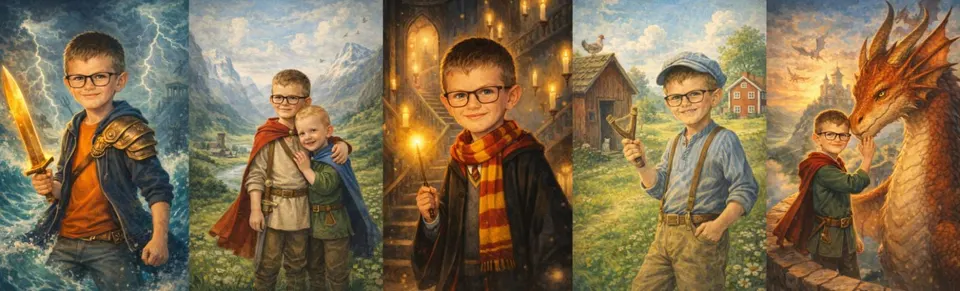
So perhaps trying to break away from the stereotype is some kind of salvation. When we don't have time for everything else, or we get lost in the sea of information—we improvise.
– There certainly has to be a measure of improvisation.
From experience, I see that programmers' children have the hardest time learning from their parents.
But every parent knows their child best. And look, in the end you found a way to show him what AI can do, and you did it together.
Next time it could be: “Let's see what AI writes for us on a given prompt, and then talk it over.” “Let's have a dialogue, or use AI to simulate some situation. What would happen if something occurred?” That's how we broaden our horizons.
The way of thinking becomes even more relevant.
Children need to be able to think, because the routine part of work keeps shrinking. The labor market is always changing—with the arrival of digitalization, of industrialization.
AI can take the jobs, at least from my point of view, of the people who can't use it.
– Allow me to disagree; the times are far more unpredictable than that. AI has already taken my job once, for example.
– True. We keep finding more and more applications; there's no profession where it isn't used in some way. What's left for us, in my view, is to start using it in a meaningful way, so that it helps us rather than hinders us.
But we have to learn to think logically. That's the foundation of programming. It develops an enormous number of skills in children. Our methodology has been designed by educators so that we develop soft skills too. But at the root of everything is teaching them to think.
Adaptation, logical thinking, sequencing, sketching out the big picture of what needs to happen and how it needs to happen. These are the things we need to spark in children.
That's why it's also important to teach them that AI can help us with many things, but it won't achieve our results for us. It will answer the question we've asked it. But we need to know what we want to achieve with that question. What the end goal is, what the final result is.
This needs to be talked about more.
– Absolutely! That's what I've been trying to do publicly for five years now, and I still feel lonely; our industry isn't having this conversation in any way either. But when we show children AI, the big problem of the easy way out comes along too. Okay, it helps, but then why should I struggle to do my homework? I think even we adults find it harder and harder to motivate ourselves to do something on our own—to write a text or code—when technology does it better. And yet we have to instill it in children, so that basic skills don't wither away. How do we keep convincing ourselves that we need to make the effort?
– AI can do my homework for me. I'm not an expert, but I'm sure that
education itself has to change, to fit the times we live in.
To become more independent, less static. More adaptive, built around scenarios that are played out with the children. I wouldn't say simply practical, but more interactive. The way we learn needs to change.
It used to be that our goal was to memorize the whole textbook, all the dates, so we could reproduce them afterward, so we'd know them. Right now I'm not sure that's exactly what children need.
– But they need that too. I ran an experiment two years in a row with models taking the matura, Bulgaria's school-leaving exam, in Bulgarian language and literature. Yes, they do better than the vast majority of students, and the exam probably doesn't adequately measure the skills that are useful today. But isn't there a risk that we'll lose sight of the importance of the knowledge that makes us human? Shouldn't the education system also be conservative at the same time, since in some way it has to hold on to the fundamentals?
– That's right, it keeps us grounded. I'm not saying children shouldn't know all of history, but the way we teach it to them has to change. Yes, they need to know what happened in the past, because it carries many facts about the present. But it has to happen in a sensible way.
For example, while we integrate AI, not to be static, and for every question to be answerable with facts. To be more like a game with different rules. For children to learn together, for it to be more adaptive.
I'm not speaking as an expert in public education, but I believe the way I learned decades ago and the way today can't be the same. The system has to change and adapt. How? I think there are quite a few directions.

– And we all believe it—I ran a survey on this too, with telling results. And yet change is a matter of public conversation, which still isn't happening.
– These questions have to be asked, however uncomfortable they are. We ask them too—what's changing in the programming courses, in the way children learn with us. A program can also be written by AI, but the program isn't what matters; what matters is that they achieve the result and can explain logically what happened.
We have to adapt. Either we deny it and don't do it, or we bring it in—even if we make mistakes at first.
More and more is being written about children using AI as a best friend or a therapist, but it depends on your point of view. Many children wouldn't have the chance to see a therapist, even though they need one. Quite a few studies show that the data and models such an artificial intelligence has access to nowadays are actually pretty good, and it can give relevant advice to that child.
But here again, in the end, it comes down to the child being prepared and aware of who they're actually talking to.
– But why do you think it still makes sense to learn programming now? Programmers have stopped writing code, especially over the last two or three months. For now, it's useful for spotting bugs and designing the architecture of applications. But won't that soon become redundant knowledge too, which we'll also delegate to technology? Maybe programming is already a vestigial skill we no longer need. Why develop it in children?
– As I said, I think the most important thing is to teach them to think. If there's a better way to make that happen, wonderful. Maybe programmers are changing, and the way they work too, but the architects themselves, the ones who define the vision, the end goal, the model, are still around.
It's like learning math—not to become calculators, but to understand how formulas work, how we can use and analyze them. Everyone learns math to be able to understand the world around them.
– Besides, programming is an interesting pursuit—I discovered that at 34, because the education system had never introduced me to it.
– Programming develops 12 skills in people. Not only programming, of course, but it gives soft skills, academic skills, a way of thinking, of expressing yourself, sequencing. In the real world, we might skip three steps if we have a long stride. But in programming, in most cases, that won't lead to a good result.
It's a way to teach children to think sequentially, not to skip steps, because the computer executes the commands, and AI answers your question.
And how to ask better questions isn't discussed much in the context of AI either. It's one thing to ask “is it good or bad,” and another to ask the right question in the right way, so you get what will actually be useful to you.

– Prompt engineering for first graders, in some form. Yes, for now we really are needed as architects, we need to understand the processes, but with the progress we're seeing, we may very soon not be needed in that role either. How can we prepare children for that moment? There I have no answer at all.
– Neither do I. We have to adapt, to teach children to be adaptable, to be able to judge what's happening and react.
Right now you really have to ask yourself questions. “Okay, so what happens if AI isn't there tomorrow?” We need to develop those skills in children as well. That this is something that exists right now. It will evolve, it will develop in some direction, and we have to adjust so we can use it.
– The bad thing, I think, is that paradoxically, the more adaptable we need to be, the less adaptable the generations we're raising are becoming in their everyday lives.
– We see it in many areas. When I was a student, we studied English, but it wasn't enough, and we had to go to extra lessons. When I look at how many English schools there are nowadays, I ask myself: why haven't we realized that English is fundamental to so many things? Why don't we do it at the state level—raise the school system to a higher level so children don't have to go to extracurricular classes? Given that we're sure it's an important skill. It's clear that everyone today needs to handle English at a pretty good level, even just to find information, to watch things, to grow, never mind entertainment. So why?
It's similar with technology. It develops very fast and offers enormous opportunities. Children nowadays can make an augmented reality game, use 3D glasses. They can program and, at just 12, create the game they play themselves. The education system, at every stage and level, can and should use it much more fully.
Children who have access to programming, even if they don't become programmers, will always be a step ahead, no matter what they do later. Whatever platform does the pure programming for you, you'll be a step ahead of the others if you understand what's going on and can model it.
– With the help of AI, today you can also write programs without knowing any code at all, to make some task easier, whatever you do for a living. But it has to occur to you, and you have to know it can work that way.
– And for children, besides it occurring to you—you need the opportunity to see it. That's why I don't think learning programming will become unnecessary… and not only programming. We're talking about it, but it's really logic, digital skills, digital education
Those are actually the right words, and sadly, every time I say them, many parents don't get it—“my kids are already digitally literate, they're born with it.” That's not enough. What I put into the term includes the limits, the good and the bad examples, and how technology works. That's digital education. So you can explain to yourself everything that's happening.
Besides, when children encounter digital skills together with other children who want to do it, they don't run into other unwanted things. When children with similar interests come together, they'll keep pushing one another forward. What could be better than that?