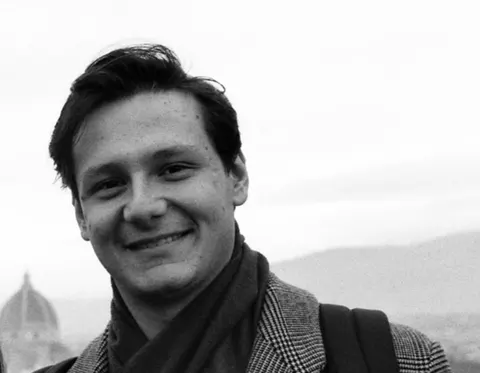
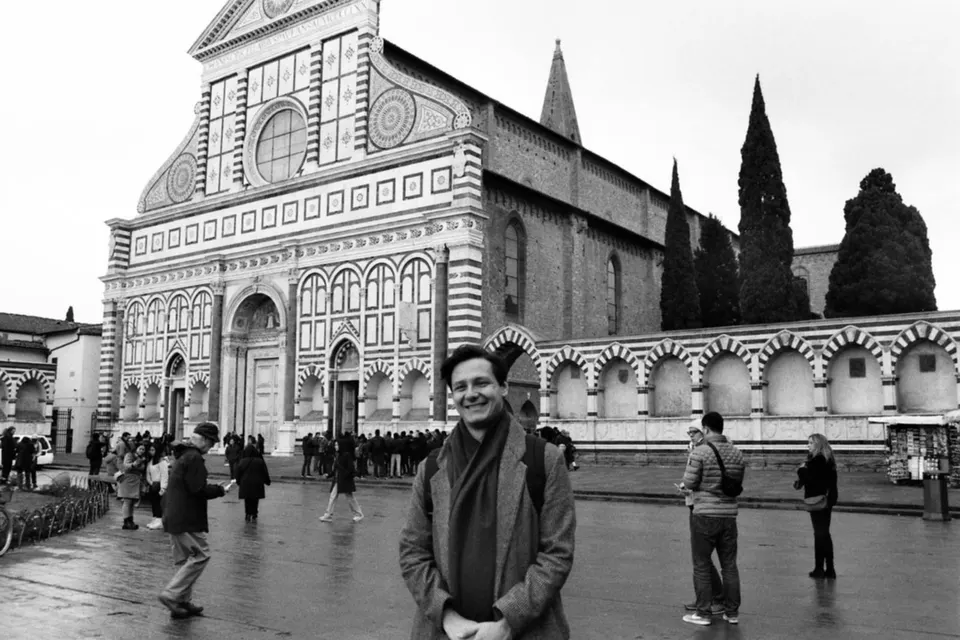
If anyone can compare how the knowledge of Bulgarian language and literature is developing, both in high school graduates and in AI, it is today’s guest.
For the second year running, Mr. Svetoslav Stoychev took part in the Digital Stories experiment in which we tested how the newest AI models handle the state school-leaving exam, the matura, Bulgaria’s school-leaving exam. What’s more, he helped the venture grow, bringing in two real graduates and producing results that were more than curious.
It’s time to discuss them, and also to talk with the young teacher from NPMG, Sofia’s National High School of Mathematics and Natural Sciences, about what students’ love of books looks like. Is artificial intelligence changing our attitude toward exams, toward education, toward literature? What do today’s high schoolers read? What draws their eyes to books? What makes a young person burn for the teaching profession in the age of artificial intelligence?
– Do your students know what AI is? Do they use it actively?
– They know very well, and they use it. And let’s not kid ourselves, most often it’s to
cheat wherever it’s very easy to use, or where they can’t be bothered, or where they don’t like the teacher.
With me they rarely try, because I don’t often give big written homework assignments. And when I do, they get plenty of time. My assignments are usually like this: we work with the text in class, we get to a certain point, and I give them a question just to think about—they don’t have to write the answer down. It would take them longer to feed it to some model, then process it, give it extra instructions, than to simply think it over for 10 minutes on the metro.
– Besides, you teach at a high school where people are expected to be more interested in the exact and natural sciences.
– Yes, but they’re interested in everything.
Kids are simply curious.
They might use it if I asked them to write an essay, a thesis, or an interpretive composition at home. But here’s the other thing: I rarely give grades for assignments like that. I grade them when they speak in class, when they discuss, when they argue their case, and on written tests. And on specific projects, where I insist that they also use classic sources.
For example, in ninth grade I have them make presentations on different currents of modernism. And the condition is that at least two of the sources must be an article or a book—something you can find in the library. Even if they use the chat, they have to show me exactly which part of the presentation is taken from which source. It can help them, but they still have to do some of the work.
– You say kids are curious, but public opinion seems to be different… Does that apply only to your students?
– I’m an optimist, and I don’t think for a moment that kids are worse than before or less curious. I’m not talking only about our students at NPMG, but in general.
– Something like the myth that they don’t read. Kids read like there’s no tomorrow, we’ve talked about it here too. You can see it in the bestseller lists, which always feature influencers who are obviously not what the over-70s are reading. But how do we teach them what to read? Something a bit more meaningful than the influencers…
– That’s a very hard question. I think this is exactly where the teaching of literature at school plays a role. And now we come to some very serious problems; colleagues, friends and I think about these questions a lot, and they’re very complex.
In my view,
the big problem with kids’ reading comes in middle school, between fifth and seventh grade.
It seems to me, and the results of external assessments show it too, that our primary education is at a very high level; kids up to fourth grade are great. Very curious, they want to learn, to read, they find it interesting. Hardly anyone drops out.
But something happens in middle school, so that when they arrive in high school we have to motivate them all over again to learn, to find it interesting, to read,
to stop caring only about the grade and simply want to learn things.
– Isn’t that mostly tied to the curriculum?
– My opinion is that
in middle school it’s not the literature teacher’s job to teach a whole pile of stylistic devices, to teach them what a synecdoche or an oxymoron is.
I don’t think it’s very productive for them to study a hundred works by Ivan Vazov at that age. Studying Hristo Botev, Peyo Yavorov, Under the Yoke in middle school… even the language is a huge barrier. Incidentally, that barrier disappears in 10th grade. Then they study these authors again, but now they can understand them and they like them.
It seems to me that from 5th to 7th grade the curriculum should actively push kids to read. And to read things that suit their interests and their age—let’s not lose them as readers.
Literary history, terminology and theory should come later, in high school, when they’re mature enough. Of course, I don’t think all that knowledge should be dropped; we need it as people, it’s also how reading taste is built. That’s how they encounter different texts, including some they would hardly read on their own, and discover them.
– Are there books you loved in high school that your students love now too? And ones that have appeared in the meantime? What do young people today really read, apart from the influencers?
– The influencers are mostly with kids from third to fifth grade, between 10 and 12 years old. With the older ones, what I notice in 8th–9th grade is that they read books with very colorful covers. That’s fantasy, romance, and something mixed that’s called romantasy.
In eighth grade literature feels distant to them, a bit difficult. That’s normal; at 14, the Iliad is quite a challenge. But in 9th grade, once they get to know the great novels, most students, at least mine, start changing their taste. Many of them like Balzac’s Père Goriot, they like Eugene Onegin.
From there on they start reading classic science fiction and fantasy—Tolkien, Robert Jordan, Douglas Adams, Terry Pratchett.
On the other hand, they read a lot of 20th-century literature—Remarque, Kafka, Russian, even Bulgarian literature, though rather the more classic kind—Dimitar Dimov, Dimitar Talev. Many students, when they have to read The Iron Candlestick in 11th grade, really like the book and go on with the next ones. Even though they aren’t in the curriculum and aren’t required, they simply want to read the whole tetralogy.
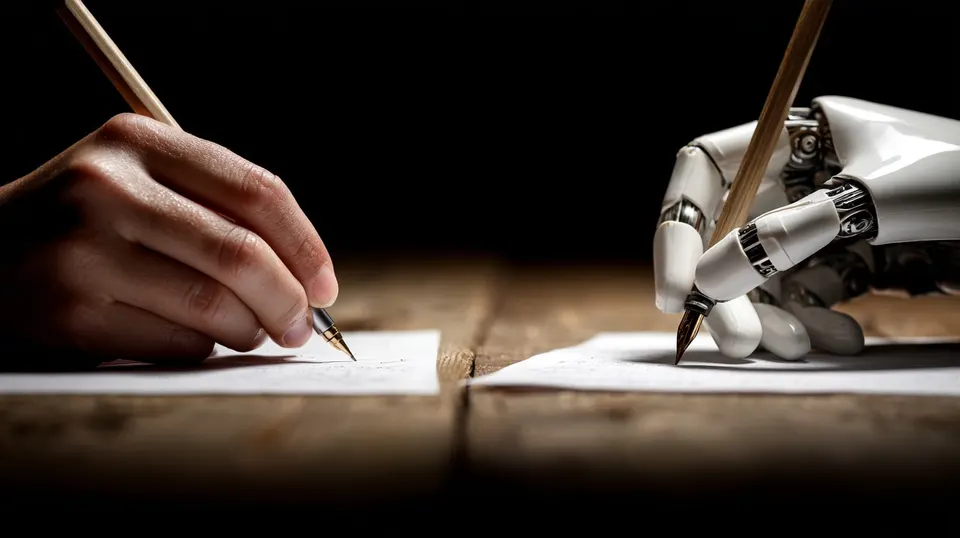
– You really surprise me with what you’re saying. That’s putting it mildly—you’re actually changing long-held stereotypes of mine, and we’re talking about students at a math and science high school. On the other side there’s the problem of concentration: fewer and fewer people are able to focus long enough to read a long text, let alone a novel. Are your students an exception, or are we overestimating this effect?
– It certainly exists, and I think the problem will get worse with the next generation. My students, the class I teach now, were born in 2008. They entered the world of TikTok at a slightly older age. Whereas with the kids being born now, I notice that en masse, before they can even really talk, they’re already in that environment. For them it will be the more serious problem. I think we’ve yet to face it.
But even now many kids expect that if they sit down to read a book, it will become super interesting from the very first page.
If they’re the kind who aren’t in the habit of reading, you have to convince them to give the book a chance, to read 40–50 pages, to get into the atmosphere, so that it becomes interesting.
But if they push themselves to do it… as with everything in life, to like something you first have to push yourself a little. Then they manage to overcome the concentration problem.
– But for that you have to choose and recommend the right reading. My older son read all 8 Harry Potter books before he had officially learned his letters in first grade.
– Harry Potter never goes out of fashion, which actually shows the book is good. For me that raises the question of why it still isn’t in the curriculum. Because it seems to me that when they study something they love at school…
– … it’s easier and more interesting.
– Especially when they’re younger! By 14 or 15 they’re sensible enough to realize that not everything you have to learn will be to your liking. That there are things you have to learn even if they’re not especially interesting or pleasant. But when you’re 12 or younger, you don’t realize that. I don’t see any problem at all with studying Harry Potter at school.
– Definitely! Let’s turn to our joint experiment with the matura—a year ago and now. There were many curious and varied conclusions, but every time you manage to tell which paper is AI’s. How?
– Last year there were only two papers—yours and ChatGPT’s. Yours, as the work of someone who does this and writes for a living, stood out very quickly, so the other one had to be the chat’s.
Now, with more papers—three AI models and two students—it was a bit different. But the students’ papers are easy to recognize too. When you’re an active teacher working with kids, there’s no way you’d mistake something written by an 18-year-old for something artificially generated or written by an adult.
So I had no trouble with the recognizing. But I have to say that
compared with last year, I was struck by how much cleaner the models’ language has become.
They’re working with better and better Bulgarian. This year’s experiment was definitely more successful at making the papers look like a living person’s.
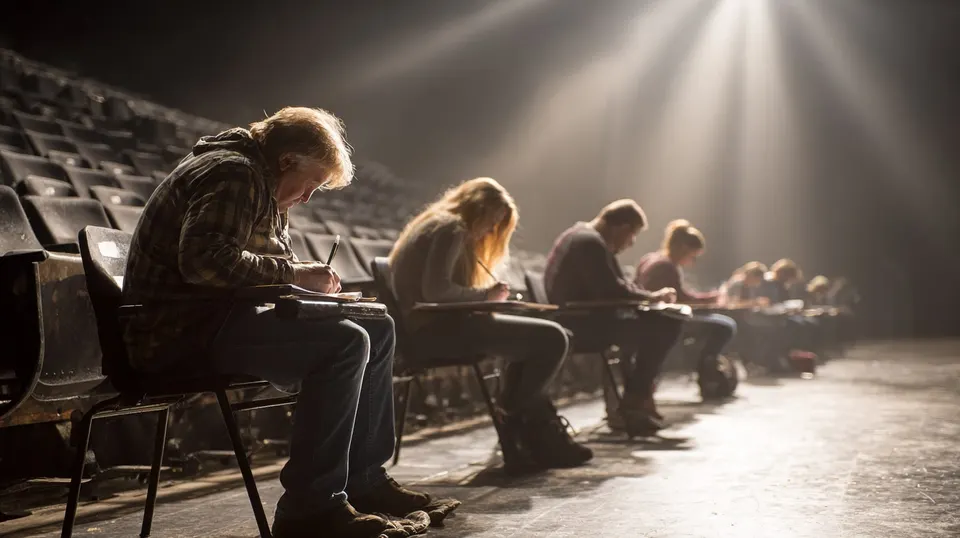
– And all 6 went for the interpretive composition format. I think that if they had been essays, it would have been harder for the two of you graders.
– Definitely. Not that there’s an exact formula for the interpretive composition, but it comes with somewhat stricter frames, which the essay lacks. With an essay, if it’s really well written, I can tell you as a grader that you don’t look at all at whether there’s an introduction, a conclusion, how many arguments there are, whether the thesis manages to develop the points of the argument consistently, precisely and in a structured way. If it’s well written, has no internal contradictions, or at least no glaring ones, and the language is good, you give a lot of points. In general the principle of grading is not to take a formalistic approach.
– So we shot ourselves in the foot, the models and I. I let them decide what they “felt like writing,” and they picked the interpretive composition, but it won’t happen again next year. As far as I understand, though, you think that if you got a text at school, you could tell whether it was written by a student or by AI?
– I could, yes. Recently a student missed a test—he was absent, then I was grading matura papers, then he was absent again. Quite a lot of time passed, and he took the test around mid-June. At the end of the year we deal with presentations, projects, finishing things off; I wasn’t actively teaching, I was at the back looking at projects, then doing oral exams—the lessons were a bit looser.
Especially when they’re your own students, you know how they talk, how they express themselves, how they write, and it’s quite hard to fool you that they wrote something when you can’t see their manner in the text. In that test I couldn’t see any trace of the student who wrote it. I graded it the same day—I had no other classes after that one—and I started to suspect that something wasn’t right.
There were things that made absolutely no sense. For example, one of the tasks—a thesis on “Albena,” Yordan Yovkov’s short story—he had written very well, in very elevated language. But… it contained things that aren’t in the story.
I pulled him out of the class he was in at the time, gave him a sheet of paper and told him to write the task as he had an hour earlier—it didn’t have to be word for word, but I wanted to read the same ideas. He couldn’t, and he admitted he had used AI.
– That’s because he used it in the crudest way. There are so many approaches where you don’t get caught. Rewriting it, having it just summarize the work for you, playing with the prompts and refining them several times…
– When you’re under pressure, in class, with little time, trying not to get caught, you can hardly play around with it so that it’s unprovable. But yes,
if it’s a homework assignment, then it’s very hard, because you can’t prove anything.
It happened to me when I first became a teacher; I was substituting at another school and we were online. The moment I suspected that a paper hadn’t been written by the student, I searched for key quotes and immediately found where it had been copied from. That’s easier to catch, whereas
with this generated text, even if I put the whole thing into search engines, nothing will come up.
– Exactly! The conditions are changing drastically. After generated poems ended up among those chosen by two successive juries of prestigious poetry competitions… Are there situations in which you encourage students to use AI?
– So far I haven’t used it in class or encouraged them in any way, but after going through a training course and after our experiments, I’ll think about some tasks, options, classwork for next year—so that we can see the benefits too.
– For the past two years I’ve been taking the matura, and I can’t comprehend how anyone who has done at least a little in those 12 years, without some serious health problem, could fail to score 30 points. And it happens to entire classes and schools. Shouldn’t we raise the requirements?
– I agree that the bar is low, but still, this is the most widespread exam. In fact, it’s the only compulsory mass exam!
I’ve thought about it too—the bar is low, it’s easy to get a 3, the lowest passing grade on Bulgaria’s 2-to-6 scale. But what would we prove and what would we achieve if we set the 3 at, say, 50 percent? The average grade would be 2.40.

– Then what’s the point of the exam?
– I think it’s a useful diagnostic. You can’t solve any problems with it. It’s simply an exam at the end of the whole of education, and if you fail people, how are you helping them, what are you telling them?
The problem should rather be sought elsewhere.
The diagnostic shows a problem, but the solution isn’t to make the exam impossible so that no one can pass it.
– The solution is to improve education, which I don’t think we’re doing actively enough. And over 90 percent of parents share that opinion.
– I should also say that the current format of the matura is much better than the previous one, because
a 3 may be easy to get, but a 6 is far from it.
A 6 is relatively hard to get. That way you can both pick out those who are really very good and have studied, and avoid telling those who for one reason or another didn’t do very well that they’re good for nothing and should be thrown out.
– Should we then test everyone on whether they know Bulgarian language and literature well?
– They certainly need the language. In my opinion they need literature too, because it develops skills that aren’t visible, practical, on the table, but are necessary.
For example, the new format of the matura, and the trend is going further in that direction, relies heavily on working with an unfamiliar text. We live at a time when social networks flood us with all sorts of things—dubious information, dubious images, videos. I’m both amused and terribly saddened when I see on Facebook an obviously generated image of some old man with a cake getting thousands of comments, people wishing him a happy birthday without realizing he isn’t a real person.
I think that when you make students work with an unfamiliar text and think critically, you’re preparing them, giving them the skills to find their way
on their own later in an environment where you need to be able to think critically and sort out by yourself what is true, what is a lie, what is unconvincing, what is manipulative.
– The question is also whether you want that, because AI handled this part of the matura absolutely flawlessly—making sense of an unfamiliar text is something it does successfully.
– It manages, but the point is that students have to manage too.
– Or maybe learn to ask it? Does the news that AI can ace the matura with ease change anything, in your view? Is there any reason why this should be our main assessment of young people finishing school? Many of the questions are about cramming. The closed questions I get wrong are mostly about specific works that I either never studied or have forgotten.
– I don’t agree that many of the questions are about cramming; there’s only one, in my view. The others rely on interpretation. You don’t know what interpretation the tasks will offer you, so you can’t sit down and cram, say, an analysis.
To solve most of the tasks properly, you’re expected to have really understood the text. To have your own interpretation, to be able to think if an alternative interpretation is offered to you. That, I think, is exactly how such skills are built: thinking critically, not counting on the idea that once you’ve crammed this analysis by heart, nothing can surprise you from then on.
– But does it really make sense to test skills at which algorithms do better than the vast majority of people?
– Algorithms could do everything.
– Is there anything you feel the matura is missing right now?
– I would add more tasks that test skills. Working with an unfamiliar text, with different types of texts, including analysis. I think
it would be very useful if the exam format included the analysis of a media text.
There are already communicative tasks; this year’s was about doing sports. It seems to me that if it were a media text dealing with a really serious social problem, one that interests the students, it would be meaningful. But I realize that right now this is impossible; our society isn’t ready, and education is too often used to achieve certain political goals or to sow discord.
For example, if it dealt with the problems of division in society. Or with fake information. If students were given some article, say generated by artificial intelligence, manipulative, and required to analyze it. But, again, that’s my ideal scenario, and I don’t think it could happen any time soon.
– One thing I liked is that subjectivity really has been reduced. In my day, to get into a sought-after program at Sofia University with the Bulgarian language and literature exam, it was definitely very strong. But here, in our experiment, there was still a considerable difference on the interpretive composition, specifically on mine—one grader gave me full marks, the other far fewer, because it isn’t an essay.
– Yes, here I disagree with my colleague on one thing. When you sit down to grade a matura paper and you see a text that is well written, where the writer obviously knows the text well, comments on it properly, is original—you give points. Lots of points.
Because that’s what is being assessed. I don’t think it’s right to cut a text down because it’s closer to an essay than to a composition. Provided the text is really good.
– But I invited ChatGPT to be the arbiter, and it was on that side too. And I’m not sure I wouldn’t be—we have an exam with clear rules, and whoever wants a free form is welcome to write an essay.
– If it went to a real arbiter, I’m almost certain they would give lots of points. I try to grade papers that way, and I believe that
when the text is good, we shouldn’t nitpick; we should simply recognize that the person is original, that they can think, write, that they know the work.
All sorts of cases come up at the matura. For example, a student first writes an interpretive composition and then writes an essay underneath. What do you do, which one do you grade? It’s graded in the student’s favor—whichever of the two is better.
And if that’s how it is in that case, I don’t see why, if the text is really good, you should take points away because it’s a bit more essayistic.
– Lately I’ve been increasingly glad of human subjectivity; sometimes it’s our strength too.
But let’s abruptly change the subject again… Why did you become a teacher? Young people are fleeing this profession, I don’t know if you’ve heard… I’m joking, of course.
– I know, yes. But it isn’t quite like that. At our school we’re noticing that the staff is getting much younger, and the reason is that there’s a gap. People who became teachers at the end of the 1980s are retiring now. Only, in the 1990s, and after that too, we know what level teachers’ salaries were at—terribly few people became teachers back then.
Now other people have to come in to replace those who are retiring. You can’t do without teachers.
The problem, though, is that the changeover is happening very abruptly, and that has its downsides. Suddenly we’re going from teachers who are mostly close to retirement age to people who are mostly under 35.
But that’s the situation now; that’s how the education system in the country has developed.
Why did I become a teacher? I was lucky to have good teachers in high school, and even then I decided this was what I wanted to do. I wanted to be in their place.
I enrolled in Bulgarian philology and tried substitute teaching as early as my second year. And the moment I stepped in front of the students… I won’t comment on how nervous I was before I went in, but the moment I did, the nerves vanished immediately and I felt very much in my place.
That’s how I decided this was the profession for me.
– What gives you satisfaction as a teacher?
– That the work is anything but monotonous. It doesn’t drag you into a routine, and time flies. It’s nice that it flies…, on the other hand, before you know it, an awful lot of time has passed.
– Like in Catch-22: if you’re bored, you’ll have more time.
– Yes, exactly. When I started at NPMG, one of our chemistry colleagues told me: “In our profession you’ll see that time flies. Let this term pass, then the year, then this class, and suddenly, like me, you’re not far from retirement.” I didn’t believe her, but… I’ve been at NPMG for 3 years now, and I have 4.5 years of teaching experience in total. Time has flown. I didn’t feel it at all. It’s as if I started work the other day.
Every lesson is different. Even when you teach the same thing to 4 classes one after another, the lessons aren’t the same. The kids constantly ask you challenging questions. Every now and then you have to check things at home so you can answer them. It gets interesting. Sometimes they offer solutions that hadn’t occurred to you.
So it’s actually dynamic work, and you don’t get stuck in a rut.
– … then perhaps it’s no surprise that today teaching is actually one of children’s dream professions! Thank you for your invaluable help and for a thought-provoking conversation. I’m sure the most interesting experiments are still to come!