Finding a way for the most high-tech industry of all to help the people who need it most, while companies profit from it at the same time… it sounds downright unbelievable.
Technology creates astonishing opportunities for solving our biggest problems as a civilization. For providing resources for everyone, for restoring justice where it is glaringly absent, for helping us as a species to keep going…
It sounds like a utopia, but there are inspiring examples showing that sometimes the line between utopia and reality comes down to how well you have drawn your dream and whether you are ready to fight for it.
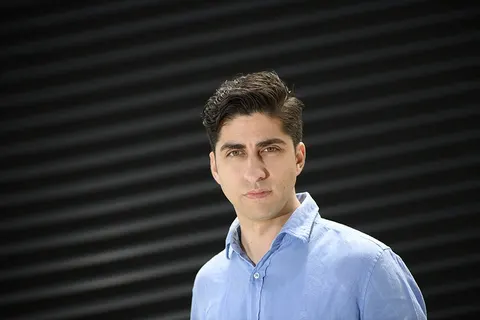
Iva Gumnishka graduated from an Ivy League university in the United States and came back to Bulgaria in 2013, determined to fulfill her dream: to find a way to help people while building a long-term, independent model.
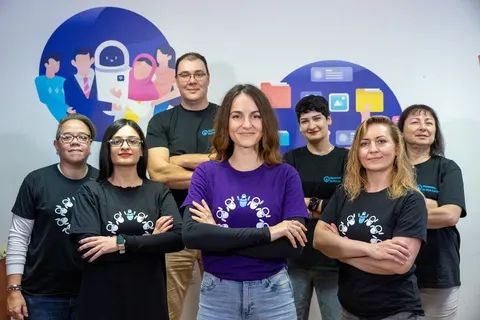
That is how Humans in the loop was born, a company that for six years now has been providing work to refugees, to people in extreme poverty, and also in places torn by war. It gives hope precisely to those who need a livelihood and a fresh start all over the world, from Afghanistan to Venezuela. And at the same time, they help develop the most cutting-edge technologies.
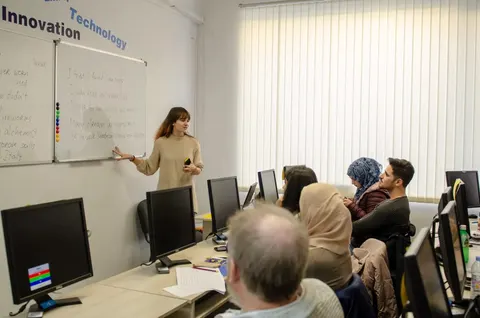
Today the news about artificial intelligence is all around us. One of its most impressive applications is “computer vision”—the ability of algorithms to process images, to judge what is in the frame, who is in the photo. To be trained, they rely on enormous volumes of data—thousands, millions of pictures. This is exactly where Iva and her “humans in the loop” come in. They help with annotation: thanks to them, what can be seen in a vast number of images gets described, and the algorithm learns to do its job.
Iva has received numerous awards for her venture, and recently took part in an event held by the world-renowned AI researchers Andrew Ng and Robert Munro.
What does it feel like to give a livelihood to 1,000 people scattered around the world? What are the most interesting projects the team has worked on? How long will humans be needed in the development cycle of technology? How could we turn the online world into a fairer and more equal place?
– Your great cause is for technology to help solve social problems. Why did the internet, which was conceived as the most democratic environment there is, start creating horrifying inequalities? From the handful of big companies that set the rules to entire civilizations having almost no access to technology.
– Naturally, the quick answer is capitalism.
But the internet is also very interesting in that anyone can write on it. Yes, in some countries access is controlled, it is not absolutely democratized, but there are still huge opportunities for everyone to have access, to create things in the online space, to exchange information.
The serious problem really is that there are a few companies that monopolize not only the online space but also our attention. When we use the internet, so much is concentrated in four or five platforms that it is very hard for strong alternatives to develop. A terrible amount of money is constantly being poured in the States into creating platforms like these. Even if they have no good business model, they pour in
huge sums so that they grow as much as possible, and only then start monetizing their users.
In my view, that is one of the reasons we have such giants, which are sponsored and subsidized by investors in the US for quite a long time. And suddenly, once they reach a large scale, they start using that huge base of people they have as users. I think that is a serious problem.
– And with the advance of artificial intelligence, it looks as though it will only get deeper. How do you think we can get out of it?
– One option is to use open-source technologies, to support solutions created for non-commercial purposes, and to defend them.
The problem is that with artificial intelligence right now
there are almost no academic developments or other projects that can compete with what the big companies publish.
Simply because it takes enormous funding and computing resources, very few companies can afford to develop such huge models, and it becomes much harder for new players to come in.
We can support alternative solutions that are not based on what the big companies create. For example, there is a company in Ethiopia developing an alternative to Google Translate for the Ethiopian languages. They work with a specific focus on their own community.
The other option, of course, is regulation—through the European Union's AI Act, for instance. The problem there, naturally, is that the lobbies are terribly strong and push through whatever matters to them. So again there is a big risk that the rules imposed will simply serve the interests of the big platforms.
– Sadly, everything suggests it will turn out that way. “Social entrepreneurship” sounds a bit like an oxymoron in our part of the world—to me, too, the two words very often seem to contradict each other. How do you manage to combine them?
– For me,
the best option is to find a social project that is sustainable and can earn its own money.
Otherwise, social ventures very often fall into a vicious cycle in which they keep chasing funding organizations or jumping from program to program. It was very important for me that we be independent, that we decide for ourselves what programs we want to run, where to grow, and not depend on the interests of whoever is funding us.
For example, since last year everyone in Bulgaria suddenly rushed to provide funding for Ukrainian refugees. It really was important; a lot of people need support. But several organizations that were funding our courses suddenly said we could not bring in other refugees, that we had to run them only for Ukrainians. It was extremely unpleasant. We work with many different migrants, and telling some of them, who are in an even more vulnerable position, that we cannot include them because they are not from Ukraine was nothing other than racism, plain and simple.
For me, the freedom to decide who we work with is the most important thing, and I am very glad we do it this way.
– How many people work for your company today?
– Since it was founded, we have worked with 1,000 people. Not all of them are actively working right now—about 200 are on projects at any given moment.
Things are growing, but at one point we decided to stop expanding quickly and focus on the people we already work with. We constantly get interest in new pilot projects, more organizations get in touch with us. There is a lot of interest, but right now we do not have enough work for everyone, and that is our biggest problem.
– Which countries are those 200 people in?
– The largest groups are in Syria and in Bulgaria, and we have smaller ones in Afghanistan, Egypt and Lebanon. We recently ran pilot projects in Moldova and Ukraine, but only for training. We also have new small teams in Colombia and Venezuela. We tried out a team from the Philippines for a specific project, too. And two fairly large pilot projects are coming up in Kenya and Uganda, under the International Labour Organization.

– Doesn't it make things harder that people are so scattered? Wouldn't it be easier if, say, they were concentrated in two countries?
– Given that everyone works online and remotely, it does not create all that many obstacles whether they are in one country or in fifteen. One problem is time zones, but that is not so hard to solve; the other is internet access.
For us it is even good to have people in different countries, because some of our clients care about knowing that different groups are working on the data rather than it being concentrated in a single demographic group. Because that would lead to some kind of bias in the processing.
– Is it hard to communicate with so many different cultures?
– We do not work with people individually; we always have a local manager who runs the team. We try to choose our managers carefully, so that we share the same mission and they also have a strong interest in this industry. Only in Bulgaria, since we are the local managers ourselves, do we communicate directly with the people.
– What do they earn?
– We try to use the same rate for all countries, one that is normal in Bulgaria. We pay 4 euros an hour, which is good here, superb in countries like Syria and Afghanistan, and quite low in others. That also limits us—we cannot start working in Germany or the US. But in a very large part of the world, that rate suits people.
– In the end, we are talking about not particularly skilled labor that practically anyone can do after some training, right?
– That is the idea—for it to be an accessible type of work that anyone can do, whether or not they speak English, whether or not they can use a computer. Something like
an introduction to the online world, with the idea that the person will then look for their next job.
It does not always work out. Many of the people who started with us in 2017 kept working for quite a few years, even though we tried to encourage them to look for other work. It is simply hard to find something you can do from home, with flexible hours.
– Are there people whose lives this kind of work has changed, who then moved on and up?
– Not one has become, say, a programmer, which would make a nice story. When I was founding the organization, one of my ideas was for it to be a coding school for people in need. But not everyone is cut out to be a programmer—not everyone finds this kind of work attractive, and not everyone has that kind of thinking. So I decided to go for something simpler that would be open to all kinds of people.
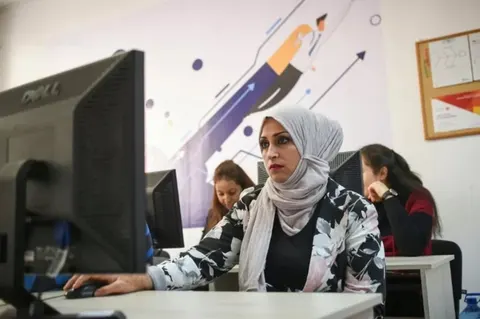
We have worked with one Iraqi woman from the very beginning, and she is incredibly hardworking. Even though her English is not very good and at first she struggled with the computer, she is very rigorous in everything and always ready for new work. Through her, her husband started working for us, and then her daughter too. At one point she became the only person earning money in the family, since her husband retired. She kept working for us and in the meantime enrolled to study biology—something she had long dreamed of.
Two other girls from Iran were part of our English and computer-skills courses, and even back then it was clear they were tremendously smart and capable. One was only 17, the other 19; they have been working with us for four years now and have grown professionally. One is the coordinator of all our projects, the other handles our training platform. I can see even better things ahead of them.
– How long do you think humans will remain part of developing artificial intelligence? Because more and more data is being found through automated processing, and annotation is becoming less necessary…
– There will definitely still be a need for people. Maybe not exactly for data annotation, but with somewhat higher-level skills. Some tasks are already very easy for artificial intelligence, but new ones keep appearing. We are on the crest of that wave and always stay one step ahead of the systems, so that we can train the next system in the skills we need.
When we started in 2017, we annotated photos—where there is a person, where there is a car. Right now
we do a similar kind of annotation, but on three-dimensional point clouds,
which is considerably more complex, labor-intensive, and requires even more data.
We also do a lot of annotation of medical images, where it is not enough just to describe what you see; it is also a matter of expertise. We have a team of doctors who do those annotations. The tasks for the people who have to train artificial intelligence keep getting more complex, but those people will certainly be around in the future too.
– When an algorithm is trained on particularly sensitive data—for example, to recognize child pornography—does that mean people first have to sort through an enormous number of images, or is there another way?
– We do not work in that area; that is a very heavy type of data. But unfortunately, that really is the way. The other is to train age-detection models that can then be applied.
But even when you already have a trained system, there are always cases that are not very clear-cut, and there still has to be a person to moderate them.
There are still huge teams doing data moderation, including in Bulgaria. Especially on platforms with user-generated content, users constantly adapt to the platform's rules and try to find loopholes. And the moderators have to stay alert, one step ahead.
– What other interesting data have you had to deal with?
– For example, we work on a project for autonomous cars.
You have thousands of frames, and specific things on the road have to be annotated. The big problem there is that the images contain a huge number of cars but far too few of the rarer road users, like motorcyclists, cyclists and skateboarders. That is why algorithms find them harder to recognize, and it is very complicated to balance the data and extract only what will be useful to the system.
We have a very interesting project on detecting different types of litter on beaches, which we do with the British government. They collect drone photos of the shoreline, with the idea of then analyzing what kinds of waste are on the beach and, as a result, recommending which plastics should be restricted.
It is a very complex project, because you have a catalog of 100 different types of waste that you have to recognize and categorize. Even if you have one tiny fragment, you have to figure out whether it comes from a fishing net or from wood, and if it is plastic, what kind. That also required quite a lot of training for the annotators themselves, so they would understand how to describe the images. The problem of balance between classes is very hard there too, because there are far too many images of one type of waste and far too few of another.