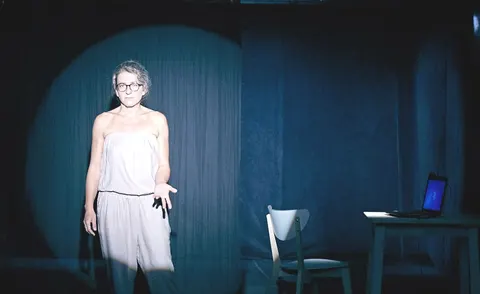
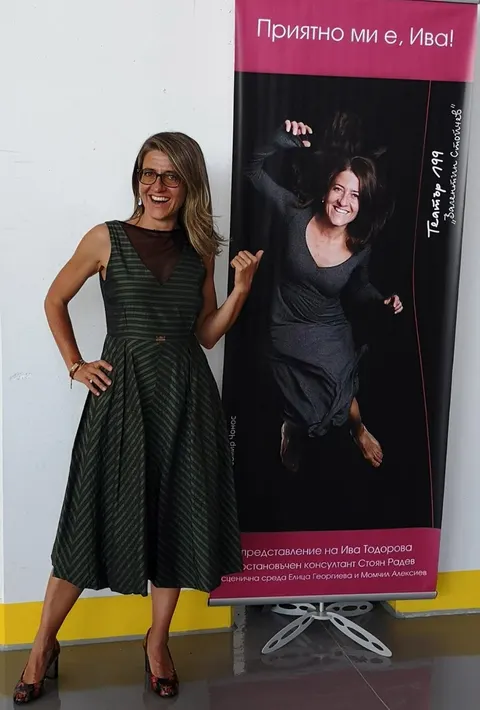
Theater lovers know her from “Nice to Meet You, Iva!”. Iva Todorova’s singular debut one-woman show became an undisputed hit, winning countless fans and prestigious awards. Not long ago, the time came for its sequel of sorts.
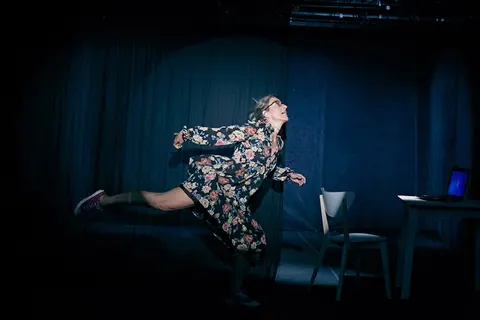
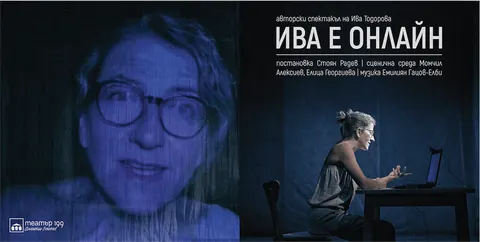
This time “Iva Is Online” at Theatre 199, and of course the story is digital. It is about love and the most important encounters—in, outside of and despite the web. About hard truths and flights of fancy.
After graduating from NATFIZ, Bulgaria’s National Academy for Theatre and Film Arts, in the class of Prof. Krikor Azaryan, she lived in Italy for many years. She came back home and for more than a decade worked as advertising director of Osem (Eight) magazine. Iva is also the editor of the novel I dodeto se razhdat luchite (And Until the Rays Are Born).
Is there freedom online? Are our Facebook friends really our friends? What kind of jokes should we expect artificial intelligence to tell us? Are dates, crushes and breakups on the internet lighter, and do they mean anything? Iva answers in her trademark dizzying style.
– “Nice to meet you!”—you became famous for that conversation opener, but it seems that online these days we have no time for such formalities.
– Time is scarce! It really is! I’ve never felt it fly the way it does today.
– Would the Iva of 20 years ago have believed that today we would live such technological lives?
– I remember my great-grandfather telling me that they used to drive horse carts, and then when the airplane appeared, everyone in the fields would stop working to watch it. Then they got used to it. Same with me. I’m a bit far from technology—I still beat my eggs with a fork.
– Is there freedom online?
– There is freedom in the heart and the mind,
it’s a matter of genes, upbringing, traditions, environment and many other things.
A matter of choice, too. There are always obstacles, and I think it’s better that way. Absolute freedom is a chimera, but there are also examples of enormous inner freedom expressed in real life. Artists, it’s believed, carry that charge. But even today, in the age of the internet, they prefer to create in the real spheres of their art. In the theater, online creation strikes me as absurd. As for freedom of information online, we all know that social networks are subject to censorship, but it’s also a fact that they give us access to an enormous amount of information.
– Can a person fall in love online?
– Yes, just as you can fall in love with the big screen. I’m in love with Brad Pitt.
– The thing is, online Brad might fall in love with you, too, while from the screen—hardly. And can you break up online?
– Yes. There are these lightweight versions of breaking up. Childhood friends “unfriend” each other as a sign that they’ve fallen out. Couples block each other so they won’t follow each other on social media.
It’s funny, frivolous, illusory, because whatever we do, there’s no way to avoid the suffering
in the heart when you break up. Bergman says in one of his texts that it’s the second hardest thing in life after the death of someone close. But today
breakups in real life come with the extra decision of what to do with that person online—
whether to block them, leave them as they are, or write about them on your wall and seek support from everyone that way. It’s very funny. My grandfather used to say, “Well, what now?! A living parting!” and we would hug goodbye… a living parting—that’s what it is.
– Where is a person more genuine: online or offline?
– Truth is a big subject of mine, and a subject of our times, too. It’s an undisputed fact that online platforms have enabled the growth and publication of both objective opinions and fake news. An industry of fake news has been created; even in official media, stress and the hunt for sensation, the chase for ratings and the eternal competition with others lead to careless mistakes or to an emphasis on facts that distorts reality.
Not to mention the world of advertising. On a personal level, I value meeting in person. I think it’s important for people to listen to each other live. It’s no secret that this is a big move in psychology—listening to the patient is already treatment. I love sharing in person, answering spontaneously; that’s a different experience from the possibility a chat offers.
I need to listen and to observe, to use all my senses—smell, touch—which are impossible online, at least for now.
Usually online we say things that are hard for us to say in person. We enter a pseudo-conflict instead of a delightful real one. Communication becomes cold, flat. I remember in our first year Koko Azaryan teaching us that conflict gives rise to action. In that sense, online communication doesn’t give rise to action; there are no preconditions for it.
We can’t call hate conflict. Because there’s no opponent. Hate is locked between the user and the computer; it isn’t up for discussion.
It’s a monologic form that the online world created, and it fooled many people into thinking it’s a dialogue or an argument. There’s no such thing! Hate is for cowards, and cowards are people who don’t stand behind the truth, behind their actions. Because haters don’t perform an action in the analog sense of the word.
– What does it mean to be online?
– To be on the line. To be connected to the internet. But
how far you can be connected to anything at all on the internet is again a big question.
I’ll turn to psychology again, according to which connections happen when we give. We give to our children, to our work, to our friends, whether time or feelings. A connection is born in the giving. We choose what and how much to give.
The internet gives us information and lightning-fast communication, but it takes our time and information about us without any control. As an ordinary user, I have no idea how much personal information I hand over, nor do I control the time I spend on the internet. And aren’t these the most valuable, even priceless things we own?!
I don’t know if it’s a fair exchange. Sleep leaves no memories, and it’s a bit like that with the internet.
– Have you ever gone offline for a long time?
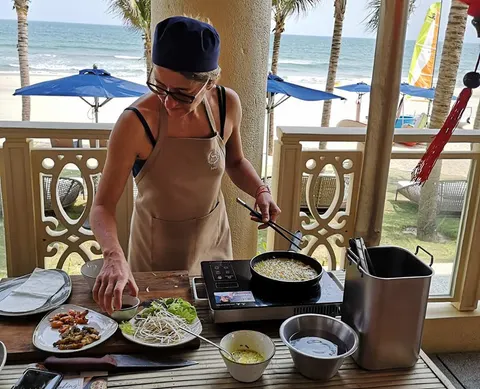
– Yes, without noticing, when I’m traveling. I got a smartphone relatively late. On purpose. When I travel, I try to take notes with pen and paper. I even once went to the Philippines without a camera, so I could look at the world and not at the little window of the lens. I have wonderful notes and, of course, wonderful memories.
I have the feeling that the internet is erasing my memories, no matter how often Facebook reminds me of photos from a year ago.
Recently I started keeping a diary again—in a notebook, with a ballpoint pen. At first it felt like a waste of time, when I could type it into a file in 2 seconds. But I can see that this pen somehow gives value to my days and experiences in a different, slow way, deeper, more attentive. I describe my days and thoughts without any censorship. Facebook—the word itself could be translated as “diary,” but it isn’t one.
There, you share with a huge audience, and collecting likes is part of the sharing.
In a personal diary you’re merciless, more genuine; not sharing and not getting approval may seem more boring, but the absence of any censorship undoubtedly inspires the imagination.
– What was your first encounter with computers like?
– At school we studied informatics—we’d wait about 10 minutes for an 8-bit computer to warm up and then do calculations on it, but only the teacher was allowed to type. We looked at the machine as if it were a cupboard and whispered that we could have been playing basketball in the yard during that class.
After I graduated from VITIZ, as the theater academy was called then, I signed up for a computer course. In the room there was me and 10 future secretaries. After the first lesson, the teacher asked me why I was taking the course, and I was surprised—wasn’t it compulsory by now, like a driver’s license?! “It isn’t,” he said, “don’t torture yourself, this stuff isn’t for you.”
– And how did you end up on the web?
– A friend of mine showed me how to dig around on the internet. You can have email. It took me a long time to grasp how I could have mail and how it was possible that nobody but me could read it.
From the very beginning of the internet, I was very preoccupied with the puzzle of personal data—how come, even if you have a password, nobody reads your mail? Surely someone knows how… But the fact that you could wander through something like a book, a library, and find information about everything there inspired me. I remember when I had my first very slow desktop computer at home, connecting to the internet over the phone line, how many nights I killed digging around. I got hooked immediately. And it’s been that way ever since.
– Tell us about a chat you’ll never forget.
– One of the dearest is with my grandmother. I had already moved to Italy, and she made herself a Skype profile. She named herself tincheto, as her family called her when she was a child. Imagine—that was 100 years ago, and she immortalized it in that chat. I’ve kept all of it. It’s from 2004, a year after one of the first versions of Skype came out. She typed very slowly; back then we all used shlyokavitsa, Bulgarian written in Latin letters, and she would get confused—a schoolteacher, after all. But she swallowed it for the sake of communicating with her beloved granddaughter hundreds of miles away. She was 71. And I remember that with every letter appearing on the screen, and they appeared slowly, I teared up with tenderness, and in the end she wrote:
im fine, dont worry, im healthy. ill learn slowly. And she did learn.
– What do you miss from the early years of the internet?
– The thrill of something new. The mystery of who is sitting out there somewhere behind their computer. I
am very preoccupied with that question—who is sitting across from me. People fascinate me.
When I was little, I would get on the trolleybus and get to know the whole trolleybus—their names, whether they had kids, where they were going… There was a time when I hung out on social media every day. Lately they bore me. Everything passes.
– Speaking of them, do social networks really make us more social?
– They make us antisocial; I’m a living example myself.
There are days when I might not meet a single person, and spend the day at home
in front of the computer. And that’s enough for me. Then I go out into nature with friends and see that this “enough” doesn’t mean “joyful.”
– Will the theater also move online one day?
– No!
I’ll be one of the sworn hardliners for keeping theater live.
– What joke will you tell artificial intelligence when you meet it?
– Me? Shouldn’t it be the one with a huge joke department, so we split our sides laughing?! I’d tell it some children’s joke, with gestures, to see whether it gets it. “Mom, Mom, is it true my head looks like a nightstand…” I wonder what kind of sense of humor it would have.
– What’s the most important thing to teach it?
– Compassion, if that’s possible.
– What makes you laugh online?
– You. I’m not joking—we’ve had terribly funny and insightful chats at the office while sitting in adjoining rooms. What I mean is that people make me laugh the most.
– But is there any point in laughing in front of a computer rather than with other people?
– Yes, laughter always has a point. I never miss a chance to laugh, whatever the situation. Even in the most forbidden ones, even when something strikes me as funny on stage and it shouldn’t.
– What are the nastiest demons lurking online?
– Loneliness. This is its kingdom.
– Where is real life: online or offline?
– For me it’s offline. And for you, as a programmer?
– For me both are forms of real life, but my answer would be rather long.
Soon we’ll be able to travel anywhere virtually, and we’ll have a separate virtual reality, a metaverse. Do you like the idea?
– I’ve watched VR films, I even have a headset; it’s great fun. We’ll be able to meet people there—at least that’s how I imagine it—and everyone will be able to decide how closely their digital avatar matches their real image and how it appears in the metaverse. So if there, too, we have an intuition about who is sitting across from us, and we’re not in the horror of David Lynch’s Lost Highway,
if hacking, abuse and aggression are kept under control, why not?!
But I love traveling so much, my body moving from one point to another… I’ve felt very happy on the Camino de Santiago. You carry one backpack with 2 T-shirts and one pair of shoes, you do the same thing every day—you walk—but you’re so rich in impressions, your body produces serotonin because it’s moving. It becomes a machine, the mind is alive, and the emotion is happiness. And everything seems to make sense.
– Will it be cooler when we can talk to an online avatar that’s indistinguishable from a human?
– Ha-ha, I imagine it that way too—there’ll be drama: which one is real, to what extent, can my avatar turn against me? Just as every day we get into quarrels and inner struggles with ourselves. Will it be able to act instead of me, or will I always be able to control that?
The schizophrenia will be complete. If we start fantasizing freely, we can go far, and most likely this really will happen quite soon. I don’t know, I have no answer to that question; I can only fantasize, and I fantasize optimistically.
– What do you think of influencers? What’s worth learning from them?
– It’s interesting and noble to set aside some of your time and share the things you’ve discovered. Anyone can be an influencer. And the social media algorithm, to put it mildly, coaxes you into doing it. I follow influencers; the ones I like best have few ads. Then again, I worked in advertising for 10 years, and I know it’s like a river—it seeks out and takes on new forms.
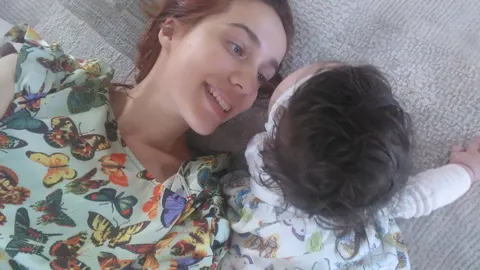
Influencers have turned out to be quite lively and inventive at presenting products. Sometimes all the commerce can be very insulting to followers, but sometimes you really do get useful information. I follow Magi San—I’ve known her since she was a baby, and today she’s a mother herself. I admire how much energy she puts in and how much work and organization it takes to be a vlogger. I also follow Maria Zhekova with interest, but I’d call her an “inspirer,” not an “influencer.”
– What sets online friends apart from real friends?
– It’s a big joke that we call online friends “friends.” I think the second most successful TV series in the world is precisely Friends. Why is it so successful? Because everyone relates to it. And what do the characters do—they’re together all the time, at home, at the bar…
I don’t know why online friends are called that. Often we have enemies on the list, too. We need real friends, we’re attached to them—to see them, to cry together, to be silent together, to giggle, to hug, to help. How lovely it is to show up at someone’s door unannounced! Like on a name day, the saint’s day Bulgarians celebrate like a second birthday… How can
that compare with dry writing on a wall… And yet that’s exactly what has become the rule, and the other thing is now the exception.
– How do we tell who is our friend and who is our enemy online?
– Oh, I just can’t take this whole affair seriously. It reminds me of those friendship questionnaires we filled in as kids. Social networks took us back to the playground. I love reading Wikipedia definitions of everyday words. The one for “friendship” is very interesting. You might want to read it. It has nothing to do with what’s on Facebook.
– How is online love different from the other, more boring kind?
– I made a whole show about love—“Iva Is Online.” Come and see it on January 3 and 25; those are the next dates. I think we’ll have some fun together… and chat sincerely.