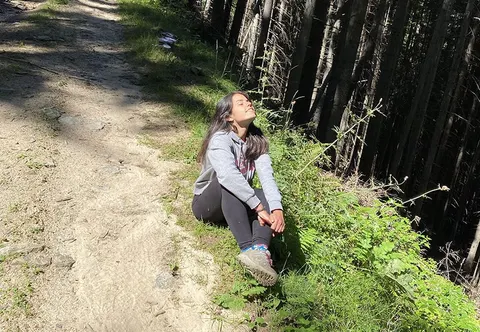
“One day I’m sitting there sealing jars of tomatoes. And I tell myself: fine, you’re sealing these jars, but you’re not doing anything, anything real, to save the Bulgarian village. At most you’re saving your own kitchen, and that’s it. Well then, you have to come up with something, since you’re so headstrong. Stand behind that stubbornness and prove it… That’s when I knew what I had to do.”
You have seen her on screen in a fancy chef’s apron, beating her rivals without so much as touching the pretentious, overdressed, modern-for-the-sake-of-modern solutions that so often take center stage in shows like this.
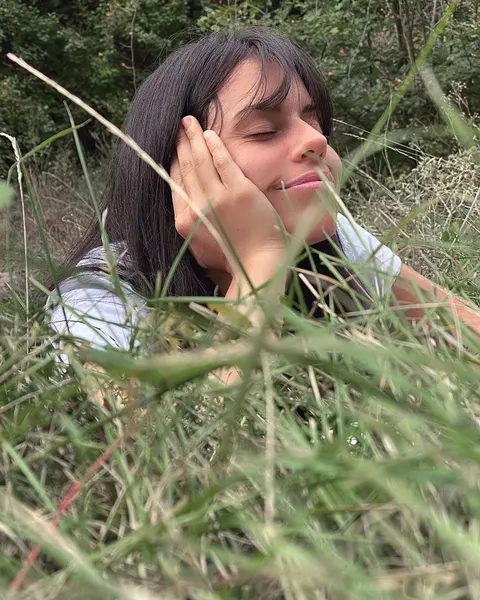
Maria Zhekova is the winner of the cooking reality show MasterChef. Her story is thoroughly digital: she is also a photographer and an Instagram influencer… just not like most of them. You won’t pause over a glossy photo of hers in your feed advertising an ultramodern multicooker. You are more likely to see her with her sleeves rolled up, helping lay pipes for kilometers to the old stone house in a remote hamlet in the Rhodopes, the mountains of southern Bulgaria, where her heart lives.
But how did this young woman bring the glossy show and the old traditions together? Do you seal jars of tomatoes differently when you are MasterChef? How does she find her taste for life again in hard moments? And what is she determined to take on to help the village?
Sweet Talk
Maria is the different kind of role model, exactly the one that I, at least, would be glad to see young people online take as inspiration. A thoughtful young woman who has lived through and set in order her own sincere philosophy of life. She knows that choosing carefully what you read is no less important than choosing what you eat. She fights fiercely to preserve the beauty of the local, the traditional, the different, without being led astray by those ugly strokes that soil and erase the love of one’s homeland.
We met a few years ago, when she came to the editorial office of 8 Magazine, where I worked, to pitch a story. She had just come back from Norway. Before that she had graduated in photography, and the wild North had captivated her with the idea that up there, among the ice, in the more civilized world, people knew how to take care of both nature and animals. It turned out to be exactly the opposite.
One day, clicking around at random, she came across a story that brought her back to Bulgaria, and that was the story she wanted to tell in the magazine’s pages. About Sider and Elena, who, in the embrace of the Pirin mountains, raise the largest flock of Karakachan sheep and preserve the Karakachan dog breed. They run a nature center where they look after… a bear and two wolves.
Maria told that story in powerful words and pictures. “I met people so dignified and genuine, who showed me what struggle is and what a dream is.”
Food for the Soul
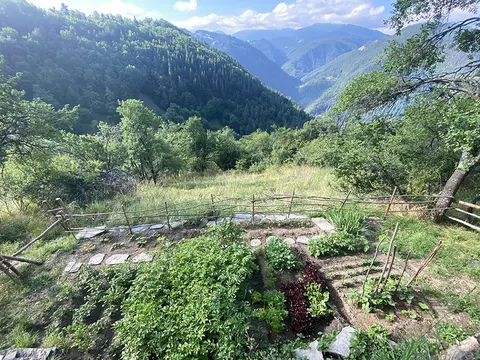
Somewhere around that time she decided it was time for her, too, to buy a house in a village. An old, real one, where her own struggles and her own dream could come to life.
One day she was driving above Shiroka Laka, on the road between Devin and Pamporovo… “road” is a generous word. The car lurched, the road ran out, and she found herself in front of an old, completely neglected stone house in an isolated hamlet. Only to decide that this would be her place.
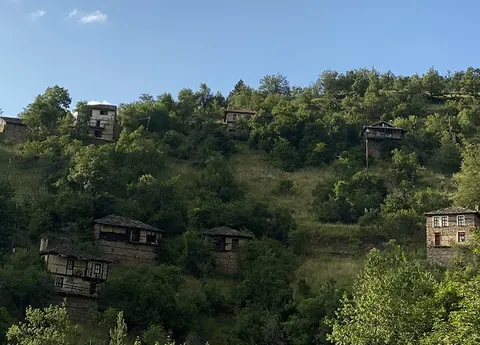
Officially it belongs to Varbovo. On Wikipedia you will see that the entire village, its few hamlets scattered across the Rhodope ridges, is home to… two people.
“The first house I saw, the first window I opened, that was it. I just bought it, without thinking too much. I hadn’t imagined how hard it would be, but that wouldn’t have put me off either,” Maria says today. And she adds: “The whole venture really shaped me as a person. Once again I realized that you become yourself precisely through hardship. Fears are limits. If you stay with them, you stay stuck somewhere back there, and you never fully find yourself.”
The Salt of Life
She still has no logical answer for how she ended up in this particular village out of the thousands scattered across Bulgaria. “You stumble upon a place, you fall in love with it, and you don’t bring logic into it. The view, the houses themselves, the fact that there were no people at all—everything seemed completely frozen in time.”
She found herself in a place of the stone houses she loves so much, and in their fully preserved form at that. Nobody had committed the outrage of putting tiles on the roofs instead of stone slabs, nobody had opened a kebab grill or pizzeria blasting the inevitable pop-folk, as in so many other such places across Bulgaria.
He Who Does Not Work Shall Not Eat
“I was 23 then. Even if I had understood how hard it would be, the foolishness of youth wouldn’t have let that stop me, luckily. Because look, now this is the most precious thing I have, and it’s the project of my life.”
Maria devoted the following years to turning the half-ruined house into a comfortable place to live. Because no one ever said we have to spend our days as ascetics, give up technology or cut ourselves off from the world. What matters is to take the best from tradition and from the future—that, as I understand it, is my interlocutor’s credo.
She laid several kilometers of pipes to get water, raised the roof, tidied up the garden. Oh, yes, and in the meantime she won one of the most hard-fought competitions on television.
Appetite Comes with Eating
Why did she sign up for MasterChef? No, it wasn’t by chance, nor did someone surprise her by entering her name because they were charmed by her culinary mastery.
At the time Maria was using Instagram quite actively to share the things that moved her. She found many kindred spirits, who gave her wings to keep going. She often photographed the everyday dishes she had cooked, and since she combines a feel for food with a photographer’s skills, the results caught people’s eyes.
“At some point I figured there must be some point to what I was saying. I’m a very self-critical person, but I told myself: Apparently you have something to say, something to show,” Maria adds. Clearly it had to do with food rather than singing, so she signed up for the show.
“I was wondering where I could share something with people. And it worked. I managed to say what I consider important. It turned out that many people recognized it, felt it, and it changed something in them, made them think about their own choices.”
The Taste of Truth
And so here I am, telling a story steeped in reverence for the Bulgarian village on a site devoted to the challenges of our technological present.
Yes, more and more people whose jobs allow it are deciding, or at least considering, to move away from the big city. And that, according to Maria, makes sense: there is no way, and no reason, for everything to be concentrated in the concrete megalopolis while we leave empty places that could give us so much.
She isn’t particularly fond, though, of the fact that many people have gone back to the villages for the convenience of the famous “home office.” In her view, being able to work from anywhere is not reason enough to move back to a village; you need something more. Something that pulls you, that binds you to the place, so that you know why you are there.
Neither of her two professions—photography and her newly official career in cooking—can be done from home. So, as she puts it herself, since the conditions don’t exist, she has to create them. That is exactly the venture she took on literally a few days ago, and she is convinced it is worth putting her strength and energy into. The one this story began with.
Not by Bread Alone
So what was Maria thinking about as she sealed her jars, when it occurred to her that it was time to take the next step?
Her mind went back a few days, to a drive home through the lower hamlets of the village. She had passed along that same winding road hundreds of times, but this time one building caught her eye: the old potato storehouse. It stood solid and massive, defying time. Defying everything.
“This is the place. Something has to happen there, there has to be life. I’ll turn it into an events center,” Maria decided, and set the jars aside for a moment to catch her breath.
It took her three weeks to find out who owned it. “It turned out to be a really decent Frenchman, Thomas, who has a house in the village. We talked and quickly came to an agreement. The 400-square-meter potato storehouse cost about as much as a parking space in Sofia. Life’s paradoxes…”
Bread and Salt
“And I told myself—jump! Here you’ll make a place for people, for ideas, for meetings,” Maria says with inspiring enthusiasm. “There will be workspaces. Anyone who wants can work from there. I think that’s what gets a village back on its feet: there has to be a livelihood. We live in a material world, people need something to live on. Because sealing jars is very romantic and idyllic, but it doesn’t put food on the table. This is my new big dream, and I’m going to dare it.”
As for me, I imagine Maria will round it off with a charming little restaurant, where she can serve at least some of the things she shows on TV or on Instagram. If the people from Michelin happen to read Digital Stories, I think I have told them enough.
She expects to be ready to welcome guests and start organizing events in the old potato storehouse next spring. And when those words come from a young person who has restored an abandoned stone house in a remote hamlet and, at the same time, won a meaningful reality format, there is hardly any reason to doubt them.
Hungry as a Wolf
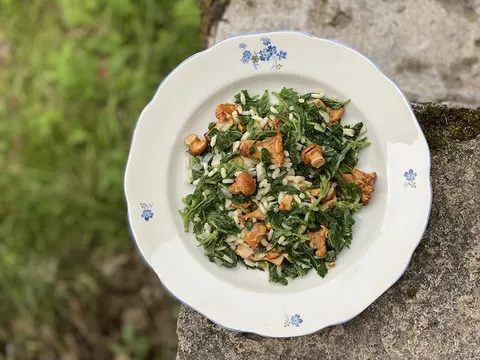
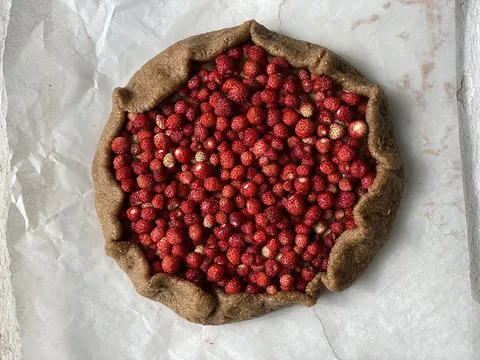
Guests will certainly come, thanks in part to Instagram. As we mentioned, Maria started posting on her favorite social network almost by accident, to share her culinary discoveries. “I’m someone who loves to eat well, it’s important to me. I don’t get the ‘I eat because it feels good’ principle; on the contrary, I eat to stay healthy, to have energy. Besides, I always make it look beautiful, because I enjoy that. I don’t make any special effort, I don’t do anything artificial. I make a dish for myself, then I offer it to others too, because it’s tasty and might be good for them.”
That is how Maria rediscovered the positive sides of social networks, which she hadn’t liked at all before. Today she believes they have serious potential, and that how they are used is a matter of personal intelligence. She stopped opening Facebook long ago, but on Instagram she finds real kindred spirits who charge her with good emotions. She feels their support, feels close to them, even if she has never met them in person. She knows that if she wrote tomorrow that she needed help, many of them really would come. Unlike some other people she is close to in real life.
“When you offer naturalness, purity, when you have no pretensions to push them away, people feel very free to communicate with you, to share the good emotion. And that constructive energy keeps accumulating. The occasion might be MasterChef, or anything at all, but afterwards you go on exchanging yourselves virtually in some way. The bond grows stronger,” our guest explains.
A Finger in Every Pie
She is adamant that she would never use her popularity to do paid advertising.
“Yes, maybe that costs me some one-off income, but it earns me people’s trust, which is far more valuable. I think everyone in my audience has already noticed this about me. I’m not the person who will take money and push on them some product that doesn’t match their idea, or mine, of what is right. That way, if tomorrow I come across something truly worthwhile, I’ll be able to look them in the face and honestly share it and recommend it,” Maria adds with feeling.
“That’s the only way we can trust each other. And, for me at least, there is nothing more precious than trust. It’s much more important to have people around me who believe in me. Tomorrow, when I take some step, they will stand behind me. They will know I’m doing it with them in mind too, not just with the idea of easy money.”
Once Burned, Twice Shy
In recent years, food blogs, shows and entire channels have made us increasingly interested in what we eat. But is the moment coming when we will also start caring about what we feed our souls? What we read, where and how we get our news?
Maria says she often draws the same parallel. “I don’t want to fall into fanatical pedantry about what I eat either. Fine, you pick the most amazing dish, but you read rubbish, watch mediocre TV, breathe poison… It’s pointless. Our lives may not be perfect. But the effort to approach the way we live sensibly is something we should apply in every sphere.
If you cultivate critical thinking in yourself, if you start asking yourself why something is the way it is, and then start asking the people around you too… Then everything will make much more sense. Today everyone says whatever they like, because nobody thinks to ask them why they say it, where they get their information.
Really, the question isn’t only what we eat. It’s also what we read. At some point, if you’re very meticulous about what you eat, you ought to think about what goes into your head as well. Then you build a kind of routine, a selective filter for every choice you have to make.”
A Royal Feast
The MasterChef winner renovated… or, as she puts it herself, restored the old house using only natural materials. The hardest part at first was finding the right craftsmen for each of the more complex tasks, but today she is happy that she knows them. She is puzzled by people who insist on doing everything themselves; it is better for everyone to shine in their strong areas and rely on professionals for the rest. Because that is precisely what makes us a society.
“People live among people. We have to seek each other out and help each other. You think you can do everything yourself, until you reach the point where you can’t do something, only by then you’ve already shut every little door to the rest of the world.”
Sweet Words
As we say goodbye, I ask her what she thinks has to happen for life to return to small towns and villages.
“Living in a village really is wonderful, but it comes at a price. I think you have to be clear that you can’t grab from both worlds. First of all, there have to be people. Even if at some point that magic happens where super-decent people come to govern us, when there are no people left in a place for the state to work for, there’s no logic in it doing so. We can’t build a school and a hospital in every municipality. There have to be people to work for. For me it’s a symbiosis; steps have to come from both sides. When there are people who start to want things, things happen.”
I couldn’t agree more. If more young people think like her and bring together the best of tradition and the modern world, things will certainly happen. And how…