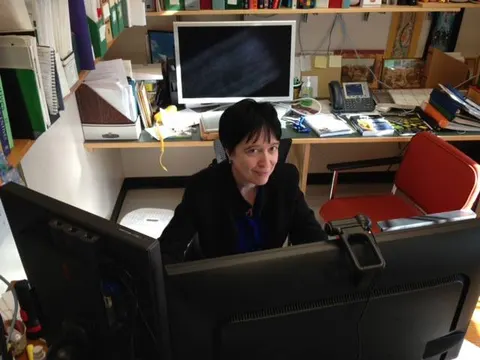
For 30 years Prof. Julita Vasileva has studied computers and the world they created. As a scientist, she was lucky enough to land in a field that went through an incredible rise; as a teacher, she has witnessed how several generations relate to technology. Prof. Vasileva knows and studies the technological side of the computer world, but she pays even more attention to its social side. Just like Digital Stories.
Prof. Vasileva has hundreds of scientific publications. She has 11,000 citations on Google Scholar and 7,954 on Research Gate. According to statistics from Stanford, she ranks among the top 0.66 percent of scientists worldwide by impact, in 1,410th place out of the 215,114 researchers included in the field of artificial intelligence and image recognition.
Her path began at the Faculty of Mathematics and Informatics of Sofia University, passed through the Bundeswehr University in Munich, and in 1997 brought her to the University of Saskatchewan in Saskatoon, in the far-off Canadian province, where she is a professor of computer science to this day.
Her research interests include the personalization of software applications, decentralized solutions, online safety, the role of artificial intelligence in education, and trust and authority in the online world. Online communities, their radicalization, aggression on the web.
I met her when I asked for her opinion on the filter bubble, a field in which she is a world-class expert.
Out on the Canadian prairie she has been growing pink tomatoes, the pride of every Bulgarian garden, for quite a few years now, and, as you will see, she has held on to quite a few charming Bulgarian words that the rest of us have half forgotten.
– Artificial intelligence (AI) lately is like aliens were decades ago. A huge number of people believe it will come and change our lives dramatically, while for others these predictions are just fashion and gullibility. What do you think?
– AI is a horizon we strive toward but will hardly ever reach, precisely because it is “artificial.” It is used to create techniques that work for certain well-defined problems. Scientists keep trying to change it, adapt it and improve it so that it can solve new problems. But once it actually works in practice, it is no longer considered “intelligence,” just a software technology. And the horizon jumps somewhere further off into the distance.
Take robots, for example. Who considers the Roomba, the household robot that cleans, “intelligent”? Or Siri, Alexa… True, they understand quite a few questions in human language, but they get a lot wrong…
After the initial amazement, we accept them as a convenient addition to the appliances
around us—like the washing machine, the toaster or the fridge. Of course they make our lives more comfortable, they make things easier and let us be lazier… They free us from unpleasant, tedious, boring chores.
AI is no different from other technologies. Excavators, for instance, dig and replace the heavy physical labor of thousands of people. There are kinds of work that disappear. Humanity adapts to the technologies it creates itself. More and more human skills can be automated, and people lose them. With calculators around, why struggle with arithmetic?

– But that way we lose some rather important skills, don't we?
– We definitely have to ask ourselves that question. Machine translation, for example, is already very good in practice, at least for the most widely spoken languages. It wouldn't be surprising if the translator's profession disappeared within 10 years. Why bother learning languages then? But the other question is: what do we lose along with the skills we used to need? The pleasure of reading a literary work in its original language? Or the ability to think in another language, since language influences how we think…
And perhaps we will lose higher skills as well. For example, the ability to plan, to make decisions, because we will trust the computer. Or the skills we need to learn new things… Lately we seem to be losing modesty and humility, and the desire to reflect, too. These things are necessary if we are to take in new facts and views that contradict our own.
The less we know, the more certain we are of what we think,
and we don't want to learn anything new, to reflect on and reconsider our beliefs.
Of course, on the internet we can always find some information, true or completely false, to support what we think, to reassure us that we're right. In other words, there's no need to learn; we can comfortably go on living with what we already know. Our lives will probably change ever faster in the direction of relying more and more on technologies that make them easier and lazier.
More and more technologies will create entertainment for us, because our lives will have less and less meaning
and will become more and more boring.
– What does the future look like after that?
– One option is like in The Matrix. We will hang, intoxicated, in a virtual world, playing games run by artificial intelligence, where we overcome obstacles and are happy. We will be satisfied both physically and psychologically. Our needs, which arose over millennia of biological evolution, will be fully met by this AI. A technological “paradise.”
There is another possible paradise, too—that of people who seek the purpose of their existence on their own
and will use the freed-up time to devote themselves to their psychological and spiritual growth. Meditation, new religions or a return to the ways of life of the past, without technology. We already see such trends today.
What's interesting is that many elements of these futuristic prospects are already a reality for some groups. But the world is big, and an awful lot of people live in extreme poverty. Globalization helps technologies get cheaper quickly and become accessible to poorer people too, but at the same time many people lose their jobs, can't retrain, can't find their place, grow poorer, feel superfluous, discarded. It's natural for them to want change, to blame technology, the Silicon Valley giants, corrupt politicians…
Social media contribute to their radicalization, and this leads to conflicts, extreme fragmentation, terrorism, wars. To the resettlement of entire peoples, the migration of desperate people… Ever-growing inequality creates additional tension and conflict and affects the politics of every country.
– Do you think there will one day be an AI capable of laughing and crying?
– No, but it will be capable of making us laugh and cry.
– And that computers might one day have feelings?
– No, but they will be superb at manipulating ours.

– Based on what you've seen over the years, is technology our friend or our enemy?
– Every technology is both. Things produced by computers are cheaper, more accessible. The material quality of life today is far better than it was 50 or 100 years ago. Technology makes many human activities easier and lets us do things ourselves for which we used to rely on the services of professionals. But then we take on more and more tasks, for which we have to learn to use ever newer programs.
Let me give you an example: to get a clean typed copy of my thesis 35 years ago, I hired a typist. That profession disappeared five years later, because programs appeared that made editing easy. Even if you make a mistake, there's no need to retype the whole page, and you can easily change fonts and layout.
We became masters of computer text editing, but it made us lazy in our thinking. Now we only start thinking about and planning a text once we sit down at the computer. We try it this way and that, we “massage” the words… and the end result isn't necessarily better in terms of meaning or logic.
We rely on autocorrectors for grammar and style, and we don't bother learning these skills at school.
Writing becomes more efficient, faster, easier. But we are losing important skills,
as we said. We rely more and more on technology, and it makes mistakes, because it, too, is a product of the same trend. “The hasty dog gives birth to blind puppies,” as the old saying went.
– How does this apply to programming, which has become such a popular profession?
– In the past, when programs were written on punch cards, the programmer thought everything through in advance, because every mistake cost precious time while you waited for the printout, made corrections and submitted the job again. There were magnificent programs that still run flawlessly on old operating systems, in banks and railways, for example.
Now programs are everywhere, and programming is much easier, even for people who haven't studied it seriously.
But most programming is done lazily: we save on brainpower and rely on libraries of ready-made code
and debuggers to “catch” the errors. We try this and that until the program works. And it may work, but with deep bugs that are very hard to catch even with modern tools built for the purpose.
– You've been working in computer science for 35 years. When you started, did you imagine it could become such a huge part of our lives?
– Of course not! My intuition has shown me how things would develop 10 years ahead at most. You notice the important elements and trends, and some things can be predicted, but others come as a complete surprise.
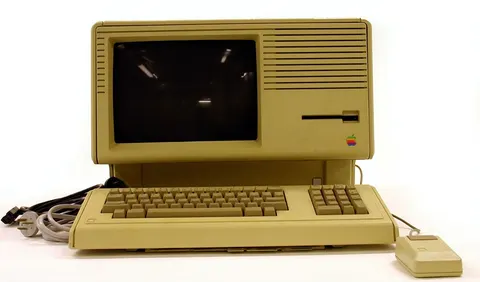
There have been three big trends over this time, and two of them are miniaturization and integration. I remember my first laptop, which I had in Germany in 1995—it weighed 7 kilograms. Its makers had figured that since it was a mobile computer, it could be used for presentations. Its screen opened at the back, so you could place it on the overhead projector instead of a transparency and give a presentation straight from the computer.
I lugged it to a conference in Washington, from there to Montreal, and then my shoulder hurt for a month…
A note for the young: in the 1990s, presentation slides were written with a felt-tip pen on transparencies and shown on an overhead projector, or printed on transparencies with a printer. PowerPoint already existed, but electronic projectors that could be hooked up to computers hadn't yet established themselves as a technology. Nobody knew whether they would win on the market or laptops like mine, which you could project from. Two or three years later, laptops were already sleeker and lighter, and at the end of the '90s came the trend toward integration, combining the functions of different specialized devices into one.

– And very soon, as if overnight, we found ourselves in the world of smartphones…
– Yes, everything really did change fast. Digital calculators and organizers—electronic notebook-calendars with a phone directory—had a big market. They quickly evolved into “handheld” computers that fit in your palm, with operating systems similar to those of personal computers. Apps were easy to make for them, they had a relatively large display, like a smartphone's, and they were convenient to work with. Mobile phones at the time, at the end of the '90s, were a completely different category of device: bricks with a three- or four-line display. For convenience and miniaturization, there were pagers, a cheap device the size of a matchbox that buzzed if someone wanted to call you. And you'd call them back—back then there were street pay phones everywhere.
But the integration trend worked once again: in 2008 the iPhone came out and completely changed the game. Although it wasn't the first combination of a handheld and a cell phone (the Canadian BlackBerry was a cell phone with email and was a huge success as early as 2002), the iPhone brought elegant design and the magic of Apple…
– That's when, suddenly, we all found ourselves online.
– That's right. Meanwhile, the trend toward decentralization was under way too. The incredible euphoria about democratic computer networks connecting individuals and whole societies. It was all theory, and then suddenly Napster hatched and people started listening to music for free. The studios shut it down (since it was centralized), but similar systems sprang up, only distributed ones, which could no longer be shut down easily. Peer-to-peer architectures arrived in parallel toward the end of the '90s; five or six years later Skype popped up, distances suddenly shrank, and people started talking for free across enormous distances.
This set another cycle spinning: travel and emigration no longer seemed so frightening,
Skype made the world smaller; grandmothers could see and hear their grandchildren thousands of kilometers away…
Meanwhile, around 2005, wireless networks arrived, computer prices kept falling, and it became easy to buy a computer and get it connected at home…
These three trends—miniaturization, integration and decentralization—will continue in the years ahead. By the laws of dialectics, of course, there are also trends and forces pushing the other way. For example, there is a limit to miniaturization beyond which it's no longer comfortable for a person to control the device or type, even though voice commands are developing. Integration has to be balanced with miniaturization, and decentralization is in conflict with centralization for the sake of efficiency. A centralized system is more efficient when it works well, but it carries many dangers: who controls it, who profits from it; it becomes a target for hackers. Besides, centralization concentrates too much power and creates inequality and monopolies. Structures that crystallize become conservative, unadaptive and brittle.
The technologies that emerge are points of balance and optimization in this eternal search,
and every optimum is local and unstable.
– How do you picture the digital future 30 years from now?
– If we haven't killed each other off by then, I picture computer systems everywhere,
so miniature that they will be invisible. Even nanosystems in the human body, helping the immune system fight harmful viruses and bacteria. At home, controlling not only the climate, the shopping and all household needs, but the cars on the streets too, decentralized, working together like bees in a hive.
It's a little hard for me to imagine what people will be doing. Beyond the scenarios we've already talked about, perhaps there will be games through which we steer systems of nanocomputers that heal sick people. Everyone will be treated in a unique way according to their DNA and their specific illness… Perhaps we will guide people learning something (according to the needs of society and the interests and the psychological and emotional state of the individual). Perhaps we will create even newer technologies.
– How did we end up in a world where tech monopolies can afford to silence even the president of the most powerful country?
– Monopolies and media giants have great power to work on the masses. But in a free, democratic system that doesn't repress people with opposing political views, dissidents will always emerge, along with new platforms that support them. That is the power of decentralization. In a centralized, authoritarian system that tolerates no dissent and uses physical violence, such a thing cannot happen.
– How did the web, which was supposed to be a democratic place giving everyone an equal chance, turn into the domain of monopolies?
– It's a natural process. There's a good book that explains it, Linked by Albert-László Barabási. These are self-organizing systems made up of individual selfish components. Such systems always centralize themselves, because a center makes communication efficient.
Facebook attracted a lot of people at one point through a combination of circumstances, and as it grew, its gravitational pull grew too. People go where most of their friends are. That's how it “drained” MySpace and Orkut. Google's attempts to create its own social network were doomed; they lacked that “critical mass,” because Google was seen above all as a search engine, and people were already on other networks. Besides centripetal forces, there are centrifugal ones too—
young people want communities of their own, where there's no chance of running into their mothers and grandmothers,
so new ones keep popping up—like Instagram and TikTok, Viber, WhatsApp, Signal. Of course, the giants keep a close eye on trends and have enough money for such new networks—what they buy is not so much the technology as the users… But new communities will keep emerging, with special features, for example purely professional ones, or ones with stronger data protection.
– Could anyone one day dethrone Google, Facebook, Amazon?
– I think so, but with difficulty. Antitrust legislation in the US could break them up if it were enforced, but the corporations have serious lobbying resources, and their influence is very strong. The US is so deeply divided politically that anything could happen. Strong voices may emerge on both sides in favor of regulating these giants, because soon that will be the way to win votes.
People are disgusted by the economic inequality that monopolies lead to.
It's high time the law was applied and they were broken up. There are many such precedents in US history; what it takes is political will.
The same goes for public control over corporations through laws protecting personal data and against automated manipulation through persuasive technologies. Technical methods will be developed; there is already a great deal of research in the field of “transparent” intelligent systems. Computer scientists work together with lawyers, philosophers, ethicists, economists and psychologists to find methods that not only work in the lab but are also accepted by people. But finding practical solutions will take a lot more work.
– Does the web connect us today, or divide us?
– It connects us. But it's up to us whether the connection is shallow or deep, and whether it connects us for good or for ill. We still can't really hug each other over the web. But statistics show that people are increasingly finding their partners online. And those marriages last longer.
– You've lived outside Bulgaria for quite a few years now. How does our country look from afar today when it comes to information technology?
– In my view, Bulgaria enjoys great respect in the field of computer technology. We have very good traditions, training, and many smart, open-minded and ambitious young people. Bulgarians are everywhere in the world, at Google, at Facebook, at the most elite universities. The Stanford list of the top 2 percent of researchers in the world, which came out last fall, includes many Bulgarians, but at least half of us, if not more, are scattered around the world.
Bulgaria, for its part, has a very strong IT industry, both outsourcing and original IT companies. Ontotext, for example, uses semantic technologies based on artificial intelligence and natural language to digitize the archives of global companies. There are many others, too.
– What do you miss most about Bulgaria?
– I don't miss that trait of always seeing the bad, of finding fault with everything, which is so widespread among us. If you look for the bad, you'll always find it. It's the good we should be looking for, not the bad. Apart from that, I miss everything else…